



BibTeX | RIS | EndNote | Medlars | ProCite | Reference Manager | RefWorks
Send citation to:


URL: http://nmcjournal.zums.ac.ir/article-1-1001-en.html

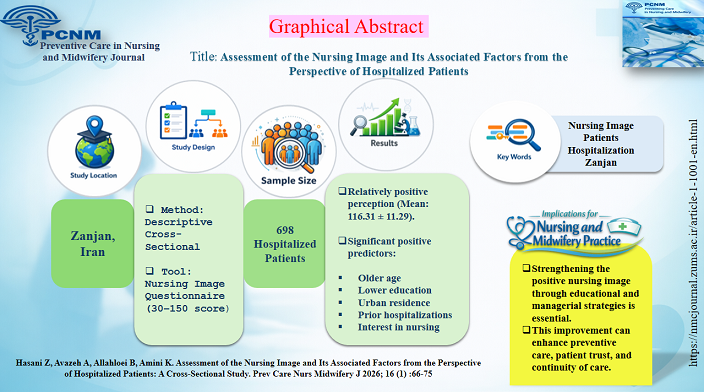
Knowledge Translation Statement
Audience: Nursing managers and hospital administrators
Hospitalized patients hold a relatively positive perception of nursing, with older patients, those with lower education, and urban residents reporting significantly higher scores. Patients with more frequent prior hospitalizations and inherent interest in nursing also showed more favorable views. Nursing managers should leverage positive hospitalization experiences through improved nurse-patient communication, develop targeted public awareness campaigns addressing demographic differences, and utilize media platforms to reinforce nursing's professional image, particularly for younger and higher-educated populations who hold less favorable perceptions.
An image reflects a phenomenon's reality and constitutes a set of observable perceptions derived from individuals' professional behavior, encompassing their competencies and ethical conduct [1, 2]. The nursing image reflects societal perceptions of the nursing profession and is intrinsically linked to a nurse’s identity and role [3]. This image is constructed based on collective knowledge, experiences, attitudes, and beliefs [4], spanning a spectrum from positive to negative [5]. Despite the professional advancement of nursing, nurses continue to face significant challenges regarding their professional image [6], which can subsequently impact professional power, self-esteem, public standing, and the quality of nursing care [2, 7].
The nursing image is significantly correlated with nurses’ self-esteem, job satisfaction, and professional identity [8]. A positive nursing image encourages students to remain in the profession [2], enhances nurses’ self-confidence [9], improves the quality of therapeutic relationships, and increases patient satisfaction [10, 11]. Conversely, a negative nursing image can lead to declines in self-confidence, self-esteem, and motivation, creating a cycle that can reinforce negative societal perceptions of nursing [12]. Establishing a positive nursing image requires collaboration among nurses, healthcare organizations, policymakers, and society, and a shift in nurses’ internal perceptions and professional self-confidence to elevate the true value of this profession within the community [7].
Despite the continuous advancement of the nursing profession, public perception remains entangled with outdated stereotypes, which can adversely affect recruitment, social standing, and health policies [13]. International studies indicate that, in many countries, society’s image of nursing is inaccurate, limited, or contradictory [1, 9]. In many instances, nurses are still perceived merely as physician assistants, lacking professional autonomy [14]. For instance, in the United Kingdom, parents and career advisors often hold a negative attitude toward nursing and are less likely to encourage students to pursue it as a career. Conversely, in the United States, the profession enjoys high social prestige and is widely recognized as a highly recommended career choice [9, 15].
Studies conducted in Iran indicate that nursing image is not at an optimal level, a factor that has significantly impacted nurses' motivation and professional performance [3, 6, 16]. These findings suggest that the socio-cultural context and media policies of each country largely influence nursing image. In Iran, the professional image, job dissatisfaction, and nursing shortages have been reported as the most critical challenges within the nursing field [3]. Many nurses believe they do not receive adequate respect and appreciation [6], a situation that has culminated in decreased job satisfaction, diminished self-esteem, increased burnout, and a decline in retention rates in the nursing profession [17].
Recent research has addressed several gaps in the concept of the nursing image. These gaps include the lack of a unified definition by redefining professional and behavioral dimensions [13], the absence of structural analysis concerning the role of health system policies and conditions in shaping the professional image, with a focus on systemic factors and health policies [18], and inadequate evidence on the impact of media and the coronavirus disease 2019 (COVID-19) pandemic on the public perception [19].
Nevertheless, the nursing image from the perspective of hospitalized patients remains under-researched. Most studies have focused on quality of care and patient satisfaction [20, 21], while existing research on the nursing image is limited and has been conducted primarily outside the hospital environment [22, 23]. In Iran, the professional and social dimensions of this concept have also received less attention [20, 24], underscoring the need for the current study.
Objectives
This study was conducted to assess the nursing image and identify demographic and clinical factors influencing it from the perspective of hospitalized patients in Zanjan, Iran, and to analyze patient perceptions of the nursing profession and the underlying components influencing it.
Methods
Study Design
The present study was a descriptive cross-sectional study.
Setting and Participants
This research was conducted among patients hospitalized in the medical-surgical wards of five hospitals in Zanjan, namely Vali-e-Asr, Mousavi, Imam Hossein, Artesh, and Bahman, during July and August 2021.
Inclusion and Exclusion Criteria
The inclusion criteria for this study consisted of being hospitalized in the medical-surgical wards of the selected hospitals for a minimum of 24 hours, having experienced three consecutive nursing shifts, being over 18 years of age, maintaining full consciousness, possessing the cognitive and verbal ability to respond to questions, and providing written informed consent. Conversely, the exclusion criteria included withdrawal of consent at any stage of the research, clinical deterioration or worsening of the patient’s condition that precluded the completion of the questionnaire, and significant questionnaire incompleteness.
The minimum sample size was calculated to be 663 participants, based on an estimated standard deviation (SD) of the nursing image score (δ = 9.2) derived from previous similar studies regarding nursing image from the perspective of hospitalized patients [14, 25]. This calculation was performed with a 95% confidence level of 1.96 (Z = 1.96) and a precision of 0.7 (d = 0.7). Accounting for a potential attrition rate of 10%, the final sample size was determined to be 730 participants. Sampling was conducted over five weeks in July and August 2021 using a random-time-point sampling approach. First, the sequence of hospital visits was determined through simple random sampling among the five selected hospitals. For each hospital, specific data collection time blocks were randomly selected using a random number table. The generated numbers were matched with the list of weekdays and the three routine work shifts (morning, evening, and night) to determine the exact days and shifts for data collection. During each selected time block, the researcher visited the medical-surgical wards of the respective hospital and recruited eligible patients who met the inclusion criteria and agreed to participate in the study. For patients with low literacy or illiteracy, the questionnaires were completed through face-to-face interviews conducted by the researcher. Patients transferred from the operating room were approached only after regaining full consciousness. The use of randomly selected hospitals, days, and work shifts ensured that the timing of data collection was not predetermined or systematic. This approach increased the likelihood of including patients admitted at different and unpredictable times, thereby helping to address the inherent unpredictability of hospital admissions and reducing potential time-related selection bias.
Data Collection Tools
The research instrument consisted of two parts:
The Demographic and Clinical Information Questionnaire
The demographic information encompassed age; gender; place of residence; hospitalization day; hospital type and ward; a history of prior hospitalization; educational, occupational, and financial status; relatives employed in the nursing profession; interest in the nursing profession; and the source of the individual’s nursing image.
The Nursing Image Questionnaire (NIQ)
The NIQ was originally developed by Hoskins (1983) and subsequently refined by Toth (1998) [26]. This instrument has been extensively used in numerous studies to assess the nursing image across diverse populations, including the general public [14], high school students [25], and nursing university students [27], with its validity and reliability consistently confirmed. The NIQ comprises 30 items designed to evaluate an individual's attitudes toward nursing roles, values, and professional activities. Scoring is based on a five-point Likert scale, ranging from "Strongly Disagree" (1) to "Strongly Agree" (5). The NIQ total score ranges from 30 to 150, with higher scores indicating a positive nursing image and lower scores reflecting a negative nursing image. The NIQ comprises five subscales: role of nurses (10 items), values (7 items), social stereotypes regarding nursing (6 items), professionalism (4 items), and characteristics related to nursing and nurses (3 items) [14, 25, 27, 28]. To utilize the NIQ in the present study, formal permission was obtained from the original developer (Jean C. Toth). Initially, the questionnaire was translated into Persian by two English language experts. The research team selected the most appropriate translation, which was then back-translated into English by a bilingual professor proficient in both Persian and English. Another English expert professor compared the back-translated version with the original to confirm its face validity. Furthermore, the internal consistency of the instrument in this study was established with a Cronbach's alpha coefficient of 0.80.
Procedure
Sampling was conducted over five weeks during July and August 2021. The schedule was structured as "one hospital per week," with the sequence of visits determined by random drawing. In each hospital, the researcher visited all medical-surgical wards over three consecutive days during morning, afternoon, and night shifts to recruit eligible patients who provided informed consent.
For illiterate patients, questionnaires were administered via interviews. Patients transferred from the operating room were evaluated only after achieving full consciousness. A total of 730 questionnaires were distributed, of which 698 were completed and collected from 23 medical-surgical wards (accounting for ward consolidations due to the COVID-19 pandemic). Data were analyzed using SPSS version 16. Since the Kolmogorov-Smirnov test confirmed the normal distribution of the variables, parametric tests, including the independent t-test, analysis of variance (ANOVA), the chi-square test, and post-hoc tests, were employed. Descriptive statistics were used for descriptive objectives, while inferential statistics were applied for comparative analysis. Statistical significance was set at p < 0.05.
Result
In this study, of the 730 distributed questionnaires, 698 were deemed valid and analyzed (response rate: 95%).
Demographic and Clinical Characteristics of Participants
The mean age of the participants was 45.01 years (SD = 16.8). Women accounted for 54.2% of the sample, and 70% were urban residents. Regarding education level, over 80% of the patients held a high school diploma or lower. In terms of clinical variables, the mean length of hospital stay at the time of the study was 5.09 days (SD = 5.28), and the majority of patients (82.52%) had a history of prior hospitalization. Furthermore, 71.78% of the participants expressed interest in the nursing profession. According to their viewpoints, the primary source influencing nursing image was "hospitalization" (63.75%). Comprehensive details are presented in Table 1 and Table 2.
Mean Nursing Image Score and Comparison across Hospitals
In this study, the mean nursing image score was 116.48 (SD = 11.37), ranging from 30 to 150, demonstrating a positive nursing image. A statistically significant difference in this score was observed among the five surveyed hospitals (p = 0.002). Specifically, the highest mean score was observed at Artesh Hospital (119.64), while the lowest was recorded at Bahman Hospital (114.15) [Table 3].
Comparison of Nursing Image Scores Based on Demographic and Clinical Variables
An analysis of the relationships among various variables and the nursing image score revealed that the score was significantly different by age, education level, place of residence, frequency and total days of prior hospitalizations, interest in the nursing profession, and the source of the nursing image (p < 0.05). For instance, older patients (ages 46–60 and 61+) and those with lower levels of education reported a more positive nursing image. Moreover, patients with an interest in the nursing profession, as well as those whose nursing image was "working in a hospital environment" or "social media," exhibited significantly higher scores. Conversely, variables such as gender, financial status, and prior hospitalization showed no statistically significant correlation with the nursing image score. Comprehensive details of these comparisons are presented in Table 4.
Table 1. Frequency Distribution of Demographic Variables among Patients Hospitalized in Medical-Surgical Wards of Zanjan Hospitals in 2021 (N=698)
| Patients’ Qualitative Demographic Variables | n | % | |
| Gender | Male | 320 | 46 |
| Female | 378 | 54 | |
| Age | 18-30 | 146 | 20.91 |
| 31-45 | 266 | 38.10 | |
| 46-60 | 151 | 21.64 | |
| ≤ 61 | 135 | 19.35 | |
| Place of residence | Urban | 470 | 67.33 |
| Rural | 228 | 32.67 | |
| Education level | Illiterate | 155 | 22.21 |
| Under high school diploma | 277 | 39.57 | |
| High school diploma | 144 | 20.57 | |
| Bachelor | 98 | 14 | |
| Master | 24 | 3.43 | |
| Doctoral | 0 | 0 | |
| Occupation | Labor-farmer | 106 | 15.15 |
| Self-employed | 134 | 19.14 | |
| Employee | 87 | 12.42 | |
| Medical staff | 7 | 1 | |
| Retired | 39 | 5.57 | |
| Student | 30 | 4.57 | |
| Housewife | 295 | 42.15 | |
| Financial status | Good | 178 | 25.42 |
| Moderate | 359 | 51.28 | |
| Poor | 161 | 23.28 | |
Table 2. Frequency Distribution of Clinical Variables among Patients Hospitalized in Medical-Surgical Wards of Zanjan Hospitals in 2021(N=698)
| Patients’ Clinical Variables | n | % | |
| A history of prior hospitalization | Yes | 576 | 82.52 |
| No | 122 | 17.48 | |
| Total prior hospitalization days | 1-10 | 291 | 50.52 |
| 11-29 | 113 | 16.62 | |
| ≤ 30 | 172 | 29.86 | |
| Being a patient companion | Yes | 488 | 69.91 |
| No | 210 | 30.09 | |
| Relatives employed in the nursing profession | Yes | 240 | 34.38 |
| No | 458 | 65.62 | |
| Interest in the nursing profession | Yes | 501 | 71.78 |
| No | 197 | 28.22 | |
| Source of the nursing image | Newspaper and magazine | 0 | 0 |
| Radio and television | 146 | 21.92 | |
| Internet and social media | 45 | 6.45 | |
| Hospitalization | 445 | 63.75 | |
| Relatives employed in the nursing profession | 50 | 7.16 | |
| Working in a hospital environment | 12 | 1.72 | |
Table 3. Frequency Distribution of Patients Hospitalized in Zanjan Hospitals and a Comparative Analysis of Mean Nursing Image Scores across Hospitals (N=698)
| Hospital Name | n (%) | Nursing Image Score According to the NIQ Separated by Hospitals | ||||
| Mean Nursing Image Score | SD | Lowest Score | Highest Score | |||
| Vali-e-Asr (academic) | 259 (37.10) | 118.45 | 9.30 | 93 | 145 | F = 4.073 p = 0.003 |
| Mousavi (academic) | 294 (42.12) | 115.09 | 12.49 | 54 | 146 | |
| Imam Hossein (social security) | 66 (9.46) | 116.55 | 11.04 | 97 | 138 | |
| Bahman (private) | 65 (9.32) | 114.15 | 12.44 | 75 | 133 | |
| Artesh (military) | 14 (2) | 119.64 | 13.15 | 54 | 146 |
Table 4. Mean Nursing Image Scores Based on Patients' Demographic and Clinical Characteristics (N = 698)
| Patients’ Demographic and Clinical Variables | Mean Nursing Image Score | SD | p | |
| Gender | Male | 115.65 | 11.79 | 0.131 |
| Female | 117.17 | 10.97 | ||
| Age group (year) | 18-30 | 114.88 | 12.46 | 0.000 |
| 31-45 | 114.08 | 11.31 | ||
| 46-60 | 119.70 | 10.77 | ||
| ≤ 61 | 119.32 | 9.36 | ||
| Place of residence | Urban | 116.83 | 11.61 | 0.017 |
| Rural | 115.76 | 10.86 | ||
| Education level | Illiterate | 118.75 | 8.18 | 0.000 |
| Under high school diploma | 118.12 | 11.09 | ||
| High school diploma | 113.93 | 10.89 | ||
| Bachelor | 113.33 | 14.10 | ||
| Master | 110.79 | 15.48 | ||
| Financial status | Good | 117 | 9.84 | 0.751 |
| Moderate | 116.44 | 11.27 | ||
| Poor | 116.07 | 12.84 | ||
| A history of prior hospitalization | Yes | 116.63 | 11.42 | 0.734 |
| No | 115.75 | 11.17 | ||
| Frequency of prior hospitalizations | 2 ≤ | 115.49 | 12.69 | 0.014 |
| 3-5 | 117.88 | 9.04 | ||
| ≤ 6 | 118.47 | 7.68 | ||
| Total prior hospitalization days | 1-10 | 114.43 | 12.32 | 0.000 |
| 11-29 | 118.64 | 12.11 | ||
| ≤ 30 | 119.03 | 8.27 | ||
| Interest in the nursing profession | Yes | 117.75 | 9.57 | 0.000 |
| No | 113.25 | 14.54 | ||
| Source of the nursing image | Radio and television | 117.64 | 10.55 | 0.019 |
| Internet and social media | 119.18 | 12.40 | ||
| Hospitalization | 116.14 | 10.60 | ||
| Relatives employed in the nursing profession | 112.66 | 16.96 | ||
| Working in a hospital environment | 120.75 | 12.53 | ||
Discussion
The primary objective of this study was to assess the nursing image from the perspective of patients hospitalized in medical-surgical wards and to determine the associated individual and clinical factors. Findings revealed that patients held a favorable perception of the nursing profession, which was influenced by certain demographic characteristics and hospitalization-related experiences. Based on the nursing image scoring range, higher scores were interpreted as a positive perception; consequently, the nursing image within the studied population was assessed as acceptable. Overall, factors such as age, education level, place of residence, prior hospitalization experience, interest in the nursing profession, and the source of image formation demonstrated a significant correlation with the nursing image. Conversely, gender, financial status, a history of hospitalization, and relatives employed in the nursing profession did not exert a significant impact. Furthermore, while variations were observed across different hospitals, the distinction between academic and non-academic institutions did not yield a notable effect.
Based on the results, advancing age was associated with an improvement in the nursing image; a pattern previously corroborated by international research. For instance, the study conducted by YAVAŞ and ÖZERLİ demonstrated that older individuals hold a more favorable perception of the nursing profession [19], which may be attributed to their increased contact with healthcare services and firsthand experience of nurses’ supportive role. Moreover, education level played a significant role, with individuals with lower levels reporting more favorable evaluations. This finding aligns with international studies, such as those by Rubbi et al. [14, 25], suggesting that higher levels of education are typically associated with higher expectations of healthcare providers. Consequently, this may lead to a more critical appraisal of nursing performance.
Place of residence was another associated factor, with urban patients demonstrating a more positive perception. This finding aligns with the results reported by Čukljek [27, 28], potentially stemming from greater access to information, increased exposure to healthcare environments, and greater familiarity with nursing roles. In urban communities, more extensive interactions with medical centers may facilitate a more realistic understanding of the nature of the nursing profession.
A history of prior hospitalization was reported as a significant influencing factor, with patients having more frequent hospitalizations presenting a more positive nursing image.
This finding aligns with the studies by Rubbi and Rubbi et al. [14, 25], which demonstrated that direct and repeated contact with healthcare environments culminated in the formation of a more accurate and professional nursing image. Such experiences allow patients to become more cognizant of the pivotal role nurses play in care delivery and to observe their clinical performance firsthand.
An inherent interest in the nursing profession is also associated with a more positive image of nursing. This point has been corroborated by other studies, including Abdollahi et al. [2]. An intrinsic inclination toward a profession enhances an individual’s understanding and attention to the nuances of that profession's practice, thereby fostering a more positive mental image.
Furthermore, the source of image formation played a prominent role. Patients reported more positive perceptions when their self-image was derived from actual hospitalization experiences, clinical encounters within the hospital environment, or from more formal sources such as credible social media. The influence of digital media on the public’s image of nursing has gained significant prominence in recent years, particularly following the COVID-19 pandemic. Studies such as those by Gündüz and Coşkun [29] and Sürücü et al. [30] have demonstrated that increased media attention to the role of nurses during the pandemic has led to improved social standing and greater public trust. The alignment of these results with the findings of the present study suggests that society's collective experience during health crises can directly impact nurses' professional representation and public perception.
Differences across hospitals were also reported; however, hospital ownership (academic versus non-academic) was not a determining factor. This suggests that the formation of the nursing image is more likely influenced by nurse-patient interactions, ward conditions, and organizational culture than by the hospital's administrative structure. Similarly, the study by Abdollahi et al. [2] reported variations in nursing image across hospital types, yet emphasized that individual and environmental interactions are more significant than structural differences.
The results concerning contradictory studies are also noteworthy. For instance, Ameri’s [16] research in Iran reported a negative nursing image, which is inconsistent with the present findings. Differences in cultural context may justify this discrepancy, along with the level of public awareness and the nature of media coverage. In addition, in certain studies such as Elibol [31] and Glerean [4], the presence of a nurse within the family was associated with a decline in the nursing image. This is likely attributable to a more intimate understanding of professional challenges, high workloads, and actual workplace conditions.
These contradictions highlight the significance of socio-cultural contexts in shaping the formation of the nursing image.
Studies conducted during the COVID-19 pandemic have shown a similar pattern of improvement in public perceptions of nursing.
The increased societal demand for care, the prominent presence of nurses on the front lines, and extensive media coverage of these activities led to an enhanced public perception of nursing. This trend is also significantly reflected in the results of the present study. As reported in the studies by Gündüz and Coşkun [29] and Sürücü et al. [30], the crisis conditions led to an increase in the prestige, status, and trust in the nursing profession.
This study had several limitations, including restricted generalizability because the research was conducted in a single city and solely within medical-surgical wards. Furthermore, the specific circumstances of the COVID-19 era and the widespread media coverage may have influenced patient responses. The scarcity of studies investigating the nursing image from the perspective of hospitalized patients also limited the comparability of the findings.
Overall, this study's results reveal that the nursing image from the perspective of hospitalized patients is favorable, with individual and experiential factors playing a significant role in shaping it. These findings can serve as a valuable resource for healthcare managers and policymakers to enhance the public perception of the nursing profession, design educational interventions, develop programs to improve nurse-patient communication, and optimize the overall patient experience. Moreover, future research should employ multicenter designs across various hospital wards and be conducted in the post-pandemic era to evaluate the stability of this image across different temporal and cultural contexts.
Conclusion
The results of the present study demonstrated a positive nursing image from the perspective of patients hospitalized in the medical-surgical wards of Zanjan hospitals. The majority of patients were hospitalized in two academic hospitals (Mousavi and Vali-e-Asr). Furthermore, the mean nursing image scores differed significantly based on several demographic and clinical variables, including age, education level, place of residence, frequency and total days of prior hospitalizations, source of the nursing image, and interest in the nursing profession.
Ethical Considerations
The present study was approved by the Vice-Chancellor for Research and the Research Ethics Committee of Zanjan University of Medical Sciences (approval code: IR.ZUMS.REC.1399.346).
Acknowledgements
The current research has been derived from a Master's thesis in Medical-Surgical Nursing. The authors would like to thank the Research Vice-Chancellor of Zanjan University of Medical Sciences, the esteemed professors, and all honorable participants who kindly cooperated in implementing this research.
Conflict of Interest
No conflicts of interest.
Funding
Zanjan University of Medical Sciences funded this study.
Authors' Contributions
Conceptualization: B. Allah Louie, A. Avazeh
Methodology: B. Allah Louie, A. Avazeh
Investigation (Data Collection): B. Allah Louie
Formal Analysis (Data Analysis & Interpretation): A. Avazeh, Z. Hasani
Writing – Original Draft: Z. Hasani, B. Allah Louie, A. Avazeh
Writing – Review & Editing: B. Allah Louie, A. Avazeh, K. Amini, Z. Hasani
All authors read and approved the final manuscript.
Artificial Intelligence Utilization
In preparing this manuscript, ChatGPT-4 (OpenAI) was used exclusively for language and structural editing of Persian and English text. The AI played no role in content generation, data analysis, or result modification. The authors bear full responsibility for all scientific content and conclusions.
Data Availability Statement
The datasets generated and analyzed during the current study are available from the corresponding author upon reasonable request.
| Rights and permissions | |
 |
This work is licensed under a Creative Commons Attribution-NonCommercial 4.0 International License. |