
Preventive Care in Nursing and Midwifery

Volume 16, Issue 1 (1-2026)
Prev Care Nurs Midwifery 2026, 16(1): 27-35 |
Back to browse issues page


Ethics code: IR.LARUMS.REC.1403.014


Download citation:
BibTeX | RIS | EndNote | Medlars | ProCite | Reference Manager | RefWorks
Send citation to:


BibTeX | RIS | EndNote | Medlars | ProCite | Reference Manager | RefWorks
Send citation to:
Barghi O, Bazrafshan M R, Mansouri A, Rajabi H, Yarbakhsh H, Kamali A H, et al . Vegan Diets Between Trend and Health: A Qualitative Study for National Nutrition Policy. Prev Care Nurs Midwifery 2026; 16 (1) :27-35
URL: http://nmcjournal.zums.ac.ir/article-1-1005-en.html
URL: http://nmcjournal.zums.ac.ir/article-1-1005-en.html
Omid Barghi  , Mohammad Rafi Bazrafshan * , Amir Mansouri , Haniyeh Rajabi , Helia Yarbakhsh , Amir Hossein Kamali , Habib Abbasi , Maryam Ranjbar Zahedani
, Mohammad Rafi Bazrafshan * , Amir Mansouri , Haniyeh Rajabi , Helia Yarbakhsh , Amir Hossein Kamali , Habib Abbasi , Maryam Ranjbar Zahedani
Nursing Department, Nursing School, Larestan University of Medical Sciences, Larestan, Iran , seeder2007@gmail.com
Full-Text [PDF 814 kb]
(295 Downloads)
| Abstract (HTML) (676 Views)
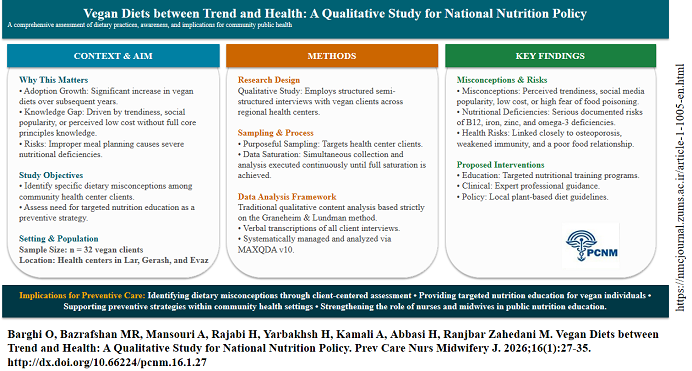
Graphical Abstract:
Reseach Highlights:
Knowledge Translation Statement
Audience: Nursing managers and hospital administrators
Many individuals adopt vegan diets based on misconceptions, viewing it as a trend, social status tool, or low-cost alternative, rather than informed nutritional choices, increasing risks of deficiencies in iron, B12, zinc, and protein. Nursing managers should integrate evidence-based nutrition education into community health services, train staff to identify at-risk individuals, and develop culturally sensitive dietary guidelines that address local misconceptions while respecting informed motivations.
Full-Text: (193 Views)
Introduction
The vegan diet (strict vegetarianism) is a dietary pattern characterized by the exclusion of all animal products. The factors that motivate individuals to adopt this dietary pattern are mainly ethical, health, and environmental reasons. In recent years, veganism has attracted increasing public and policy attention as part of broader discussions on sustainable nutrition, prevention of non-communicable diseases, and environmental protection [1]. From a nutritional quality perspective, the vegan diet has the highest Healthy Eating Index (HEI) score compared to vegetarian, semi-vegetarian, and omnivorous diets. It shows the greatest similarity to the Mediterranean diet [2, 3]. Evidence suggests that vegan diets may provide greater protection against obesity, hypertension, type 2 diabetes, and cardiovascular mortality [4].
Despite these documented benefits, adherence to a vegan diet is not solely determined by nutritional knowledge. An individual's relationship with food, personal beliefs, and social influences play a critical role in shaping dietary behaviors and, in some cases, may contribute to health impairments or the development of disordered eating patterns [5]. From a clinical and public health perspective, concerns have been raised regarding the nutritional adequacy of poorly planned vegan diets, as individuals following this pattern tend to consume lower amounts of protein and may have inadequate intake of vitamins B2, niacin (B3), B12, and D, as well as iodine, zinc, calcium, potassium, and selenium [6].
Although international research has extensively examined the health effects of vegan diets, there is a limited understanding of how misconceptions, secondary motivations, and sociocultural factors influence adherence to this dietary pattern in non-Western contexts. In Iran, particularly in southern regions, dietary behaviors are shaped by local food availability, economic constraints, cultural norms, and public perceptions of food safety, all of which may influence motivations to adopt veganism and its associated health outcomes [6].
From a health policy perspective, the growing popularity of vegan diets presents both opportunities and challenges for healthcare systems. When adherence is based on misconceptions and lacks appropriate nutritional guidance, the risk of diet-related deficiencies may increase, potentially placing additional burdens on primary healthcare services [6]. Conversely, informed adherence supported by evidence-based nutrition education and context-sensitive public health policies may enhance health outcomes and contribute to broader goals of sustainable nutrition [1].
Therefore, given the importance of informed and well-understood adherence to vegan diets, this study was designed to identify misconceptions and incorrect views about vegan diets and to generate evidence to inform targeted nutrition education and policy-oriented interventions within the healthcare system.
Objectives
The present study aimed to systematically identify prevalent misconceptions about the vegan diet among individuals attending community health centers in southern Iran. In addition, it sought to examine how these misconceptions influence dietary practices and potential nutritional risks. The study further aimed to assess participants' perceived need for professional nutrition education and guidance and to provide evidence to inform the design of targeted educational interventions and public health strategies to promote safe and informed adherence to vegan dietary patterns.
Methods
Type of Study
This study employed a qualitative approach, using conventional content analysis, to explore the experiences of vegan individuals. Among the three perspectives of qualitative content analysis, the conventional method was deemed most appropriate for this research. Unlike directed or deductive approaches, the conventional method allows categories and codes to emerge inductively from the raw data without being constrained by prior theoretical frameworks or predefined categories [7]. This was particularly suitable for our study, as limited prior research exists on the experiences of vegan individuals in this context, and the aim was to capture participants' perspectives as authentically as possible.
Study Population
This study population comprised residents of Larestan, Gerash, and Evaz counties identified through electronic health records at community health centers and informational posters placed within these facilities. Participants were selected using purposive sampling to recruit information-rich cases and to achieve maximum variation in experiences. Specifically, we targeted individuals with sustained vegan practice and the ability to articulate their perspectives, while seeking diversity across counties and key sociodemographic characteristics to capture a broad range of viewpoints. Recruitment proceeded iteratively until thematic sufficiency was reached.
Inclusion Criteria
1. The participant must have a strict vegan diet for at least six months to ensure they have sufficient experience with the lifestyle.
2. The participants must be willing to participate in the research voluntarily.
3. The participants must be residents of Larestan, Gerash, or Evaz counties.
4. The participants must be familiar with Persian.
5. The participants must be able to share their experiences.
Exclusion Criteria
Participants' unwillingness to continue participating in the research.
Data Collection Procedure
Data were collected through semi-structured, in-depth interviews, which allowed participants to share their experiences and perspectives on the vegan diet freely. Before the main study, a pilot phase was conducted with two participants to test and refine the interview guide, ensuring the questions were clear and effectively addressed the research objectives. Individual interviews with open-ended questions are among the most popular methods of data collection. In qualitative research, this type of interview is considered an unstructured conversation, accompanied by word-for-word transcription and audio recording. It is more self-directed than rigid, inflexible questions. Open interviews (unstructured) allow participants to describe and define their experiences [8].
In such cases, interviews start with a general question. Then, as the interview continues, more specific questions are asked based on the results of the initial interviews and the main themes, in line with the research goals [9].
In this study, the interview process began with the question, "What is the reason or reasons for starting a vegan diet?" Other questions were asked of the participants during the interview process and in line with the study objectives. Exploratory questions, such as "Can you explain more?" or "Can you give an example?" were used to collect deeper information.
After completing the consent form, the time and place of the interview were determined by the agreement of the interviewer and each participant in the study. To increase data accuracy, with participants' consent, their voices were recorded in addition to notes. Each interview was audio-recorded and transcribed verbatim, with an average duration of 45 to 60 minutes, reflecting the depth of the data collected. At the end of each interview, after thanking and appreciating the participants, they also discussed the possibility of conducting additional interviews.
Sampling continued until data saturation was reached, which occurred after 32 interviews, that is, until the classes and characteristics of each class that were identified did not change with the entry of new data into the research [10].
Sampling Method
In this study, a purpose-based sampling method was used. Sampling was done among people with a vegan diet who had informed consent to participate in the research.
The sampling process continued until the data saturation level was reached. One of the researchers asked the questions and recorded them.
Analysis Method
According to Granheim and Landman's content analysis approach in qualitative research, data collection and analysis took place simultaneously [10]. To analyze the data, the recorded interviews were typed word-for-word after several listens and then entered into MAXQDA 10. After entering each interview into the software, it was read word-for-word, and each text was broken into meaning units. Then, meaning units that had similar meanings were placed in the same category. Main classes and sub-classes were finally formed based on content and similarities. To improve the accuracy and robustness of the findings, the criteria of Lincoln and Guba (2007) were used [8]. Long-term involvement of the researcher in data collection and analysis, writing reminders, confirming the accuracy of the data analysis by qualitative research experts, and checking primary codes with participants can increase the credibility of the data. To increase dependability and confirm the validity of the data, maximum variation sampling was used. Finally, to increase the transferability of the data, an attempt was made to provide a sufficient description of the data for the critical study of the findings by other researchers.
Result
Overview of Findings
A total of 32 individuals (mean age: 40.21 (10.20) years) participated in this study. Participants varied in age, gender, educational background, occupation, and duration of adherence to a vegan diet [Table 1].
Thematic analysis of interview data identified four principal categories of consumer misconceptions regarding the vegan diet:
1. Perceiving veganism as a trendy dietary pattern
2. Seeking social popularity through vegan identity
3. Adopting the diet primarily due to perceived lower cost.
4. Avoiding meat products because of fear of food poisoning.
Across these categories, misconceptions were associated with specific anticipated consequences if left unaddressed, including superficial adherence, nutritional inadequacy, reinforcement of misinformation, and potential protein and micronutrient deficiencies. To mitigate these risks, participants' narratives were synthesized into evidence-informed strategies focusing on public awareness, dietary literacy, food system regulation, and policy interventions.
Table 1. Characteristics of the Participants
The vegan diet (strict vegetarianism) is a dietary pattern characterized by the exclusion of all animal products. The factors that motivate individuals to adopt this dietary pattern are mainly ethical, health, and environmental reasons. In recent years, veganism has attracted increasing public and policy attention as part of broader discussions on sustainable nutrition, prevention of non-communicable diseases, and environmental protection [1]. From a nutritional quality perspective, the vegan diet has the highest Healthy Eating Index (HEI) score compared to vegetarian, semi-vegetarian, and omnivorous diets. It shows the greatest similarity to the Mediterranean diet [2, 3]. Evidence suggests that vegan diets may provide greater protection against obesity, hypertension, type 2 diabetes, and cardiovascular mortality [4].
Despite these documented benefits, adherence to a vegan diet is not solely determined by nutritional knowledge. An individual's relationship with food, personal beliefs, and social influences play a critical role in shaping dietary behaviors and, in some cases, may contribute to health impairments or the development of disordered eating patterns [5]. From a clinical and public health perspective, concerns have been raised regarding the nutritional adequacy of poorly planned vegan diets, as individuals following this pattern tend to consume lower amounts of protein and may have inadequate intake of vitamins B2, niacin (B3), B12, and D, as well as iodine, zinc, calcium, potassium, and selenium [6].
Although international research has extensively examined the health effects of vegan diets, there is a limited understanding of how misconceptions, secondary motivations, and sociocultural factors influence adherence to this dietary pattern in non-Western contexts. In Iran, particularly in southern regions, dietary behaviors are shaped by local food availability, economic constraints, cultural norms, and public perceptions of food safety, all of which may influence motivations to adopt veganism and its associated health outcomes [6].
From a health policy perspective, the growing popularity of vegan diets presents both opportunities and challenges for healthcare systems. When adherence is based on misconceptions and lacks appropriate nutritional guidance, the risk of diet-related deficiencies may increase, potentially placing additional burdens on primary healthcare services [6]. Conversely, informed adherence supported by evidence-based nutrition education and context-sensitive public health policies may enhance health outcomes and contribute to broader goals of sustainable nutrition [1].
Therefore, given the importance of informed and well-understood adherence to vegan diets, this study was designed to identify misconceptions and incorrect views about vegan diets and to generate evidence to inform targeted nutrition education and policy-oriented interventions within the healthcare system.
Objectives
The present study aimed to systematically identify prevalent misconceptions about the vegan diet among individuals attending community health centers in southern Iran. In addition, it sought to examine how these misconceptions influence dietary practices and potential nutritional risks. The study further aimed to assess participants' perceived need for professional nutrition education and guidance and to provide evidence to inform the design of targeted educational interventions and public health strategies to promote safe and informed adherence to vegan dietary patterns.
Methods
Type of Study
This study employed a qualitative approach, using conventional content analysis, to explore the experiences of vegan individuals. Among the three perspectives of qualitative content analysis, the conventional method was deemed most appropriate for this research. Unlike directed or deductive approaches, the conventional method allows categories and codes to emerge inductively from the raw data without being constrained by prior theoretical frameworks or predefined categories [7]. This was particularly suitable for our study, as limited prior research exists on the experiences of vegan individuals in this context, and the aim was to capture participants' perspectives as authentically as possible.
Study Population
This study population comprised residents of Larestan, Gerash, and Evaz counties identified through electronic health records at community health centers and informational posters placed within these facilities. Participants were selected using purposive sampling to recruit information-rich cases and to achieve maximum variation in experiences. Specifically, we targeted individuals with sustained vegan practice and the ability to articulate their perspectives, while seeking diversity across counties and key sociodemographic characteristics to capture a broad range of viewpoints. Recruitment proceeded iteratively until thematic sufficiency was reached.
Inclusion Criteria
1. The participant must have a strict vegan diet for at least six months to ensure they have sufficient experience with the lifestyle.
2. The participants must be willing to participate in the research voluntarily.
3. The participants must be residents of Larestan, Gerash, or Evaz counties.
4. The participants must be familiar with Persian.
5. The participants must be able to share their experiences.
Exclusion Criteria
Participants' unwillingness to continue participating in the research.
Data Collection Procedure
Data were collected through semi-structured, in-depth interviews, which allowed participants to share their experiences and perspectives on the vegan diet freely. Before the main study, a pilot phase was conducted with two participants to test and refine the interview guide, ensuring the questions were clear and effectively addressed the research objectives. Individual interviews with open-ended questions are among the most popular methods of data collection. In qualitative research, this type of interview is considered an unstructured conversation, accompanied by word-for-word transcription and audio recording. It is more self-directed than rigid, inflexible questions. Open interviews (unstructured) allow participants to describe and define their experiences [8].
In such cases, interviews start with a general question. Then, as the interview continues, more specific questions are asked based on the results of the initial interviews and the main themes, in line with the research goals [9].
In this study, the interview process began with the question, "What is the reason or reasons for starting a vegan diet?" Other questions were asked of the participants during the interview process and in line with the study objectives. Exploratory questions, such as "Can you explain more?" or "Can you give an example?" were used to collect deeper information.
After completing the consent form, the time and place of the interview were determined by the agreement of the interviewer and each participant in the study. To increase data accuracy, with participants' consent, their voices were recorded in addition to notes. Each interview was audio-recorded and transcribed verbatim, with an average duration of 45 to 60 minutes, reflecting the depth of the data collected. At the end of each interview, after thanking and appreciating the participants, they also discussed the possibility of conducting additional interviews.
Sampling continued until data saturation was reached, which occurred after 32 interviews, that is, until the classes and characteristics of each class that were identified did not change with the entry of new data into the research [10].
Sampling Method
In this study, a purpose-based sampling method was used. Sampling was done among people with a vegan diet who had informed consent to participate in the research.
The sampling process continued until the data saturation level was reached. One of the researchers asked the questions and recorded them.
Analysis Method
According to Granheim and Landman's content analysis approach in qualitative research, data collection and analysis took place simultaneously [10]. To analyze the data, the recorded interviews were typed word-for-word after several listens and then entered into MAXQDA 10. After entering each interview into the software, it was read word-for-word, and each text was broken into meaning units. Then, meaning units that had similar meanings were placed in the same category. Main classes and sub-classes were finally formed based on content and similarities. To improve the accuracy and robustness of the findings, the criteria of Lincoln and Guba (2007) were used [8]. Long-term involvement of the researcher in data collection and analysis, writing reminders, confirming the accuracy of the data analysis by qualitative research experts, and checking primary codes with participants can increase the credibility of the data. To increase dependability and confirm the validity of the data, maximum variation sampling was used. Finally, to increase the transferability of the data, an attempt was made to provide a sufficient description of the data for the critical study of the findings by other researchers.
Result
Overview of Findings
A total of 32 individuals (mean age: 40.21 (10.20) years) participated in this study. Participants varied in age, gender, educational background, occupation, and duration of adherence to a vegan diet [Table 1].
Thematic analysis of interview data identified four principal categories of consumer misconceptions regarding the vegan diet:
1. Perceiving veganism as a trendy dietary pattern
2. Seeking social popularity through vegan identity
3. Adopting the diet primarily due to perceived lower cost.
4. Avoiding meat products because of fear of food poisoning.
Across these categories, misconceptions were associated with specific anticipated consequences if left unaddressed, including superficial adherence, nutritional inadequacy, reinforcement of misinformation, and potential protein and micronutrient deficiencies. To mitigate these risks, participants' narratives were synthesized into evidence-informed strategies focusing on public awareness, dietary literacy, food system regulation, and policy interventions.
Table 1. Characteristics of the Participants
| Duration of Vegan Diet Adherence (Years) | Education | Occupation | Gender | Age | N |
| 1 | AS | Retired | Female | 62 | P1 |
| 4 | MSc | Student | Male | 29 | P2 |
| 1 | BSc | Self-employed | Female | 35 | P3 |
| 3 | Primary School | Housewife | Female | 58 | P4 |
| 3 | Diploma | Homemaker | Female | 50 | P5 |
| 2 | BSc | Self-employed | Female | 31 | P6 |
| 2 | Middle School | Self-employed | Male | 58 | P7 |
| 5 | AS | Self-employed | Male | 42 | P8 |
| 1 | Diploma | Homemaker | Female | 44 | P9 |
| 2 | BSc | Student | Female | 27 | P10 |
| 4 | BSc | Employee | Female | 35 | P11 |
| 2 | BSc | Employee | Male | 36 | P12 |
| 7 | BSc | Employee | Female | 40 | P13 |
| 3 | BSc | Student | Female | 28 | P14 |
| 1 | BSc | Self-employed | Male | 45 | P15 |
| 2 | BSc | Employee | Female | 38 | P16 |
| 8 | BSc | Homemaker | Female | 46 | P17 |
| 3 | BSc | Employee | Female | 32 | P18 |
| 1 | MSc | Student | Male | 29 | P19 |
| 3 | Diploma | Homemaker | Female | 27 | P20 |
| 3 | Diploma | Self-employed | Female | 46 | P21 |
| 1 | Primary School Education | Homemaker | Female | 40 | P22 |
| 3 | BSc | Self-employed | Male | 42 | P23 |
| 5 | AS | Self-employed | Female | 47 | P24 |
| 2 | Diploma | Homemaker | Female | 52 | P25 |
| 3 | Diploma | Self-employed | Male | 23 | P26 |
| 2 | Diploma | Self-employed | Male | 54 | P27 |
| 5 | BSc | Employee | Female | 33 | P28 |
| 2 | Diploma | Self-employed | Female | 41 | P29 |
| 6 | BSc | Homemaker | Female | 48 | P30 |
| 4 | Diploma | Self-employed | Male | 28 | P31 |
| 3 | BSc | Employee | Male | 41 | P32 |
Table 1 presents participants' demographic characteristics, while Table 2 provides a structured summary of identified misconceptions, their potential consequences, and proposed corrective strategies. The following sections narratively elaborate these findings.
A. Trendiness of the Vegan Diet
One of the most frequently reported misconceptions was viewing veganism as a fashionable lifestyle rather than a health-, ethical-, or evidence-based dietary choice. Participants influenced by this perception adopted the diet to align with popular culture trends.
As one participant stated:
"In my opinion, the vegan diet is a trendy diet that is rapidly increasing, and I am also a supporter of this eating trend" (P6). As summarized in Table 2 (Consequences column), failure to address this misconception may lead to superficial adherence, neglect of nutritional adequacy, and deviation from the diet's fundamental purpose. Popularization without adequate education risks transforming veganism into a symbolic identity rather than a nutritionally informed practice.
B. Seeking Social Popularity
Another identified misconception was using veganism to attract attention and enhance social visibility, particularly in digital environments. In this context, dietary behavior functioned as a tool for self-presentation.
One interviewee explained:
"When you say that I follow a vegan diet, it attracts a lot of attention and even gains you followers, especially on social media" (P10).
According to Table 2, unaddressed popularity-driven motivations may reinforce misinformation, encourage performative adherence, and prioritize social recognition over dietary quality and nutritional adequacy.
C. Cost of the Diet
Economic considerations also shaped dietary decisions. Some participants perceived vegan diets as financially advantageous compared to meat-based diets. For example:
"Obtaining vegan food ingredients can be challenging; however, since the diet is plant-based, it is less expensive than purchasing meat" (P8).
Conversely, another participant emphasized financial capability:
"I do not face any financial difficulties in obtaining vegan foods, whether those I prepare myself or those I order" (P21).
As outlined in Table 2, reliance on cost-driven adoption without appropriate nutritional planning may increase the risk of insufficient protein intake and deficiencies in essential micronutrients among individuals with higher physiological requirements.
D. Fear of Food Poisoning from Meat Products
Experiential health concerns, particularly fear of contamination and foodborne illness, constituted another misconception category.
Personal experiences with food poisoning strongly influenced dietary elimination of meat products.
For instance:
"A few years ago, I suffered a severe illness due to consuming contaminated food with Salmonella-infected chicken, and since then I gave up eating meat and gradually started following a vegan diet" (P23).
As presented in Table 2, while food safety concerns are legitimate, complete avoidance of meat without professional guidance may result in unintended nutritional consequences, particularly reduced intake of high-quality protein and vital minerals.
Additional Motivations and Perspectives
Importantly, participants' accounts were not limited to misconceptions.
Alongside misinformed drivers, several individuals reported informed and value-based motivations for adopting a vegan diet.
Health-related motivations included perceived longevity benefits (P1), disease improvement (P4), weight management (P5), prevention of chronic diseases (P5), hormonal regulation (P12), and physician recommendation (P17).
A. Trendiness of the Vegan Diet
One of the most frequently reported misconceptions was viewing veganism as a fashionable lifestyle rather than a health-, ethical-, or evidence-based dietary choice. Participants influenced by this perception adopted the diet to align with popular culture trends.
As one participant stated:
"In my opinion, the vegan diet is a trendy diet that is rapidly increasing, and I am also a supporter of this eating trend" (P6). As summarized in Table 2 (Consequences column), failure to address this misconception may lead to superficial adherence, neglect of nutritional adequacy, and deviation from the diet's fundamental purpose. Popularization without adequate education risks transforming veganism into a symbolic identity rather than a nutritionally informed practice.
B. Seeking Social Popularity
Another identified misconception was using veganism to attract attention and enhance social visibility, particularly in digital environments. In this context, dietary behavior functioned as a tool for self-presentation.
One interviewee explained:
"When you say that I follow a vegan diet, it attracts a lot of attention and even gains you followers, especially on social media" (P10).
According to Table 2, unaddressed popularity-driven motivations may reinforce misinformation, encourage performative adherence, and prioritize social recognition over dietary quality and nutritional adequacy.
C. Cost of the Diet
Economic considerations also shaped dietary decisions. Some participants perceived vegan diets as financially advantageous compared to meat-based diets. For example:
"Obtaining vegan food ingredients can be challenging; however, since the diet is plant-based, it is less expensive than purchasing meat" (P8).
Conversely, another participant emphasized financial capability:
"I do not face any financial difficulties in obtaining vegan foods, whether those I prepare myself or those I order" (P21).
As outlined in Table 2, reliance on cost-driven adoption without appropriate nutritional planning may increase the risk of insufficient protein intake and deficiencies in essential micronutrients among individuals with higher physiological requirements.
D. Fear of Food Poisoning from Meat Products
Experiential health concerns, particularly fear of contamination and foodborne illness, constituted another misconception category.
Personal experiences with food poisoning strongly influenced dietary elimination of meat products.
For instance:
"A few years ago, I suffered a severe illness due to consuming contaminated food with Salmonella-infected chicken, and since then I gave up eating meat and gradually started following a vegan diet" (P23).
As presented in Table 2, while food safety concerns are legitimate, complete avoidance of meat without professional guidance may result in unintended nutritional consequences, particularly reduced intake of high-quality protein and vital minerals.
Additional Motivations and Perspectives
Importantly, participants' accounts were not limited to misconceptions.
Alongside misinformed drivers, several individuals reported informed and value-based motivations for adopting a vegan diet.
Health-related motivations included perceived longevity benefits (P1), disease improvement (P4), weight management (P5), prevention of chronic diseases (P5), hormonal regulation (P12), and physician recommendation (P17).
Table 2. Misconceptions of Vegan Diet Consumers and Proposed Strategies
| Appropriate Methods for Implementing Strategies | Strategies | Consequences of Not Addressing Misconceptions | Misconceptions | Items |
| 1. Using social media 2. Designing appropriate posters 3. Producing documentaries related to the diet |
Increasing public awareness of the benefits of this diet and correcting misconceptions to preserve its main purpose | Popularization of the vegan diet without attention to its main purpose and benefits | Recognition of the vegan diet as a trendy diet |
Trendiness of the Vegan Diet |
| 1. Utilizing social platforms 2. Creating and designing relevant posters 3. Producing documentaries related to dietary patterns |
Enhancing public understanding of the diet's benefits and addressing misconceptions to maintain its core purpose | Formation of misconceptions regarding the diet and using it as a means to achieve social popularity | Using the vegan diet as a tool to attract attention | Seeking Social Popularity |
| 1. Using subsidies and food coupons 2. Distributing protein packages in underprivileged areas 3. Improving the supply chain and reducing waste 4. Developing local production |
Proposing policy strategies to provide access to meat products for individuals with low financial capacity | Deficiency of protein and essential minerals in individuals who require meat products | Preference for the diet due to lower cost | Cost of the Diet |
| 1. Monitoring the production and distribution of meat products 2. Using healthy and high-quality raw materials 3. Eliminating or reducing harmful additives 4. Maintaining the cold chain |
Preparation of high-quality and safe meat products | Reduction of protein and vital minerals in individuals for whom meat consumption is essential | Fear of food poisoning from meat products | Food Poisoning from Meat Products |
Ethical considerations were reflected in concerns for animal rights (P2) and compassion toward sentient beings (P32). Environmental sustainability concerns were also noted, particularly the environmental burden of meat production (P2).
Highlighting these perspectives provides a balanced representation of participants' viewpoints and demonstrates that vegan diet adoption in this sample reflected both evidence-informed motivations and consumer misconceptions.
Summary of Key Findings
Overall, perceiving veganism as a trendy dietary pattern and using it as a tool for social recognition emerged as the most prominent and potentially concerning misconceptions due to their association with superficial adherence and misinformation propagation.
While economic and food safety concerns were also influential, they appeared more context-dependent. Importantly, the coexistence of misconceptions and informed motivations underscores the complexity of dietary decision-making.
Thus, the findings suggest that improving dietary literacy, strengthening public education, and enhancing food system transparency are essential to ensure that vegan diet adoption is guided by informed choice rather than misperception.
Discussion and Policy Implications
The findings of this qualitative study revealed that although the vegan diet provides considerable health and environmental benefits, adherence to it is often based on misconceptions and secondary motivations. These misconceptions include perceiving the vegan diet as a social trend, a means of gaining attention, or a low-cost dietary alternative. When such perceptions are not accompanied by adequate nutritional knowledge, they may increase the risk of nutrient deficiencies and lead to adverse physical and psychological outcomes.
Firstly, it is important to acknowledge that the data offered a more complex message. In addition to the misconceptions, a range of informed, positive motivations also appeared within the sample. These included deep concern for animal welfare, direct concern for specific health outcomes, and concern for sustainability. This highlights the importance of a two-pronged policy approach. In particular, while it is necessary for health policies to dispel common misconceptions to safeguard health actively, it is also necessary to validate the informed, positive motivations of individuals adopting this diet to empower this group to succeed in their decision. This means providing the information they need to succeed. Secondly, the positioning of these observations within the international discourse shows that there is both universality and local specificity. The phenomenon of "trendy veganism," or the use of diet as a form of social capital, aligns with observations in Western societies that social media strongly influences lifestyle decisions. However, certain misconceptions seem to resonate particularly deeply in the local Iranian context. The significance of fears about foodborne illness from meat products may reflect specific public health concerns about food safety standards. Similarly, the perception of veganism as primarily a low-cost alternative needs to be framed in light of regional economic pressures and household financial strategies.
These localized drivers make it clear that, while the superficial motivations may echo global trends, their causes and potential risks differ across distinct socio-economic and public health realities. As such, policy interventions cannot simply be imported; they need to be culturally adapted to these root causes through targeted strategies, including enhancing food safety systems and incorporating nutrition security into economic support programs.
Accordingly, health policymakers should address these challenges through evidence-based educational interventions to improve public understanding of the principles and nutritional requirements of vegan diets. Public health campaigns, social media–based educational initiatives, and nutritional counseling services provided by community health centers may be effective strategies for promoting informed, safe dietary practices. In addition, nutritionists and primary healthcare professionals should be equipped with up-to-date scientific knowledge to provide appropriate guidance to individuals who intend to adopt or maintain a vegan diet. It is important to contextualize these recommendations within the Iranian setting.
While this study did not explicitly report issues related to familial support or functional limitations, national policy programs must be designed with an understanding of local socio-economic realities and family structures. Initiatives should be sensitive to potential barriers such as household economic pressures and traditional food practices to ensure feasibility and effectiveness.
Developing official, context-sensitive guidelines for plant-based nutrition can help prevent deficiencies and ensure that the growing interest in veganism translates into sustainable health benefits for the population.
In addition, national health authorities should develop official, evidence-based guidelines for the safe implementation of plant-based diets to prevent deficiencies in vitamin B12, iron, zinc, and essential fatty acids. Supporting interdisciplinary research involving experts in nutrition, health psychology, and sociology can further advance understanding of the underlying personal and social motivations behind vegan diet adherence and inform more effective policy interventions. Ultimately, fostering public dialogue and education about healthy, sustainable nutrition can guide the growing social interest in plant-based diets toward a scientifically sound, health-promoting direction rather than a fleeting social trend. Due to its qualitative design and the relatively small, purposively selected sample, the findings may not be generalizable to all individuals following a vegan diet.
Conclusion
Based on the data from this qualitative study, some consumers of the vegan diet adhere to it without considering its main purpose and nature. These perspectives include following the diet as a trend, seeking social popularity, perceiving it as low-cost, and fear of food poisoning from animal products.
Following the diet based on such misconceptions can be harmful.
For instance, adopting a vegan diet solely because it is cheaper than animal-based foods may cause individuals who require animal proteins and essential minerals to harm their bodies and increase the risk of certain health issues.
These issues include iron-deficiency anemia, zinc deficiency, vitamin B12 deficiency, omega-3 fatty acid deficiency, osteoporosis, weakened immune function, and growth disorders. Therefore, given its importance, benefits, and the emphasis on adopting a vegan diet in certain groups, adherence to this diet should be based on a full understanding of its nature and in consultation with nutrition experts and professionals.
Ethical Considerations
This study was approved by the Ethics Committee of Larestan University of Medical Sciences (Approval Code: IR.LARUMS.REC.1403.014).
All participants provided written informed consent before participation.
Acknowledgements
This research was financially supported by Larestan University of Medical Sciences (Project No. 1402-166).
The authors also express their sincere appreciation to all participants who cooperated in this study.
Conflict of Interest
The authors declare that there are no conflicts of interest regarding the publication of this article.
Funding
This research was financially supported by Larestan University of Medical Sciences (Project No. 1402-166).
Authors' Contributions
Conceptualization: M.-R. Bazrafshan
Methodology: M.-R. Bazrafshan
Investigation (Data Collection): H. Rajabi, H. Yarbakhsh
Data Curation: H. Yarbakhsh
Formal Analysis (Data Analysis): O. Barghi, A. Mansouri, M. Ranjbar Zahedani
Writing – Original Draft: O. Barghi
Writing – Review & Editing: H. Abbasi, M.-R. Bazrafshan
All authors read and approved the final manuscript.
Artificial intelligence utilization
No artificial intelligence tools were used in the writing, data analysis, or preparation of this manuscript.
Data Availability Statement
The data that support the findings of this study are available from the corresponding author upon reasonable request.
Highlighting these perspectives provides a balanced representation of participants' viewpoints and demonstrates that vegan diet adoption in this sample reflected both evidence-informed motivations and consumer misconceptions.
Summary of Key Findings
Overall, perceiving veganism as a trendy dietary pattern and using it as a tool for social recognition emerged as the most prominent and potentially concerning misconceptions due to their association with superficial adherence and misinformation propagation.
While economic and food safety concerns were also influential, they appeared more context-dependent. Importantly, the coexistence of misconceptions and informed motivations underscores the complexity of dietary decision-making.
Thus, the findings suggest that improving dietary literacy, strengthening public education, and enhancing food system transparency are essential to ensure that vegan diet adoption is guided by informed choice rather than misperception.
Discussion and Policy Implications
The findings of this qualitative study revealed that although the vegan diet provides considerable health and environmental benefits, adherence to it is often based on misconceptions and secondary motivations. These misconceptions include perceiving the vegan diet as a social trend, a means of gaining attention, or a low-cost dietary alternative. When such perceptions are not accompanied by adequate nutritional knowledge, they may increase the risk of nutrient deficiencies and lead to adverse physical and psychological outcomes.
Firstly, it is important to acknowledge that the data offered a more complex message. In addition to the misconceptions, a range of informed, positive motivations also appeared within the sample. These included deep concern for animal welfare, direct concern for specific health outcomes, and concern for sustainability. This highlights the importance of a two-pronged policy approach. In particular, while it is necessary for health policies to dispel common misconceptions to safeguard health actively, it is also necessary to validate the informed, positive motivations of individuals adopting this diet to empower this group to succeed in their decision. This means providing the information they need to succeed. Secondly, the positioning of these observations within the international discourse shows that there is both universality and local specificity. The phenomenon of "trendy veganism," or the use of diet as a form of social capital, aligns with observations in Western societies that social media strongly influences lifestyle decisions. However, certain misconceptions seem to resonate particularly deeply in the local Iranian context. The significance of fears about foodborne illness from meat products may reflect specific public health concerns about food safety standards. Similarly, the perception of veganism as primarily a low-cost alternative needs to be framed in light of regional economic pressures and household financial strategies.
These localized drivers make it clear that, while the superficial motivations may echo global trends, their causes and potential risks differ across distinct socio-economic and public health realities. As such, policy interventions cannot simply be imported; they need to be culturally adapted to these root causes through targeted strategies, including enhancing food safety systems and incorporating nutrition security into economic support programs.
Accordingly, health policymakers should address these challenges through evidence-based educational interventions to improve public understanding of the principles and nutritional requirements of vegan diets. Public health campaigns, social media–based educational initiatives, and nutritional counseling services provided by community health centers may be effective strategies for promoting informed, safe dietary practices. In addition, nutritionists and primary healthcare professionals should be equipped with up-to-date scientific knowledge to provide appropriate guidance to individuals who intend to adopt or maintain a vegan diet. It is important to contextualize these recommendations within the Iranian setting.
While this study did not explicitly report issues related to familial support or functional limitations, national policy programs must be designed with an understanding of local socio-economic realities and family structures. Initiatives should be sensitive to potential barriers such as household economic pressures and traditional food practices to ensure feasibility and effectiveness.
Developing official, context-sensitive guidelines for plant-based nutrition can help prevent deficiencies and ensure that the growing interest in veganism translates into sustainable health benefits for the population.
In addition, national health authorities should develop official, evidence-based guidelines for the safe implementation of plant-based diets to prevent deficiencies in vitamin B12, iron, zinc, and essential fatty acids. Supporting interdisciplinary research involving experts in nutrition, health psychology, and sociology can further advance understanding of the underlying personal and social motivations behind vegan diet adherence and inform more effective policy interventions. Ultimately, fostering public dialogue and education about healthy, sustainable nutrition can guide the growing social interest in plant-based diets toward a scientifically sound, health-promoting direction rather than a fleeting social trend. Due to its qualitative design and the relatively small, purposively selected sample, the findings may not be generalizable to all individuals following a vegan diet.
Conclusion
Based on the data from this qualitative study, some consumers of the vegan diet adhere to it without considering its main purpose and nature. These perspectives include following the diet as a trend, seeking social popularity, perceiving it as low-cost, and fear of food poisoning from animal products.
Following the diet based on such misconceptions can be harmful.
For instance, adopting a vegan diet solely because it is cheaper than animal-based foods may cause individuals who require animal proteins and essential minerals to harm their bodies and increase the risk of certain health issues.
These issues include iron-deficiency anemia, zinc deficiency, vitamin B12 deficiency, omega-3 fatty acid deficiency, osteoporosis, weakened immune function, and growth disorders. Therefore, given its importance, benefits, and the emphasis on adopting a vegan diet in certain groups, adherence to this diet should be based on a full understanding of its nature and in consultation with nutrition experts and professionals.
Ethical Considerations
This study was approved by the Ethics Committee of Larestan University of Medical Sciences (Approval Code: IR.LARUMS.REC.1403.014).
All participants provided written informed consent before participation.
Acknowledgements
This research was financially supported by Larestan University of Medical Sciences (Project No. 1402-166).
The authors also express their sincere appreciation to all participants who cooperated in this study.
Conflict of Interest
The authors declare that there are no conflicts of interest regarding the publication of this article.
Funding
This research was financially supported by Larestan University of Medical Sciences (Project No. 1402-166).
Authors' Contributions
Conceptualization: M.-R. Bazrafshan
Methodology: M.-R. Bazrafshan
Investigation (Data Collection): H. Rajabi, H. Yarbakhsh
Data Curation: H. Yarbakhsh
Formal Analysis (Data Analysis): O. Barghi, A. Mansouri, M. Ranjbar Zahedani
Writing – Original Draft: O. Barghi
Writing – Review & Editing: H. Abbasi, M.-R. Bazrafshan
All authors read and approved the final manuscript.
Artificial intelligence utilization
No artificial intelligence tools were used in the writing, data analysis, or preparation of this manuscript.
Data Availability Statement
The data that support the findings of this study are available from the corresponding author upon reasonable request.
Type of Study: Orginal research |
Subject:
Nursing
References
1. Marrone G, Guerriero C, Palazzetti D, Lido P, Marolla A, Di Daniele F. Vegan diet health benefits in metabolic syndrome. Nutrients. 2021;13(3):817. [https://doi.org/10.3390/nu13030817] [PMID]
2. Clarys P, Deliens T, Huybrechts I, Deriemaeker P, Vanaelst B, De Keyzer W. Comparison of nutritional quality of the vegan, vegetarian, semi-vegetarian, pesco-vegetarian and omnivorous diet. Nutrients. 2014;6(3):1318-32. [https://doi.org/10.3390/nu6031318] [PMID]
3. Avital K, Buch A, Hollander I, Brickner T, Goldbourt U. Adherence to a Mediterranean diet by vegetarians and vegans as compared to omnivores. Journal of Human Nutrition and Dietetics. 2020;33(3):378-87. [https://doi.org/10.1080/09637486.2019.1663797] [PMID]
4. Le LT, Sabaté J. Beyond meatless, The health effects of vegan diets: findings from the Adventist cohorts. Nutrients. 2014;6(6):2131-47. [https://doi.org/10.3390/nu6062131] [PMID]
5. Costa I, Gill PR, Morda R, Ali L. More than a diet: a qualitative investigation of young vegan women's relationship to food. Appetite. 2019;143:104418. [https://doi.org/10.1016/j.appet.2019.104418] [PMID]
6. Bakaloudi DR, Halloran A, Rippin HL, Oikonomidou AC, Dardavesis TI, Williams J. Intake and adequacy of the vegan diet: A systematic review of the evidence. Clinical Nutrition. 2021;40(5):3503-21. [https://doi.org/10.1016/j.clnu.2020.11.035] [PMID]
7. Hsieh HF, Shannon SE. Three approaches to qualitative content analysis. Qualitative Health Research. 2005;15(9):1277-88. [https://doi.org/10.1177/1049732305276687] [PMID]
8. Qualitative Research in Nursing: Advancing the Humanistic Imperative. 5 ed. Philadelphia: Wolters Kluwer Health/Lippincott Williams & Wilkins; 2011. p.379-402.
9. Essentials of Nursing Research: Methods, Appraisal, and Utilization. 5 ed. Philadelphia: Lippincott Williams & Wilkins; 2001. p. 64-264.
10. Graneheim UH, Lundman B. Qualitative content analysis in nursing research: concepts, procedures and measures to achieve trustworthiness. Nurse Education Today. 2004;24(2):105-12. [https://doi.org/10.1016/j.nedt.2003.10.001] [PMID]
Send email to the article author
| Rights and permissions | |
 |
This work is licensed under a Creative Commons Attribution-NonCommercial 4.0 International License. |