Preventive Care in Nursing and Midwifery Journal
Volume 16, Issue 1 (1-2026)
Prev Care Nurs Midwifery J 2026, 16(1): 27-35 |
Back to browse issues page


Ethics code: IR.LARUMS.REC.1403.014


Download citation:
BibTeX | RIS | EndNote | Medlars | ProCite | Reference Manager | RefWorks
Send citation to:


BibTeX | RIS | EndNote | Medlars | ProCite | Reference Manager | RefWorks
Send citation to:
Barghi O, Bazrafshan M, Mansouri A, Rajabi H, Yarbakhsh H, Kamali A, et al . Vegan Diets Between Trend and Health: A Qualitative Study for National Nutrition Policy. Prev Care Nurs Midwifery J 2026; 16 (1) :27-35
URL: http://nmcjournal.zums.ac.ir/article-1-1005-en.html
URL: http://nmcjournal.zums.ac.ir/article-1-1005-en.html
Omid Barghi  , Mohammad-Rafi Bazrafshan * , Amir Mansouri , Haniyeh Rajabi , Helia Yarbakhsh , AmirHossein Kamali , Habib Abbasi , Maryam Ranjbar Zahedani
, Mohammad-Rafi Bazrafshan * , Amir Mansouri , Haniyeh Rajabi , Helia Yarbakhsh , AmirHossein Kamali , Habib Abbasi , Maryam Ranjbar Zahedani
Department of Nursing, School of Nursing, Larestan University of Medical Sciences, Larestan, Iran , seeder2007@gmail.com
Abstract: (266 Views)
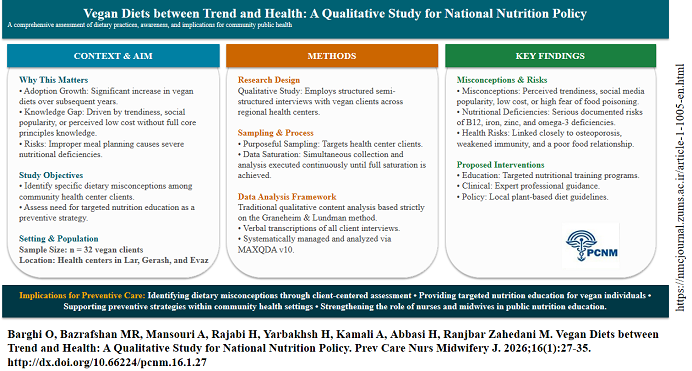
Background: The number of vegan consumers has increased markedly over the past decade. Some individuals adopt this diet without adequate understanding of its core principles, often driven by secondary motives and misconceptions. These misunderstandings may result in adverse health outcomes, including nutritional deficiencies, when the diet is poorly planned. Understanding the sociocultural and educational context of the target population, particularly in regions such as Lar, Gerash, and Evaz in southern Iran, is therefore essential.
Objectives: This study aimed to identify common misconceptions about the vegan diet among individuals referring to community health centers and to evaluate the need for targeted nutrition education as a preventive approach to reduce diet-related health risks.
Methods: This qualitative study employed semi-structured interviews and purposive sampling to recruit vegan individuals from community health centers in Lar, Gerash, and Evaz. Data were analyzed using conventional qualitative content analysis based on the Graneheim and Lundman approach. Interviews were transcribed verbatim, managed with MAXQDA version 10, and analyzed concurrently with data collection until saturation was achieved.
Results: Data from 32 participants, mean age: 40.21 (10.20) years, yielded four main themes: misconceptions about the vegan diet, consequences of unresolved misconceptions (including nutritional deficiencies), proposed solutions, and implementation strategies. Several misconceptions conflicted with fundamental dietary principles and, in some cases, led to unintended negative health effects.
Conclusion: While the vegan diet has potential health benefits, inadequate understanding of its objectives may increase health risks. Targeted nutrition education, professional guidance, and supportive public health policies are recommended to promote informed adherence and prevent diet-related harm.
Objectives: This study aimed to identify common misconceptions about the vegan diet among individuals referring to community health centers and to evaluate the need for targeted nutrition education as a preventive approach to reduce diet-related health risks.
Methods: This qualitative study employed semi-structured interviews and purposive sampling to recruit vegan individuals from community health centers in Lar, Gerash, and Evaz. Data were analyzed using conventional qualitative content analysis based on the Graneheim and Lundman approach. Interviews were transcribed verbatim, managed with MAXQDA version 10, and analyzed concurrently with data collection until saturation was achieved.
Results: Data from 32 participants, mean age: 40.21 (10.20) years, yielded four main themes: misconceptions about the vegan diet, consequences of unresolved misconceptions (including nutritional deficiencies), proposed solutions, and implementation strategies. Several misconceptions conflicted with fundamental dietary principles and, in some cases, led to unintended negative health effects.
Conclusion: While the vegan diet has potential health benefits, inadequate understanding of its objectives may increase health risks. Targeted nutrition education, professional guidance, and supportive public health policies are recommended to promote informed adherence and prevent diet-related harm.
Full-Text [PDF 812 kb]
(121 Downloads)
| | Full-Text (HTML) (66 Views)
Knowledge Translation Statement
Audience: Nursing managers and hospital administrators
Many individuals adopt vegan diets based on misconceptions, viewing it as a trend, social status tool, or low-cost alternative, rather than informed nutritional choices, increasing risks of deficiencies in iron, B12, zinc, and protein. Nursing managers should integrate evidence-based nutrition education into community health services, train staff to identify at-risk individuals, and develop culturally sensitive dietary guidelines that address local misconceptions while respecting informed motivations.
Type of Study: Orginal research |
Subject:
Nursing
References
1. Marrone G, Guerriero C, Palazzetti D, Lido P, Marolla A, Di Daniele F. Vegan diet health benefits in metabolic syndrome. Nutrients. 2021;13(3):817. [https://doi.org/10.3390/nu13030817] [PMID]
2. Clarys P, Deliens T, Huybrechts I, Deriemaeker P, Vanaelst B, De Keyzer W. Comparison of nutritional quality of the vegan, vegetarian, semi-vegetarian, pesco-vegetarian and omnivorous diet. Nutrients. 2014;6(3):1318-32. [https://doi.org/10.3390/nu6031318] [PMID]
3. Avital K, Buch A, Hollander I, Brickner T, Goldbourt U. Adherence to a Mediterranean diet by vegetarians and vegans as compared to omnivores. Journal of Human Nutrition and Dietetics. 2020;33(3):378-87. [https://doi.org/10.1080/09637486.2019.1663797] [PMID]
4. Le LT, Sabaté J. Beyond meatless, The health effects of vegan diets: findings from the Adventist cohorts. Nutrients. 2014;6(6):2131-47. [https://doi.org/10.3390/nu6062131] [PMID]
5. Costa I, Gill PR, Morda R, Ali L. More than a diet: a qualitative investigation of young vegan women's relationship to food. Appetite. 2019;143:104418. [https://doi.org/10.1016/j.appet.2019.104418] [PMID]
6. Bakaloudi DR, Halloran A, Rippin HL, Oikonomidou AC, Dardavesis TI, Williams J. Intake and adequacy of the vegan diet: A systematic review of the evidence. Clinical Nutrition. 2021;40(5):3503-21. [https://doi.org/10.1016/j.clnu.2020.11.035] [PMID]
7. Hsieh HF, Shannon SE. Three approaches to qualitative content analysis. Qualitative Health Research. 2005;15(9):1277-88. [https://doi.org/10.1177/1049732305276687] [PMID]
8. Qualitative Research in Nursing: Advancing the Humanistic Imperative. 5 ed. Philadelphia: Wolters Kluwer Health/Lippincott Williams & Wilkins; 2011. p.379-402.
9. Essentials of Nursing Research: Methods, Appraisal, and Utilization. 5 ed. Philadelphia: Lippincott Williams & Wilkins; 2001. p. 64-264.
10. Graneheim UH, Lundman B. Qualitative content analysis in nursing research: concepts, procedures and measures to achieve trustworthiness. Nurse Education Today. 2004;24(2):105-12. [https://doi.org/10.1016/j.nedt.2003.10.001] [PMID]
Send email to the article author
| Rights and permissions | |
 |
This work is licensed under a Creative Commons Attribution-NonCommercial 4.0 International License. |