




BibTeX | RIS | EndNote | Medlars | ProCite | Reference Manager | RefWorks
Send citation to:


URL: http://nmcjournal.zums.ac.ir/article-1-1015-en.html

Knowledge Translation Statement
Audience: Nursing managers and hospital administrators
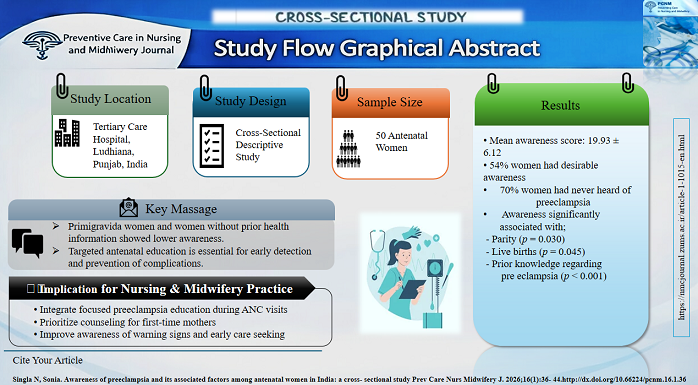
Most antenatal women lack comprehensive preeclampsia awareness, with 70% never having heard of the condition; knowledge is primarily gained through prior pregnancy experience rather than formal education or routine counseling. Parity and previous live births significantly influence awareness scores, while first-time mothers remain at highest risk with lowest knowledge levels. Nursing managers should implement structured, targeted education for primigravida women during antenatal visits, train staff to provide consistent counseling regardless of patients' education levels, and develop practical symptom-recognition tools, shifting from passive information provision to active, experience-based learning.
Hypertensive disorders of pregnancy (HDP) represent a complex group of medical conditions characterized by a blood pressure reading of 140/90 mmHg or higher, typically confirmed by two measurements taken at least four hours apart [1]. Although a typical pregnancy is a physiological process lasting approximately 40 weeks, HDP, and specifically Preeclampsia, introduces significant pathological complications. Preeclampsia is defined by the onset of hypertension after 20 weeks of gestation, often accompanied by proteinuria (albuminuria) or edema, stemming from a complex etiology involving impaired remodeling of uterine spiral arteries and trophoblast infiltration during placental formation [2].
In India, the burden of HDP is substantial, with Preeclampsia affecting 8% to 10% of all pregnancies [1, 3]. It significantly increases maternal and perinatal morbidity and mortality and affects 2% to 8% of births globally [3]. Preeclampsia remains a major global health challenge. Estimates from 2016 suggest that it was responsible for nearly 46,000 maternal deaths and approximately 500,000 fetal losses each year, with the burden falling most heavily on resource-limited settings [4].
The state of Punjab presents a unique and concerning paradox. According to the 2024 Punjab State Health Department audit, the state's maternal mortality ratio (MMR) stands at 90, which, while an improvement from previous years, is still higher than the national average [5, 6]. These figures underscore a persistent public health challenge that has not diminished despite advancements in obstetric medicine.
The consequences of failing to manage these disorders are severe for both mother and child. Maternal morbidities include convulsions, placental abruption, pulmonary edema, acute renal failure, and HELLP syndrome [2, 4]. For the neonate, Preeclampsia is a leading driver of prematurity, low birth weight, and prolonged stays in the neonatal intensive care unit (NICU) [3]. This disparity is striking. Women in developing nations are 14 times more likely to die from maternal complications than those in developed nations [4]. Therefore, early detection and prompt intervention are the primary defenses against these fatal outcomes.
Due to a lack of awareness, inadequate follow-up, and the higher cost of healthier eating, pregnant women frequently do not take part in programs aimed at improving their lifestyles. According to studies, pregnant women with low levels of education were more likely to experience risky situations like premature birth or neonatal death [7]. While routine prenatal care and blood pressure monitoring are vital, their effectiveness is limited if patients cannot recognize the symptoms that necessitate urgent care between scheduled visits. Despite the clear importance of awareness, there is currently a significant knowledge gap regarding the specific level of knowledge and the unique determinants of awareness among pregnant women in the Punjab region.
This lack of localized data hinders the development of targeted educational interventions necessary to reduce maternal and neonatal mortality in this specific population.
Objectives
This study aimed to assess the level of knowledge regarding Preeclampsia among pregnant women attending a tertiary care hospital in Ludhiana, Punjab, India, and to identify the sociodemographic and clinical factors associated with this awareness.
Methods
Study Design and Setting
A cross-sectional study was conducted from February 2020 to October 2020 to assess the level of awareness regarding Preeclampsia and its associated factors among antenatal women.
The study was conducted in the antenatal outpatient department (OPD) of a tertiary care hospital in Punjab, India, serving a diverse patient population from both urban and rural areas.
Study Participants
The target population comprised antenatal women attending the OPD of DMC & Hospital, Ludhiana.
Inclusion Criteria
- Women in their second or third trimester of pregnancy
- Women who voluntarily participate and provide written consent.
- Women with confirmed intrauterine death (IUD) according to medical records and ultrasonography.
- Women with overt cognitive impairments, determined by their inability to understand the purpose of the study or provide informed consent.
Sample Size and Sampling
The sample size was determined using Cochran's formula: n = Z²pq/e². Due to varying maternal awareness levels reported in regional literature, a prevalence (p) of 50% was utilized to maximize variability and ensure a conservative estimate [8, 9, 10]. With a 95% confidence interval (Z = 1.96) and a 5% margin of error (e = 0.05), the formula yielded a requirement of 384 participants for a full-scale study. However, as this research was a pilot study, a sample of 50 antenatal women was selected.
Participants were selected using a convenience sampling technique based on their availability and willingness to participate during the study period.
Data Collection Tool
The data collection tool was a researcher-developed questionnaire based on established clinical guidelines and an extensive review of obstetric literature. To ensure accessibility, it was administered in Hindi, Punjabi, or English, according to participants' preference
The instrument was organized into three sections:
Section 1: Sociodemographic Profile
The first section focused on the baseline information of the participants, including age, marital status, family type, religion, dietary habits, educational level, occupation, socioeconomic status, and previous exposure to information regarding Preeclampsia, including the specific sources of that information.
Section 2: Maternal Profile
This section focused on the participants' obstetric history, including gestational age and personal history of preeclampsia diagnosis.
Section 3: Preeclampsia Awareness Assessment
Awareness was evaluated using a structured questionnaire comprising 6 main questions of 40 dichotomous items (sub-questions) [Appendix 1]. Each correct response received 1 mark, with a maximum possible total score of 40. These items covered the definition of Preeclampsia, its signs and symptoms, risk factors, prevention strategies, management protocols, and potential complications.
For scoring, each correct response received 1 mark (a maximum of 40). Scores were classified using modified Bloom's criteria: excellent (31–40), good (21–30), average (11–20), and poor (0–10).
Validity and Reliability
A panel of seven experts assessed content validity. The content validity index (CVI) was 0.86. Reliability was assessed using the test–retest method across five participants with a one-week interval between administrations. The resulting reliability coefficient was 0.88.
Data Collection Procedure
Data were collected from 1 Aug to 30 Aug, 2020. After obtaining informed consent, the primary investigator administered the questionnaire via face-to-face interviews to ensure clarity and to accommodate varying literacy levels. Each session lasted approximately 15–20 minutes. To ensure data quality, all questionnaires were reviewed for completeness and accuracy immediately following the interview.
Statistical Analysis
Data were analyzed using SPSS version 26. Normality was assessed using the Shapiro-Wilk test, which indicated a normal distribution (p > 0.05). Descriptive statistics (frequencies, percentages, means, and standard deviations) were used to summarize the data. Independent t-test and ANOVA were used to examine associations, with a significance level of p < 0.05.
Result
| Variable | N | % |
| Age (in years) Below 20 21-25 26-30 31-35 36-40 |
3 16 26 4 1 |
6 32 52 8 2 |
| Marital Status Married Divorced/separated/widowed |
49 1 |
98 2 |
| Habitat Rural Urban |
36 14 |
72 28 |
| Type of family Joint Nuclear |
22 28 |
44 56 |
| Religion Sikh Muslim Hindu |
37 03 10 |
74 6 2 |
| Educational Status (Women) Illiterate Elementary Secondary Senior secondary Graduation & above |
1 5 10 16 18 |
2 10 20 32 36 |
| Occupational Status (Women) Non-working Working |
41 9 |
82 18 |
| Socioeconomic Status Upper Class I Upper Middle-Class II Lower Middle-Class III Upper Lower Class IV |
1 21 25 3 |
2 42 50 6 |
| Obstetrical History |
| Gravida 1 2 3 4 |
30 13 5 2 |
60 26 10 4 |
| Para 0 1 2 3 |
32 12 4 2 |
64 24 8 4 |
| Gestational age 2nd trimester 3rd trimester |
22 28 |
44 56 |
| History of Preeclampsia Personal Diagnosis (Yes) Family History (Yes) |
3 5 |
6 10 |
| Awareness of Preeclampsia Ever heard of the condition (Yes) Source of Information (n = 15) Family members Friends/Neighbours Health personnel |
15 6 5 4 |
30 12 10 8 |
Table 2. Distribution of Awareness Levels Regarding Preeclampsia (N = 50)
| Components | Max Score | M | SD | Mean % | Rank |
| Introduction | 4 | 2.02 | 1.12 | 50.5% | 3 |
| Contributing factors | 9 | 4.06 | 1.93 | 45.1% | 6 |
| Sign and symptoms | 8 | 3.86 | 1.49 | 48.3% | 4 |
| Prevention | 5 | 2.64 | 1.24 | 52.8% | 2 |
| Management | 7 | 4.08 | 1.69 | 58.2% | 1 |
| Complications | 7 | 3.24 | 1.48 | 46.3% | 5 |
| Total Awareness Score | 40 | 19.93 | 6.12 | 49.8% | - |
Table 3. Association of Awareness Scores with Selected Variables (N = 50)
| Variable | n (%) | M (SD) | F/t value |
| Prior Knowledge of Preeclampsia No Yes |
35 (70) 15 (30) |
18.00 (5.45) 24.43 (5.21) |
t = 3.812 p < 0.001** |
| GPLAS status (Gravida) 1 2 3 4 |
30 (60) 13 (26) 05 (10) 02 (04) |
18.30 ( 6.10) 24.15 (4.98) 18.60 (4.27) 19.5 (6.36) |
F = 3.298 p = 0.290 |
| Parity 0 1 2 3 |
32 (64) 12 (24) 04 (8) 02 (4) |
18.53 (5.97) 24.33 (5.15) 17.70 (4.22) 19.50 (6.30) |
F = 3.22 p = 0.030* |
| Live Births 0 1 2 |
34 (68) 12 (24) 04 (8) |
18.56 (5.87) 23.58 (5.03) 20.25 (7.54) |
F = 3.32 p = 0.045* |
| Gestational Age 2nd trimester 3rd trimester |
22 (44) 28 (56) |
18.05 ( 5.46) 21.36 ( 6.23) |
t =3.86 p =0.500 |
| Age (in years) Below 20 21-25 26-30 31-35 36-40 |
3 (06) 16 (32) 26 (52) 04 (08) 1 (02) |
16.33 (1.53) 19.56 (6.89) 20.54 (5.78) 22.00 (6.16) 11.00 (0.00) |
F = 0.996 p = 0.420 |
| Educational status of (women): Illiterate Elementary Secondary Senior Secondary Graduation and above |
1 (02) 5 (10) 10 (20) 16 (32) 18 (36) |
22.00 (0.00) 16.00 (5.61) 20.40 (7.35) 19.62 (5.62) 20.83 ( 6.07) |
F = 0.656 p = 0.626 |
| Habitat Rural Urban |
36 (72) 14 (28) |
19.89 (6.13) 19.93 (6.17) |
t = 0.21 p = 0.980 |
| Socioeconomic status: Upper Class I Upper Middle-Class II Lower Middle-Class III Upper Lower Class IV |
1 (02) 21 (42) 25 (50) 3 (06) |
22.0 (0.00) 22.1 (6.164) 18.48 (5.88) 15.67 (2.157) |
F = 2.007 p = 0.126 |
Sociodemographic and Obstetric Profile
The sociodemographic characteristics of the 50 antenatal women are summarized in Table 1. Most participants were aged 26–30 years (52.0%) and were married (98.0%). Most resided in rural areas (72.0%) and were Sikhs (74.0%). Regarding education, 36.0% had a graduation degree or higher. Obstetric history revealed that 60% of participants were in their first pregnancy (primigravida). While 30% of women had heard of Preeclampsia, 70% reported having no prior knowledge of the condition. Among those with some awareness, the majority received information from social circles (family and neighbors) rather than clinical health personnel.
Awareness Levels Regarding Preeclampsia
The distribution of awareness scores across different components is presented in Table 2. The highest mean percentage score was observed in the management component (58.2%), which ranked first. This was followed by prevention (52.8%) and introduction (50.5%). The lowest awareness levels were identified in contributing factors (45.1%). The overall mean (SD) awareness score for the total sample was 19.93 (6.12).
Associations with Awareness Scores
Given the pilot nature of the study, these inferential findings should be interpreted cautiously. The association between awareness scores and selected variables is shown in Table 3. Significant associations were found between awareness levels and prior knowledge of Preeclampsia (p < 0.001), parity (p = 0.030), and the number of live births (p = 0.045). Participants who had previously heard of (M=24.43, SD=5.21) scored significantly higher than those who had not (M=18.00, SD=5.45). No significant associations were found with age, women's education, habitat, socioeconomic status, or gestational age (p <0.05).
The lack of significance may be due to limited sample size.
Discussion
This study aimed to address the critical knowledge gap regarding preeclampsia awareness among antenatal women in the Punjab region, as a profound lack of baseline understanding of hypertensive disorders of pregnancy (HDP) has been consistently identified in the literature [2].
Research conducted in the Moga district of Punjab identified that a significant number of antenatal mothers, ranging from 57% to 67%, possess only average knowledge regarding the prevention of Preeclampsia. In comparison, a notable percentage (22%–24%) have below-average knowledge [11].
The primary finding was that a substantial majority of the women (70%) had never heard of the condition before the study, confirming that even within a tertiary care hospital setting, maternal health literacy on this critical topic remains low. Notably, although so many women had never heard the name "preeclampsia," nearly half still scored "good" on the awareness test. This gap suggests that women are picking up bits and pieces of information, such as recognizing a symptom or knowing they need to check their blood pressure during their doctor visits, even if they do not understand the actual disease. Essentially, they have gathered fragmented facts through experience rather than having a clear, complete understanding of what the condition really is and how dangerous it can be.
A pivotal finding of this research is the significant association between awareness levels and parity and number of live births. This suggests that knowledge is primarily gained through lived experience and repeated interactions with the healthcare system during previous pregnancies, rather than through proactive primary education. This mirrors the findings by Wilkinson and Cole [12], who noted that experienced mothers often possess higher health literacy regarding obstetric complications. Conversely, the lack of association with formal education level is a critical finding because it shows that having a degree does not automatically mean a person understands pregnancy risks [13].
It suggests that schools are not teaching practical health skills, which makes it even more important for nurses and midwives to provide clear, expert counseling to every patient, regardless of their formal education.
While this study primarily focused on awareness, the demographic and clinical data reinforce several key risk factors. In this study population, the prevalence of a preeclampsia diagnosis was reported at 6% (n = 3). In comparison, a family history of the condition was present in 10% (n = 5) of the participants, primarily involving first-degree relatives such as mothers and sisters. These findings are particularly significant when aligned with established literature. For instance, while 52% of the sample fell into the 26–30 age range, literature suggests that women over 35 face a fourfold increase in preeclampsia risk due to age-related cardiovascular changes [14]. Furthermore, 60% of the participants were primigravida. Given that primiparous women are at triple the risk for developing Preeclampsia, their significantly lower awareness scores represent a high-risk "education gap" that must be prioritized in preventive care [15].
A key strength of this study is its identification of modifiable factors, such as parity and information sources, that influence women's awareness of Preeclampsia. The study also offers an initial baseline for the Punjab population, filling an important gap in regional maternal health literature. In addition, the instrument demonstrated good reliability, and the findings revealed that women who were aware often relied on informal sources such as family and friends rather than healthcare providers, highlighting a significant information gap.
This pilot study has several limitations. The small sample size limits statistical power and raises the risk of type II error, meaning some true associations may not have been detected. The test–retest reliability assessment was based on a very small subsample (n = 5), which restricts confidence in the instrument's stability. The single-center convenience sampling also limits generalizability, and the reliance on self-reported data introduces the possibility of recall bias. Larger, multi-center studies are needed to confirm these findings.
Conclusion
This pilot study showed that while many pregnant women have heard something about Preeclampsia, most do not fully understand what the condition means or why it is dangerous. Women who had been pregnant before were generally more aware, suggesting that personal experience plays a greater role than formal education or routine antenatal counseling. These findings point to a clear need for more accessible, practical, and consistent health education provided by nurses and midwives. Special attention should be given to first-time mothers and to women with limited exposure to health information. Strengthening communication during antenatal visits can help close this knowledge gap, support early recognition of warning symptoms, and promote safer pregnancy outcomes for both mothers and babies.
Ethical Considerations
The study was ethically approved by the Institutional Ethics Committee (IEC) of Dayanand Medical College & Hospital (IEC no. DMCH/R&D/2020/85). All procedures were conducted in accordance with the principles of the Declaration of Helsinki and ICMR guidelines. Informed consent was obtained from all participants, and data remained anonymous.
Acknowledgements
The authors would like to thank the staff of the Antenatal OPD and the study participants for their cooperation.
Conflict of Interest
The authors declare no conflict of interest.
Funding
This research received no specific grant from any funding agency in the public, commercial, or not-for-profit sectors.
Authors' Contributions
Conceptualization: N. Singla
Investigation (Data Collection): N. Singla
Formal Analysis (Data Analysis): Sonia
Writing – Original Draft: N. Singla, Sonia
Writing – Review & Editing: N. Singla, Sonia
All authors read and approved the final manuscript.
Artificial Intelligence Utilization
The authors used Grammarly (version 1.0) to improve language. The authors reviewed and edited the text and take full responsibility for the final content.
| Rights and permissions | |
 |
This work is licensed under a Creative Commons Attribution-NonCommercial 4.0 International License. |