


logo
Volume 16, Issue 1 (1-2026)                   Prev Care Nurs Midwifery J 2026, 16(1): 36-44 | Back to browse issues page

Ethics code: DMCH/ R& D/2020/85


XML Print


Download citation:
BibTeX | RIS | EndNote | Medlars | ProCite | Reference Manager | RefWorks
Send citation to:

Singla N, . S. Awareness of Preeclampsia and Its Associated Factors Among Antenatal Women in India: A Cross-Sectional Study. Prev Care Nurs Midwifery J 2026; 16 (1) :36-44
URL: http://nmcjournal.zums.ac.ir/article-1-1015-en.html
College of Nursing, Assistant Professor, All India Institute of Medical Sciences, Raebareli, Uttar Pradesh, India , singla89neha@gmail.com
Abstract:   (273 Views)
Background: Preeclampsia affects 2–8% of pregnancies and remains a serious threat to maternal and neonatal health. It typically develops after 20 weeks of gestation, presenting with hypertension and proteinuria, and can lead to immediate fetal complications as well as long-term cardiovascular risks for the mother. Increasing maternal awareness is essential for timely intervention and the prevention of avoidable adverse outcomes.
Objective: This study aimed to assess the level of awareness regarding preeclampsia and determine associated factors among antenatal women.
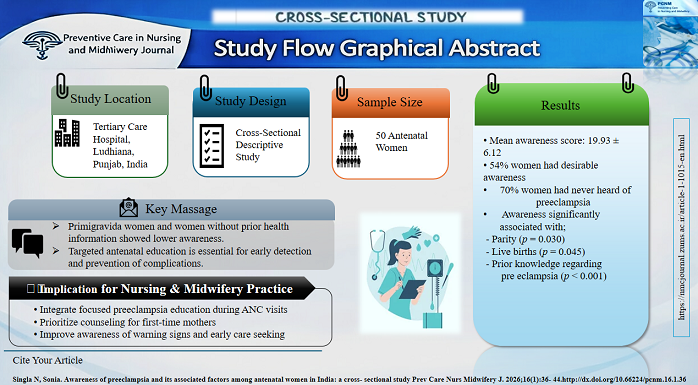
Methods: This cross-sectional study was conducted on 50 antenatal women in the antenatal outpatient department of a tertiary care hospital in Ludhiana, Punjab, India, from February 2020 to October 2020. Participants were selected through convenience sampling. Data were collected using a researcher-made questionnaire. Data analysis was performed using an independent t-test and ANOVA in SPSS version 26.
Results: The mean (SD) awareness score was 19.93 (6.12) out of 40. More than half of antenatal women had desirable awareness (54%). Participants' awareness levels were significantly associated with parity (p = 0.03), the number of live births (p = 0.045), and prior knowledge regarding the condition (p <0.001).
Conclusion: The study concludes that most antenatal women had a desirable level of awareness, though their knowledge was influenced by parity and prior health information. Strengthening targeted educational interventions for primigravida women and those without previous obstetric experience is crucial for early detection and effective management of preeclampsia, ultimately improving maternal and neonatal safety outcomes.
 
Full-Text [PDF 731 kb]   (142 Downloads) |   |   Full-Text (HTML)  (64 Views)  

Knowledge Translation Statement

Audience: Nursing managers and hospital administrators

Most antenatal women lack comprehensive preeclampsia awareness, with 70% never having heard of the condition; knowledge is primarily gained through prior pregnancy experience rather than formal education or routine counseling. Parity and previous live births significantly influence awareness scores, while first-time mothers remain at highest risk with lowest knowledge levels. Nursing managers should implement structured, targeted education for primigravida women during antenatal visits, train staff to provide consistent counseling regardless of patients' education levels, and develop practical symptom-recognition tools, shifting from passive information provision to active, experience-based learning.


Type of Study: Orginal research | Subject: Nursing

References
1. Damasceno AAA, Matijasevich A, Mosquera PS, Malta MB, Cardoso MA; MINA‐Brazil Study Group. Hypertensive disorders of pregnancy in Western Brazilian Amazon: associated factors and neonatal outcomes. American Journal of Human Biology. 2024 May; 36(5): 1-12. [https://doi.org/10.1002/ajhb.24026] [PMID]
2. Duley L. The global impact of pre-eclampsia and eclampsia. Seminars in Perinatology. 2009;33(3):130-137. [https://doi.org/10.1053/j.semperi.2009.02.005] [PMID]
3. Ives CW, Sinkey R, Rajapreyar I, Tita ATN, Oparil S. Preeclampsia-Pathophysiology and Clinical Presentations: JACC State-of-the-Art Review. Journal of the American College of Cardiology. 2020; 76(14): 1690-1702. [https://doi.org/10.1016/j.jacc.2020.08.014] [PMID]
4. von Dadelszen P, Magee LA. Preventing deaths due to the hypertensive disorders of pregnancy. Best Practice & Research Clinical Obstetrics & Gynaecology. 2016; 36:108-122. [https://doi.org/10.1016/j.bpobgyn.2016.05.005] [PMID]
5. Comptroller and Auditor General of India. Performance audit of public health infrastructure and management of health services: government of Punjab. Report No. 4 of 2024. Chandigarh: Principal Accountant General (Audit) Punjab; 2024.
6. Government of Punjab. Punjab vision document 2030: SDG 3 indicators and milestones. Department of Planning; 2024.
7. Gholami K, Norouzkhani N, Kargar M, Ghasemirad H, Ashtiani AJ, Kiani S, et. al. Impact of educational interventions on knowledge about hypertensive disorders of pregnancy among pregnant women: a systematic review. Frontiers in Cardiovascular Medicine. 2022; 9: 1-11. [https://doi.org/10.3389/fcvm.2022.886679] [PMID]
8. Deo J, Gurmeet P. Study of knowledge, attitude and practices of antenatal care and determinants of utilisation of its services in Pathankot, Punjab. International Journal of Scientific Research. 2019;8(11):70-72. [https://doi.org/10.36106/ijsr]
9. Hertzog MA. Considerations in determining sample size for pilot studies. Research in Nursing & Health. 2008;31(2):180-191. [https://doi.org/10.1002/nur.20247] [PMID]
10. Eldridge SM, Lancaster GA, Campbell MJ, Thabane L, Hopewell S, Coleman CL, et al. Defining feasibility and pilot studies in preparation for randomised controlled trials: development of a conceptual framework. PLoS One. 2016;11(3):1-22. https://doi.org/10.1371/journal.pone.0150205 [https://doi.org/10.1371/journal.pone.0150205] [PMID]
11. Jaskaran Kaur, Parveen Sandha. An exploratory study to assess the knowledge regarding prevention of Pre-eclampsia among antenatal mothers in seleced hospital of Moga, Punjab. International Journal of Emerging Tehnologies and Innovative Research. 2025;12(6):79-96. [https://www.jetir.org/papers/JETIR2506912.pdf]
12. Wilkinson SA, Cole S. Health literacy and its impact on pregnancy outcomes. Australian and New Zealand Journal of Obstetrics and Gynaecology. 2018;58(1):15-22. [https://doi.org/10.1111/ajo.12724]
13. Moussa HN, Leon MG, Marti A, Nasab S, Blackwell SC, Sibai BM. Knowledge of preeclampsia: a survey of recent mothers. The Journal of Maternal-Fetal & Neonatal Medicine. 2018;31(1):110-113. [https://doi.org/10.1080/14767058.2016.1271404]
14. Poon LC, Shennan A, Hyett JA, Kapur A, Hadar E, Divakar H, et al. The international federation of gynecology and obstetrics (FIGO) initiative on pre-eclampsia: a pragmatic guide for first-trimester screening and prevention. International Journal of Gynecology & Obstetrics. 2019;145(Suppl 1):1-33. [https://doi.org/10.1002/ijgo.12802] [PMID]
15. English FA, Kenny LC, McCarthy FP. Risk factors and effective management of preeclampsia. Integrated Blood Pressure Control. 2015; 8: 7-12. [https://doi.org/10.2147/IBPC.S50641] [PMID]

Add your comments about this article : Your username or Email:
CAPTCHA

Send email to the article author


Rights and permissions
Creative Commons License This work is licensed under a Creative Commons Attribution-NonCommercial 4.0 International License.