
Preventive Care in Nursing and Midwifery

Volume 16, Issue 1 (1-2026)
Prev Care Nurs Midwifery 2026, 16(1): 74-76 |
Back to browse issues page


Ethics code: This letter to the editor does not report original research involving human participants or identifi


Download citation:
BibTeX | RIS | EndNote | Medlars | ProCite | Reference Manager | RefWorks
Send citation to:


BibTeX | RIS | EndNote | Medlars | ProCite | Reference Manager | RefWorks
Send citation to:
Amiri E, Amiri Y, Azimzadeh R, Koohi Garebag M, Heydari Tolash Z, Khezerlou Z. Safeguarding Psychiatric Patients' Fundamental Rights as a Preventive Nursing Imperative. Prev Care Nurs Midwifery 2026; 16 (1) :74-76
URL: http://nmcjournal.zums.ac.ir/article-1-1017-en.html
URL: http://nmcjournal.zums.ac.ir/article-1-1017-en.html
Elham Amiri  , Yalda Amiri , Roghaieh Azimzadeh * , Mahsa Koohi Garebag , Zahra Heydari Tolash , Zahra Khezerlou
, Yalda Amiri , Roghaieh Azimzadeh * , Mahsa Koohi Garebag , Zahra Heydari Tolash , Zahra Khezerlou
Medical Surgical Nursing Department, Nursing and Midwifery School, Urmia University of Medical Sciences, Urmia, Iran , azimzadeh20@gmail.com
Full-Text [PDF 666 kb]
(369 Downloads)
| Abstract (HTML) (714 Views)
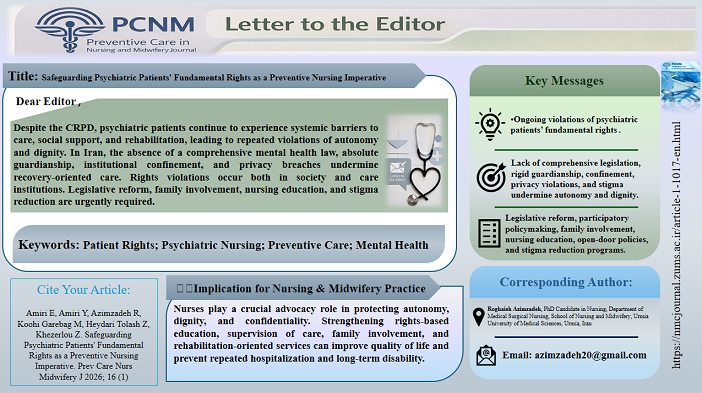
Graphical Abstract:
Full-Text: (190 Views)
How often must patients describe psychiatric wards as resembling a prison before we critically examine whether such environments are consistent with therapeutic and rights-based care? Despite the Convention on the Rights of Persons with Disabilities (CRPD) guaranteeing equal rights, people with psychiatric disorders still face systemic barriers to care and social support, which leads to recurrent rights violations. Evidence from low- and middle-income countries shows that these individuals have very limited access to health services and are often deprived of community‑based rehabilitation programs. This issue is further aggravated by the limited legal measures adopted at the national level to secure the right of psychiatric patients to appropriate treatment, social support, and protection against discrimination, ultimately resulting in repeated violations of their rights [1].
One of the frequently reported violations of patients’ rights is the infringement of their independence and autonomy [2]. Facilitating patient independence creates a multifaceted challenge in healthcare, requiring a delicate balance between preserving patients’ ability to choose and supporting them in making decisions that promote well-being and long-term recovery [3]. Qualitative studies and patient narratives point to a clear problem: some laws undermine autonomy. Rather than protecting patients' rights, these laws work against them. Mental health laws in many countries have been developed to safeguard the human rights of individuals with psychiatric disorders. In Iran, however, despite the existence of scattered regulations, Iran still doesn't have a real mental health law of its own. In practice, these structural and legal shortcomings are most clearly reflected in institutional care settings.
For example, patients with schizophrenia may have limited control over their financial matters, as a guardian is appointed to manage their assets. The problem is that guardianship is applied as an all-or-nothing arrangement. Patients have no chance to gradually take control of their assets or have a say in decisions about their own lives [4]. Such practices hinder patient empowerment and delay social reintegration. A clear example of disregard for the dignity of psychiatric patients within Iran's healthcare system is the violation of their autonomy in institutional settings. Individuals in psychiatric institutions are frequently placed in facilities with locked doors or limited access to the outside environment. Although locked wards may reduce patient escape, they create a sense of imprisonment and loss of personal freedom. When patients are locked behind closed doors and their days are run by hospital routines, "independence" becomes an empty word. This directly undermines preventive nursing goals aimed at recovery-oriented care.
Furthermore, patients often lack access to education, employment opportunities, and public services. These locked facilities also fail to provide effective rehabilitative interventions that could prepare patients to return to everyday life and reconnect with their families and communities [5, 6]. The violation of human rights ultimately undermines human dignity [1].
Another example of rights violations among psychiatric patients is the failure to respect patient privacy and the disclosure of confidential information. Neglect of bodily and informational privacy constitutes a direct violation of human dignity [5]. Unfortunately, cases of neglect, as well as physical and psychological abuse, have been reported in several studies among patients with psychiatric disorders [7]. According to patients with psychiatric disorders, family relationships are often weak, with limited emotional connection and inadequate involvement in patients' lives. In many cases, families remove patients from active participation in social life rather than supporting recovery and rehabilitation [8].
Violations of the basic rights of psychiatric patients occur not only in society but also within care institutions [1]. Patients frequently report experiences of humiliating or mocking behavior related to their illness. Patient accounts have also raised concerns about experiences suggestive of physical or psychological abuse, particularly in care settings where effective supervision is limited [5]. In some institutions, insufficient oversight of staff practice appears to contribute to more subtle forms of mistreatment, including the neglect of essential care activities. [5].
Protecting the rights of psychiatric patients requires urgent attention from policymakers and health managers to develop and implement comprehensive, preventive, and rights-based programs. Key actions include:
1. Legislative and Policy Reform: In Iran, mental health legislation alone cannot fully safeguard patients' rights. A participatory and comprehensive approach is required, involving mental health service users, families, healthcare providers, nurses, health planners, and policymakers. Within this framework, structured family engagement should be formally integrated into policy development and service delivery models, as family presence and participation enhance patient autonomy and continuity of care. The revival and expansion of open-door policies in psychiatric centers may further support transparency, reduce institutional isolation, and strengthen family–patient connections.
In addition, public education initiatives (such as radio and television programs) should be incorporated into national mental health strategies to increase societal awareness of the rights, capabilities, and social contributions of individuals with psychiatric disorders. Such initiatives can play a significant role in reducing stigma and preventing systemic human rights violations.
2. Nursing Education and Professional Development: Given the critical role of respecting patients' rights in improving quality of life, strengthening the infrastructure for rights-based care at the bedside is essential. Given nurses' central role in daily patient care, education on patients' rights should be emphasized in undergraduate curricula and continuing professional development programs.
Structured training programs not only enhance nurses' advocacy competencies but also serve as an effective strategy for reducing stigma in healthcare settings. By equipping nurses with ethical, legal, and human rights-based knowledge, clinical practice can shift toward more person-centered, autonomy-supportive, and dignity-preserving care models.
A deeper understanding of the factors threatening the rights of psychiatric patients can help health policymakers and nursing leaders design and implement effective programs, ultimately improving health outcomes and quality of life for this vulnerable population, as well as preventing repeated hospitalization and long-term disability.
Ethical Considerations
N/A
Acknowledgments
N/A
Conflict of Interest
The authors confirm that there are no conflicts of interest associated with this work.
Funding
The authors received no financial support for this study.
Authors' Contributions
Conceptualization: E. Amiri, R. Azimzadeh, Z. Khezerlou
Writing – Original Draft: E. Amiri, R. Azimzadeh
Writing – Review & Editing: E. Amiri, R. Azimzadeh, Z. Khezerlou
Supervision: Z. Khezerlou
All authors read and approved the final manuscript.
Artificial Intelligence Utilization
ChatGPT-4 (OpenAI) was employed only for minor grammar and clarity edits and for limited translation support. The authors affirm full responsibility for the integrity, accuracy, and final version of the manuscript.
Data Availability Statement
N/A
One of the frequently reported violations of patients’ rights is the infringement of their independence and autonomy [2]. Facilitating patient independence creates a multifaceted challenge in healthcare, requiring a delicate balance between preserving patients’ ability to choose and supporting them in making decisions that promote well-being and long-term recovery [3]. Qualitative studies and patient narratives point to a clear problem: some laws undermine autonomy. Rather than protecting patients' rights, these laws work against them. Mental health laws in many countries have been developed to safeguard the human rights of individuals with psychiatric disorders. In Iran, however, despite the existence of scattered regulations, Iran still doesn't have a real mental health law of its own. In practice, these structural and legal shortcomings are most clearly reflected in institutional care settings.
For example, patients with schizophrenia may have limited control over their financial matters, as a guardian is appointed to manage their assets. The problem is that guardianship is applied as an all-or-nothing arrangement. Patients have no chance to gradually take control of their assets or have a say in decisions about their own lives [4]. Such practices hinder patient empowerment and delay social reintegration. A clear example of disregard for the dignity of psychiatric patients within Iran's healthcare system is the violation of their autonomy in institutional settings. Individuals in psychiatric institutions are frequently placed in facilities with locked doors or limited access to the outside environment. Although locked wards may reduce patient escape, they create a sense of imprisonment and loss of personal freedom. When patients are locked behind closed doors and their days are run by hospital routines, "independence" becomes an empty word. This directly undermines preventive nursing goals aimed at recovery-oriented care.
Furthermore, patients often lack access to education, employment opportunities, and public services. These locked facilities also fail to provide effective rehabilitative interventions that could prepare patients to return to everyday life and reconnect with their families and communities [5, 6]. The violation of human rights ultimately undermines human dignity [1].
Another example of rights violations among psychiatric patients is the failure to respect patient privacy and the disclosure of confidential information. Neglect of bodily and informational privacy constitutes a direct violation of human dignity [5]. Unfortunately, cases of neglect, as well as physical and psychological abuse, have been reported in several studies among patients with psychiatric disorders [7]. According to patients with psychiatric disorders, family relationships are often weak, with limited emotional connection and inadequate involvement in patients' lives. In many cases, families remove patients from active participation in social life rather than supporting recovery and rehabilitation [8].
Violations of the basic rights of psychiatric patients occur not only in society but also within care institutions [1]. Patients frequently report experiences of humiliating or mocking behavior related to their illness. Patient accounts have also raised concerns about experiences suggestive of physical or psychological abuse, particularly in care settings where effective supervision is limited [5]. In some institutions, insufficient oversight of staff practice appears to contribute to more subtle forms of mistreatment, including the neglect of essential care activities. [5].
Protecting the rights of psychiatric patients requires urgent attention from policymakers and health managers to develop and implement comprehensive, preventive, and rights-based programs. Key actions include:
1. Legislative and Policy Reform: In Iran, mental health legislation alone cannot fully safeguard patients' rights. A participatory and comprehensive approach is required, involving mental health service users, families, healthcare providers, nurses, health planners, and policymakers. Within this framework, structured family engagement should be formally integrated into policy development and service delivery models, as family presence and participation enhance patient autonomy and continuity of care. The revival and expansion of open-door policies in psychiatric centers may further support transparency, reduce institutional isolation, and strengthen family–patient connections.
In addition, public education initiatives (such as radio and television programs) should be incorporated into national mental health strategies to increase societal awareness of the rights, capabilities, and social contributions of individuals with psychiatric disorders. Such initiatives can play a significant role in reducing stigma and preventing systemic human rights violations.
2. Nursing Education and Professional Development: Given the critical role of respecting patients' rights in improving quality of life, strengthening the infrastructure for rights-based care at the bedside is essential. Given nurses' central role in daily patient care, education on patients' rights should be emphasized in undergraduate curricula and continuing professional development programs.
Structured training programs not only enhance nurses' advocacy competencies but also serve as an effective strategy for reducing stigma in healthcare settings. By equipping nurses with ethical, legal, and human rights-based knowledge, clinical practice can shift toward more person-centered, autonomy-supportive, and dignity-preserving care models.
A deeper understanding of the factors threatening the rights of psychiatric patients can help health policymakers and nursing leaders design and implement effective programs, ultimately improving health outcomes and quality of life for this vulnerable population, as well as preventing repeated hospitalization and long-term disability.
Ethical Considerations
N/A
Acknowledgments
N/A
Conflict of Interest
The authors confirm that there are no conflicts of interest associated with this work.
Funding
The authors received no financial support for this study.
Authors' Contributions
Conceptualization: E. Amiri, R. Azimzadeh, Z. Khezerlou
Writing – Original Draft: E. Amiri, R. Azimzadeh
Writing – Review & Editing: E. Amiri, R. Azimzadeh, Z. Khezerlou
Supervision: Z. Khezerlou
All authors read and approved the final manuscript.
Artificial Intelligence Utilization
ChatGPT-4 (OpenAI) was employed only for minor grammar and clarity edits and for limited translation support. The authors affirm full responsibility for the integrity, accuracy, and final version of the manuscript.
Data Availability Statement
N/A
Type of Study: Letter to editor |
Subject:
Nursing
References
1. Amiri E, Baghaei R, Ebrahimi H, Habibzadeh H. Barriers to maintaining dignity for patients with schizophrenia: A qualitative study. Nursing Ethics. 2024;32(2):560-574. [https://doi.org/10.1177/09697330241262320] [PMID]
2. Peele R, Palmer RR. Patient rights and patient chronicity. The Journal of Psychiatry & Law. 1980;8(1):59-71. [https://doi.org/10.1177/009318538000800105] [PMID]
3. Liang Z, Xu M, Liu G, Zhou Y, Howard P. Patient-centered care and patient autonomy: doctors' views in Chinese hospitals. BMC Medical Ethics. 2022;23(1):38-50. [https://doi.org/10.1186/s12910-022-00777-w] [PMID]
4. Nasr Esfahani M, Attari Moghadam J. Development of the draft of law (mental health act). Iranian Journal of Psychiatry and Clinical Psychology. 2017;23(1):50-67. [https://doi.org/10.18869/nirp.ijpcp.23.1.50]
5. Amiri E, Ebrahimi H, Habibzadeh H, Baghaei R. Organizational silence and hidden threats to patients' dignity with schizophrenia: A qualitative study. Nursing Ethics. 2024;31(7):1205-1219. [https://doi.org/10.1177/09697330241262312] [PMID]
6. Amiri E, Galehdarifard A, Baghaei R, Ebrahimi H, Habibzadeh H, Habibpour Z. Revitalizing open-door policies in psychiatric institutions: A strategy for preserving patient dignity - A letter to the editor-in-chief. Nursing and Midwifery Journal. 2024;22(4):337-340. [https://doi.org/10.61186/unmf.22.4.337]
7. Rani A, Chethan R, Janaki T, Antony S, Thirumoorthy A. Women with severe mental illness and marital rape: A critical review. Partner Abuse. 2022;13(1):1-19. [https://doi.org/10.1891/PA-2021-0014]
8. Amiri E, Ebrahimi H, Habibzadeh H, Baghaei R. Family caregivers' role in dignity of people with schizophrenia: A qualitative study. Nursing Ethics. 2025;32(6):1911-1925. [https://doi.org/10.1177/09697330251319372] [PMID]
Send email to the article author
| Rights and permissions | |
 |
This work is licensed under a Creative Commons Attribution-NonCommercial 4.0 International License. |