
Preventive Care in Nursing and Midwifery

Volume 16, Issue 2 (4-2026)
Prev Care Nurs Midwifery 2026, 16(2): 30-36 |
Back to browse issues page


Ethics code: 1404.331.IR.GOUMS.REC


Download citation:
BibTeX | RIS | EndNote | Medlars | ProCite | Reference Manager | RefWorks
Send citation to:


BibTeX | RIS | EndNote | Medlars | ProCite | Reference Manager | RefWorks
Send citation to:
Ranjbar Noei F, Yazdi K. Empowering a Patient with COPD to Change Smoking Behavior: A Case Study Based on Barrett's Theory of Power as Knowing Participation in Change. Prev Care Nurs Midwifery 2026; 16 (2) :30-36
URL: http://nmcjournal.zums.ac.ir/article-1-1022-en.html
URL: http://nmcjournal.zums.ac.ir/article-1-1022-en.html

Nursing Research Center, School of Nursing and Midwifery, Golestan University of Medical Sciences, Gorgan, Iran , yazdi@goums.ac.ir
Abstract: (817 Views)
Background: Effective COPD management requires sustained behavioral change, particularly smoking cessation, which remains challenging despite standard counseling. Barrett’s Theory of Power as Knowing Participation in Change emphasizes awareness, participation, and autonomy, potentially facilitating smoking behavior change.
Objectives: This case study examined changes in smoking behavior and empowerment following a Barrett Theory‑based nursing intervention in a COPD patient with previous unsuccessful quit attempts.
Methods: A six‑month theory‑based intervention was delivered to a 55-year-old man with moderate COPD (GOLD stage II) in northern Iran. It included individualized education, collaborative smoking reduction planning, anxiety management, breathing exercises, and weekly follow‑ups. Outcomes were daily cigarette use, dyspnea (0–10 Numeric Rating Scale), and FEV₁ spirometry.
Results: After six months, daily smoking dropped from 20 to 10 cigarettes (50% reduction), and dyspnea improved from 9/10 (severe) to 5/10 (moderate). FEV₁ stabilized at 60% of predicted value. The patient engaged actively in follow‑ups, self-monitored his smoking, and reported greater self‑management confidence. In month three, he temporarily increased smoking after a stressful event but, with ongoing support, resumed his reduction plan, consistent with Barrett’s helicy principle.
Conclusion: This case suggests that Barrett’s empowerment framework may support smoking reduction and enhance engagement in COPD care. The helicy principle helps reframe relapse as part of a nonlinear process, maintaining motivation. Further research with larger samples and longer follow‑up is needed.
Objectives: This case study examined changes in smoking behavior and empowerment following a Barrett Theory‑based nursing intervention in a COPD patient with previous unsuccessful quit attempts.
Methods: A six‑month theory‑based intervention was delivered to a 55-year-old man with moderate COPD (GOLD stage II) in northern Iran. It included individualized education, collaborative smoking reduction planning, anxiety management, breathing exercises, and weekly follow‑ups. Outcomes were daily cigarette use, dyspnea (0–10 Numeric Rating Scale), and FEV₁ spirometry.
Results: After six months, daily smoking dropped from 20 to 10 cigarettes (50% reduction), and dyspnea improved from 9/10 (severe) to 5/10 (moderate). FEV₁ stabilized at 60% of predicted value. The patient engaged actively in follow‑ups, self-monitored his smoking, and reported greater self‑management confidence. In month three, he temporarily increased smoking after a stressful event but, with ongoing support, resumed his reduction plan, consistent with Barrett’s helicy principle.
Conclusion: This case suggests that Barrett’s empowerment framework may support smoking reduction and enhance engagement in COPD care. The helicy principle helps reframe relapse as part of a nonlinear process, maintaining motivation. Further research with larger samples and longer follow‑up is needed.
Full-Text [PDF 591 kb]
(384 Downloads)
| | Full-Text (HTML) (234 Views)
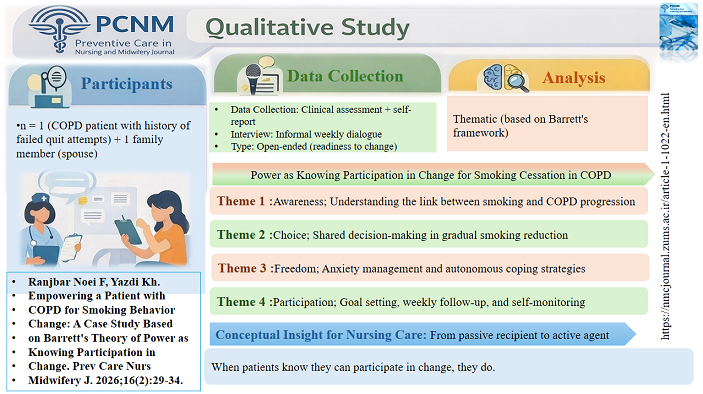
Graphical Abstract:
Reseach Highlights:
Knowledge Translation Statement
Audience: Nursing managers and chronic disease care coordinators
A Barrett theory-based intervention was associated with reduced smoking and improved dyspnea in a COPD patient, with relapse reframed as nonlinear progress. Managers may consider supporting empowerment-based behavioral training in routine chronic care.
Type of Study: case report |
Subject:
Nursing
References
1. Siltanen H, Jylhä V, Holopainen A, Paavilainen E. Family members' experiences and expectations of self-management counseling while caring for a person with chronic obstructive pulmonary disease: a systematic review of qualitative evidence. JBI Evidence Synthesis. 2019;17(11): 2214-2247. [https://doi.org/10.11124/JBISRIR-D-19-00056] [PMID]
2. Dehkordi AH, Heidari-Beni F, Reiszadeh I, Hosseini M, Ali FK. Effect of self-management program on health status and dyspnea in patients with chronic obstructive pulmonary disease. Tanaffos. 2022;21(1): 96-103. [https://www.tanaffosjournal.ir/article_254233.html]
3. Pradana A, Sari DK, Rusda M, Tarigan AP, Wiyono WH, Soeroso NN, et al. Protective effects of probiotics against systemic inflammation in Mice model with chronic obstructive pulmonary disease induced by cigarette-smoke. Reports of Biochemistry and Molecular Biology. 2024;13(3):322-328. [https://doi.org/10.61186/rbmb.13.3.322] [PMID]
4. Ur Rehman A, Ahmad Hassali MA, Muhammad SA, Shah S, Abbas S, Hyder Ali IAB, Salman A. The economic burden of chronic obstructive pulmonary disease (COPD) in the USA, Europe, and Asia: results from a systematic review of the literature. Expert Review of Pharmacoeconomics & Outcomes Research. 2020;20(6): 661-672. [https://doi.org/10.1080/14737167.2020.1678385] [PMID]
5. Venkatesan P. GOLD COPD report: 2024 update. The Lancet Respiratory Medicine. 2024;12(1): 15-16. [https://doi.org/10.1016/S2213-2600(23)00461-7] [PMID]
6. Hübsch C, Clarenbach CF, Franzen DP, Schmid-Mohler G. Post-acute care interventions in patients hospitalized due to COPD exacerbation before and after implementation of an integrated care program. International Journal of Chronic Obstructive Pulmonary Disease. 2025;20:207-216. [https://doi.org/10.2147/COPD.S496167] [PMID]
7. Fabbri LM. Smoking, not COPD, as the disease. New England Journal of Medicine. 2016;374(19):1885-1886. [https://doi.org/10.1056/NEJMe1515508] [PMID]
8. Andy A. Role of behavioral interventions in smoking cessation: a comprehensive review. Depression.2021;9(4):1-3. [https://scholar.google.com/scholar?q=Andy+A+Role+of+Behavioral+Interventions+in+Smoking+Cessation+20]
9. Calle Rubio M, López-Campos JL, Soler-Cataluña JJ, Alcázar Navarrete B, Soriano JB, Rodríguez González-Moro JM, et al. Variability in adherence to clinical practice guidelines and recommendations in COPD outpatients: a multi-level, cross-sectional analysis of the EPOCONSUL study. Respiratory Research. 2017;18(1):1-14. [https://doi.org/10.1186/s12931-017-0685-8] [PMID]
10. Seys D, Bruyneel L, Decramer M, Lodewijckx C, Panella M, Sermeus W, et al. An international study of adherence to guidelines for patients hospitalised with a COPD exacerbation. COPD: Journal of Chronic Obstructive Pulmonary Disease. 2017;14(2):156-163. [https://doi.org/10.1080/15412555.2016.1257599] [PMID]
11. Montano AR. Neuman systems model with nurse-led interprofessional collaborative practice. Nursing Science Quarterly. 2021;34(1):45-53. [https://doi.org/10.1177/0894318420965219] [PMID]
12. Etheridge-Bagley E. Barrett's power theory: re-conceptualizing the pediatric organ donation experience with letter writing. Nursing Science Quarterly. 2022;35(4):427-432. [https://doi.org/10.1177/08943184221115146] [PMID]
13. Barrett EAM. Barrett's theory of power as knowing participation in change. n: Smith MC, Parker ME, editors. Nursing Theories & Nursing Practice. 4th ed. Philadelphia, PA: F.A. Davis Company; 2015. p. 495-508. ISBN: 9780803633124.
14. Chang SJ, Kwak EY, Hahm BJ, Seo SH, Lee da W, Jang SJ. Effects of a meditation program on nurses' power and quality of life. Nursing Science Quarterly. 2016;29(3): 227-234. [https://doi.org/10.1177/0894318416647778] [PMID]
15. Barrett EAM. Power as knowing participation in change: What's new and what's next. Nursing Science Quarterly. 2010;23(1):47-54. [https://doi.org/10.1177/0894318409353797] [PMID]
16. Matthews E. Power perception and critical thinking promotion of clinical nursing instructors [doctoral dissertation]. Charlottetown, PE, Canada: Faculty of Nursing, University of Prince Edward Island; 2024. islandora.upei.ca
17. Barrett EAM. Caroselli C. Methodological ponderings related to the power as knowing participation in change tool. Nursing Science Quarterly. 1998;11(1):17-22. [https://doi.org/10.1177/089431849801100106] [PMID]
Send email to the article author
| Rights and permissions | |
 |
This work is licensed under a Creative Commons Attribution-NonCommercial 4.0 International License. |