
Preventive Care in Nursing and Midwifery Journal

Volume 16, Issue 1 (1-2026)
Prev Care Nurs Midwifery J 2026, 16(1): 77-84 |
Back to browse issues page


Ethics code: IR.SSU.REC.1395.239


Download citation:
BibTeX | RIS | EndNote | Medlars | ProCite | Reference Manager | RefWorks
Send citation to:


BibTeX | RIS | EndNote | Medlars | ProCite | Reference Manager | RefWorks
Send citation to:
Hosseini S M, Hosseini S E. Relationship Between Academic Resilience and Academic Satisfaction Among Undergraduate Nursing Students at Iran University of Medical Sciences. Prev Care Nurs Midwifery J 2026; 16 (1) :77-84
URL: http://nmcjournal.zums.ac.ir/article-1-1028-en.html
URL: http://nmcjournal.zums.ac.ir/article-1-1028-en.html

Medical Surgical Nursing Department, Nursing and Midwifery School, Iran University of Medical Sciences, Tehran, Iran , esmat.hosseini_110@yahoo.com
Full-Text [PDF 642 kb]
(250 Downloads)
| Abstract (HTML) (1655 Views)
Discussion
In the present study, the status of two main variables, including academic resilience and academic satisfaction, was investigated among nursing students. The results of the present study show that there is a direct and significant relationship between academic resilience and academic satisfaction, and that students with higher academic resilience have better satisfaction with education and academic progress. In a study of 780 students in Spain, distinct roles of coping strategies in resilience were identified, as well as the relationship between resilience and academic satisfaction [19]. The characteristics of academic resilience among Chinese nursing students include self-efficacy, self-regulation, and recovery. They are formed by the interaction between internal and external factors when facing obstacles or challenges in their academic activities. This interaction ultimately leads to the development of academic resilience among nursing students, which results in positive outcomes such as adjustment, career maturity, increased likelihood of academic success, a sense of belonging to the university, and lower levels of psychological distress. Nursing students with high levels of academic resilience can view academic obstacles positively, enhance problem-solving skills, and effectively overcome academic difficulties, thereby completing their education [20]. There is a moderate level of happiness among nursing students in Vietnam in the post-pandemic COVID-19 era, and resilience is one of the key determinants of this [21].
In the present study, the dimensions of academic resilience were measured, and a weak-to-moderate, significant relationship was observed between these dimensions and academic satisfaction. Studies conducted on these two variables either did not report the dimensions of resilience or did not observe a significant relationship between these dimensions and academic satisfaction [19, 22]. Considering that communication skills, future orientation, problem orientation, and a positive outlook, which are dimensions of resilience, involve many issues, including social, psychological, and cultural ones, they warrant further investigation.
In Iran, female gender and low resilience were found to predict mental health disorders among nursing students; therefore, those with higher resilience tend to enjoy better mental health [20]. Another study from Iran emphasized the growing recognition of academic resilience in nursing students, suggesting that implementing effective educational strategies and providing adequate support can enhance both their resilience and academic performance [21].
In the present study, alcohol consumption was significantly inversely associated with academic satisfaction. Studies have shown that students who reported alcohol consumption had lower life satisfaction and more mental health complaints than those who consumed less alcohol. They also experienced more emotional and social loneliness [23]. One of the immediate effects of alcohol is decreased academic performance because it reduces concentration. Studies have also shown that alcohol consumption is associated with lower grade point averages, in a dose-dependent manner [24].
In the present study, marriage was associated with decreased academic satisfaction. Married students face very significant challenges in higher education. Among these challenges are academic, social, time management, financial, and health challenges in married students [25]. A study found that academic problems among married students often include laziness and poor time management [26]. In the present study, students in higher semesters had lower academic satisfaction, which is related to many factors. Personality variables, cognitive variables and variables related to academic achievement (intelligence, academic achievement), as well as various motivational structures (satisfaction with the content of the study, satisfaction with the conditions of the academic program, satisfaction with the ability to cope with academic stress, satisfaction with the future of the career) play a role in academic satisfaction in students in higher semester [27]. More in-depth studies should be conducted to determine which factors contribute to academic dissatisfaction among students in higher semesters.
Academic resilience plays an important role in nursing students' academic satisfaction. Given the stressful nature of academic and clinical environments, teaching and strengthening resilience skills can enhance students' mental health, academic performance, and overall satisfaction. It is recommended that educational programs include resilience training and that future intervention studies further explore this area. The most important limitation of this study is its cross-sectional design, which can only determine relationships between variables and cannot establish a cause-and-effect relationship. Also, limitations in educational level and place of study are worth noting. Given that satisfaction with education is affected by various factors, including the educational environment, the number of students, and educational facilities, the generalizability of this study's results to other statistical populations and educational environments is limited. Therefore, it is suggested that similar studies be conducted at other universities and in other cities to identify patterns that can be applied to the results for further examination and generalization. Concurrent use of an online and an in-person questionnaire may introduce response bias. Still, due to limited access to senior students at the university, we were forced to use an online questionnaire.
Conclusion
Resilience is essential for academic success, so it's important to incorporate targeted programs, such as stress management workshops, mindfulness exercises, and problem-solving training, into nursing education. By helping students build their resilience, these programs can increase their satisfaction with their learning experience and encourage talented nursing students to stay motivated and committed to providing high-quality, preventive nursing care throughout their studies and future careers.
Ethical Considerations
This study was approved by the Ethics Committee at Iran University of Medical Sciences with the ethics code IR.IUMS.REC.1403.1154.
Acknowledgements
The nursing students at Iran University of Medical Sciences who completed the questionnaires for this project are hereby acknowledged. This study was derived from a research project approved by Iran University of Medical Sciences (Research Code: 26116).
Conflict of Interest
According to the authors, this article has no conflict of interest. No artificial intelligence was used in writing this article.
Funding
No funding.
Authors' Contributions
Conceptualization: S.E. Hosseini
Methodology: S.E. Hosseini
Investigation (Data Collection): S.E. Hosseini
Formal Analysis (Data Analysis & Interpretation): S.E. Hosseini, S. Lotfi
Writing – Original Draft: S.E. Hosseini
Writing – Review & Editing: S.E. Hosseini
Supervision: S.E. Hosseini
All authors read and approved the final manuscript.
Artificial Intelligence Utilization
Artificial intelligence was not used to write the article.
Data Availability Statement
The data are available from the corresponding author.
Knowledge Translation Statement
Audience: Nursing managers and hospital administrators
Academic resilience significantly predicts nursing students' academic satisfaction, with a positive correlation between resilience and satisfaction, where resilience training could enhance mental health and academic performance. Married students, those in higher semesters, and alcohol consumers reported lower satisfaction, suggesting targeted support needs. Nursing managers and educators should integrate resilience-building programs, including stress management workshops, mindfulness exercises, and problem-solving training, into nursing curricula to support student well-being and prepare them for preventive, high-quality care.
Full-Text: (180 Views)
Introduction
In today's world, academic challenges and the stress they cause have become major concerns in higher education [1]. Entering university represents a significant transition in an individual's life. It exposes students to various stressors, such as being away from family, living in dormitories, and managing academic assignments, which may lead to academic burnout [2]. Nursing students experience additional stress during clinical training in hospital settings, which are among the most stressful work environments. This heightened stress can affect both their personal lives and professional development [3].
Academic resilience is recognized as a key characteristic that enables students to cope effectively with academic challenges and may significantly influence their academic satisfaction [4]. It refers to students' ability to achieve academic success despite challenging circumstances. This concept encompasses a range of skills and personal attributes that help individuals adapt to academic pressures and continue progressing toward their goals [5]. Academic resilience has been identified as a predictor of academic success; students with higher resilience generally perform better under academic pressure and demonstrate greater confidence in difficult situations [6]. Recent research also indicates that resilience can reduce academic burnout and enhance academic satisfaction [7].
Academic satisfaction is an emotional state reflecting the extent to which students enjoy and are content with their academic role and experiences in nursing education. It is associated with motivation, personality traits, academic achievement, professional accomplishments, and the overall quality of educational institutions [8]. Since students will form the future workforce, their satisfaction with their field of study plays an important role in motivation and long-term success [9].
Students with higher academic satisfaction tend to perform better academically. Grade point average (GPA), as an indicator of academic progress, is often higher among students who are more satisfied with their educational experience [10].
Previous studies suggest that both academic resilience and academic satisfaction contribute to academic success and progress among nursing students, and that individual and environmental factors influence both variables [11]. Moreover, academic satisfaction enhances motivation, interest in learning, and enjoyment of education, leading to personal and academic development and contributing to improvements within educational institutions [10]. A positive and significant relationship between resilience and both job and academic satisfaction has been reported, and identifying factors related to these variables may help in developing strategies to strengthen them [12].
In a study conducted in Iran among undergraduate nursing students from three major medical universities in Tehran, academic resilience was reported to be at a moderate to high level. The findings indicated that factors such as gender, health status, living situation, satisfaction with the field of study, availability of support resources, nutritional status, and non‑smoking behavior were significant predictors of resilience and collectively explained variations in it [13]. Given the essential role of nurses in health promotion, patient education, and disease prevention, their psychological readiness and professional competence are particularly important. Nursing students, as future nurses, need sufficient resilience to manage academic and clinical stress effectively, maintain optimal clinical performance, and provide safe and prevention-oriented care. Therefore, understanding the relationship between academic resilience and academic satisfaction is important not only from an educational perspective but also for strengthening the quality of preventive care within the healthcare system.
Although research on resilience and satisfaction exists separately, there is limited evidence examining the relationship between academic resilience and satisfaction among undergraduate nursing students, particularly within the local/regional context. Furthermore, the specific educational and clinical conditions of nursing students may influence this relationship differently than those of other student populations [12].
This highlights the need for further investigation in this group.
Therefore, considering the existing research gap and the limited local evidence, it is necessary to examine the relationship between academic resilience and academic satisfaction among nursing students. A clearer understanding of this relationship may provide valuable insights into factors influencing their educational experiences.
Objectives
This study was conducted to determine "the relationship between academic resilience and academic satisfaction among undergraduate nursing students".
Methods
Study Design
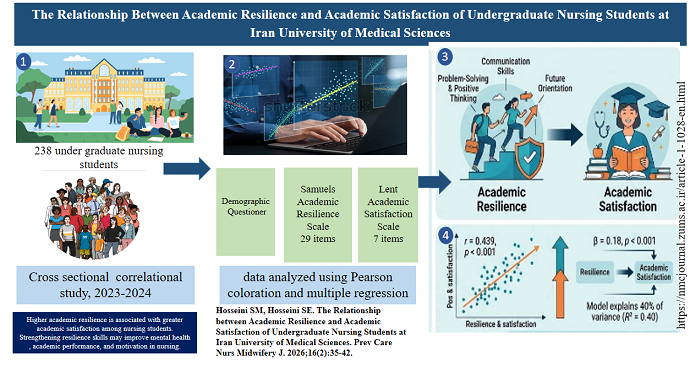
This study was a correlational study conducted among 238 undergraduate nursing students at the School of Nursing and Midwifery, Iran University of Medical Sciences (out of a total of 574 students), from March 1, 2023, to June 30, 2024.
Participants and Sampling
Participants were selected through convenience sampling from undergraduate nursing students in semesters 2-8.
Students who did not use psychotropic drugs, based on self-declaration in the demographic questionnaire, were included in the study. Students who were guests from other universities were excluded from the study.
To calculate the sample size, the formula for estimating a correlation coefficient was used. With a type I error of 0.05, a type II error of 0.20 (power = 80%), and an expected correlation coefficient of 0.20, the minimum required sample size was calculated to be 193 participants.
To improve the study's accuracy and account for possible incomplete questionnaires or non‑participation, the final sample size was increased to 238 participants.
Measurement Instruments (Validity & Reliability)
To collect data, a demographic information form and two instruments, the Samuels Resilience Questionnaire [14] and the Lent Academic Satisfaction Questionnaire [15], were used.
The demographic form included items on age, gender, marital status, number of children, dormitory residence, academic semester, previous semester GPA, employment status, blood type, history of smoking and alcohol use, possession of a university degree other than nursing, and birth order in the family.
The Academic Resilience Scale was originally developed by Samuels in 2004. The original version consisted of 40 items and demonstrated acceptable reliability, with a reported Cronbach's alpha of approximately 0.89 [14].
The psychometric properties of the Persian version were evaluated by Soltaninejad et al. in 2014. Based on exploratory factor analysis using principal component analysis with Varimax rotation, 11 items were removed due to factor loadings below 0.30 or significant cross‑loadings across multiple factors. The final Persian version consisted of 29 items with a three‑factor structure: communication skills, future orientation, and problem‑oriented/positive thinking. The construct validity of the Persian version was reported as satisfactory. The internal consistency of the scale in the validation study was acceptable, with Cronbach's alpha coefficients ranging from 0.63 to 0.77 in student samples and from 0.62 to 0.76 in university samples [16].
Items are rated on a five‑point Likert scale ranging from 1 (completely disagree) to 5 (completely agree). Items 4, 5, 7, 10, 14, 15, 23, 27, 28, and 29 are reversed. Total scores range from 29 to 145, with higher scores indicating greater academic resilience.
The communication skills dimension includes items 5, 7, 10, 11, 13, 14, 15, 23, 25, 26, 27, 28, and 29. The future orientation dimension comprises items 4, 6, 8, 16, 17, 18, 19, 20, and 24. The problem‑oriented and positive outlook dimension includes items 1, 2, 3, 9, 21, and 22.
The Academic Satisfaction Scale was developed by Lent et al. in 2005 to assess students' overall satisfaction with their academic experiences. The instrument consists of 7 items rated on a five‑point Likert scale ranging from 1 (strongly disagree) to 5 (strongly agree). Total scores range from 7 to 35, with higher scores indicating greater academic satisfaction [15].
The original version demonstrated good internal consistency, with Cronbach's alpha coefficients ranging from 0.86 to 0.87. Evidence of construct validity was supported through significant correlations with academic resilience, life satisfaction, and other cognitive–social variables [15-17].
The psychometric properties of the Persian version were examined by Hashemi et al. in 2015. Reliability was assessed using Cronbach's alpha (0.82) and the Spearman–Brown coefficient (0.77), indicating acceptable internal consistency [18].
Before data collection, the content validity of the questionnaires was assessed by a panel of five faculty members from the School of Nursing, Iran University of Medical Sciences. They reviewed the instruments for clarity, relevance, and appropriateness. To assess reliability, the questionnaires were administered to 20 nursing students from different academic semesters. Cronbach's alpha coefficients were then calculated, and these participants were excluded from the main study sample. In the present study, Cronbach's alpha coefficients were 0.83 for the Academic Resilience Scale and 0.79 for the Academic Satisfaction Scale, indicating acceptable internal consistency.
Data Collection Procedure
The researcher, by attending the students' classroom, explained the study objectives to them, and the students who were willing to participate in the study then completed paper questionnaires. Because seventh- and eighth-semester students were often in hospitals, the link to the questionnaires was sent to the group representative via email, who had access to all the students in the group. The average time to complete the questionnaires was estimated to be 10 minutes.
Statistical Analysis
Data were analyzed using SPSS version 16 statistical software in two sections: descriptive statistics (frequency, percentage, mean, and standard deviation) and inferential statistics. Pearson's correlation coefficient was used to examine the relationship between the two main variables, and the Kolmogorov–Smirnov test was used to assess the normality of the data distribution. Academic satisfaction was the dependent variable, and academic resilience was the main predictor. Multiple linear regression analysis was performed to examine the relationship between academic satisfaction and academic resilience while adjusting for potential confounding variables. Potential confounding variables, including age, gender, marital status, academic semester, previous semester GPA, birth order, blood type, smoking status, and alcohol consumption, were selected based on previous studies and expert opinion and were entered into the regression model. All variables were entered into the model simultaneously using the enter method, and no backward or forward selection procedures were applied. A significance level of less than 0.05 was considered statistically significant.
Result
In this study, 238 nursing students from different academic semesters at the School of Nursing and Midwifery of Iran University of Medical Sciences participated, of whom 52.1% were female. The mean (SD) age of the students was 22.83 (3.61) years, ranging from 18 to 36. Most of the participants in this study were single (98.7%). The cognitive and educational demographic characteristics of the participants are shown in Table 1. The mean (SD) of academic resilience and satisfaction with education for these students were 99.46 (12.62) (minimum 71 and maximum 125) and 21.11 (6.64) (minimum 7 and maximum 35), respectively.
The Pearson correlation coefficient test showed a positive, significant relationship between academic resilience and satisfaction with education (p < 0.001, r = 0.439) [Table 2].
Table 1. Demographic Characteristics of Nursing Students (N = 238)
Note. Data are presented as n (%) or M (SD) [Min, Max]
Table 2. Correlation between Academic Satisfaction and Academic Resilience and Its Dimensions in Nursing Students
Note. r = Pearson correlation coefficient.
Multiple linear regression analysis was conducted to examine the relationship between academic resilience and academic satisfaction while controlling for potential confounding variables. The regression model was statistically significant and explained 40% of the variance in academic satisfaction (R² = 0.40), indicating a substantial proportion of explained variance. Academic resilience was a significant positive predictor of academic satisfaction (B = 0.18, p < 0.001). In contrast, alcohol consumption, being married, and higher academic semester were significantly associated with lower academic satisfaction. No statistically significant associations were observed between academic satisfaction and age, gender, previous semester's GPA, birth order, blood type, or smoking status [Table 3].
In today's world, academic challenges and the stress they cause have become major concerns in higher education [1]. Entering university represents a significant transition in an individual's life. It exposes students to various stressors, such as being away from family, living in dormitories, and managing academic assignments, which may lead to academic burnout [2]. Nursing students experience additional stress during clinical training in hospital settings, which are among the most stressful work environments. This heightened stress can affect both their personal lives and professional development [3].
Academic resilience is recognized as a key characteristic that enables students to cope effectively with academic challenges and may significantly influence their academic satisfaction [4]. It refers to students' ability to achieve academic success despite challenging circumstances. This concept encompasses a range of skills and personal attributes that help individuals adapt to academic pressures and continue progressing toward their goals [5]. Academic resilience has been identified as a predictor of academic success; students with higher resilience generally perform better under academic pressure and demonstrate greater confidence in difficult situations [6]. Recent research also indicates that resilience can reduce academic burnout and enhance academic satisfaction [7].
Academic satisfaction is an emotional state reflecting the extent to which students enjoy and are content with their academic role and experiences in nursing education. It is associated with motivation, personality traits, academic achievement, professional accomplishments, and the overall quality of educational institutions [8]. Since students will form the future workforce, their satisfaction with their field of study plays an important role in motivation and long-term success [9].
Students with higher academic satisfaction tend to perform better academically. Grade point average (GPA), as an indicator of academic progress, is often higher among students who are more satisfied with their educational experience [10].
Previous studies suggest that both academic resilience and academic satisfaction contribute to academic success and progress among nursing students, and that individual and environmental factors influence both variables [11]. Moreover, academic satisfaction enhances motivation, interest in learning, and enjoyment of education, leading to personal and academic development and contributing to improvements within educational institutions [10]. A positive and significant relationship between resilience and both job and academic satisfaction has been reported, and identifying factors related to these variables may help in developing strategies to strengthen them [12].
In a study conducted in Iran among undergraduate nursing students from three major medical universities in Tehran, academic resilience was reported to be at a moderate to high level. The findings indicated that factors such as gender, health status, living situation, satisfaction with the field of study, availability of support resources, nutritional status, and non‑smoking behavior were significant predictors of resilience and collectively explained variations in it [13]. Given the essential role of nurses in health promotion, patient education, and disease prevention, their psychological readiness and professional competence are particularly important. Nursing students, as future nurses, need sufficient resilience to manage academic and clinical stress effectively, maintain optimal clinical performance, and provide safe and prevention-oriented care. Therefore, understanding the relationship between academic resilience and academic satisfaction is important not only from an educational perspective but also for strengthening the quality of preventive care within the healthcare system.
Although research on resilience and satisfaction exists separately, there is limited evidence examining the relationship between academic resilience and satisfaction among undergraduate nursing students, particularly within the local/regional context. Furthermore, the specific educational and clinical conditions of nursing students may influence this relationship differently than those of other student populations [12].
This highlights the need for further investigation in this group.
Therefore, considering the existing research gap and the limited local evidence, it is necessary to examine the relationship between academic resilience and academic satisfaction among nursing students. A clearer understanding of this relationship may provide valuable insights into factors influencing their educational experiences.
Objectives
This study was conducted to determine "the relationship between academic resilience and academic satisfaction among undergraduate nursing students".
Methods
Study Design
This study was a correlational study conducted among 238 undergraduate nursing students at the School of Nursing and Midwifery, Iran University of Medical Sciences (out of a total of 574 students), from March 1, 2023, to June 30, 2024.
Participants and Sampling
Participants were selected through convenience sampling from undergraduate nursing students in semesters 2-8.
Students who did not use psychotropic drugs, based on self-declaration in the demographic questionnaire, were included in the study. Students who were guests from other universities were excluded from the study.
To calculate the sample size, the formula for estimating a correlation coefficient was used. With a type I error of 0.05, a type II error of 0.20 (power = 80%), and an expected correlation coefficient of 0.20, the minimum required sample size was calculated to be 193 participants.
To improve the study's accuracy and account for possible incomplete questionnaires or non‑participation, the final sample size was increased to 238 participants.
Measurement Instruments (Validity & Reliability)
To collect data, a demographic information form and two instruments, the Samuels Resilience Questionnaire [14] and the Lent Academic Satisfaction Questionnaire [15], were used.
The demographic form included items on age, gender, marital status, number of children, dormitory residence, academic semester, previous semester GPA, employment status, blood type, history of smoking and alcohol use, possession of a university degree other than nursing, and birth order in the family.
The Academic Resilience Scale was originally developed by Samuels in 2004. The original version consisted of 40 items and demonstrated acceptable reliability, with a reported Cronbach's alpha of approximately 0.89 [14].
The psychometric properties of the Persian version were evaluated by Soltaninejad et al. in 2014. Based on exploratory factor analysis using principal component analysis with Varimax rotation, 11 items were removed due to factor loadings below 0.30 or significant cross‑loadings across multiple factors. The final Persian version consisted of 29 items with a three‑factor structure: communication skills, future orientation, and problem‑oriented/positive thinking. The construct validity of the Persian version was reported as satisfactory. The internal consistency of the scale in the validation study was acceptable, with Cronbach's alpha coefficients ranging from 0.63 to 0.77 in student samples and from 0.62 to 0.76 in university samples [16].
Items are rated on a five‑point Likert scale ranging from 1 (completely disagree) to 5 (completely agree). Items 4, 5, 7, 10, 14, 15, 23, 27, 28, and 29 are reversed. Total scores range from 29 to 145, with higher scores indicating greater academic resilience.
The communication skills dimension includes items 5, 7, 10, 11, 13, 14, 15, 23, 25, 26, 27, 28, and 29. The future orientation dimension comprises items 4, 6, 8, 16, 17, 18, 19, 20, and 24. The problem‑oriented and positive outlook dimension includes items 1, 2, 3, 9, 21, and 22.
The Academic Satisfaction Scale was developed by Lent et al. in 2005 to assess students' overall satisfaction with their academic experiences. The instrument consists of 7 items rated on a five‑point Likert scale ranging from 1 (strongly disagree) to 5 (strongly agree). Total scores range from 7 to 35, with higher scores indicating greater academic satisfaction [15].
The original version demonstrated good internal consistency, with Cronbach's alpha coefficients ranging from 0.86 to 0.87. Evidence of construct validity was supported through significant correlations with academic resilience, life satisfaction, and other cognitive–social variables [15-17].
The psychometric properties of the Persian version were examined by Hashemi et al. in 2015. Reliability was assessed using Cronbach's alpha (0.82) and the Spearman–Brown coefficient (0.77), indicating acceptable internal consistency [18].
Before data collection, the content validity of the questionnaires was assessed by a panel of five faculty members from the School of Nursing, Iran University of Medical Sciences. They reviewed the instruments for clarity, relevance, and appropriateness. To assess reliability, the questionnaires were administered to 20 nursing students from different academic semesters. Cronbach's alpha coefficients were then calculated, and these participants were excluded from the main study sample. In the present study, Cronbach's alpha coefficients were 0.83 for the Academic Resilience Scale and 0.79 for the Academic Satisfaction Scale, indicating acceptable internal consistency.
Data Collection Procedure
The researcher, by attending the students' classroom, explained the study objectives to them, and the students who were willing to participate in the study then completed paper questionnaires. Because seventh- and eighth-semester students were often in hospitals, the link to the questionnaires was sent to the group representative via email, who had access to all the students in the group. The average time to complete the questionnaires was estimated to be 10 minutes.
Statistical Analysis
Data were analyzed using SPSS version 16 statistical software in two sections: descriptive statistics (frequency, percentage, mean, and standard deviation) and inferential statistics. Pearson's correlation coefficient was used to examine the relationship between the two main variables, and the Kolmogorov–Smirnov test was used to assess the normality of the data distribution. Academic satisfaction was the dependent variable, and academic resilience was the main predictor. Multiple linear regression analysis was performed to examine the relationship between academic satisfaction and academic resilience while adjusting for potential confounding variables. Potential confounding variables, including age, gender, marital status, academic semester, previous semester GPA, birth order, blood type, smoking status, and alcohol consumption, were selected based on previous studies and expert opinion and were entered into the regression model. All variables were entered into the model simultaneously using the enter method, and no backward or forward selection procedures were applied. A significance level of less than 0.05 was considered statistically significant.
Result
In this study, 238 nursing students from different academic semesters at the School of Nursing and Midwifery of Iran University of Medical Sciences participated, of whom 52.1% were female. The mean (SD) age of the students was 22.83 (3.61) years, ranging from 18 to 36. Most of the participants in this study were single (98.7%). The cognitive and educational demographic characteristics of the participants are shown in Table 1. The mean (SD) of academic resilience and satisfaction with education for these students were 99.46 (12.62) (minimum 71 and maximum 125) and 21.11 (6.64) (minimum 7 and maximum 35), respectively.
The Pearson correlation coefficient test showed a positive, significant relationship between academic resilience and satisfaction with education (p < 0.001, r = 0.439) [Table 2].
Table 1. Demographic Characteristics of Nursing Students (N = 238)
| Variable | Category | n (%) |
| Gender | Male | 114 (47.9) |
| Female | 124 (52.1) | |
| Dormitory | Yes | 119 (50.0) |
| No | 119 (50.0) | |
| Marital status | Single | 235 (98.7) |
| Married | 3 (1.3) | |
| Semester | 2 | 37 (15.5) |
| 3 | 31 (13.1) | |
| 4 | 16 (4.6) | |
| 5 | 18 (5.0) | |
| 6 | 63 (26.5) | |
| 7 | 28 (11.8) | |
| 8 | 45 (18.9) | |
| Birth rank | First | 107 (45.0) |
| Second | 68 (28.6) | |
| Third | 42 (17.6) | |
| Fourth | 17 (7.1) | |
| Seventh | 4 (1.7) | |
| Blood group | O | 42 (17.6) |
| A | 73 (30.7) | |
| B | 90 (37.8) | |
| AB | 33 (13.9) | |
| Rh factor | Positive | 203 (85.3) |
| Negative | 35 (14.7) | |
| Smoking | Yes | 22 (9.2) |
| No | 216 (90.8) | |
| Alcohol use | Yes | 11 (4.6) |
| No | 227 (95.4) | |
| Age (years) | — | 22.83 (3.61) [18, 36] |
| Previous semester GPA | — | 17.55 (1.60) [12.8, 20.0] |
Table 2. Correlation between Academic Satisfaction and Academic Resilience and Its Dimensions in Nursing Students
| Variables | r | p | |
| Academic satisfaction – Academic resilience | 0.439 | < 0.001 | |
| Academic satisfaction – Communication skills | 0.393 | < 0.001 | |
| Academic satisfaction – Future orientation | 0.322 | < 0.001 | |
| Academic satisfaction – Problem-oriented & positive outlook | 0.356 | < 0.001 | |
Multiple linear regression analysis was conducted to examine the relationship between academic resilience and academic satisfaction while controlling for potential confounding variables. The regression model was statistically significant and explained 40% of the variance in academic satisfaction (R² = 0.40), indicating a substantial proportion of explained variance. Academic resilience was a significant positive predictor of academic satisfaction (B = 0.18, p < 0.001). In contrast, alcohol consumption, being married, and higher academic semester were significantly associated with lower academic satisfaction. No statistically significant associations were observed between academic satisfaction and age, gender, previous semester's GPA, birth order, blood type, or smoking status [Table 3].
Table 3. Multiple Regression Analysis of Factors Influencing Academic Satisfaction
Note. B = unstandardized regression coefficient; SE = standard error; CI = confidence interval. Reference categories: Female (gender), Single (marital status), O (blood type), No (smoking), No (alcohol consumption), outcome variable: academic satisfaction.
| Variable | B | SE | t | p | 95% CI Lower | 95% CI Upper |
| Intercept | -1.42 | 6.11 | -0.23 | 0.816 | -13.47 | 10.62 |
| Age | 0.18 | 0.11 | 1.83 | 0.068 | -0.01 | 0.38 |
| Gender | ||||||
| Male (vs. Female) | 1.05 | 0.81 | 1.30 | 0.195 | -0.54 | 2.65 |
| Marital status | ||||||
| Married (vs. Single) | -11.66 | 3.20 | -3.64 | < 0.001 | -17.98 | -5.34 |
| Academic semester | -0.69 | 0.16 | -4.24 | < 0.001 | -1.01 | -0.37 |
| Previous semester GPA | 0.27 | 0.22 | 1.22 | 0.223 | -0.16 | 0.71 |
| Birth rank | -0.30 | 0.32 | -0.96 | 0.339 | -0.94 | 0.32 |
| Blood type | ||||||
| AB (vs. O) | 1.36 | 1.36 | 1.00 | 0.316 | -1.31 | 4.04 |
| B (vs. O) | -1.26 | 1.02 | -1.24 | 0.217 | -3.28 | 0.75 |
| A (vs. O) | -0.22 | 1.16 | -0.19 | 0.846 | -2.51 | 2.06 |
| Smoking | ||||||
| Yes (vs. No) | 1.14 | 1.82 | 0.63 | 0.529 | -2.44 | 4.73 |
| Alcohol consumption | ||||||
| Yes (vs. No) | -11.25 | 2.46 | -4.75 | < 0.001 | -16.10 | -6.40 |
| Academic resilience | 0.18 | 0.03 | 5.15 | < 0.001 | 0.11 | 0.25 |
Discussion
In the present study, the status of two main variables, including academic resilience and academic satisfaction, was investigated among nursing students. The results of the present study show that there is a direct and significant relationship between academic resilience and academic satisfaction, and that students with higher academic resilience have better satisfaction with education and academic progress. In a study of 780 students in Spain, distinct roles of coping strategies in resilience were identified, as well as the relationship between resilience and academic satisfaction [19]. The characteristics of academic resilience among Chinese nursing students include self-efficacy, self-regulation, and recovery. They are formed by the interaction between internal and external factors when facing obstacles or challenges in their academic activities. This interaction ultimately leads to the development of academic resilience among nursing students, which results in positive outcomes such as adjustment, career maturity, increased likelihood of academic success, a sense of belonging to the university, and lower levels of psychological distress. Nursing students with high levels of academic resilience can view academic obstacles positively, enhance problem-solving skills, and effectively overcome academic difficulties, thereby completing their education [20]. There is a moderate level of happiness among nursing students in Vietnam in the post-pandemic COVID-19 era, and resilience is one of the key determinants of this [21].
In the present study, the dimensions of academic resilience were measured, and a weak-to-moderate, significant relationship was observed between these dimensions and academic satisfaction. Studies conducted on these two variables either did not report the dimensions of resilience or did not observe a significant relationship between these dimensions and academic satisfaction [19, 22]. Considering that communication skills, future orientation, problem orientation, and a positive outlook, which are dimensions of resilience, involve many issues, including social, psychological, and cultural ones, they warrant further investigation.
In Iran, female gender and low resilience were found to predict mental health disorders among nursing students; therefore, those with higher resilience tend to enjoy better mental health [20]. Another study from Iran emphasized the growing recognition of academic resilience in nursing students, suggesting that implementing effective educational strategies and providing adequate support can enhance both their resilience and academic performance [21].
In the present study, alcohol consumption was significantly inversely associated with academic satisfaction. Studies have shown that students who reported alcohol consumption had lower life satisfaction and more mental health complaints than those who consumed less alcohol. They also experienced more emotional and social loneliness [23]. One of the immediate effects of alcohol is decreased academic performance because it reduces concentration. Studies have also shown that alcohol consumption is associated with lower grade point averages, in a dose-dependent manner [24].
In the present study, marriage was associated with decreased academic satisfaction. Married students face very significant challenges in higher education. Among these challenges are academic, social, time management, financial, and health challenges in married students [25]. A study found that academic problems among married students often include laziness and poor time management [26]. In the present study, students in higher semesters had lower academic satisfaction, which is related to many factors. Personality variables, cognitive variables and variables related to academic achievement (intelligence, academic achievement), as well as various motivational structures (satisfaction with the content of the study, satisfaction with the conditions of the academic program, satisfaction with the ability to cope with academic stress, satisfaction with the future of the career) play a role in academic satisfaction in students in higher semester [27]. More in-depth studies should be conducted to determine which factors contribute to academic dissatisfaction among students in higher semesters.
Academic resilience plays an important role in nursing students' academic satisfaction. Given the stressful nature of academic and clinical environments, teaching and strengthening resilience skills can enhance students' mental health, academic performance, and overall satisfaction. It is recommended that educational programs include resilience training and that future intervention studies further explore this area. The most important limitation of this study is its cross-sectional design, which can only determine relationships between variables and cannot establish a cause-and-effect relationship. Also, limitations in educational level and place of study are worth noting. Given that satisfaction with education is affected by various factors, including the educational environment, the number of students, and educational facilities, the generalizability of this study's results to other statistical populations and educational environments is limited. Therefore, it is suggested that similar studies be conducted at other universities and in other cities to identify patterns that can be applied to the results for further examination and generalization. Concurrent use of an online and an in-person questionnaire may introduce response bias. Still, due to limited access to senior students at the university, we were forced to use an online questionnaire.
Conclusion
Resilience is essential for academic success, so it's important to incorporate targeted programs, such as stress management workshops, mindfulness exercises, and problem-solving training, into nursing education. By helping students build their resilience, these programs can increase their satisfaction with their learning experience and encourage talented nursing students to stay motivated and committed to providing high-quality, preventive nursing care throughout their studies and future careers.
Ethical Considerations
This study was approved by the Ethics Committee at Iran University of Medical Sciences with the ethics code IR.IUMS.REC.1403.1154.
Acknowledgements
The nursing students at Iran University of Medical Sciences who completed the questionnaires for this project are hereby acknowledged. This study was derived from a research project approved by Iran University of Medical Sciences (Research Code: 26116).
Conflict of Interest
According to the authors, this article has no conflict of interest. No artificial intelligence was used in writing this article.
Funding
No funding.
Authors' Contributions
Conceptualization: S.E. Hosseini
Methodology: S.E. Hosseini
Investigation (Data Collection): S.E. Hosseini
Formal Analysis (Data Analysis & Interpretation): S.E. Hosseini, S. Lotfi
Writing – Original Draft: S.E. Hosseini
Writing – Review & Editing: S.E. Hosseini
Supervision: S.E. Hosseini
All authors read and approved the final manuscript.
Artificial Intelligence Utilization
Artificial intelligence was not used to write the article.
Data Availability Statement
The data are available from the corresponding author.
Type of Study: Orginal research |
Subject:
Nursing
References
1. Javaid ZK, Chen Z, Ramzan M. Assessing stress causing factors and language related challenges among first year students in higher institutions in Pakistan. Acta Psychologica. 2024;248(1):1-9. [https://doi.org/10.1016/j.actpsy.2024.104356] [PMID]
2. Islam MS, Rabbi MF. Exploring the sources of academic stress and adopted coping mechanisms among university students. International Journal on Studies in Education (IJonSE). 2024;6(2):255-271. [https://doi.org/10.46328/ijonse.203]
3. Amsrud KE, Lyberg A, Severinsson E. Development of resilience in nursing students: A systematic qualitative review and thematic synthesis. Nurse Education in Practice. 2019;41(10):1-13. [https://doi.org/10.1016/j.nepr.2019.102621] [PMID]
4. Ye W, Strietholt R, Blömeke S. Academic resilience: underlying norms and validity of definitions. Educational Assessment, Evaluation and Accountability. 2021;33(1):169-202. [https://doi.org/10.1007/s11092-020-09351-7]
5. Cai Z, Meng Q. Academic resilience and academic performance of university students: the mediating role of teacher support. Frontiers in Psychology. 2025;16(1):1-11. [https://doi.org/10.3389/fpsyg.2025.1463643] [PMID]
6. Hafeez FA, Mohsin MN. Effect of resilience on academic achievement of university students. Journal of Social Sciences Research & Policy. 2024;2(3):127-134. [http://jssrp.org.pk]
7. Tran TX, Vo TTT, Ho C. From academic resilience to academic burnout among international university students during the post-COVID-19 new normal: An empirical study in Taiwan. Behavioral Sciences. 2023;13(3):1-13. [https://doi.org/10.3390/bs13030206.10.3390/bs13030206] [PMID]
8. Bagdžiūnienė D, Žukauskaitė I, Bulotaitė L, Sargautytė R. Study and personal resources of university students' academic resilience and the relationship with positive psychological outcomes. Frontiers in Psychology. 2025;16(5):1-16. [https://doi.org/10.3389/fpsyg.2025.1517359] [PMID]
9. Talebi Z, Sanagoo A, Saeedi E, Mancheri H, Saeedi S, Mehr-Avar F, et al. Study of nursing and midwifery students' satisfaction with their field of study. Nursing Development in Health Journal. 2022;13(2):17-24. [https://ndhj.lums.ac.ir/browse.php?a_id=346&sid=1&slc_lang=en]
10. Rossini S, Mazzotta R, Kangasniemi M, Badolamenti S, Macale L, Sili A, et al. Measuring academic satisfaction in nursing students: a systematic review of the instruments. International Journal of Nursing Education Scholarship. 2022;19(1):1-17. [https://doi.org/10.1515/ijnes-2021-0159] [PMID]
11. Medina-Ramirez SA, Rojas-Humpire R, Canaza JF, Hernandez F, Huancahuire-Vega S. Online academic satisfaction during the COVID-19 pandemic in medical students: role of sleep, psychological issues, college adjustment, and digital skills. F1000Research. 2022;11(3):1-16.
3 [https://doi.org/10.12688/f1000research.76127] [PMID]
12. Ozdemir C, Kaplan A. Factors affecting psychological resilience, self‐efficacy and job satisfaction of nurse academics: A cross‐sectional study. International Nursing Review. 2025;72(1):1-9. [https://doi.org/10.1111/inr.13007] [PMID]
13. Bushehri MS, Dinmohammadi M, Farahani-Hosseinabadi M, Saatchi M. Factors associated with academic resilience in nursing students: the role of individual, academic, and social factors. BMC Medical Education. 2026;26(1):1-7. [https://doi.org/10.1186/s12909-026-08875-8] [PMID]
14. Samuels WE: Development of a non-intellective measure of academic success: towards the quantification of resilience. The University of Texas at Arlingtonat ProQuest Dissertations & Theses; 2004:1-217. [https://wesamuels.net/pdfs/Dissertation_Mechanical_for_William_Ellery_Samuels.pdf]
15. Lent RW, Singley D, Sheu H-B, Gainor KA, Brenner BR, Treistman D, Ades L. Social cognitive predictors of domain and life satisfaction: Exploring the theoretical precursors of subjective well-being. Journal of Counseling Psychology. 2005;52(3):429-442. [https://doi.org/10.1037/0022-0167.52.3.429]
16. Soltaninejad M, Asiabi M, Ahmdi B, Tavanaiee Yosefian S. A study of the psychometric properties of the academic resilience inventory (ARI). Quarterly of Educational Measurement. 2014;5(15):17-35. [https://jem.atu.ac.ir/article_267.html]
17. Ojeda L, Flores LY, Navarro RL. Social cognitive predictors of mexican american college students' academic and life satisfaction. Journal of Counseling Psychology. 2011;58(1):1-94. [https://doi.org/10.1037/a0021687] [PMID]
18. Hashemi T, Vahedi S, Mohebbi M. The structural relationship of school and parental bonding with academic satisfaction and academic control: the mediating role of academic self-efficacy. Journal of Cognitive Strategies in Learning. 2016;3(5):1-20. [https://asj.basu.ac.ir/article_1357.html?]
19. Meneghel I, Martínez IM, Salanova M, De Witte H. Promoting academic satisfaction and performance: building academic resilience through coping strategies. Psychology in the Schools. 2019;56(6):875-890. [https://doi.org/10.1002/pits.22253]
20. Shen Y, Feng H, Li X. Academic resilience in nursing students: A concept analysis. BMC Nursing. 2024;23(1):1-10. [https://doi.org/10.1186/s12912-024-02133-2] [PMID]
21. Nga NNQ, Mai DTT, Thuy PT, Linh TTT. Impact of resilience, social support, and perceived health status on happiness among nursing students: a cross-sectional study. Nursing Practice Today. 2025;12(3):295-303. [https://doi.org/10.18502/npt.v12i3.18978]
22. Romano L, Consiglio P, Angelini G, Fiorilli C. Between academic resilience and burnout: The moderating role of satisfaction on school context relationships. European Journal of Investigation in Health, Psychology and Education. 2021;11(3):770-780. [https://doi.org/10.3390/ejihpe11030055] [PMID]
23. Sæther SMM, Knapstad M, Askeland KG, Skogen JC. Alcohol consumption, life satisfaction and mental health among Norwegian college and university students. Addictive Behaviors Reports. 2019;10:1-9. [https://doi.org/10.1016/j.abrep.2019.100216] [PMID]
24. Morjigcs S. High school alcohol intake impairs academic success in a dose-dependent manner. Medical Bag. 2023:1-10. [https://doi.org/10.1016/j.jadohealth.2023.07.008] [PMID]
25. Tahira SS, Khan EA, Arif MI. Problems and challenges faced by married students to continue their study at university level. Annals of Human and Social Sciences. 2023;4(4):405-411. [https://doi.org/10.35484/ahss.2023(4-IV)39]
26. Amni S, Suwarjo S. Undergtaduate students'mariage. Jurnal Bimbingan Dan Konseling Islam. 2020;10(2):218-226. [https://doi.org/10.29080/jbki.2020.10.2.218-226]
27. Wach F-S, Karbach J, Ruffing S, Brünken R, Spinath FM. University students' satisfaction with their academic studies: personality and motivation matter. Frontiers in Psychology. 2016;7:1-12. [https://doi.org/10.3389/fpsyg.2016.00055] [PMID]
Send email to the article author
| Rights and permissions | |
 |
This work is licensed under a Creative Commons Attribution-NonCommercial 4.0 International License. |