
Preventive Care in Nursing and Midwifery

Volume 16, Issue 2 (4-2026)
Prev Care Nurs Midwifery 2026, 16(2): 49-59 |
Back to browse issues page


Ethics code: IR.ZUMS.REC.1401.269


Download citation:
BibTeX | RIS | EndNote | Medlars | ProCite | Reference Manager | RefWorks
Send citation to:


BibTeX | RIS | EndNote | Medlars | ProCite | Reference Manager | RefWorks
Send citation to:
Aligholipour M, Hossein Khani M, Shiri Gheidari P, Khezerlou Z, Hanifi N. Spiritual Well-Being, Hope, and Positive Mental Health among Critical Care and Emergency Nurses: A Cross-Sectional Study. Prev Care Nurs Midwifery 2026; 16 (2) :49-59
URL: http://nmcjournal.zums.ac.ir/article-1-1033-en.html
URL: http://nmcjournal.zums.ac.ir/article-1-1033-en.html
Mahtab Aligholipour  , Mohammad Hossein Khani , Parvin Shiri Gheidari , Zahra Khezerlou , Nasrin Hanifi *
, Mohammad Hossein Khani , Parvin Shiri Gheidari , Zahra Khezerlou , Nasrin Hanifi *
Social Determinants of Health Research Center, Health and Metabolic Diseases Research Institute, Zanjan University of Medical Sciences, Zanjan, Iran , nasrinhanifi@gmail.com
Keywords: Spiritual well-being, Hope, Positive mental health, Nurses, Critical care, Emergency departments.
Full-Text [PDF 838 kb]
(266 Downloads)
| Abstract (HTML) (633 Views)
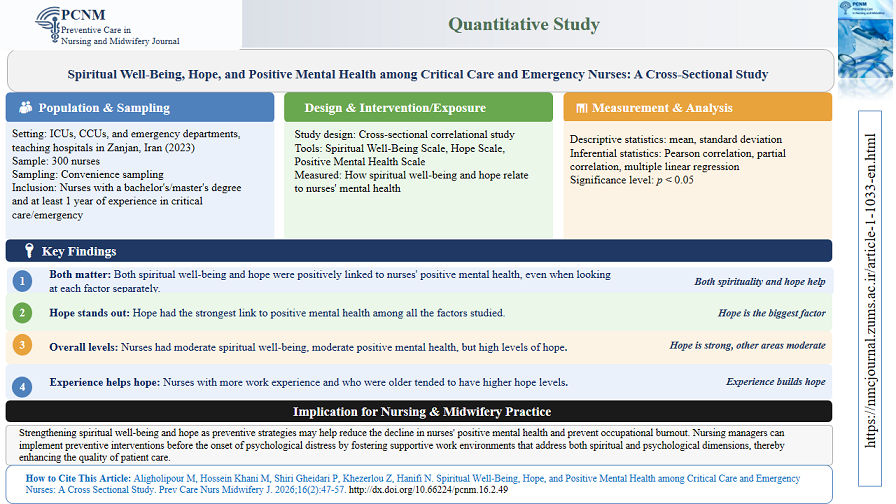
Graphical Abstract:
Reseach Highlights:
Knowledge Translation Statement
Audience: Nursing managers and hospital administrators
Spiritual well-being and hope were associated with positive mental health among critical care nurses. Managers may consider hope-enhancement and spiritually sensitive programs as part of burnout-prevention efforts.
Full-Text: (130 Views)
Introduction
Human beings are multidimensional, encompassing biological, psychological, social, and spiritual aspects, and the interdependence of these dimensions requires that health and well-being be approached holistically [1]. Within this framework, mental health, as one of the fundamental pillars of overall health, is influenced by complex interactions among individual, occupational, and spiritual factors. Nurses, as a vital component of the healthcare workforce, are considered a vulnerable group in terms of mental health due to continuous exposure to patient suffering, pain, death, irregular shift work, and persistent occupational stressors [2, 3].
In particular, nurses working in Intensive Care Units (ICUs) and Coronary Care Units (CCUs), as well as emergency departments, are at greater risk of psychological distress due to the critical nature of their work environment, high levels of stress, and constant exposure to mortality and acute clinical conditions [2]. Evidence indicates that more than 90% of nurses experience occupational stressors, which may lead to emotional exhaustion, reduced performance, decreased job satisfaction, and psychological disorders [3].
In recent decades, the focus of mental health research has shifted from emphasizing risk factors toward identifying protective and strengthening factors. Within this framework, hope is introduced as a fundamental concept in positive psychology that plays a central role in human adaptation to adverse conditions [4]. Hope is a cognitive–motivational state that directs individuals toward goal setting, developing pathways to achieve those goals, and maintaining motivation for their attainment [5]. Evidence indicates that individuals with higher levels of hope demonstrate greater resilience in the face of stress and experience more favorable mental health outcomes [6].
In recent years, spirituality and spiritual well-being have also received increasing attention as important dimensions of human health [7]. Spiritual well-being is a multidimensional construct comprising two core components: religious well-being, which reflects an individual's relationship with God or a higher power; and existential well-being, which refers to the sense of meaning, purpose, and an inner connection with oneself, others, and the universe [8]. Diminished spiritual well-being has been associated with feelings of emptiness, depression, and anxiety [9]. In contrast, a positive relationship with the spiritual dimension is associated with enhanced resilience, life satisfaction, and reduced negative stress consequences [10, 11].
Spiritual well-being, as an indicator of the integration of spiritual experience into daily life, reflects an individual's positive interaction with the self, others, and existence as a whole [12]. Individuals with higher levels of spiritual well-being tend to demonstrate greater psychological stability, and various studies have confirmed a positive and significant correlation between spiritual well-being and variables such as hope and positive mental health [13, 14].
In the nursing profession, which is inherently stressful and influenced by the critical conditions of the healthcare environment [15], internal resources such as hope and spiritual well-being may play a protective and buffering role. Nurses experiencing low levels of positive mental health may lack the necessary capacity to provide effective and safe patient care, and this issue can significantly compromise the quality of healthcare services and patient satisfaction [16, 17].
International studies have also documented the importance of this association. Coppola et al. and González-Sanguino et al. demonstrated that spiritual well-being, particularly in crises, is one of the most important protective factors against depression, anxiety, and the deterioration of positive mental health [18, 19].
In Iran, similar findings have been reported in internal studies. Kord et al. demonstrated that spiritual well-being serves as a significant predictor of hope and optimism among women attending healthcare centers [13]. Similarly, Samadi Fard et al. reported that religious beliefs and spiritual well-being are positively associated with hope in patients with diabetes [20].
Although numerous studies have examined spiritual well-being, hope, and positive mental health separately, their findings suggest that these constructs are associated with psychological well-being and adaptive functioning. To the best of our knowledge, no study in Iran has simultaneously investigated the relationship between spiritual well-being, hope, and positive mental health among nurses working in critical care and emergency departments. Identifying these protective factors may provide a foundation for developing preventive interventions that promote nurses' mental health and improve the quality of patient care.
Objectives
This study aimed to investigate the relationship between spiritual well-being, hope, and positive mental health among nurses working in CCUs, surgical intensive care units (SICUs), medical intensive care units (MICUs), and emergency departments (EDs) of teaching hospitals in Zanjan, Iran.
Methods
Study Design
This study was a correlational cross-sectional design conducted in 2023.
Participants and Sampling
The target population consisted of all nurses working in CCUs, SICUs, MICUs, and EDs of Ayatollah Mousavi and Vali-Asr (PBUH) teaching hospitals affiliated with Zanjan University of Medical Sciences. The total number of eligible nurses was estimated to be 356. Using a convenience sampling method and with the researcher's direct presence, invitations were distributed to all eligible nurses, and they were invited to participate voluntarily. Participation was entirely voluntary, and there was no obligation to take part.
Inclusion criteria were having at least a Bachelor's or Master's degree in Nursing and a minimum of one year of work experience in critical care or emergency departments.
Exclusion criteria included experiencing major stressful life events such as divorce or the death of a first-degree relative within the past six months, self-reported history of psychiatric disorders or use of specific psychotropic medications, incomplete completion of more than 50% of the questionnaire items or providing uniform responses (e.g., the same option) for more than 50% of items, and transfer to general wards during the course of the study.
The sample size was determined using G*Power software (version 3.1.9.7) and the "Linear multiple regression: Fixed model, R² deviation from zero" module, which is consistent with the main statistical analysis of the study (multiple linear regression). With a statistical power of 0.95, a significance level of 0.05, and a medium effect size based on the correlation coefficient reported in a previous similar study (r = 0.48; Samadi Fard et al., 2015) [20], the required sample size was estimated to be 288 participants. Considering a 10% attrition rate, the final sample size was increased to 320 participants.
Measurement Instruments (Validity & Reliability)
Data were collected using four instruments. First, a demographic information questionnaire was completed, including variables such as age, gender, marital status, level of education, total work experience, work experience in critical care or emergency departments, and history of psychiatric disorders and exposure to stressful life events. It should be noted that self-reported history of psychiatric disorders and medication use were included in the demographic questionnaire solely for screening purposes to apply the exclusion criteria, and these variables were not entered into any of the statistical analyses of the study.
The Spiritual Well-Being Scale (SWBS) developed by Paloutzian and Ellison was used to assess spiritual well-being. This instrument consists of 20 items across two subscales: Religious Well-Being (10 items) and Existential Well-Being (10 items). Items are scored on a six-point Likert scale (1 = strongly disagree to 6 = strongly agree), and negatively worded items are reverse scored. The score range for each subscale is 10 to 60, while the total score ranges from 20 to 120. Scores of 20–40 indicate low spiritual well-being, 41–99 moderate, and 100–120 high levels of spiritual well-being [21].
The validity of this instrument in Iran was confirmed by Fatemi et al. through expert review by 10 specialists [22], and its reliability was reported by Abbasi as acceptable, with a Cronbach's alpha coefficient of 0.82 [23].
The Snyder Hope Scale (SHS) consists of 12 items structured into two subscales: Agency thinking (4 items) and Pathways thinking (4 items), along with 4 filler items. Responses are rated on a five-point Likert scale (1 = strongly disagree to 5 = strongly agree), and items 3, 7, and 11 are reverse scored. The total score ranges from 12 to 60, with scores below 24 indicating low hope, 25–36 moderate hope, and above 36 high hope [24]. In the study by Kermani et al., the Cronbach's alpha coefficient was reported as 0.86 for the total scale, 0.77 for the Agency subscale, and 0.79 for the Pathways subscale [25].
The Positive Mental Health Scale (MHPK), developed by Mahmoudi et al., consists of 10 items rated on a six-point Likert scale (0 = I don't know, 1 = not true, 2 = somewhat true, 3 = moderately true, 4 = true, 5 = completely true). The total score is calculated as the mean of the 10 items, yielding a range from 0 to 5. Scores below 1.6 indicate low positive mental health, 1.7–3.3 indicate moderate levels, and scores above 3.4 represent high positive mental health. The scale demonstrated acceptable reliability, with a reported Cronbach's alpha of 0.81 and a Guttman coefficient of 0.79 [26].
Data Collection Procedure
The Research Council and the Ethics Committee first approved the study protocol. After obtaining an official introduction letter from the Deputy of Research at the university, sampling was initiated through on-site presence in the clinical wards. After explaining the study objectives to the participants and obtaining written informed consent, the questionnaires were distributed.
The researcher remained present in the clinical settings, considering nurses' work schedules, until the required sample size was reached and data collection was completed. A checklist was used to ensure the accuracy and completeness of the collected data. Incomplete or improperly completed questionnaires were excluded from the study.
Statistical Analysis
Data were analyzed using SPSS software version 22. The Kolmogorov–Smirnov test was applied to assess the normality of data distribution. Descriptive statistics, including mean, standard deviation, and frequency percentages, were used to describe participants' characteristics and study variables. To examine relationships between variables, the Pearson correlation coefficient was used, depending on the normality of the data distribution.
To evaluate the predictive role of spiritual well-being and hope in positive mental health, multiple linear regression analysis was performed using the backward method. This approach was selected to identify the most parsimonious set of significant predictors. Before conducting the regression analysis, its assumptions were tested: normality of residuals was assessed using P–P plots, homogeneity of variance was examined through scatter plots, and multicollinearity was evaluated using Tolerance values (> 0.1) and Variance Inflation Factor (VIF < 10), all of which were confirmed. An independent samples t-test was used to compare the mean scores of the main variables across gender, marital status, and type of ward (ICU versus emergency). A significance level of 0.05 was considered for all statistical analyses.
Results
Out of 320 distributed questionnaires, 300 were eligible for analysis (response rate: 93.75%). Twenty questionnaires were excluded based on predefined exclusion criteria. These included cases in which participants selected a single response option (e.g., neutral/disagree) for more than 50% of the items or failed to return the questionnaire. As a result, 20 participants were excluded from the study, and ultimately the data of 300 participants were included in the final analysis.
Demographic Characteristics of Participants
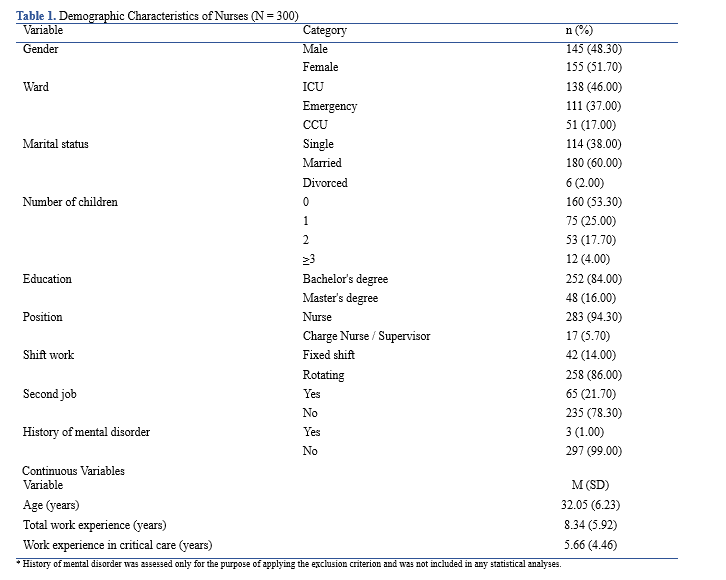
The demographic characteristics of the participants are presented in Table 1. The majority of participants were female (51.7%), employed in ICU settings (46%), and married (60%). More than half of the participants had no children (53.3%), and most nurses held a bachelor's degree (84%). The majority of participants worked rotating shifts (86%) and did not have a second job (78.3%).
The mean age of participants was 32.05 years (SD = 6.23), the mean total work experience was 8.34 years (SD = 5.92), and the mean work experience in critical care units was 5.66 years (SD = 4.46).
Mean Scores of the Main Study Variables
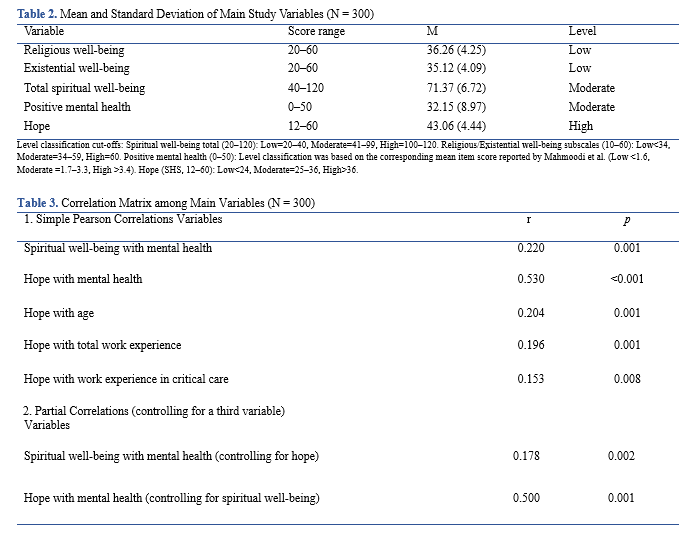
The mean scores for religious well-being (36.26, SD = 4.25) and existential well-being (35.12, SD = 4.09) were classified as low.
The total spiritual well-being score (71.37, SD = 6.72) was categorized as moderate. The mean score of positive mental health was 32.15 (SD = 8.97) out of 50, indicating a moderate level. In contrast, the level of hope among nurses was evaluated as high, with a mean score of 43.6 (SD = 4.44) [Table 2].
Association between Demographic Variables and Main Study Variables
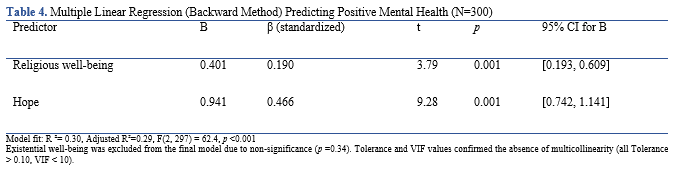
Pearson correlation analysis [Table 3] showed that hope had a positive and significant relationship with work experience in critical care units (r = 0.153, p = 0.008), total work experience (r = 0.196, p = 0.001), and age (r = 0.204, p = 0.001). No significant associations were observed between age or work experience and either the dimensions of spiritual well-being or positive mental health.
Additionally, independent samples t-test results indicated no significant differences in mean scores of spiritual well-being, positive mental health, or hope according to gender and marital status. To maintain statistical power and focus on clinical settings with the highest level of acute stress and exposure to critical conditions, the main group comparisons were conducted between nurses working in EDs and those working in ICUs. Although the CCU is also considered a critical care unit, it was not included in the primary dichotomous comparison due to differences in the acuity level of care compared to ICU and emergency settings, as well as to avoid significant imbalance in group sample sizes (n = 51 in the CCU subgroup). Therefore, the group comparison was limited to the two primary high-acuity clinical environments (emergency versus ICU).
Discussion
The findings of this study indicated that the level of spiritual well-being among nurses was moderate. This result is consistent with previous studies conducted in Iran and other countries [27, 28], suggesting that despite high occupational stress, nurses still possess an acceptable level of spiritual resources. It appears that spirituality, as a psychological coping strategy, may help nurses better interpret and make meaning of challenging clinical experiences and adapt to occupational stressors [16, 17].
A notable finding of the present study was that, although overall spiritual well-being was at a moderate level, both subdimensions (religious well-being (mean = 36.26) and existential well-being (mean = 35.12)) were independently classified as low. This discrepancy may be attributed to the intense workload in critical care settings, which limits opportunities for deep spiritual reflection. Furthermore, continuous exposure to death and suffering may challenge nurses' sense of meaning and purpose in life, thereby negatively affecting existential well-being.
Given the nature of the nursing profession, which involves continuous exposure to suffering, illness, death, and critical situations, an acceptable level of spiritual well-being can be considered an important internal resource for attributing meaning to work-related experiences and enhancing psychological resilience. Spirituality and religiosity represent fundamental pathways to meaning, purposefulness, and hope in life and play a protective role in situations [29].
Previous studies have also demonstrated that higher levels of spiritual well-being are associated with positive outcomes such as increased job satisfaction, organizational commitment, reduced occupational stress, and improved quality of life [30, 31]. From this perspective, the findings of the present study underscore the importance of addressing nurses' spiritual well-being as a key component of professional health.
The findings of the present study indicated that the mean level of hope among nurses was high. This result is consistent with a study conducted in Iran [32]. However, it was higher than those reported in other studies conducted in different regions of the country or under different conditions [33].
The observed differences may be attributed to contextual factors such as cultural conditions, social support, religious beliefs, economic status, and temporal variations (e.g., the COVID-19 pandemic period).
Existing evidence suggests that religious beliefs and engagement in religious practices are positively and significantly associated with increased levels of hope. Religion, by providing a coherent meaning-making system, attributing meaning to suffering, and offering social support, can play an important role in strengthening hope. In this regard, the findings of the present study are consistent with those of Lehmann and Samadi Fard, who reported a positive association between religiosity and hope [20, 34].
The results indicated that nurses' positive mental health was at a moderate level. This finding, when compared with studies conducted during the peak of the COVID-19 pandemic that reported high levels of anxiety and psychological distress [35, 36], suggests a relatively more favorable situation. However, existing evidence indicates that nurses, particularly those working in critical care and emergency departments, remain at risk of psychological harm due to direct contact with critically ill patients and high occupational demands. Anxiety, feelings of insecurity, and occupational burnout are common consequences of health crisis conditions that can negatively affect nurses' positive mental health.
Partial correlation results indicated that after controlling for the effect of hope, spiritual well-being remained positively and significantly associated with nurses' positive mental health. This finding suggests the independent role of spiritual well-being in enhancing positive mental health.
Another notable finding was the positive relationship between hope and both age and work experience among nurses. This result may indicate that with increasing professional experience, nurses develop more effective coping strategies in response to occupational stressors and strengthen internal resources such as hope. However, a more precise interpretation of this relationship requires longitudinal studies.
Several studies have also emphasized the role of religious and existential well-being in maintaining and promoting positive mental health. Religious well-being contributes to improved psychological status by providing social support, strengthening positive coping strategies, and reducing unhealthy behaviors. In contrast, existential well-being enhances mental health by fostering meaning in life and a sense of purpose [18, 37].
The findings indicated that hope had the highest standardized coefficient in the regression model (β = 0.466), such that after controlling for spiritual well-being, a strong and positive association was observed between hope and positive mental health. This result is consistent with previous studies reporting the strong role of hope in psychological well-being and mental health outcomes across different populations [38]. Hope, as a fundamental component of positive mental health, enables individuals to identify effective pathways toward goal attainment and to cope with challenges [39]. Nurses with higher levels of positive mental health are better able to maintain hope, engage in goal-directed decision-making, and manage stress effectively.
In the second step of the present study, only religious well-being and hope emerged as significant predictors of positive mental health. In contrast, existential well-being was excluded from the model due to non-significance (p = 0.34). Although existential well-being may show a simple bivariate association with positive mental health, its unique contribution becomes negligible after controlling for religious well-being and hope. This may be explained by conceptual overlap and potential multicollinearity, whereby shared variance between existential well-being, religious well-being, and hope is accounted for by the latter variables.
The regression analysis showed that religious well-being and hope together explained 29% of the variance in nurses' positive mental health. This finding suggests that although both dimensions of spirituality are important, in this specific sample, the religious dimension alongside hope plays a more prominent role in predicting positive mental health.
This study had several limitations that should be considered when interpreting the findings. First, the cross-sectional design of the study precludes inference of causal relationships among the variables and allows only for the examination of associations. Second, the data were collected using self-report instruments, which may be subject to response bias and participants' subjective perceptions. Third, the study participants were limited to nurses working in teaching hospitals in Zanjan; therefore, the generalizability of the findings to other cities or nursing populations should be made with caution. In addition, the lack of cooperation from some nurses due to workload and time constraints was another limitation of the study, which was addressed by extending the data collection period and making multiple follow-up visits.
It should be noted that the findings of this study were specifically obtained within the context of nurses working in critical care units (ICU, CCU) and emergency departments.
Due to higher levels of stress, continuous exposure to death, and critically ill patients, this group may exhibit different patterns compared to nurses working in general wards. Therefore, the generalization of the results to other nursing populations should be made with caution.
Conclusion
The findings of the present study indicated that spiritual well-being and hope are positively and significantly associated with nurses' positive mental health. Moreover, hope and religious well-being were identified as significant predictors of positive mental health in this study.
Although the observed correlation was statistically significant, its magnitude was weak; therefore, strong clinical interpretations should be made with caution.
These results suggest that strengthening internal psychological resources such as hope and spirituality may be associated with improved positive mental health among nurses. Considering the psychological burden in critical care and emergency settings, designing intervention programs aimed at enhancing hope, spirituality, and adaptive coping strategies may contribute to improving nurses' positive mental health and, ultimately, the quality of nursing care.
Ethical Consideration
This study was conducted in full compliance with ethical principles and was approved by the Ethics Committee of Zanjan University of Medical Sciences under the ethics code IR.ZUMS.REC.1401.296. Participation in the study was entirely voluntary, and participants were informed of their right to withdraw at any stage of the research without any consequences.
Written informed consent was obtained from all participants before data collection. The confidentiality of participants' information was strictly maintained, and they were asked not to include their names on the questionnaires to ensure anonymity.
Acknowledgements
The authors would like to sincerely thank all nurses who participated in this study for their valuable cooperation.
Conflict of Interest
Given that the fourth author served as the Editor-in-Chief of PCNM, the manuscript underwent the same standard peer-review process as other submissions. The journal's editorial board made the final decision regarding the manuscript.
Funding
The Vice-Chancellor for Research and Technology of Zanjan University of Medical Sciences supported this study.
Authors' Contributions
Conceptualization: P. Shiri, M. Hossein Khani
Methodology: N. Hanifi
Investigation (Data Collection): M. Hossein Khani
Data Curation: M. Hossein Khani
Formal Analysis (Data Analysis): M. Aligholipour, P. Shiri, Z. Khezerlou, N. Hanifi
Visualization: Z. Khezerlou
Writing – Original Draft: M. Aligholipour, P. Shiri, Z. Khezerlou
Writing – Review & Editing: M. Aligholipour, P. Shiri, M. Hossein Khani, Z. Khezerlou, N. Hanifi
Supervision: P. Shiri, N. Hanifi
All authors read and approved the final manuscript.
Artificial Intelligence Utilization
No artificial intelligence tools were used in the preparation of this manuscript.
Data Availability Statement
The datasets generated and/or analyzed during the current study are available from the corresponding author upon reasonable request.
Human beings are multidimensional, encompassing biological, psychological, social, and spiritual aspects, and the interdependence of these dimensions requires that health and well-being be approached holistically [1]. Within this framework, mental health, as one of the fundamental pillars of overall health, is influenced by complex interactions among individual, occupational, and spiritual factors. Nurses, as a vital component of the healthcare workforce, are considered a vulnerable group in terms of mental health due to continuous exposure to patient suffering, pain, death, irregular shift work, and persistent occupational stressors [2, 3].
In particular, nurses working in Intensive Care Units (ICUs) and Coronary Care Units (CCUs), as well as emergency departments, are at greater risk of psychological distress due to the critical nature of their work environment, high levels of stress, and constant exposure to mortality and acute clinical conditions [2]. Evidence indicates that more than 90% of nurses experience occupational stressors, which may lead to emotional exhaustion, reduced performance, decreased job satisfaction, and psychological disorders [3].
In recent decades, the focus of mental health research has shifted from emphasizing risk factors toward identifying protective and strengthening factors. Within this framework, hope is introduced as a fundamental concept in positive psychology that plays a central role in human adaptation to adverse conditions [4]. Hope is a cognitive–motivational state that directs individuals toward goal setting, developing pathways to achieve those goals, and maintaining motivation for their attainment [5]. Evidence indicates that individuals with higher levels of hope demonstrate greater resilience in the face of stress and experience more favorable mental health outcomes [6].
In recent years, spirituality and spiritual well-being have also received increasing attention as important dimensions of human health [7]. Spiritual well-being is a multidimensional construct comprising two core components: religious well-being, which reflects an individual's relationship with God or a higher power; and existential well-being, which refers to the sense of meaning, purpose, and an inner connection with oneself, others, and the universe [8]. Diminished spiritual well-being has been associated with feelings of emptiness, depression, and anxiety [9]. In contrast, a positive relationship with the spiritual dimension is associated with enhanced resilience, life satisfaction, and reduced negative stress consequences [10, 11].
Spiritual well-being, as an indicator of the integration of spiritual experience into daily life, reflects an individual's positive interaction with the self, others, and existence as a whole [12]. Individuals with higher levels of spiritual well-being tend to demonstrate greater psychological stability, and various studies have confirmed a positive and significant correlation between spiritual well-being and variables such as hope and positive mental health [13, 14].
In the nursing profession, which is inherently stressful and influenced by the critical conditions of the healthcare environment [15], internal resources such as hope and spiritual well-being may play a protective and buffering role. Nurses experiencing low levels of positive mental health may lack the necessary capacity to provide effective and safe patient care, and this issue can significantly compromise the quality of healthcare services and patient satisfaction [16, 17].
International studies have also documented the importance of this association. Coppola et al. and González-Sanguino et al. demonstrated that spiritual well-being, particularly in crises, is one of the most important protective factors against depression, anxiety, and the deterioration of positive mental health [18, 19].
In Iran, similar findings have been reported in internal studies. Kord et al. demonstrated that spiritual well-being serves as a significant predictor of hope and optimism among women attending healthcare centers [13]. Similarly, Samadi Fard et al. reported that religious beliefs and spiritual well-being are positively associated with hope in patients with diabetes [20].
Although numerous studies have examined spiritual well-being, hope, and positive mental health separately, their findings suggest that these constructs are associated with psychological well-being and adaptive functioning. To the best of our knowledge, no study in Iran has simultaneously investigated the relationship between spiritual well-being, hope, and positive mental health among nurses working in critical care and emergency departments. Identifying these protective factors may provide a foundation for developing preventive interventions that promote nurses' mental health and improve the quality of patient care.
Objectives
This study aimed to investigate the relationship between spiritual well-being, hope, and positive mental health among nurses working in CCUs, surgical intensive care units (SICUs), medical intensive care units (MICUs), and emergency departments (EDs) of teaching hospitals in Zanjan, Iran.
Methods
Study Design
This study was a correlational cross-sectional design conducted in 2023.
Participants and Sampling
The target population consisted of all nurses working in CCUs, SICUs, MICUs, and EDs of Ayatollah Mousavi and Vali-Asr (PBUH) teaching hospitals affiliated with Zanjan University of Medical Sciences. The total number of eligible nurses was estimated to be 356. Using a convenience sampling method and with the researcher's direct presence, invitations were distributed to all eligible nurses, and they were invited to participate voluntarily. Participation was entirely voluntary, and there was no obligation to take part.
Inclusion criteria were having at least a Bachelor's or Master's degree in Nursing and a minimum of one year of work experience in critical care or emergency departments.
Exclusion criteria included experiencing major stressful life events such as divorce or the death of a first-degree relative within the past six months, self-reported history of psychiatric disorders or use of specific psychotropic medications, incomplete completion of more than 50% of the questionnaire items or providing uniform responses (e.g., the same option) for more than 50% of items, and transfer to general wards during the course of the study.
The sample size was determined using G*Power software (version 3.1.9.7) and the "Linear multiple regression: Fixed model, R² deviation from zero" module, which is consistent with the main statistical analysis of the study (multiple linear regression). With a statistical power of 0.95, a significance level of 0.05, and a medium effect size based on the correlation coefficient reported in a previous similar study (r = 0.48; Samadi Fard et al., 2015) [20], the required sample size was estimated to be 288 participants. Considering a 10% attrition rate, the final sample size was increased to 320 participants.
Measurement Instruments (Validity & Reliability)
Data were collected using four instruments. First, a demographic information questionnaire was completed, including variables such as age, gender, marital status, level of education, total work experience, work experience in critical care or emergency departments, and history of psychiatric disorders and exposure to stressful life events. It should be noted that self-reported history of psychiatric disorders and medication use were included in the demographic questionnaire solely for screening purposes to apply the exclusion criteria, and these variables were not entered into any of the statistical analyses of the study.
The Spiritual Well-Being Scale (SWBS) developed by Paloutzian and Ellison was used to assess spiritual well-being. This instrument consists of 20 items across two subscales: Religious Well-Being (10 items) and Existential Well-Being (10 items). Items are scored on a six-point Likert scale (1 = strongly disagree to 6 = strongly agree), and negatively worded items are reverse scored. The score range for each subscale is 10 to 60, while the total score ranges from 20 to 120. Scores of 20–40 indicate low spiritual well-being, 41–99 moderate, and 100–120 high levels of spiritual well-being [21].
The validity of this instrument in Iran was confirmed by Fatemi et al. through expert review by 10 specialists [22], and its reliability was reported by Abbasi as acceptable, with a Cronbach's alpha coefficient of 0.82 [23].
The Snyder Hope Scale (SHS) consists of 12 items structured into two subscales: Agency thinking (4 items) and Pathways thinking (4 items), along with 4 filler items. Responses are rated on a five-point Likert scale (1 = strongly disagree to 5 = strongly agree), and items 3, 7, and 11 are reverse scored. The total score ranges from 12 to 60, with scores below 24 indicating low hope, 25–36 moderate hope, and above 36 high hope [24]. In the study by Kermani et al., the Cronbach's alpha coefficient was reported as 0.86 for the total scale, 0.77 for the Agency subscale, and 0.79 for the Pathways subscale [25].
The Positive Mental Health Scale (MHPK), developed by Mahmoudi et al., consists of 10 items rated on a six-point Likert scale (0 = I don't know, 1 = not true, 2 = somewhat true, 3 = moderately true, 4 = true, 5 = completely true). The total score is calculated as the mean of the 10 items, yielding a range from 0 to 5. Scores below 1.6 indicate low positive mental health, 1.7–3.3 indicate moderate levels, and scores above 3.4 represent high positive mental health. The scale demonstrated acceptable reliability, with a reported Cronbach's alpha of 0.81 and a Guttman coefficient of 0.79 [26].
Data Collection Procedure
The Research Council and the Ethics Committee first approved the study protocol. After obtaining an official introduction letter from the Deputy of Research at the university, sampling was initiated through on-site presence in the clinical wards. After explaining the study objectives to the participants and obtaining written informed consent, the questionnaires were distributed.
The researcher remained present in the clinical settings, considering nurses' work schedules, until the required sample size was reached and data collection was completed. A checklist was used to ensure the accuracy and completeness of the collected data. Incomplete or improperly completed questionnaires were excluded from the study.
Statistical Analysis
Data were analyzed using SPSS software version 22. The Kolmogorov–Smirnov test was applied to assess the normality of data distribution. Descriptive statistics, including mean, standard deviation, and frequency percentages, were used to describe participants' characteristics and study variables. To examine relationships between variables, the Pearson correlation coefficient was used, depending on the normality of the data distribution.
To evaluate the predictive role of spiritual well-being and hope in positive mental health, multiple linear regression analysis was performed using the backward method. This approach was selected to identify the most parsimonious set of significant predictors. Before conducting the regression analysis, its assumptions were tested: normality of residuals was assessed using P–P plots, homogeneity of variance was examined through scatter plots, and multicollinearity was evaluated using Tolerance values (> 0.1) and Variance Inflation Factor (VIF < 10), all of which were confirmed. An independent samples t-test was used to compare the mean scores of the main variables across gender, marital status, and type of ward (ICU versus emergency). A significance level of 0.05 was considered for all statistical analyses.
Results
Out of 320 distributed questionnaires, 300 were eligible for analysis (response rate: 93.75%). Twenty questionnaires were excluded based on predefined exclusion criteria. These included cases in which participants selected a single response option (e.g., neutral/disagree) for more than 50% of the items or failed to return the questionnaire. As a result, 20 participants were excluded from the study, and ultimately the data of 300 participants were included in the final analysis.
Demographic Characteristics of Participants
The demographic characteristics of the participants are presented in Table 1. The majority of participants were female (51.7%), employed in ICU settings (46%), and married (60%). More than half of the participants had no children (53.3%), and most nurses held a bachelor's degree (84%). The majority of participants worked rotating shifts (86%) and did not have a second job (78.3%).
The mean age of participants was 32.05 years (SD = 6.23), the mean total work experience was 8.34 years (SD = 5.92), and the mean work experience in critical care units was 5.66 years (SD = 4.46).
Mean Scores of the Main Study Variables
The mean scores for religious well-being (36.26, SD = 4.25) and existential well-being (35.12, SD = 4.09) were classified as low.
The total spiritual well-being score (71.37, SD = 6.72) was categorized as moderate. The mean score of positive mental health was 32.15 (SD = 8.97) out of 50, indicating a moderate level. In contrast, the level of hope among nurses was evaluated as high, with a mean score of 43.6 (SD = 4.44) [Table 2].
Association between Demographic Variables and Main Study Variables
Pearson correlation analysis [Table 3] showed that hope had a positive and significant relationship with work experience in critical care units (r = 0.153, p = 0.008), total work experience (r = 0.196, p = 0.001), and age (r = 0.204, p = 0.001). No significant associations were observed between age or work experience and either the dimensions of spiritual well-being or positive mental health.
Additionally, independent samples t-test results indicated no significant differences in mean scores of spiritual well-being, positive mental health, or hope according to gender and marital status. To maintain statistical power and focus on clinical settings with the highest level of acute stress and exposure to critical conditions, the main group comparisons were conducted between nurses working in EDs and those working in ICUs. Although the CCU is also considered a critical care unit, it was not included in the primary dichotomous comparison due to differences in the acuity level of care compared to ICU and emergency settings, as well as to avoid significant imbalance in group sample sizes (n = 51 in the CCU subgroup). Therefore, the group comparison was limited to the two primary high-acuity clinical environments (emergency versus ICU).
Association between Spiritual Well-Being and Positive Mental Health
Partial correlation analysis showed that even after controlling for the effect of hope, the relationship between spiritual well-being and positive mental health remained statistically significant (r = 0.178, p = 0.002).
Association between Hope and Positive Mental Health
Partial correlation results, controlling for spiritual well-being, indicated that the relationship between hope and positive mental health also remained significant (r = 0.500, p = 0.001).
Predictive Role of Spiritual Well-Being and Hope in Positive Mental Health
Multiple linear regression analysis was performed using the backward method [Table 4], religious well-being (B = 0.401, β = 0.190, t = 3.79, p = 0.001, 95% CI [0.193, 0.609]) and hope (B = 0.941, β = 0.466, t = 9.28, p = 0.001, 95% CI [0.742, 1.141]) remained the only significant predictors of positive mental health. The final model demonstrated an acceptable fit (F(2,297) = 62.4, p < 0.001, R² = 0.30, Adjusted R² = 0.29).
Partial correlation analysis showed that even after controlling for the effect of hope, the relationship between spiritual well-being and positive mental health remained statistically significant (r = 0.178, p = 0.002).
Association between Hope and Positive Mental Health
Partial correlation results, controlling for spiritual well-being, indicated that the relationship between hope and positive mental health also remained significant (r = 0.500, p = 0.001).
Predictive Role of Spiritual Well-Being and Hope in Positive Mental Health
Multiple linear regression analysis was performed using the backward method [Table 4], religious well-being (B = 0.401, β = 0.190, t = 3.79, p = 0.001, 95% CI [0.193, 0.609]) and hope (B = 0.941, β = 0.466, t = 9.28, p = 0.001, 95% CI [0.742, 1.141]) remained the only significant predictors of positive mental health. The final model demonstrated an acceptable fit (F(2,297) = 62.4, p < 0.001, R² = 0.30, Adjusted R² = 0.29).
Discussion
The findings of this study indicated that the level of spiritual well-being among nurses was moderate. This result is consistent with previous studies conducted in Iran and other countries [27, 28], suggesting that despite high occupational stress, nurses still possess an acceptable level of spiritual resources. It appears that spirituality, as a psychological coping strategy, may help nurses better interpret and make meaning of challenging clinical experiences and adapt to occupational stressors [16, 17].
A notable finding of the present study was that, although overall spiritual well-being was at a moderate level, both subdimensions (religious well-being (mean = 36.26) and existential well-being (mean = 35.12)) were independently classified as low. This discrepancy may be attributed to the intense workload in critical care settings, which limits opportunities for deep spiritual reflection. Furthermore, continuous exposure to death and suffering may challenge nurses' sense of meaning and purpose in life, thereby negatively affecting existential well-being.
Given the nature of the nursing profession, which involves continuous exposure to suffering, illness, death, and critical situations, an acceptable level of spiritual well-being can be considered an important internal resource for attributing meaning to work-related experiences and enhancing psychological resilience. Spirituality and religiosity represent fundamental pathways to meaning, purposefulness, and hope in life and play a protective role in situations [29].
Previous studies have also demonstrated that higher levels of spiritual well-being are associated with positive outcomes such as increased job satisfaction, organizational commitment, reduced occupational stress, and improved quality of life [30, 31]. From this perspective, the findings of the present study underscore the importance of addressing nurses' spiritual well-being as a key component of professional health.
The findings of the present study indicated that the mean level of hope among nurses was high. This result is consistent with a study conducted in Iran [32]. However, it was higher than those reported in other studies conducted in different regions of the country or under different conditions [33].
The observed differences may be attributed to contextual factors such as cultural conditions, social support, religious beliefs, economic status, and temporal variations (e.g., the COVID-19 pandemic period).
Existing evidence suggests that religious beliefs and engagement in religious practices are positively and significantly associated with increased levels of hope. Religion, by providing a coherent meaning-making system, attributing meaning to suffering, and offering social support, can play an important role in strengthening hope. In this regard, the findings of the present study are consistent with those of Lehmann and Samadi Fard, who reported a positive association between religiosity and hope [20, 34].
The results indicated that nurses' positive mental health was at a moderate level. This finding, when compared with studies conducted during the peak of the COVID-19 pandemic that reported high levels of anxiety and psychological distress [35, 36], suggests a relatively more favorable situation. However, existing evidence indicates that nurses, particularly those working in critical care and emergency departments, remain at risk of psychological harm due to direct contact with critically ill patients and high occupational demands. Anxiety, feelings of insecurity, and occupational burnout are common consequences of health crisis conditions that can negatively affect nurses' positive mental health.
Partial correlation results indicated that after controlling for the effect of hope, spiritual well-being remained positively and significantly associated with nurses' positive mental health. This finding suggests the independent role of spiritual well-being in enhancing positive mental health.
Another notable finding was the positive relationship between hope and both age and work experience among nurses. This result may indicate that with increasing professional experience, nurses develop more effective coping strategies in response to occupational stressors and strengthen internal resources such as hope. However, a more precise interpretation of this relationship requires longitudinal studies.
Several studies have also emphasized the role of religious and existential well-being in maintaining and promoting positive mental health. Religious well-being contributes to improved psychological status by providing social support, strengthening positive coping strategies, and reducing unhealthy behaviors. In contrast, existential well-being enhances mental health by fostering meaning in life and a sense of purpose [18, 37].
The findings indicated that hope had the highest standardized coefficient in the regression model (β = 0.466), such that after controlling for spiritual well-being, a strong and positive association was observed between hope and positive mental health. This result is consistent with previous studies reporting the strong role of hope in psychological well-being and mental health outcomes across different populations [38]. Hope, as a fundamental component of positive mental health, enables individuals to identify effective pathways toward goal attainment and to cope with challenges [39]. Nurses with higher levels of positive mental health are better able to maintain hope, engage in goal-directed decision-making, and manage stress effectively.
In the second step of the present study, only religious well-being and hope emerged as significant predictors of positive mental health. In contrast, existential well-being was excluded from the model due to non-significance (p = 0.34). Although existential well-being may show a simple bivariate association with positive mental health, its unique contribution becomes negligible after controlling for religious well-being and hope. This may be explained by conceptual overlap and potential multicollinearity, whereby shared variance between existential well-being, religious well-being, and hope is accounted for by the latter variables.
The regression analysis showed that religious well-being and hope together explained 29% of the variance in nurses' positive mental health. This finding suggests that although both dimensions of spirituality are important, in this specific sample, the religious dimension alongside hope plays a more prominent role in predicting positive mental health.
This study had several limitations that should be considered when interpreting the findings. First, the cross-sectional design of the study precludes inference of causal relationships among the variables and allows only for the examination of associations. Second, the data were collected using self-report instruments, which may be subject to response bias and participants' subjective perceptions. Third, the study participants were limited to nurses working in teaching hospitals in Zanjan; therefore, the generalizability of the findings to other cities or nursing populations should be made with caution. In addition, the lack of cooperation from some nurses due to workload and time constraints was another limitation of the study, which was addressed by extending the data collection period and making multiple follow-up visits.
It should be noted that the findings of this study were specifically obtained within the context of nurses working in critical care units (ICU, CCU) and emergency departments.
Due to higher levels of stress, continuous exposure to death, and critically ill patients, this group may exhibit different patterns compared to nurses working in general wards. Therefore, the generalization of the results to other nursing populations should be made with caution.
Conclusion
The findings of the present study indicated that spiritual well-being and hope are positively and significantly associated with nurses' positive mental health. Moreover, hope and religious well-being were identified as significant predictors of positive mental health in this study.
Although the observed correlation was statistically significant, its magnitude was weak; therefore, strong clinical interpretations should be made with caution.
These results suggest that strengthening internal psychological resources such as hope and spirituality may be associated with improved positive mental health among nurses. Considering the psychological burden in critical care and emergency settings, designing intervention programs aimed at enhancing hope, spirituality, and adaptive coping strategies may contribute to improving nurses' positive mental health and, ultimately, the quality of nursing care.
Ethical Consideration
This study was conducted in full compliance with ethical principles and was approved by the Ethics Committee of Zanjan University of Medical Sciences under the ethics code IR.ZUMS.REC.1401.296. Participation in the study was entirely voluntary, and participants were informed of their right to withdraw at any stage of the research without any consequences.
Written informed consent was obtained from all participants before data collection. The confidentiality of participants' information was strictly maintained, and they were asked not to include their names on the questionnaires to ensure anonymity.
Acknowledgements
The authors would like to sincerely thank all nurses who participated in this study for their valuable cooperation.
Conflict of Interest
Given that the fourth author served as the Editor-in-Chief of PCNM, the manuscript underwent the same standard peer-review process as other submissions. The journal's editorial board made the final decision regarding the manuscript.
Funding
The Vice-Chancellor for Research and Technology of Zanjan University of Medical Sciences supported this study.
Authors' Contributions
Conceptualization: P. Shiri, M. Hossein Khani
Methodology: N. Hanifi
Investigation (Data Collection): M. Hossein Khani
Data Curation: M. Hossein Khani
Formal Analysis (Data Analysis): M. Aligholipour, P. Shiri, Z. Khezerlou, N. Hanifi
Visualization: Z. Khezerlou
Writing – Original Draft: M. Aligholipour, P. Shiri, Z. Khezerlou
Writing – Review & Editing: M. Aligholipour, P. Shiri, M. Hossein Khani, Z. Khezerlou, N. Hanifi
Supervision: P. Shiri, N. Hanifi
All authors read and approved the final manuscript.
Artificial Intelligence Utilization
No artificial intelligence tools were used in the preparation of this manuscript.
Data Availability Statement
The datasets generated and/or analyzed during the current study are available from the corresponding author upon reasonable request.
Type of Study: Orginal research |
Subject:
Nursing
References
1. Cooper ZW, Wolfer TA. Conceptualizing the biopsychosocial-spiritual health influences of adverse childhood experiences and the application of primary care behavioral health for their treatment. Journal of Religion and Health. 2024;63(1):619-39. [https://doi.org/10.1007/s10943-023-01928-y] [PMID]
2. Fowler K, Wholeben M. COVID-19: Outcomes for trauma-impacted nurses and nursing students. Nurse Education Today. 2020;93:104525. [https://doi.org/10.1016/j.nedt.2020.104525] [PMID]
3. Limungi GM, Amer M, Elmadani M, Simon K, Hamad O, Horvath E, et al. Understanding key factors contributing to mental health challenges among pediatric nurses: a systematic review. Frontiers in Public Health. 2025;13:1480024. [https://doi.org/10.3389/fpubh.2025.1480024] [PMID]
4. Seligman ME. Positive Psychology: A Personal History. Annual Review of Clinical Psychology. 2019;15:1-23. [https://doi.org/10.1146/annurev-clinpsy-050718-095653] [PMID]
5. Snyder CR, Harris C, Anderson JR, Holleran SA, Irving LM, Sigmon ST, et al. The will and the ways: development and validation of an individual-differences measure of hope. Journal of Personality and Social Psychology. 1991;60(4):570. [https://psycnet.apa.org/doi/10.1037/0022-3514.60.4.570] [PMID]
6. Hakimi AR, Khosropour F, Chatroudi S, Khojasteh A. Investigating the Relationship between Religious Attitude and Positivism and Life Expectancy in Patients Hospitalized in Kerman Hospitals in 2019: The Mediating Role of Psychological Hardiness and Perceived Stress: A Descriptive Study. Journal of Rafsanjan University of Medical Sciences. 2021;20(1):23-36. [https://sid.ir/paper/966757/en]
7. Hikmatovna BZ, Tukhtaeva KK. Abu Ali Ibn Sina About A Healthy Lifestyle. Academicia Globe: Inderscience Research. 2021;2(6):380-3. [https://doi.org/10.17605/OSF.IO/KH7TQ]
8. Ghaderi A, Tabatabaei SM, Nedjat S, Javadi M, Larijani B. Explanatory definition of the concept of spiritual health: a qualitative study in Iran. Journal of Medical Ethics and History of Medicine. 2018;11. [https://pubmed.ncbi.nlm.nih.gov/30258553/]
9. Asadzandi M. Characteristics of sound heart owners as islamic spiritual health indicators. Journal of Community Medicine & Health Care. 2019;4(1):1-4. [https://doi.org/10.26420/jcommunitymedhealthcare.2019.1032]
10. Bolat HK. Connections of mental disorders and psychological well-being with religious attitude and religious struggle [Master's thesis]. Istanbul: Ibn Haldun University; 2020. [https://openaccess.ihu.edu.tr/entities/publication/695e3c7a-df99-4a6c-a923-a7ac9137185d]
11. Caplan S. Intersection of cultural and religious beliefs about mental health: Latinos in the faith-based setting. Hispanic Health Care International. 2019;17(1):4-10. [https://doi.org/10.1177/1540415319828265] [PMID]
12. Sajadi M, Niazi N, Khosravi S, Yaghobi A, Rezaei M, Koenig HG. Effect of spiritual counseling on spiritual well-being in Iranian women with cancer: A randomized clinical trial. Complementary Therapies in Clinical Practice. 2018;30:79-84. [https://doi.org/10.1016/j.ctcp.2017.12.011] [PMID]
13. Kord B, Biadar S. Predictive role of spiritual well-being for optimism and life expectancy among women who referred to health centers. Health, Spirituality and Medical Ethics. 2019;6(4):23-8. [http://dx.doi.org/10.29252/jhsme.6.4.23]
14. Vitorino LM, Lucchetti G, Leão FC, Vallada H, Peres MFP. The association between spirituality and religiousness and mental health. Scientific Reports. 2018;8(1):1-9. [https://doi.org/10.1038/s41598-018-35380-w] [PMID]
15. Bodner E, Bergman YS. Loneliness and depressive symptoms among older adults: The moderating role of subjective life expectancy. Psychiatry Research. 2016;237:78-82. [https://doi.org/10.1016/j.psychres.2016.01.074] [PMID]
16. Nantsupawat A, Wichaikhum OA, Abhicharttibutra K, Kunaviktikul W, Nurumal MSB, Poghosyan L. Nurses' knowledge of health literacy, communication techniques, and barriers to the implementation of health literacy programs: A cross‐sectional study. Nursing & Health Sciences. 2020;22(3):577-85. [https://doi.org/10.1111/nhs.12698] [PMID]
17. Bauer JC, John E, Wood CL, Plass D, Richardson D. Data entry automation improves cost, quality, performance, and job satisfaction in a hospital nursing unit. Journal of Nursing Administration (JONA). 2020;50(1):34-39. [https://doi.org/10.1097/NNA.0000000000000836] [PMID]
18. Coppola I, Rania N, Parisi R, Lagomarsino F. Spiritual well-being and mental health during the COVID-19 pandemic in Italy. Frontiers in Psychiatry. 2021;12:296. [https://doi.org/10.3389/fpsyt.2021.626944] [PMID]
19. González-Sanguino C, Ausín B, Castellanos MÁ, Saiz J, López-Gómez A, Ugidos C, et al. Mental health consequences during the initial stage of the 2020 Coronavirus pandemic (COVID-19) in Spain. Brain, Behavior, and Immunity. 2020;87:172-6. [https://doi.org/10.1016/j.bbi.2020.05.040] [PMID]
20. Samadi Fard HR. Relationship between spiritual well-being and religious belief with life expectancy of diabetics. Islam and Health Journal. 2015;2(2):44-51. [https://sid.ir/paper/258941/en]
21. Paloutzian RF, Ellison CW. Loneliness, spiritual well-being and quality of life. In: Peplau LA, Perlman D, editors. Loneliness: A Sourcebook of Current Theory, Research and Therapy. New York: Wiley-Interscience; 1982. p. 224-237. [https://psycnet.apa.org/doi/10.1037/t00534-000]
22. Fatemi MM, Nazari R, Safavi M, Naini MK, Savadpour MT. The relationship between nurses' spirituality and patient satisfaction in hospitals affiliated to Ardabil University of Medical Sciences. Medical Ethics Journal. 2011;5(17):141-159. [https://sid.ir/paper/195641/en]
23. Farahaninia M, Abbasi M, Givari A, Haghani H. Nursing students' spiritual well-being and their perspectives towards spirituality and spiritual care perspectives. Iran Journal of Nursing. 2006;18(44):7-14. [https://sid.ir/paper/114136/en]
24. Schneider MC, Castillo-Salgado C, Bacallao J, Loyola E, Mujica OJ, Vidaurre M, et al. Summary of indicators most used for the measurement of health inequalities. Epidemiological Bulletin. 2005:7-10. PMID: 16578907
25. Kermani Z, Khoda panahi MK, Heydari M. Psychometric properties of Omid Snyder scale. Applied Psychology Quarterly. 2011;3(19):7-23. [https://apsy.sbu.ac.ir/article_95512.html]
26. Mahmoodi SMH, Ahmadzad-Asl M, Rasoulian M. Mental Health Positive Knowledge Questionnaire: Translation and Cultural Adaptation and Psychometric Properties. Social Welfare Quarterly. 2021;21(82):139-59. [http://refahj.uswr.ac.ir/article-1-3852-en.html]
27. Moeini B, Rezapur-Shahkolai F, Tapak L, Seifi F, Veasli-monfared E. The Relationship between Spiritual Well-Being and Stress Coping Methods to Deal with Job Stress among Nurses in Educational Hospitals in Ardabil City 2021. Iranian Journal of Health Sciences. 2022;10(1):10-20. [https://sid.ir/paper/991840/en]
28. Assarroudi A, Jalilvand M, Oudi D, Akaberi A. The relationship between spiritual well-being and life satisfaction in the nursing staff of Mashhad Hasheminezhad Hospital (2011). Modern Care Journal. 2012;9(2). [https://sid.ir/paper/384375/en]
29. Litalien M, Atari DO, Obasi I. The influence of religiosity and spirituality on health in Canada: A systematic literature review. Journal of Religion and Health. 2021:1-42. [https://doi.org/10.1007/s10943-020-01148-8] [PMID]
30. Fry LW, Latham JR, Clinebell SK, Krahnke K. Spiritual leadership as a model for performance excellence: a study of Baldrige award recipients. Journal of Management, Spirituality & Religion. 2017;14(1):22-47. [https://doi.org/10.1080/14766086.2016.1202130]
31. Roshani D, Saboni K, Amjadian M. The anxiety associated with COVID-19, general health, spiritual health, and job satisfaction in healthcare providers: a cross-sectional study. BMC Psychology. 2023;11(1):240. [https://doi.org/10.1186/s40359-023-01283-3] [PMID]
32. Dehghan Aa-S, Nejad ZC, Maznab AA. The Effectiveness of Positive teaching with an Islamic Approach in a group way in Nurses' Life Expectancy. Journal of Nursing Education (JNE). 2019;8(4): 57-62. [http://dx.doi.org/10.21859/jne-08408]
33. Dasht Bozorgi Z, Alipoor S, Shahandh A, Payan S. Predicting the life expectancy in nurse based on happiness, acting to religious beliefs and psychological hardiness. Quarterly Journal of Nursing Management. 2018;6(3):57-65. [http://dx.doi.org/10.29252/ijnv.6.3.4.57]
34. Lehmann D. Hope and religion. Sociological Theory and the Question of Religion: Routledge; 2016. p. 75-104. [https://www.taylorfrancis.com/chapters/edit/10.4324/9781315609775-5/hope-religion-david-lehmann] [PMID]
35. Nemati M, Ebrahimi B, Nemati F. Assessment of Iranian nurses' knowledge and anxiety toward COVID-19 during the current outbreak in Iran. Archives of Clinical Infectious Diseases. 2020;15(COVID-19). [http://dx.doi.org/10.5812/archcid.102848]
36. Yang Y, Zhu J-f, Yang S-y, Lin H-j, Chen Y, Zhao Q, et al. Prevalence and associated factors of poor sleep quality among Chinese returning workers during the COVID-19 pandemic. Sleep Medicine. 2020;73:47-52. [https://doi.org/10.1016/j.sleep.2020.06.034] [PMID]
37. Unterrainer H-F, Ladenhauf KH, Moazedi ML, Wallner-Liebmann SJ, Fink A. Dimensions of religious/spiritual well-being and their relation to personality and psychological well-being. Personality and Individual Differences. 2010;49(3):192-7. [https://doi.org/10.1016/j.paid.2010.03.032]
38. Barbosa A, Robalo Nunes I, Nunes J, Sá L, Charepe Z. Hope in mental health and psychiatric nursing: a scoping review. BMC Psychiatry. 2026;26(1):18. [https://doi.org/10.1186/s12888-025-07355-5] [PMID]
39. Van Gestel‐Timmermans H, Van Den Bogaard J, Brouwers E, Herth K, Van Nieuwenhuizen C. Hope as a determinant of mental health recovery: a psychometric evaluation of the Herth Hope Index‐Dutch version. Scandinavian Journal of Caring Sciences. 2010;24:67-74. [https://doi.org/10.1111/j.1471-6712.2009.00758.x] [PMID]
Send email to the article author
| Rights and permissions | |
 |
This work is licensed under a Creative Commons Attribution-NonCommercial 4.0 International License. |