
Preventive Care in Nursing and Midwifery

Volume 16, Issue 3 (7-2026)
Prev Care Nurs Midwifery 2026, 16(3): 14-22 |
Back to browse issues page


Ethics code: IR.BPUMS.REC.1402.101


Download citation:
BibTeX | RIS | EndNote | Medlars | ProCite | Reference Manager | RefWorks
Send citation to:


BibTeX | RIS | EndNote | Medlars | ProCite | Reference Manager | RefWorks
Send citation to:
Azemian A, Ebneroomi S, Jafari N, Mokhtari Zanjani M. Comparison of Emotional Intelligence Between Medical and Nursing Students During Clinical Training at Bushehr University of Medical Sciences. , Prev Care Nurs Midwifery. 2026; 16 (3) :14-22
URL: http://nmcjournal.zums.ac.ir/article-1-1043-en.html
URL: http://nmcjournal.zums.ac.ir/article-1-1043-en.html

Department of Midwifery, Faculty of Nursing and Midwifery, Zanjan University of Medical Sciences, Zanjan, Iran. , mokhtari@zums.ac.ir
Full-Text [PDF 941 kb]
(163 Downloads)
| Abstract (HTML) (887 Views)
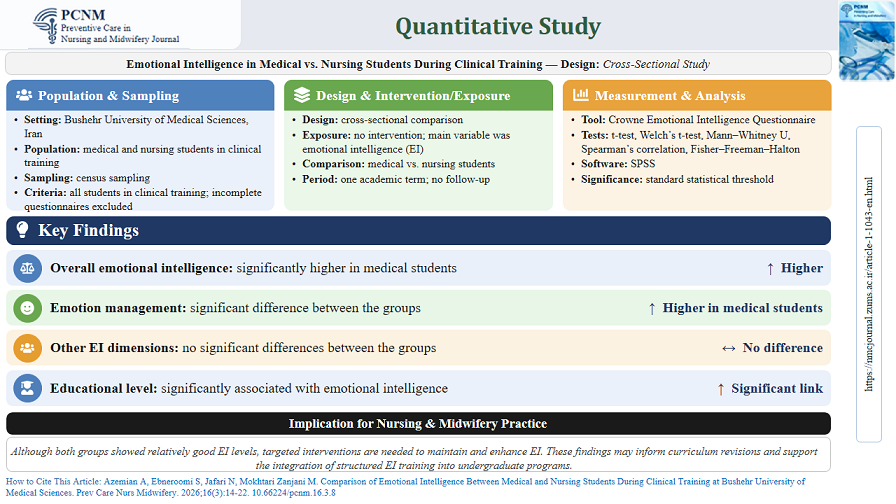
Graphical Abstract:
Reseach Highlights:
Knowledge Translation Statement
Audience: Nursing and medical education managers, clinical training coordinators
Medical students had higher total emotional intelligence than nursing students, mainly in emotion management. Pre-intern students scored higher than interns, and age and gender showed no meaningful association. Managers may consider embedding emotional intelligence and communication workshops into clinical training, especially for interns.
Full-Text: (33 Views)
Introduction
Intelligence is considered one of the fundamental aspects of how individuals adapt to their environment and one of the most critical components of individual differences [1]. Although decades of research have focused on cognitive intelligence as the primary predictor of personal success, cognitive intelligence is an important predictor of academic and professional achievement, it does not fully explain individual success, and non-cognitive factors such as emotional intelligence (EI) may also contribute substantially to personal, educational, and occupational outcomes [2].
Among these, EI stands out as one of the most influential non-cognitive constructs, playing a decisive role in personal, occupational, and social performance [3]. EI was first introduced by Salovey and Mayer (1990) within an ability-based model framework, defined as “the capacity to reason about emotions to enhance thinking,” which encompasses four dimensions: perceiving, facilitating, understanding, and regulating emotions [4]. Subsequently, broader conceptualizations of EI emerged. Mixed models conceptualize EI as a combination of emotional, personal, and social competencies that influence an individual’s ability to cope effectively with environmental demands and interpersonal interactions. These models encompass dimensions such as self-awareness, emotion management, self-motivation, empathy, and social skills, emphasizing the application of emotional competencies in real-world personal and professional contexts [5-7].
Among the most influential mixed-model approaches are Goleman’s competency model and Bar-On’s model of emotional-social intelligence. Consistent with this perspective, the Crowne EI Questionnaire was developed based on the mixed-model conceptualization of EI as its operational framework.
The questionnaire assesses dimensions including self-awareness, emotion management, self-motivation, empathy, and social skills [8]. Accordingly, the present study adopts a mixed-model conceptualization of EI as its operational framework.
In the realm of healthcare professions, particularly in nursing and medicine, EI has been associated with notably significant clinical outcomes.
A substantial body of research evidence indicates that higher levels of EI are positively and meaningfully related to more effective communication skills, greater empathy, resilience in emotionally intense situations, enhanced teamwork efficacy, and optimal stress management within clinical environments [9]. EI assists nurses in enhancing their resilience and reducing burnout by improving communication skills, stress management, and empathy. Consequently, it positively influences primary healthcare delivery and the implementation of preventive services and programs [10, 11].
For instance, Riaz and colleagues (2025) reported a strong correlation (r = 0.961) between EI and communication skills among nursing students [12]. Furthermore, Kosydar-Boecenk and colleagues (2025) have demonstrated that EI plays a determining role in preparing healthcare professionals for the management and delivery of unfavorable news [13]. At the domestic level, a study by Amini et al., which aimed to examine the relationship between communication abilities and EI among medical personnel working in outpatient clinics in Shiraz, with the participation of 108 such personnel, revealed that higher levels of EI led to improved treatment outcomes and enhanced quality of patient rapport [14]. In addition, studies by Tasdighi et al. and Mohammadi et al. have identified a significant relationship between EI and academic achievement among medical and nursing students [15, 16].
Many studies confirm a positive and significant relationship between EI and key outcomes, including empathy, clinical performance, quality of care, and resilience, among nursing and medical students. For instance, Maity et al. demonstrated that higher EI contributes to improved doctor-patient relationships, reduced burnout, enhanced clinical decision-making, and ultimately greater patient satisfaction and more compassionate healthcare delivery [17].
Additionally, a meta-analysis by Kawashima et al. (2025) evaluated the effectiveness of EI training on nurses and nursing students. The results showed that EI training significantly improved participants’ EI compared to the control group. It also had a significant effect on reducing stress and produced a significant positive effect on communication skills. However, the training had no significant effect on resilience [18].
Growing evidence indicates that higher education systems in health sciences in many countries, including Iran, continue to rely on memory‑based strategies and information accumulation, while failing to adequately nurture fundamental components such as self‑awareness, self‑management, empathy, and impulse control, which are elements that constitute the core of EI [15]. On the other hand, given the critical role of communication skills, patient empathy, resilience in high‑stress and emotionally charged situations, teamwork and collaborative capacity, as well as stress management and control within clinical environments, and considering the influence of EI on individual success across occupational, social, and emotional domains, it can be argued that systematic attention to EI provides a foundation for more effective adaptation and optimal individual performance. This underscores the necessity of assessing the current state of EI as an initial step in designing any educational intervention.
Despite the growing body of evidence highlighting the critical role of EI in healthcare education and clinical practice, limited research has directly compared the level and development of EI between medical and nursing students within the same educational and cultural context. Most previous studies in Iran have focused on nursing or medical students separately, with few examining both groups simultaneously during their clinical training. This is particularly evident in regional settings such as Bushehr University of Medical Sciences. Given the distinct professional roles, responsibilities, and training pathways of these two disciplines, it remains unclear whether EI competencies, such as empathy, self-awareness, and stress management, develop similarly or differently across the two groups. Addressing this gap is essential for designing tailored educational interventions and curricula that effectively enhance emotional and interpersonal competencies among future healthcare professionals.
Objectives
The objective of this study was to compare the levels of EI between medical and nursing students undergoing clinical training at Bushehr University of Medical Sciences.
Methods
Study Design
The present study was descriptive‑cross‑sectional in design.
Participants and Sampling
The study population comprised all clinical-level medical and nursing students enrolled during the 2023–2024 academic year (corresponding to the first semester of the 1402–1403 academic year in the Iranian calendar). Data were collected from August 23 to October 23, 2023.
Sampling was conducted using a census method. Nursing students were studying in the sixth and seventh semesters, and medical students (pre-intern and intern) were studying in the fifth and sixth years (pre-intern and intern). The data collection took place at the Persian Gulf Teaching Hospital and Nursing Faculty. Out of 168 nursing and medical students in the clinical stage, 87 returned the questionnaire (response rate 52%).
In the Iranian educational system, intern students were defined as nursing students enrolled in semesters 7–8 and medical students enrolled in semesters 12–14, who were undergoing clinical internship training. Pre-intern students were defined as nursing students enrolled in semesters 2–6 and medical students enrolled in semesters 8–11, who were completing clinical training before entering the internship phase.
The inclusion criterion for the study was that nursing students were studying in the sixth and seventh semesters, and medical students (pre-intern and intern) were studying in the Fifth and sixth years (pre-intern and intern). The exclusion criteria were defined as incomplete completion of the questionnaire or unwillingness to continue participation during the study.
Measurement Instruments (Validity & Reliability)
The Crowne EI Questionnaire has previously been used in domestic studies, and its face and content validity have been confirmed by expert opinion. In the study by Abdali et al. (2019), the instrument's reliability was reported as 0.83 using Cronbach's alpha, and the subscales' reliability fell within an acceptable range [19]. In the present study, reliability was assessed using Cronbach's alpha; the overall alpha of the questionnaire was 0.83, indicating acceptable reliability.
Data Collection Procedure
The data collection instrument was the Crowne EI Questionnaire (2007), which consists of 25 items across five dimensions, comprising self‑awareness, emotion management, empathy, social skills, and motivation, along with a section on demographic characteristics. Scoring was based on a five‑point Likert scale ranging from "strongly agree" (5) to "strongly disagree" (1). The score range extended from a minimum of 25 to a maximum of 125. Accordingly, a total score of 100 or higher indicates high EI, a score between 75 and 100 reflects good EI capacity, and a score below 75 signifies that the individual falls below the average level of EI [20].
Statistical Analysis
After the questionnaires were completed, the data were coded and analyzed using SPSS version 20. In this study, Statistical analyses were performed using SPSS software. Descriptive statistics, including frequency, percentage, mean, and standard deviation, were used to summarize the data. The normality of quantitative variables was assessed using the Shapiro–Wilk test, together with visual inspection of histograms and Q–Q plots. Independent-samples t tests were used to compare EI scores and their dimensions between medical and nursing students. The Mann–Whitney U test was applied to compare EI scores across gender and academic levels when the assumption of normality was not satisfied. Pearson’s correlation coefficient was used to examine the relationship between age and EI. A p-value less than .05 was considered statistically significant.
Result
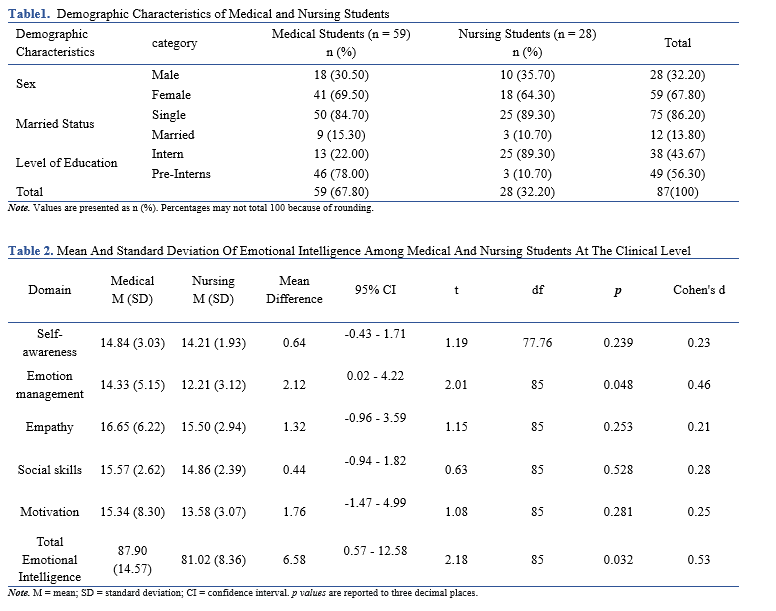
In the present study, out of 168 eligible students, 87 participants completed the questionnaire in full, yielding a response rate of 52%. The Sociodemographic characteristics of the participants are summarized in Table 1.
The results showed that the mean EI score of medical students was 87.90 (SD = 14.57), which was evaluated as "good" (above the mean of 75). Furthermore, the mean EI score of nursing students was 81.02 (SD = 8.36), which also fell within the "good" range. The results of the independent samples t-test indicated statistically significant differences between medical and nursing students in the "Emotion Management" domain (p = 0.048, Cohen’s d = 0.46) and in total EI (p = 0.032, Cohen’s d = 0.53). No significant differences were observed in other domains. For the self-awareness domain, Welch's t-test was used because the assumption of homogeneity of variances was violated. Therefore, the degree of freedom was estimated using the Welch–Satterthwaite approximation, resulting in a fractional df value (df = 77.76) [Table 2].
In addition, no significant correlation was found between age and EI among medical students (Spearman's ρ = -0.124, 95% CI [-0.383, 0.167], p = 0.347) or nursing students (Spearman's ρ = -0.121, 95% CI [-0.466, 0.272], p = 0.530). Similarly, in the pooled sample, there was no significant difference in EI scores between male and female students (U = 772.00, Z = -0.49, p = 0.623). Because the assumption of normality was not met, the Mann–Whitney U test was used to compare EI scores across educational levels. The results indicated a statistically significant difference between pre-intern and intern students (U = 575.00, Z = -2.89, p = 0.004). pre-intern students demonstrated higher EI scores (mean rank = 50.27) than intern students (mean rank = 34.54) [Table 3].
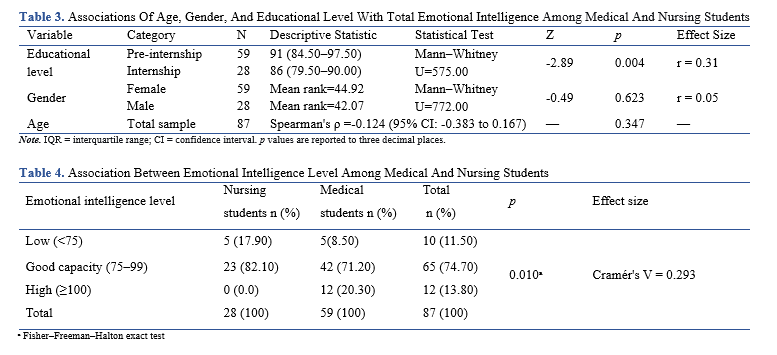
There was a statistically significant association between educational level and EI level (Fisher–Freeman–Halton exact test, p = 0.01). The strength of this association was moderate (Cramér’s V = 0.293) [Table 4].
Discussion
The present study aimed to compare the EI of medical and nursing students during clinical training. The results showed medical students demonstrated significantly higher total EI scores than nursing students with a medium effect size. This suggests that this difference is not only statistically significant but also practically meaningful. Among the EI domains, a statistically significant difference was observed only in emotion management. While no significant differences were observed in self-awareness, empathy, social skills, or motivation. Regarding EI categorization, the majority of students in both groups had moderate EI (72.9% of nursing students and 82.1% of medical students).
This finding partially contrasts with Choudry et al. (2023), who reported comparable EI between medical and paramedical students in the first year [21]. The observed difference in EI between the two groups may be partly attributable to the uneven sample sizes (59 medical vs. 28 nursing students) and the imbalanced distribution of educational levels, with a significantly higher proportion of nursing students being at the internship stage compared to medical students. Although greater clinical exposure among interns could potentially influence certain EI domains, this relationship should be interpreted cautiously due to the confounding effect of the field of study and uneven sample sizes.
Similarly, Talman et al. (2020), Horne et al. (2024), and Dewsnap et al. (2021) reported favorable levels of EI among medical and nursing students, further supporting the present findings. Taken together, these findings suggest that students in health professions generally demonstrate a satisfactory level of EI, regardless of their specific field of study [22-24].
Additionally, in this study, a statistically significant difference in total EI between pre-intern and intern students, with pre-intern students demonstrating significantly higher EI scores. This finding suggests that EI may vary across different stages of education. The higher EI among pre-intern students may stem from the fact that these students, particularly in the early stages of medical education, often enter university with greater enthusiasm, motivation, and optimism. This positive mindset can significantly enhance their emotional functioning. In contrast, clinical internship students typically face increased clinical responsibilities, heavier workloads, prolonged patient contact, and intense academic and professional pressures. These factors can lead to emotional exhaustion, heightened stress, and reduced emotional well-being, ultimately resulting in lower EI scores. Previous studies have shown that prolonged exposure to stressful clinical environments can negatively impact certain emotional competencies. In contrast to our findings, findings from a study by Bagle et al. (2021) of 200 undergraduate medical students over two years from January 2018 to February 2020 reported that overall EI increased gradually from the first to the fourth year of medical training [25]. However, they found that empathy and motivation declined as students progressed through their training. Consistent with the present findings, Tasdighi et al. (2021) also reported a significant association between EI and academic level [16]. In contrast, Vasfi et al. (2018) found lower EI among clinical students [26], while Horne et al. (2024) reported no significant differences across educational levels [23]. These inconsistent findings suggest that the relationship between educational stage and EI may be influenced by differences in curricula, clinical training environments, and study populations.
The present study did not find a significant relationship between EI and age or gender. Similar findings have been reported by Hanson et al. (2024), Mahanta et al. (2024), and Vasefi et al. (2018) [26-28]. However, other studies, including those by Mohamad et al. (2019), Budler et al. (2022), Shubayr and Dailah (2025), and Mohammadi et al. (2019) identified age, gender, or perceived stress as significant factors associated with EI [15, 29-31]. These inconsistent findings may be explained by variations in participant characteristics, cultural and educational contexts, measurement instruments, and study designs. Since demographic characteristics alone do not consistently explain variations in EI across studies, future research should investigate additional factors that may contribute to its development.
Overall, the findings indicate that EI among medical and nursing students is at a good level. Given the established role of EI in communication, teamwork, stress management, and patient-centered care, its continuous assessment and reinforcement during undergraduate education remain important. Integrating educational strategies that promote emotional awareness, communication skills, and reflective practice may further strengthen these competencies and better prepare future healthcare professionals for the interpersonal and emotional demands of clinical practice.
This study has several limitations. First, the use of self-reported data may have introduced response bias, including social desirability bias. Second, the cross-sectional design precludes causal inferences regarding the relationships examined. Third, the study was conducted at a single institution with a relatively small sample size (n = 87), a moderate response rate (52%), and unequal group sizes between medical and nursing students, particularly the smaller number of nursing students. These factors may have made it more difficult to detect small or moderate differences between the groups and may limit the generalizability of the findings. Therefore, the results should be interpreted with caution. Future research should employ larger, multicenter, and longitudinal studies to better understand the development of EI throughout clinical training and to evaluate the effectiveness of targeted educational interventions. In addition, qualitative approaches may provide deeper insights into students’ experiences and the factors influencing EI development.
Conclusion
Based on the findings of the present study, A significant difference was observed in EI between medical and nursing students, and EI was not significantly associated with age or gender. Differences between the present findings and those of previous studies may be explained by variations in measurement instruments, study populations, sample sizes, and cultural or educational contexts. Given the importance of EI in healthcare education, implementing evidence-based educational workshops may help strengthen these competencies among medical and nursing students.
Ethical Considerations
The study protocol was approved by the institutional review board of Bushehr University of Medical Sciences.
(Approval No IR.BPUMS.REC.1402.101).
Participants were provided with sufficient information about the study objectives. They were informed that participation was voluntary and that they could withdraw at any time without penalty. Following verbal consent, they were assured of the anonymity of the questionnaires, the strict confidentiality of their data, and that the information would be analyzed collectively with no individual consequences.
The study results would also be shared with them upon request.
Acknowledgements
The authors would like to express their sincere gratitude to Bushehr University of Medical Sciences (BUMS) for funding this research We also extend our appreciation to all the students who participated in this study.
Conflict of Interest
The authors declare that the research was conducted in the absence of any commercial or financial relationships that could be construed as a potential conflict of interest.
Funding
This research received no specific grant from funding agencies in the public, commercial, or not-for-profit sectors.
Authors' Contributions
Conceptualization: N. Jafari
Methodology: S. Ebneroomi, N. Jafemian
Writing – Review & Editing: A. Azemian, N. Jafari, S. Ebneroomi, M. Mokhtari Zanjani
Supervision: A. Azemian, N. Jafari, M. Mokhtari Zanjani
All authors read and approved the final manuscript.ari, A. Azemian
Data Curation: A. Azemian, S. Ebneroomi, M. Mokhtari Zanjani
Investigation: A. Azemian, S. Ebneroomi, M. Mokhtari Zanjani
Formal Analysis: A. Azemian, M. Mokhtari Zanjani
Writing – Original Draft: N. Jafari, S. Ebneroomi, A. Az
Artificial Intelligence Utilization
In the preparation of this manuscript, artificial intelligence tool (Chat GPT4) was utilized solely for the purpose of editing and improving the structure of Persian and English sentences. No scientific content generation, data analysis, or alteration of results was performed by artificial intelligence. The authors remain fully responsible for the scientific integrity, analyses, and findings presented in this study.
Data Availability Statement
The data analyzed during this study are available from the corresponding author on reasonable request.
Intelligence is considered one of the fundamental aspects of how individuals adapt to their environment and one of the most critical components of individual differences [1]. Although decades of research have focused on cognitive intelligence as the primary predictor of personal success, cognitive intelligence is an important predictor of academic and professional achievement, it does not fully explain individual success, and non-cognitive factors such as emotional intelligence (EI) may also contribute substantially to personal, educational, and occupational outcomes [2].
Among these, EI stands out as one of the most influential non-cognitive constructs, playing a decisive role in personal, occupational, and social performance [3]. EI was first introduced by Salovey and Mayer (1990) within an ability-based model framework, defined as “the capacity to reason about emotions to enhance thinking,” which encompasses four dimensions: perceiving, facilitating, understanding, and regulating emotions [4]. Subsequently, broader conceptualizations of EI emerged. Mixed models conceptualize EI as a combination of emotional, personal, and social competencies that influence an individual’s ability to cope effectively with environmental demands and interpersonal interactions. These models encompass dimensions such as self-awareness, emotion management, self-motivation, empathy, and social skills, emphasizing the application of emotional competencies in real-world personal and professional contexts [5-7].
Among the most influential mixed-model approaches are Goleman’s competency model and Bar-On’s model of emotional-social intelligence. Consistent with this perspective, the Crowne EI Questionnaire was developed based on the mixed-model conceptualization of EI as its operational framework.
The questionnaire assesses dimensions including self-awareness, emotion management, self-motivation, empathy, and social skills [8]. Accordingly, the present study adopts a mixed-model conceptualization of EI as its operational framework.
In the realm of healthcare professions, particularly in nursing and medicine, EI has been associated with notably significant clinical outcomes.
A substantial body of research evidence indicates that higher levels of EI are positively and meaningfully related to more effective communication skills, greater empathy, resilience in emotionally intense situations, enhanced teamwork efficacy, and optimal stress management within clinical environments [9]. EI assists nurses in enhancing their resilience and reducing burnout by improving communication skills, stress management, and empathy. Consequently, it positively influences primary healthcare delivery and the implementation of preventive services and programs [10, 11].
For instance, Riaz and colleagues (2025) reported a strong correlation (r = 0.961) between EI and communication skills among nursing students [12]. Furthermore, Kosydar-Boecenk and colleagues (2025) have demonstrated that EI plays a determining role in preparing healthcare professionals for the management and delivery of unfavorable news [13]. At the domestic level, a study by Amini et al., which aimed to examine the relationship between communication abilities and EI among medical personnel working in outpatient clinics in Shiraz, with the participation of 108 such personnel, revealed that higher levels of EI led to improved treatment outcomes and enhanced quality of patient rapport [14]. In addition, studies by Tasdighi et al. and Mohammadi et al. have identified a significant relationship between EI and academic achievement among medical and nursing students [15, 16].
Many studies confirm a positive and significant relationship between EI and key outcomes, including empathy, clinical performance, quality of care, and resilience, among nursing and medical students. For instance, Maity et al. demonstrated that higher EI contributes to improved doctor-patient relationships, reduced burnout, enhanced clinical decision-making, and ultimately greater patient satisfaction and more compassionate healthcare delivery [17].
Additionally, a meta-analysis by Kawashima et al. (2025) evaluated the effectiveness of EI training on nurses and nursing students. The results showed that EI training significantly improved participants’ EI compared to the control group. It also had a significant effect on reducing stress and produced a significant positive effect on communication skills. However, the training had no significant effect on resilience [18].
Growing evidence indicates that higher education systems in health sciences in many countries, including Iran, continue to rely on memory‑based strategies and information accumulation, while failing to adequately nurture fundamental components such as self‑awareness, self‑management, empathy, and impulse control, which are elements that constitute the core of EI [15]. On the other hand, given the critical role of communication skills, patient empathy, resilience in high‑stress and emotionally charged situations, teamwork and collaborative capacity, as well as stress management and control within clinical environments, and considering the influence of EI on individual success across occupational, social, and emotional domains, it can be argued that systematic attention to EI provides a foundation for more effective adaptation and optimal individual performance. This underscores the necessity of assessing the current state of EI as an initial step in designing any educational intervention.
Despite the growing body of evidence highlighting the critical role of EI in healthcare education and clinical practice, limited research has directly compared the level and development of EI between medical and nursing students within the same educational and cultural context. Most previous studies in Iran have focused on nursing or medical students separately, with few examining both groups simultaneously during their clinical training. This is particularly evident in regional settings such as Bushehr University of Medical Sciences. Given the distinct professional roles, responsibilities, and training pathways of these two disciplines, it remains unclear whether EI competencies, such as empathy, self-awareness, and stress management, develop similarly or differently across the two groups. Addressing this gap is essential for designing tailored educational interventions and curricula that effectively enhance emotional and interpersonal competencies among future healthcare professionals.
Objectives
The objective of this study was to compare the levels of EI between medical and nursing students undergoing clinical training at Bushehr University of Medical Sciences.
Methods
Study Design
The present study was descriptive‑cross‑sectional in design.
Participants and Sampling
The study population comprised all clinical-level medical and nursing students enrolled during the 2023–2024 academic year (corresponding to the first semester of the 1402–1403 academic year in the Iranian calendar). Data were collected from August 23 to October 23, 2023.
Sampling was conducted using a census method. Nursing students were studying in the sixth and seventh semesters, and medical students (pre-intern and intern) were studying in the fifth and sixth years (pre-intern and intern). The data collection took place at the Persian Gulf Teaching Hospital and Nursing Faculty. Out of 168 nursing and medical students in the clinical stage, 87 returned the questionnaire (response rate 52%).
In the Iranian educational system, intern students were defined as nursing students enrolled in semesters 7–8 and medical students enrolled in semesters 12–14, who were undergoing clinical internship training. Pre-intern students were defined as nursing students enrolled in semesters 2–6 and medical students enrolled in semesters 8–11, who were completing clinical training before entering the internship phase.
The inclusion criterion for the study was that nursing students were studying in the sixth and seventh semesters, and medical students (pre-intern and intern) were studying in the Fifth and sixth years (pre-intern and intern). The exclusion criteria were defined as incomplete completion of the questionnaire or unwillingness to continue participation during the study.
Measurement Instruments (Validity & Reliability)
The Crowne EI Questionnaire has previously been used in domestic studies, and its face and content validity have been confirmed by expert opinion. In the study by Abdali et al. (2019), the instrument's reliability was reported as 0.83 using Cronbach's alpha, and the subscales' reliability fell within an acceptable range [19]. In the present study, reliability was assessed using Cronbach's alpha; the overall alpha of the questionnaire was 0.83, indicating acceptable reliability.
Data Collection Procedure
The data collection instrument was the Crowne EI Questionnaire (2007), which consists of 25 items across five dimensions, comprising self‑awareness, emotion management, empathy, social skills, and motivation, along with a section on demographic characteristics. Scoring was based on a five‑point Likert scale ranging from "strongly agree" (5) to "strongly disagree" (1). The score range extended from a minimum of 25 to a maximum of 125. Accordingly, a total score of 100 or higher indicates high EI, a score between 75 and 100 reflects good EI capacity, and a score below 75 signifies that the individual falls below the average level of EI [20].
Statistical Analysis
After the questionnaires were completed, the data were coded and analyzed using SPSS version 20. In this study, Statistical analyses were performed using SPSS software. Descriptive statistics, including frequency, percentage, mean, and standard deviation, were used to summarize the data. The normality of quantitative variables was assessed using the Shapiro–Wilk test, together with visual inspection of histograms and Q–Q plots. Independent-samples t tests were used to compare EI scores and their dimensions between medical and nursing students. The Mann–Whitney U test was applied to compare EI scores across gender and academic levels when the assumption of normality was not satisfied. Pearson’s correlation coefficient was used to examine the relationship between age and EI. A p-value less than .05 was considered statistically significant.
Result
In the present study, out of 168 eligible students, 87 participants completed the questionnaire in full, yielding a response rate of 52%. The Sociodemographic characteristics of the participants are summarized in Table 1.
The results showed that the mean EI score of medical students was 87.90 (SD = 14.57), which was evaluated as "good" (above the mean of 75). Furthermore, the mean EI score of nursing students was 81.02 (SD = 8.36), which also fell within the "good" range. The results of the independent samples t-test indicated statistically significant differences between medical and nursing students in the "Emotion Management" domain (p = 0.048, Cohen’s d = 0.46) and in total EI (p = 0.032, Cohen’s d = 0.53). No significant differences were observed in other domains. For the self-awareness domain, Welch's t-test was used because the assumption of homogeneity of variances was violated. Therefore, the degree of freedom was estimated using the Welch–Satterthwaite approximation, resulting in a fractional df value (df = 77.76) [Table 2].
In addition, no significant correlation was found between age and EI among medical students (Spearman's ρ = -0.124, 95% CI [-0.383, 0.167], p = 0.347) or nursing students (Spearman's ρ = -0.121, 95% CI [-0.466, 0.272], p = 0.530). Similarly, in the pooled sample, there was no significant difference in EI scores between male and female students (U = 772.00, Z = -0.49, p = 0.623). Because the assumption of normality was not met, the Mann–Whitney U test was used to compare EI scores across educational levels. The results indicated a statistically significant difference between pre-intern and intern students (U = 575.00, Z = -2.89, p = 0.004). pre-intern students demonstrated higher EI scores (mean rank = 50.27) than intern students (mean rank = 34.54) [Table 3].
There was a statistically significant association between educational level and EI level (Fisher–Freeman–Halton exact test, p = 0.01). The strength of this association was moderate (Cramér’s V = 0.293) [Table 4].
Discussion
The present study aimed to compare the EI of medical and nursing students during clinical training. The results showed medical students demonstrated significantly higher total EI scores than nursing students with a medium effect size. This suggests that this difference is not only statistically significant but also practically meaningful. Among the EI domains, a statistically significant difference was observed only in emotion management. While no significant differences were observed in self-awareness, empathy, social skills, or motivation. Regarding EI categorization, the majority of students in both groups had moderate EI (72.9% of nursing students and 82.1% of medical students).
This finding partially contrasts with Choudry et al. (2023), who reported comparable EI between medical and paramedical students in the first year [21]. The observed difference in EI between the two groups may be partly attributable to the uneven sample sizes (59 medical vs. 28 nursing students) and the imbalanced distribution of educational levels, with a significantly higher proportion of nursing students being at the internship stage compared to medical students. Although greater clinical exposure among interns could potentially influence certain EI domains, this relationship should be interpreted cautiously due to the confounding effect of the field of study and uneven sample sizes.
Similarly, Talman et al. (2020), Horne et al. (2024), and Dewsnap et al. (2021) reported favorable levels of EI among medical and nursing students, further supporting the present findings. Taken together, these findings suggest that students in health professions generally demonstrate a satisfactory level of EI, regardless of their specific field of study [22-24].
Additionally, in this study, a statistically significant difference in total EI between pre-intern and intern students, with pre-intern students demonstrating significantly higher EI scores. This finding suggests that EI may vary across different stages of education. The higher EI among pre-intern students may stem from the fact that these students, particularly in the early stages of medical education, often enter university with greater enthusiasm, motivation, and optimism. This positive mindset can significantly enhance their emotional functioning. In contrast, clinical internship students typically face increased clinical responsibilities, heavier workloads, prolonged patient contact, and intense academic and professional pressures. These factors can lead to emotional exhaustion, heightened stress, and reduced emotional well-being, ultimately resulting in lower EI scores. Previous studies have shown that prolonged exposure to stressful clinical environments can negatively impact certain emotional competencies. In contrast to our findings, findings from a study by Bagle et al. (2021) of 200 undergraduate medical students over two years from January 2018 to February 2020 reported that overall EI increased gradually from the first to the fourth year of medical training [25]. However, they found that empathy and motivation declined as students progressed through their training. Consistent with the present findings, Tasdighi et al. (2021) also reported a significant association between EI and academic level [16]. In contrast, Vasfi et al. (2018) found lower EI among clinical students [26], while Horne et al. (2024) reported no significant differences across educational levels [23]. These inconsistent findings suggest that the relationship between educational stage and EI may be influenced by differences in curricula, clinical training environments, and study populations.
The present study did not find a significant relationship between EI and age or gender. Similar findings have been reported by Hanson et al. (2024), Mahanta et al. (2024), and Vasefi et al. (2018) [26-28]. However, other studies, including those by Mohamad et al. (2019), Budler et al. (2022), Shubayr and Dailah (2025), and Mohammadi et al. (2019) identified age, gender, or perceived stress as significant factors associated with EI [15, 29-31]. These inconsistent findings may be explained by variations in participant characteristics, cultural and educational contexts, measurement instruments, and study designs. Since demographic characteristics alone do not consistently explain variations in EI across studies, future research should investigate additional factors that may contribute to its development.
Overall, the findings indicate that EI among medical and nursing students is at a good level. Given the established role of EI in communication, teamwork, stress management, and patient-centered care, its continuous assessment and reinforcement during undergraduate education remain important. Integrating educational strategies that promote emotional awareness, communication skills, and reflective practice may further strengthen these competencies and better prepare future healthcare professionals for the interpersonal and emotional demands of clinical practice.
This study has several limitations. First, the use of self-reported data may have introduced response bias, including social desirability bias. Second, the cross-sectional design precludes causal inferences regarding the relationships examined. Third, the study was conducted at a single institution with a relatively small sample size (n = 87), a moderate response rate (52%), and unequal group sizes between medical and nursing students, particularly the smaller number of nursing students. These factors may have made it more difficult to detect small or moderate differences between the groups and may limit the generalizability of the findings. Therefore, the results should be interpreted with caution. Future research should employ larger, multicenter, and longitudinal studies to better understand the development of EI throughout clinical training and to evaluate the effectiveness of targeted educational interventions. In addition, qualitative approaches may provide deeper insights into students’ experiences and the factors influencing EI development.
Conclusion
Based on the findings of the present study, A significant difference was observed in EI between medical and nursing students, and EI was not significantly associated with age or gender. Differences between the present findings and those of previous studies may be explained by variations in measurement instruments, study populations, sample sizes, and cultural or educational contexts. Given the importance of EI in healthcare education, implementing evidence-based educational workshops may help strengthen these competencies among medical and nursing students.
Ethical Considerations
The study protocol was approved by the institutional review board of Bushehr University of Medical Sciences.
(Approval No IR.BPUMS.REC.1402.101).
Participants were provided with sufficient information about the study objectives. They were informed that participation was voluntary and that they could withdraw at any time without penalty. Following verbal consent, they were assured of the anonymity of the questionnaires, the strict confidentiality of their data, and that the information would be analyzed collectively with no individual consequences.
The study results would also be shared with them upon request.
Acknowledgements
The authors would like to express their sincere gratitude to Bushehr University of Medical Sciences (BUMS) for funding this research We also extend our appreciation to all the students who participated in this study.
Conflict of Interest
The authors declare that the research was conducted in the absence of any commercial or financial relationships that could be construed as a potential conflict of interest.
Funding
This research received no specific grant from funding agencies in the public, commercial, or not-for-profit sectors.
Authors' Contributions
Conceptualization: N. Jafari
Methodology: S. Ebneroomi, N. Jafemian
Writing – Review & Editing: A. Azemian, N. Jafari, S. Ebneroomi, M. Mokhtari Zanjani
Supervision: A. Azemian, N. Jafari, M. Mokhtari Zanjani
All authors read and approved the final manuscript.ari, A. Azemian
Data Curation: A. Azemian, S. Ebneroomi, M. Mokhtari Zanjani
Investigation: A. Azemian, S. Ebneroomi, M. Mokhtari Zanjani
Formal Analysis: A. Azemian, M. Mokhtari Zanjani
Writing – Original Draft: N. Jafari, S. Ebneroomi, A. Az
Artificial Intelligence Utilization
In the preparation of this manuscript, artificial intelligence tool (Chat GPT4) was utilized solely for the purpose of editing and improving the structure of Persian and English sentences. No scientific content generation, data analysis, or alteration of results was performed by artificial intelligence. The authors remain fully responsible for the scientific integrity, analyses, and findings presented in this study.
Data Availability Statement
The data analyzed during this study are available from the corresponding author on reasonable request.
Type of Study: Orginal research |
Subject:
Multidisciplinary
References
1. Sternberg RJ. A theory of adaptive intelligence and its relation to general intelligence. Journal of Intelligence. 2019;7(4):23. [https://doi.org/10.3390/jintelligence7040023] [PMID]
2. Bjorklund-Young A. What do we know about developing students' non-cognitive skills? [Internet]. Baltimore: Institute for Education Policy, Johns Hopkins School of Education; 2016 [cited 2026 Aug 7]. [http://jscholarship.library.jhu.edu/items/356b1942-95f0-400c-ac38-86b4eafa94d1]
3. Benington MR, Hussey LC, Long JM. Emotional intelligence and successful completion of nursing courses in associate degree nursing students. Teaching and Learning in Nursing. 2020;15(3):186-189. [https://doi.org/10.1016/j.teln.2020.03.003]
4. Guo M, Yin X, Wang C, Nie L, Wang G. Emotional intelligence and academic procrastination among junior college nursing students. Journal of Advanced Nursing. 2019;75(11):2710-2718. [https://doi.org/10.1111/jan.14101] [PMID]
5. Ackley D. Emotional intelligence: a practical review of models, measures, and applications. Consulting Psychology Journal: Practice and Research. 2016;68(4):269-286. [https://doi.org/10.1037/cpb0000070]
6. Mayer JD, Salovey P, Caruso DR. Target articles: "emotional intelligence: theory, findings, and implications". Psychological Inquiry. 2004;15(3):197-215. [https://doi.org/10.1207/s15327965pli1503_02]
7. Singh A, Prabhakar R, Kiran JS. Emotional intelligence: a literature review of its concept, models, and measures. Journal of Positive School Psychology. 2022;6(10):113-125. [https://journalppw.com/index.php/jpsp/article/view/13616]
8. Afzalur Rahim M, Psenicka C. Relationship between emotional intelligence and effectiveness of leader role: a dyadic study in four countries. International Journal of Organizational Analysis. 2005;13(4):327-342. [https://doi.org/10.1108/eb029010]
9. Ghrayeb F, Zaben K, Haddad RH, Ghrayeb N, Barhoush M, Zuraikat N, et al. Exploring the relationship between emotional intelligence and communication skills in nurses: a cross-sectional study. BMC Nursing. 2025;24(1):1002. [https://doi.org/10.1186/s12912-025-03679-5] [PMID]
10. Foji S, Vejdani M, Salehiniya H, Khosrorad R. The effect of emotional intelligence training on general health promotion among nurse. Journal of Education and Health Promotion. 2020;9(1):4. [https://doi.org/10.4103/jehp.jehp_134_19] [PMID]
11. Oweidat I, Alzoubi M, Shosha GA, Ta'an W, Khalifeh A, Alzoubi MM, et al. Relationship between emotional intelligence and quality of healthcare among nurses. Frontiers in Psychology. 2024;15:1423235. [https://doi.org/10.3389/fpsyg.2024.1423235] [PMID]
12. Riaz M, Roger R, Bashir S, Javed K, Charles R, Khursheed U. Communication skills and emotional intelligence among nursing students on patient's outcome. Nursearcher (Journal of Nursing & Midwifery Sciences). 2025;5(1):67-72. [https://doi.org/10.54393/nrs.v5i1.148]
13. Kosydar-Bochenek J, Kobak J, Szczupak M, Będkowski JH, Krupa-Nurcek S. Delivering bad news in clinical practice: the role of communication skills and emotional intelligence among Polish healthcare professionals. BMC Medical Education. 2025;25(1):153. [https://doi.org/10.1186/s12909-025-08222-3] [PMID]
14. Amini M, Amini M, Nabiee P, Delavari S. The relationship between emotional intelligence and communication skills in healthcare staff. Shiraz E-Medical Journal. 2018;20(4):e80275. [https://doi.org/10.5812/semj.80275]
15. Mohammadi A, Shamsi A. The relationship between emotional intelligence and academic achievement in anesthesiology and operating room students of Tehran University of Medical Sciences. Journal of Paramedical Faculty of Tehran University of Medical Sciences (Piyavard Salmat). 2019;6(3):248-256. [https://doi.org/10.29252/mcs.6.3.10]
16. Tasdighi Z, Ramazanzade KH, Nourani A. Emotional intelligence, depression and stress in students of Birjand University of Medical Sciences. Journal of Development Strategies in Medical Education. 2022;8(4):67-75. [http://dsme.hums.ac.ir/article-1-334-en.html]
17. Maity S, De Filippis SM, Aldanese A, McCulloch MA, Sandor AP, Perez Cajigas JE, et al. Enhancing emotional intelligence in medical education: a systematic review of interventions. Frontiers in Medicine. 2025;12:1587090. [https://doi.org/10.3389/fmed.2025.1587090] [PMID]
18. Kawashima T, Ota Y, Aikawa G, Watanabe M, Ashida K, Sakuramoto H. Effectiveness of emotional intelligence training on nurses' and nursing students' emotional intelligence, resilience, stress, and communication skills: a systematic review and meta-analysis. Nurse Education Today. 2025;151:106743. [https://doi.org/10.1016/j.nedt.2025.106743] [PMID]
19. Abdali N, Nobahar M, Ghorbani R. Evaluation of emotional intelligence, sleep quality, and fatigue among Iranian medical, nursing, and paramedical students: a cross-sectional study. Qatar Medical Journal. 2019;2019(3):15. [https://doi.org/10.5339/qmj.2019.15] [PMID]
20. Saatchi M KK, Askarian M. . Psychological Tests. Tehran: Virayesh; 2012.
21. Choudry ZA, Malik SA, Malik MTB, Javed MS. Comparative Analysis of Awareness Regarding the Impact of Emotional Intelligence on Academic Performance Among MBBS and Allied Health Sciences Students at Sargodha Medical College. Pak-Euro Journal of Medical and Life Sciences.2024; 7(4):605-611. [https://readersinsight.net/index.php/PJMLS/article/view/3170]
22. Dewsnap MA, Arroliga AC, Adair-White BA, editors. The lived experience of medical training and emotional intelligence. Baylor University Medical Center Proceedings. 2021;34(6):744-747. [https://doi.org/10.1080/08998280.2021.1941582] [PMID]
23. Horne MJ, Allbright M, D'Nea AG, Patel A. Emotional intelligence in medicine: an investigation of the significance for physicians, residents, and medical students-a systematic review. Journal of Surgical Education. 2024;81(12):103307. [https://doi.org/10.1016/j.jsurg.2024.103307] [PMID]
24. Talman K, Hupli M, Rankin R, Engblom J, Haavisto E. Emotional intelligence of nursing applicants and factors related to it: a cross-sectional study. Nurse Education Today. 2020;85:104271. [https://doi.org/10.1016/j.nedt.2019.104271] [PMID]
25. Bagle TR, Baviskar PA, Mital AK, Vare VA, Hire RC, Chincholkar VS. Emotional intelligence assessment in undergraduate medical students: a cross-sectional study. Journal of Clinical and Diagnostic Research. 2021;15(3): JC05-JC08. [https://doi.org/10.7860/JCDR/2021/47709.14665]
26. Vasefi A, Dehghani M, Mirzaaghapoor M. Emotional intelligence of medical students of Shiraz University of Medical Sciences: cross sectional study. Annals of Medicine and Surgery. 2018;32:26-31. [https://doi.org/10.1016/j.amsu.2018.07.005] [PMID]
27. Hanson VF, Pitre S, Dabou EA. Emotional intelligence levels among nursing students at RAK Medical and Health Sciences University, United Arab Emirates. New Emirates Medical Journal. 2024;5(1): E02506882330415. [https://doi.org/10.2174/0102506882330415250204052551]
28. Mahanta K, Roy S. Relationship between academic stress and emotional intelligence of secondary level students. The Social Science Review: A Multidisciplinary Journal. 2024;2(4):133-142. [https://tssreview.in/wp-content/uploads/2024/08/20-Kamal-Mohanta.pdf]
29. Budler LC, Gosak L, Vrbnjak D, Pajnkihar M, Štiglic G, editors. Emotional intelligence among nursing students: findings from a longitudinal study. Healthcare. 2022;10(10):2032. [https://doi.org/10.3390/healthcare10102032] [PMID]
30. Mohamed SAEF. Relationship between emotional intelligence and self-esteem among nursing students. Egyptian Nursing Journal. 2019;16(2):53-58. [https://doi.org/10.4103/ENJ.ENJ_2_19]
31. Shubayr N, Dailah H. Assessment of emotional intelligence, self-efficacy, and perceived stress among nursing students in clinical practice: a cross-sectional study. BMC Nursing. 2025;24(1):505. [https://doi.org/10.1186/s12912-025-03109-6] [PMID]
Send email to the article author
| Rights and permissions | |
 |
This work is licensed under a Creative Commons Attribution-NonCommercial 4.0 International License. |