
Preventive Care in Nursing and Midwifery

Volume 16, Issue 3 (7-2026)
Prev Care Nurs Midwifery 2026, 16(3): 14-22 |
Back to browse issues page


Ethics code: IR.BPUMS.REC.1402.101


Download citation:
BibTeX | RIS | EndNote | Medlars | ProCite | Reference Manager | RefWorks
Send citation to:


BibTeX | RIS | EndNote | Medlars | ProCite | Reference Manager | RefWorks
Send citation to:
Azemian A, Ebneroomi S, Jafari N, Mokhtari Zanjani M. Comparison of Emotional Intelligence Between Medical and Nursing Students During Clinical Training at Bushehr University of Medical Sciences. , Prev Care Nurs Midwifery. 2026; 16 (3) :14-22
URL: http://nmcjournal.zums.ac.ir/article-1-1043-en.html
URL: http://nmcjournal.zums.ac.ir/article-1-1043-en.html

Department of Midwifery, Faculty of Nursing and Midwifery, Zanjan University of Medical Sciences, Zanjan, Iran. , mokhtari@zums.ac.ir
Abstract: (887 Views)
Background: Emotional intelligence (EI) plays a pivotal role in clinical education by enhancing learners’ adaptation to the clinical setting, improving communication and interpersonal interactions, and ultimately contributing to successful learning outcomes in clinical practice.
Objectives: The objective of this study was to compare EI levels between medical and nursing students in the clinical training phase of their education.
Methods: This descriptive cross-sectional study was conducted in the first semester of the 1402–1403 academic year at Bushehr University of Medical Sciences. The study population included 87 students undergoing clinical training, comprising 59 medical students and 28 nursing students, who were selected by census sampling. Data were collected using the Crowne EI Questionnaire, a 25-item instrument that assesses five domains. Items were scored on a 5-point Likert scale ranging from 1 (strongly disagree) to 5 (strongly agree). The total score of the questionnaire ranges from 25 to 125. Data analysis was performed using SPSS version 20.
Results: The mean EI score was 87.9 (14.57) among medical students and 81.02 (8.36) among nursing students. A statistically significant difference was found in overall EI between the two groups (t = 2.18, p = 0.03, d = 0.53). Moreover, demographic variables showed no significant association with EI scores in either group.
Conclusion: Although both groups showed relatively good EI levels, targeted interventions are needed to maintain and enhance EI. These findings may inform curriculum revisions and support the integration of structured EI training into undergraduate programs.
Full-Text [PDF 941 kb]
(163 Downloads)
| | Full-Text (HTML) (34 Views)
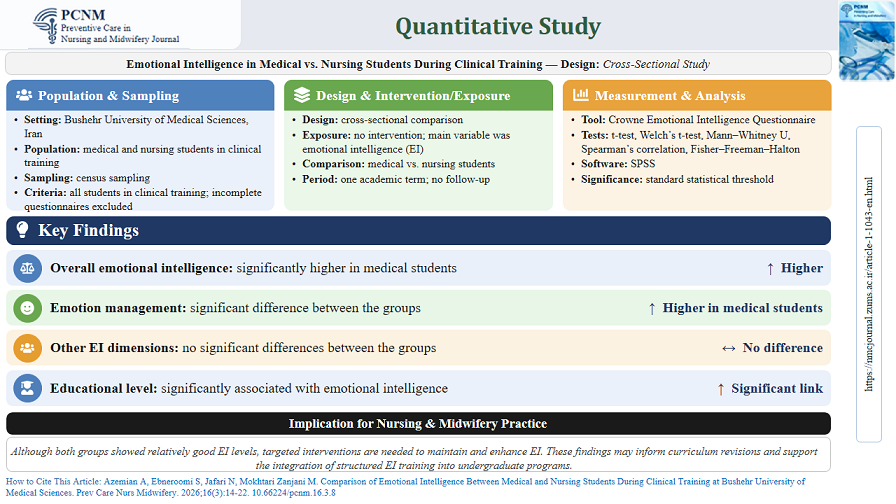
Graphical Abstract:
Reseach Highlights:
Knowledge Translation Statement
Audience: Nursing and medical education managers, clinical training coordinators
Medical students had higher total emotional intelligence than nursing students, mainly in emotion management. Pre-intern students scored higher than interns, and age and gender showed no meaningful association. Managers may consider embedding emotional intelligence and communication workshops into clinical training, especially for interns.
Type of Study: Orginal research |
Subject:
Multidisciplinary
References
1. Sternberg RJ. A theory of adaptive intelligence and its relation to general intelligence. Journal of Intelligence. 2019;7(4):23. [https://doi.org/10.3390/jintelligence7040023] [PMID]
2. Bjorklund-Young A. What do we know about developing students' non-cognitive skills? [Internet]. Baltimore: Institute for Education Policy, Johns Hopkins School of Education; 2016 [cited 2026 Aug 7]. [http://jscholarship.library.jhu.edu/items/356b1942-95f0-400c-ac38-86b4eafa94d1]
3. Benington MR, Hussey LC, Long JM. Emotional intelligence and successful completion of nursing courses in associate degree nursing students. Teaching and Learning in Nursing. 2020;15(3):186-189. [https://doi.org/10.1016/j.teln.2020.03.003]
4. Guo M, Yin X, Wang C, Nie L, Wang G. Emotional intelligence and academic procrastination among junior college nursing students. Journal of Advanced Nursing. 2019;75(11):2710-2718. [https://doi.org/10.1111/jan.14101] [PMID]
5. Ackley D. Emotional intelligence: a practical review of models, measures, and applications. Consulting Psychology Journal: Practice and Research. 2016;68(4):269-286. [https://doi.org/10.1037/cpb0000070]
6. Mayer JD, Salovey P, Caruso DR. Target articles: "emotional intelligence: theory, findings, and implications". Psychological Inquiry. 2004;15(3):197-215. [https://doi.org/10.1207/s15327965pli1503_02]
7. Singh A, Prabhakar R, Kiran JS. Emotional intelligence: a literature review of its concept, models, and measures. Journal of Positive School Psychology. 2022;6(10):113-125. [https://journalppw.com/index.php/jpsp/article/view/13616]
8. Afzalur Rahim M, Psenicka C. Relationship between emotional intelligence and effectiveness of leader role: a dyadic study in four countries. International Journal of Organizational Analysis. 2005;13(4):327-342. [https://doi.org/10.1108/eb029010]
9. Ghrayeb F, Zaben K, Haddad RH, Ghrayeb N, Barhoush M, Zuraikat N, et al. Exploring the relationship between emotional intelligence and communication skills in nurses: a cross-sectional study. BMC Nursing. 2025;24(1):1002. [https://doi.org/10.1186/s12912-025-03679-5] [PMID]
10. Foji S, Vejdani M, Salehiniya H, Khosrorad R. The effect of emotional intelligence training on general health promotion among nurse. Journal of Education and Health Promotion. 2020;9(1):4. [https://doi.org/10.4103/jehp.jehp_134_19] [PMID]
11. Oweidat I, Alzoubi M, Shosha GA, Ta'an W, Khalifeh A, Alzoubi MM, et al. Relationship between emotional intelligence and quality of healthcare among nurses. Frontiers in Psychology. 2024;15:1423235. [https://doi.org/10.3389/fpsyg.2024.1423235] [PMID]
12. Riaz M, Roger R, Bashir S, Javed K, Charles R, Khursheed U. Communication skills and emotional intelligence among nursing students on patient's outcome. Nursearcher (Journal of Nursing & Midwifery Sciences). 2025;5(1):67-72. [https://doi.org/10.54393/nrs.v5i1.148]
13. Kosydar-Bochenek J, Kobak J, Szczupak M, Będkowski JH, Krupa-Nurcek S. Delivering bad news in clinical practice: the role of communication skills and emotional intelligence among Polish healthcare professionals. BMC Medical Education. 2025;25(1):153. [https://doi.org/10.1186/s12909-025-08222-3] [PMID]
14. Amini M, Amini M, Nabiee P, Delavari S. The relationship between emotional intelligence and communication skills in healthcare staff. Shiraz E-Medical Journal. 2018;20(4):e80275. [https://doi.org/10.5812/semj.80275]
15. Mohammadi A, Shamsi A. The relationship between emotional intelligence and academic achievement in anesthesiology and operating room students of Tehran University of Medical Sciences. Journal of Paramedical Faculty of Tehran University of Medical Sciences (Piyavard Salmat). 2019;6(3):248-256. [https://doi.org/10.29252/mcs.6.3.10]
16. Tasdighi Z, Ramazanzade KH, Nourani A. Emotional intelligence, depression and stress in students of Birjand University of Medical Sciences. Journal of Development Strategies in Medical Education. 2022;8(4):67-75. [http://dsme.hums.ac.ir/article-1-334-en.html]
17. Maity S, De Filippis SM, Aldanese A, McCulloch MA, Sandor AP, Perez Cajigas JE, et al. Enhancing emotional intelligence in medical education: a systematic review of interventions. Frontiers in Medicine. 2025;12:1587090. [https://doi.org/10.3389/fmed.2025.1587090] [PMID]
18. Kawashima T, Ota Y, Aikawa G, Watanabe M, Ashida K, Sakuramoto H. Effectiveness of emotional intelligence training on nurses' and nursing students' emotional intelligence, resilience, stress, and communication skills: a systematic review and meta-analysis. Nurse Education Today. 2025;151:106743. [https://doi.org/10.1016/j.nedt.2025.106743] [PMID]
19. Abdali N, Nobahar M, Ghorbani R. Evaluation of emotional intelligence, sleep quality, and fatigue among Iranian medical, nursing, and paramedical students: a cross-sectional study. Qatar Medical Journal. 2019;2019(3):15. [https://doi.org/10.5339/qmj.2019.15] [PMID]
20. Saatchi M KK, Askarian M. . Psychological Tests. Tehran: Virayesh; 2012.
21. Choudry ZA, Malik SA, Malik MTB, Javed MS. Comparative Analysis of Awareness Regarding the Impact of Emotional Intelligence on Academic Performance Among MBBS and Allied Health Sciences Students at Sargodha Medical College. Pak-Euro Journal of Medical and Life Sciences.2024; 7(4):605-611. [https://readersinsight.net/index.php/PJMLS/article/view/3170]
22. Dewsnap MA, Arroliga AC, Adair-White BA, editors. The lived experience of medical training and emotional intelligence. Baylor University Medical Center Proceedings. 2021;34(6):744-747. [https://doi.org/10.1080/08998280.2021.1941582] [PMID]
23. Horne MJ, Allbright M, D'Nea AG, Patel A. Emotional intelligence in medicine: an investigation of the significance for physicians, residents, and medical students-a systematic review. Journal of Surgical Education. 2024;81(12):103307. [https://doi.org/10.1016/j.jsurg.2024.103307] [PMID]
24. Talman K, Hupli M, Rankin R, Engblom J, Haavisto E. Emotional intelligence of nursing applicants and factors related to it: a cross-sectional study. Nurse Education Today. 2020;85:104271. [https://doi.org/10.1016/j.nedt.2019.104271] [PMID]
25. Bagle TR, Baviskar PA, Mital AK, Vare VA, Hire RC, Chincholkar VS. Emotional intelligence assessment in undergraduate medical students: a cross-sectional study. Journal of Clinical and Diagnostic Research. 2021;15(3): JC05-JC08. [https://doi.org/10.7860/JCDR/2021/47709.14665]
26. Vasefi A, Dehghani M, Mirzaaghapoor M. Emotional intelligence of medical students of Shiraz University of Medical Sciences: cross sectional study. Annals of Medicine and Surgery. 2018;32:26-31. [https://doi.org/10.1016/j.amsu.2018.07.005] [PMID]
27. Hanson VF, Pitre S, Dabou EA. Emotional intelligence levels among nursing students at RAK Medical and Health Sciences University, United Arab Emirates. New Emirates Medical Journal. 2024;5(1): E02506882330415. [https://doi.org/10.2174/0102506882330415250204052551]
28. Mahanta K, Roy S. Relationship between academic stress and emotional intelligence of secondary level students. The Social Science Review: A Multidisciplinary Journal. 2024;2(4):133-142. [https://tssreview.in/wp-content/uploads/2024/08/20-Kamal-Mohanta.pdf]
29. Budler LC, Gosak L, Vrbnjak D, Pajnkihar M, Štiglic G, editors. Emotional intelligence among nursing students: findings from a longitudinal study. Healthcare. 2022;10(10):2032. [https://doi.org/10.3390/healthcare10102032] [PMID]
30. Mohamed SAEF. Relationship between emotional intelligence and self-esteem among nursing students. Egyptian Nursing Journal. 2019;16(2):53-58. [https://doi.org/10.4103/ENJ.ENJ_2_19]
31. Shubayr N, Dailah H. Assessment of emotional intelligence, self-efficacy, and perceived stress among nursing students in clinical practice: a cross-sectional study. BMC Nursing. 2025;24(1):505. [https://doi.org/10.1186/s12912-025-03109-6] [PMID]
Send email to the article author
| Rights and permissions | |
 |
This work is licensed under a Creative Commons Attribution-NonCommercial 4.0 International License. |