
Preventive Care in Nursing and Midwifery

Volume 16, Issue 2 (4-2026)
Prev Care Nurs Midwifery 2026, 16(2): 83-96 |
Back to browse issues page


Ethics code: IR.TUMS.FNM.REC.1398.019


Download citation:
BibTeX | RIS | EndNote | Medlars | ProCite | Reference Manager | RefWorks
Send citation to:


BibTeX | RIS | EndNote | Medlars | ProCite | Reference Manager | RefWorks
Send citation to:
Gheiasi S F, Cheraghi M A, Dastjerdi M, Navid H, Khoshavi M, Kamali K et al . Effect of an Educational Program Based on the Partnership Care Model on Treatment Adherence in Patients with Heart Failure: A Randomized Controlled Trial. Prev Care Nurs Midwifery 2026; 16 (2) :83-96
URL: http://nmcjournal.zums.ac.ir/article-1-1045-en.html
URL: http://nmcjournal.zums.ac.ir/article-1-1045-en.html
Seyede Fatemeh Gheiasi  , Mohammad Ali Cheraghi , Mahdieh Dastjerdi , Hossein Navid , Meysam Khoshavi , Koorosh Kamali , Elham Navab *
, Mohammad Ali Cheraghi , Mahdieh Dastjerdi , Hossein Navid , Meysam Khoshavi , Koorosh Kamali , Elham Navab *
Critical Care and Geriatric Nursing Department, Nursing & Midwifery School, Tehran University of Medical Sciences, Tehran, Iran , navab@sina.tums.ac.ir
Abstract: (517 Views)
Background: Treatment adherence is a cornerstone of heart failure management and is closely associated with reduced hospital readmissions and improved clinical outcomes. Despite advances in patient education and disease management, achieving sustained patient engagement in the care process remains challenging.
Objectives: To evaluate the effect of an educational program based on the partnership care model on treatment adherence among patients with heart failure.
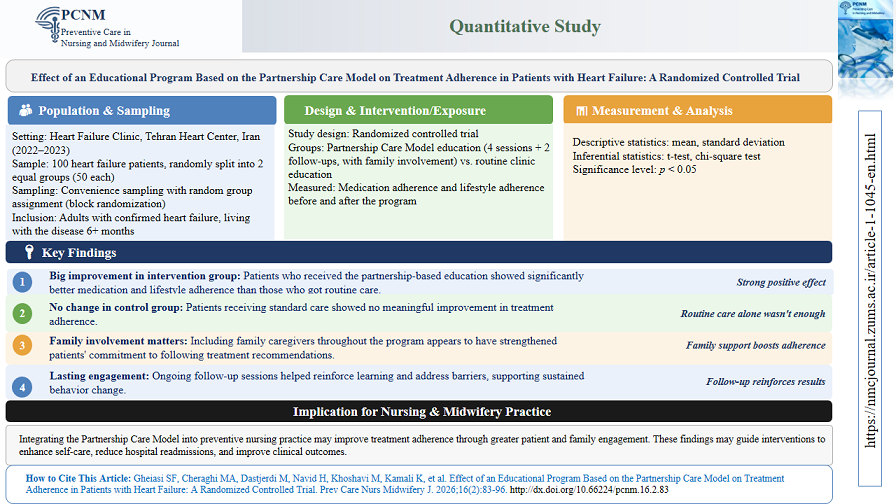
Methods: This randomized controlled trial enrolled 100 patients with heart failure who attended the Heart Failure Clinic at Tehran Heart Center, Iran, in 2022. Participants were allocated to either the intervention or control group using permuted block randomization with a block size of four and a 1:1 allocation ratio. The intervention group participated in an educational program based on the partnership care model, which comprised four collaborative educational sessions followed by two collaborative follow-up sessions. The control group received routine educational care provided by the clinic. Data were collected using a demographic and clinical characteristics questionnaire and a researcher-developed treatment adherence questionnaire. Statistical analyses were performed using the chi-square test, independent-sample t test, and paired-sample t test.
Results: Following the intervention, the intervention group demonstrated significantly higher mean scores for medication adherence, lifestyle adherence, and overall treatment adherence than the control group (all p < 0.001). Within-group analysis also showed a significant improvement in treatment adherence after the intervention among participants in the intervention group. In contrast, no statistically significant change was observed in the control group (p > 0.05).
Conclusion: An educational program based on the partnership care model improved treatment adherence among patients with heart failure. Incorporating this approach into routine nursing care may help improve treatment adherence and support patient participation in the management of heart failure.
Objectives: To evaluate the effect of an educational program based on the partnership care model on treatment adherence among patients with heart failure.
Methods: This randomized controlled trial enrolled 100 patients with heart failure who attended the Heart Failure Clinic at Tehran Heart Center, Iran, in 2022. Participants were allocated to either the intervention or control group using permuted block randomization with a block size of four and a 1:1 allocation ratio. The intervention group participated in an educational program based on the partnership care model, which comprised four collaborative educational sessions followed by two collaborative follow-up sessions. The control group received routine educational care provided by the clinic. Data were collected using a demographic and clinical characteristics questionnaire and a researcher-developed treatment adherence questionnaire. Statistical analyses were performed using the chi-square test, independent-sample t test, and paired-sample t test.
Results: Following the intervention, the intervention group demonstrated significantly higher mean scores for medication adherence, lifestyle adherence, and overall treatment adherence than the control group (all p < 0.001). Within-group analysis also showed a significant improvement in treatment adherence after the intervention among participants in the intervention group. In contrast, no statistically significant change was observed in the control group (p > 0.05).
Conclusion: An educational program based on the partnership care model improved treatment adherence among patients with heart failure. Incorporating this approach into routine nursing care may help improve treatment adherence and support patient participation in the management of heart failure.
Keywords: Partnership Care Model, Treatment Adherence, Heart Failure, Patient Compliance, Cooperative Behavior.
Full-Text [PDF 877 kb]
(152 Downloads)
| | Full-Text (HTML) (83 Views)
Graphical Abstract:
Reseach Highlights:
Knowledge Translation Statement
Audience: Nursing managers and heart failure clinic administrators
A partnership care model program was associated with improved medication and lifestyle adherence in heart failure patients. Managers may consider incorporating this collaborative, nurse-led, family-engaging approach into routine heart failure care.
Type of Study: Orginal research |
Subject:
Nursing
References
1. Herber OR, Kastaun S, Wilm S, Barroso J. From Qualitative Meta-Summary to Qualitative Meta-Synthesis: Introducing a New Situation-Specific Theory of Barriers and Facilitators for Self-Care in Patients with Heart Failure. Qualitative Health Research. 2019;29(1):96-106. [https://doi.org/10.1177/1049732318800290] [PMID]
2. Heidenreich PA, Bozkurt B, Aguilar D, Allen LA, Byun JJ, Colvin MM, et al. 2022 AHA/ACC/HFSA Guideline for the Management of Heart Failure: Executive Summary: A Report of the American College of Cardiology/American Heart Association Joint Committee on Clinical Practice Guidelines. Journal of the American College of Cardiology. 2022;145(18):e876-e894. [https://doi.org/10.1161/CIR.0000000000001062]
3. Lippi G, Sanchis-Gomar F. Global Epidemiology and Future Trends of Heart Failure. AME Medical Journal. 2020;5:1-6. [https://doi.org/10.21037/amj.2020.03.03]
4. Zahed Nakhjiri L, et al. Assessing the Self-Care Status in Older Adults Diagnosed with Heart Failure and Hospitalized in the Cardiovascular Intensive Care Units of the Public Hospitals in the East of Guilan, Iran (2020). Iran Journal of Nursing. 2021;34(129):67-81. [https://doi.org/10.52547/ijn.34.129.67]
5. Nordfonn OK, Morken IM, Bru LE, Husebø AML. Patients' Experience with Heart Failure Treatment and Self-Care: A Qualitative Study Exploring the Burden of Treatment. Journal of Clinical Nursing. 2019;28(9-10):1782-1793. [https://doi.org/10.1111/jocn.14799] [PMID]
6. Sarrafzadegan N, Mohammmadifard N. Cardiovascular Disease in Iran in the Last 40 Years: Prevalence, Mortality, Morbidity, Challenges and Strategies for Cardiovascular Prevention. Archives of Iranian Medicine. 2019;22(4):204-210. [https://pubmed.ncbi.nlm.nih.gov/31126179/]
7. Bahroodi PS, Safa A, Ajorpaz NM. Medication Nonadherence in Patients with Heart Failure: A Systematic Review. Journal of Education and Health Promotion. 2026;15:1-9. [https://doi.org/10.4103/jehp.jehp_1550_24] [PMID]
8. Jankowska-Polańska B, Świątoniowska-Lonc N, Sławuta A, Krówczyńska D, Dudek K, Mazur G. Patient-Reported Compliance in Older Age Patients with Chronic Heart Failure. PLoS One. 2020;15(4):1-16. [https://doi.org/10.1371/journal.pone.0231076] [PMID]
9. Goudarzi H, Barati M, Bashirian S, Moeini B. Determinants of Medication Adherence among Hypertensive Patients Using the Pender's Health Promotion Model. Journal of Education and Health Promotion. 2020;9:1-7. [https://doi.org/10.4103/jehp.jehp_687_19]
10. Gunnthorsdottir I, Gunnarsdottir AI, Andersen K, Svansdottir E, Thrainsdottir IS, Forsyth P, et al. Exploring Medication Adherence in Heart Failure from a Patient Perspective: A Qualitative Study. Circulation: Heart Failure Journal. 2026;19(5):598-609. [https://doi.org/10.1161/CIRCHEARTFAILURE.125.014133] [PMID]
11. Kvarnström K, Westerholm A, Airaksinen M, Liira H. Factors Contributing to Medication Adherence in Patients with a Chronic Condition: A Scoping Review of Qualitative Research. Pharmaceutics. 2021;13(7):1-41. [https://doi.org/10.3390/pharmaceutics13071100] [PMID]
12. ShariatPanahi S, Farahani MA, Rafii F, Rassouli M, Tehrani FJ. Application of Roy Adaptation Model on Adherence to Treatment in Patients with Heart Failure. Revista Latinoamericana de Hipertensión. 2020;15(2):128-137. [https://doi.org/10.5281/zenodo.4074387]
13. Kamrani F, Nikkhah S, Borhani F, Jalali M, Shahsavari S, Nirumand-Zandi K. The Effect of Patient Education and Nurse-Led Telephone Follow-Up (Telenursing) on Adherence to Treatment in Patients with Acute Coronary Syndrome. Iranian Journal of Cardiovascular Nursing. 2015;4(3):16-24. [http://journal.icns.org.ir/article-1-346-en.html]
14. Wu JR, Moser DK. Medication Adherence Mediates the Relationship between Heart Failure Symptoms and Cardiac Event-Free Survival in Patients with Heart Failure. Journal of Cardiovascular Nursing. 2018;33(1):40-46. [https://doi.org/10.1097/JCN.0000000000000427] [PMID]
15. Pallangyo P, Millinga J, Bhalia S, Mkojera Z, Misidai N, Swai HJ, et al. Medication Adherence and Survival among Hospitalized Heart Failure Patients in a Tertiary Hospital in Tanzania: A Prospective Cohort Study. BMC Research Notes. 2020;13(1):1-8. [https://doi.org/10.1186/s13104-020-04959-w] [PMID]
16. Sánchez LZR, Correa LEE, Figuera FAC. Adherence to Pharmacological and Non-Pharmacological Treatment in Patients with Heart Failure. Enfermería Global. 2014;13(4):15. [https://doi.org/10.6018/eglobal.13.4.178311]
17. Silva AF, Cavalcanti AC, Malta M, Arruda CS, Gandin T, Fé AD, et al. Treatment Adherence in Heart Failure Patients Followed Up by Nurses in Two Specialized Clinics. Revista Latino-Americana de Enfermagem. 2015;23(5):888-894. [https://doi.org/10.1590/0104-1169.0268.2628] [PMID]
18. Ruppar TM, et al. Medication Adherence Interventions Improve Heart Failure Mortality and Readmission Rates: Systematic Review and Meta-Analysis of Controlled Trials. Journal of the American Heart Association. 2016;5(6):e002606. [https://doi.org/10.1161/JAHA.115.002606] [PMID]
19. Mikaili N, Ghasemi MA, Salari S, Sakeni Z. Theoretical and Practical Dimensions of Adherence to Treatment in Patients: A Review Study. Medical Journal of Mashhad University of Medical Sciences. 2019;62(2):1403-1419. [https://doi.org/10.22038/mjms.2019.14116]
20. Shah D, Simms K, Barksdale DJ, Wu JR. Improving Medication Adherence of Patients with Chronic Heart Failure: Challenges and Solutions. Research Reports in Clinical Cardiology. 2015;6:87-95. [https://doi.org/10.2147/RRCC.S50658]
21. Albano MG, Jourdain P, De Andrade V, Domenke A, Desnos M, d'Ivernois JF. Therapeutic Patient Education in Heart Failure: Do Studies Provide Sufficient Information about the Educational Program? Archives of Cardiovascular Diseases. 2014;107(5):328-339. [https://doi.org/10.1016/j.acvd.2013.12.002] [PMID]
22. Dessie G, Burrowes S, Mulugeta H, Haile D, Negess A, Jara D, et al. Effect of a Self-Care Educational Intervention to Improve Self-Care Adherence among Patients with Chronic Heart Failure: A Clustered Randomized Controlled Trial in Northwest Ethiopia. BMC Cardiovascular Disorders. 2021;21(1):1-11. [https://doi.org/10.1186/s12872-021-02170-8] [PMID]
23. Unverzagt S, Meyer G, Mittmann S, Samos FA, Unverzagt M, Prondzinsky R. Improving Treatment Adherence in Heart Failure: A Systematic Review and Meta-Analysis of Pharmacological and Lifestyle Interventions. Deutsches Ärzteblatt International. 2016;113(25):423-430. [https://doi.org/10.3238/arztebl.2016.0423] [PMID]
24. Kollia ZA, Giakoumidakis K, Brokalaki H. The Effectiveness of Nursing Education on Clinical Outcomes of Patients with Heart Failure: A Systematic Review. Jundishapur Journal of Chronic Disease Care. 2016;5(2):1-11. [https://doi.org/10.17795/jjcdc-35881]
25. Tabarsy B, Ghiasvandian S, Moslemi Meheni S, Mohammadzadeh Zarankesh S. Evaluation of the Effectiveness of Collaborative Care Model on the Quality of Life and Metabolic Indexes in Patients with Type 2 Diabetes. Journal of Education and Community Health. 2018;5(1):4-12. [https://doi.org/10.21859/jech.5.1.4]
26. Borji M, Motaghi M. The Effect of Collaborative Care Model on Social Support and General Self-Efficacy of the Elderly. Iranian Journal of Psychiatric Nursing. 2017;5(1):21-29. [https://doi.org/10.21859/ijpn-05014]
27. Mohammadi E. Design and Evaluation of Partnership Care Model in Control of High Blood Pressure [PhD dissertation]. Tehran: Tarbiat Modares University, Faculty of Medical Sciences; 2002. p. 198.
28. Granger BB, Ekman I, Hernandez AF, Sawyer T, Bowers MT, DeWald TA, et al. Results of the Chronic Heart Failure Intervention to Improve Medication Adherence Study: A Randomized Intervention in High-Risk Patients. American Heart Journal. 2015;169(4):539-548. [https://doi.org/10.1016/j.ahj.2015.01.006] [PMID]
29. Seyed Fatemi N, Rafii F, Hajizadeh E, Modanloo M. Psychometric Properties of the Adherence Questionnaire in Patients with Chronic Disease: A Mixed-Methods Study. Koomesh. 2018;20(2):179-191. [https://brieflands.com/journals/koomesh/articles/152948]
30. Seid MA, Abdela OA, Zeleke EG. Adherence to Self-Care Recommendations and Associated Factors among Adult Heart Failure Patients: From the Patients' Point of View. PLoS One. 2019;14(2):1-13. [https://doi.org/10.1371/journal.pone.0211768] [PMID]
31. Vellone E, De Maria M, Iovino P, Barbaranelli C, Zeffiro V, Pucciarelli G, et al. The Self-Care of Heart Failure Index Version 7.2: Further Psychometric Testing. Research in Nursing & Health. 2020;43(6):640-650. [https://doi.org/10.1002/nur.22083] [PMID]
32. Seyedfatemi N, Zeinali E, Bahremand M, Mehran A, Zeinali M. The Relationship between Medication Adherence and Coping Skills in Patients with Heart Failure. Avicenna Journal of Nursing and Midwifery Care. 2019;27(2):89-96. [https://doi.org/10.30699/sjhnmf.27.2.89]
33. Amininasab SS, Lolaty HA, Moosazadeh M, Shafipour V. Medication Adherence and Its Predictors among Patients with Heart Failure. Nursing and Midwifery Studies. 2018;7(2):81-86. [https://doi.org/10.4103/nms.nms_9_17]
34. Tam NB, Chunlestskul K, Deoisres W, Rosenberg E. Factors Predicting Treatment Adherence among Patients with Heart Failure in Vietnam. Journal of Nursing and Health Care. 2016;34(1):143-152. [https://he01.tci-thaijo.org/index.php/jnat-ned/article/view/57367]
35. Baymot A, Gela D, Bedada T. Adherence to Self-Care Recommendations and Associated Factors among Adult Heart Failure Patients in Public Hospitals, Addis Ababa, Ethiopia, 2021: Cross-Sectional Study. BMC Cardiovascular Disorders. 2022;22(1):1-11. [https://doi.org/10.1186/s12872-022-02717-3] [PMID]
36. Clements L, Frazier SK, Lennie TA, Chung ML, Moser DK. Improvement in Heart Failure Self-Care and Patient Readmissions with Caregiver Education: A Randomized Controlled Trial. Western Journal of Nursing Research. 2023;45(5):402-415. [https://doi.org/10.1177/01939459221141296] [PMID]
37. Najafi F, Pishkar Mofrad Z, Ayubi E, Hosseini R. The Effect of Self-Management Based Discharge Planning on Treatment Adherence in Patients with Heart Failure. Hayat. 2021;26(4):455-468. [https://sid.ir/paper/396584/en]
38. Mohammadzadeh S, Olyaie N, Ghanei-Gheshlagh R. Effect of Education Based on Collaborative Care Model on the Self-Efficacy of Patients with Heart Failure. Journal of Preventive and Complementary Medicine. 2022;1(3):143-150. [https://doi.org/10.22034/ncm.2022.336458.1034]
39. Zakeri MA, Khoshnood Z, Dehghan M, Abazari F. The Effect of the Continuous Care Model on Treatment Adherence in Patients with Myocardial Infarction: A Randomized Controlled Trial. Journal of Research in Nursing. 2020;25(1):54-65. [https://doi.org/10.1177/1744987119890666] [PMID]
40. Bahramnezhad F, Sanaie N, Jackson AC, Shariati E, Atashzadeh-Shoorideh F. The Effect of Partnership-Based Education on Adherence to the Treatment Plans in Open Heart Surgery. Journal of Education and Health Promotion. 2021;10:1-21. [https://doi.org/10.4103/jehp.jehp_1463_20] [PMID]
41. Kobraei AA, Adib HM, Kargar K, Miranzadeh S. The Effect of Educational Package on Adherence to Treatment and Health Literacy in Patients with Heart Failure. Feyz Journal of Kashan University of Medical Sciences. 2022;26(3):302-310. [https://sid.ir/paper/1021370/en]
42. Falahinia G, Ghanbari Azarm Z, Soltanian AR, Maghsoudi Z, Oshvandi K. Comparing the Effect of Patient Education with or without Participation of Family on Adherence to Treatment Regimen in Patients with Chronic Heart Failure. Avicenna Journal of Nursing and Midwifery Care. 2018;26(4):267-274. [https://doi.org/10.30699/sjhnmf.26.4.267]
43. Borhani F, Khoshab H, Abbaszadeh A, Rashidinejad H, Mohammadi E. Study of the Effect of Partnership Care Model on the Quality of Life in Patients with Heart Failure. Journal of Critical Care Nursing. 2012;5(1):43-48. [http://jccnursing.com/article-1-213-en.html]
Send email to the article author
| Rights and permissions | |
 |
This work is licensed under a Creative Commons Attribution-NonCommercial 4.0 International License. |