
Preventive Care in Nursing and Midwifery

Volume 16, Issue 1 (1-2026)
Prev Care Nurs Midwifery 2026, 16(1): 85-104 |
Back to browse issues page

Ethics code: IR.ZUMS.REC.1400.290


Download citation:
BibTeX | RIS | EndNote | Medlars | ProCite | Reference Manager | RefWorks
Send citation to:


BibTeX | RIS | EndNote | Medlars | ProCite | Reference Manager | RefWorks
Send citation to:
Nouri M, Aligholipour M, Costeira C, Hanifi N. A Concept Development of Risk Perceptions During COVID-19: Application of Schwartz-Barcott and Kim's Hybrid Model. Prev Care Nurs Midwifery 2026; 16 (1) :85-104
URL: http://nmcjournal.zums.ac.ir/article-1-1048-en.html
URL: http://nmcjournal.zums.ac.ir/article-1-1048-en.html

Social Determinants of Health Research Center, Health and Metabolic Diseases Research Institute, Zanjan University of Medical Sciences, Zanjan, Iran , nasrinhanifi@gmail.com
Abstract: (579 Views)
Background: Healthcare behaviors, including preventive practices, treatment adherence, and decision-making during health crises, are strongly influenced by individual risk perceptions.
Objectives: This study aimed to understand risk perception during the COVID-19 pandemic.
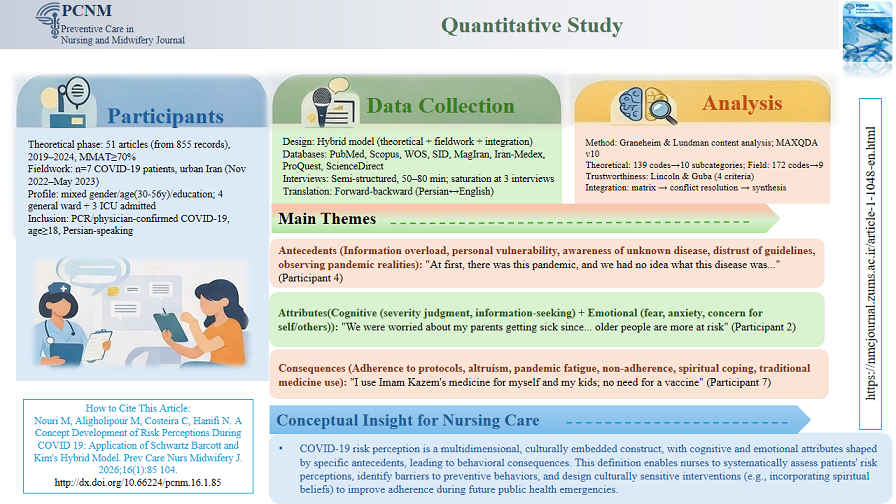
Methods: A hybrid concept analysis was conducted using the Schwartz-Barcott and Kim model in three phases: theoretical (systematic review of 51 articles from PubMed, Scopus, Web of Science, SID, MagIran, and IranMedex, 2019–2024), fieldwork (semi-structured interviews with seven COVID-19 patients), and final analytical integration.
Results: The theoretical phase generated 139 initial codes and 10 subcategories, whereas the fieldwork phase yielded 172 initial codes and nine subcategories. COVID-19 risk perception emerged as a multifaceted phenomenon comprising three categories: antecedents (information overload, personal vulnerability, awareness of an unknown disease, distrust of guidelines, and observing pandemic realities), attributes (cognitive dimensions, including information seeking and severity judgment, and emotional dimensions of fear and anxiety), and consequences (ranging from adherence to protective protocols and altruism to pandemic fatigue and non-adherence). The fieldwork phase also identified culturally specific influences within the Iranian context, including reliance on spiritual beliefs and traditional medicine.
Conclusion: COVID-19 risk perception is a multidimensional construct with cognitive and emotional attributes shaped by specific antecedents and leading to behavioral consequences. This definition enables nurses to systematically assess patients' risk perceptions, identify barriers to preventive behaviors, and develop culturally sensitive interventions to improve adherence during future public health emergencies.
Objectives: This study aimed to understand risk perception during the COVID-19 pandemic.
Methods: A hybrid concept analysis was conducted using the Schwartz-Barcott and Kim model in three phases: theoretical (systematic review of 51 articles from PubMed, Scopus, Web of Science, SID, MagIran, and IranMedex, 2019–2024), fieldwork (semi-structured interviews with seven COVID-19 patients), and final analytical integration.
Results: The theoretical phase generated 139 initial codes and 10 subcategories, whereas the fieldwork phase yielded 172 initial codes and nine subcategories. COVID-19 risk perception emerged as a multifaceted phenomenon comprising three categories: antecedents (information overload, personal vulnerability, awareness of an unknown disease, distrust of guidelines, and observing pandemic realities), attributes (cognitive dimensions, including information seeking and severity judgment, and emotional dimensions of fear and anxiety), and consequences (ranging from adherence to protective protocols and altruism to pandemic fatigue and non-adherence). The fieldwork phase also identified culturally specific influences within the Iranian context, including reliance on spiritual beliefs and traditional medicine.
Conclusion: COVID-19 risk perception is a multidimensional construct with cognitive and emotional attributes shaped by specific antecedents and leading to behavioral consequences. This definition enables nurses to systematically assess patients' risk perceptions, identify barriers to preventive behaviors, and develop culturally sensitive interventions to improve adherence during future public health emergencies.
Keywords: Risk Perception, COVID-19, Pandemic, Hybrid Model, Concept Analysis, Schwartz-Barcott and Kim.
Type of Study: Orginal research |
Subject:
Nursing
References
1. Kolosov VA, Tikunov VS, Eremchenko EN. Areas of socio-geographical study of the COVID-19 pandemic in Russia and the world. Geography, Environment, Sustainability. 2021;14(4):109-16. [https://doi.org/10.24057/2071-9388-2021-091]
2. Bae SY, Chang P-J. The effect of coronavirus disease-19 (COVID-19) risk perception on behavioural intention towards 'untact'tourism in South Korea during the first wave of the pandemic (March 2020). Current issues in Tourism. 2021;24(7):1017-35. [https://doi.org/10.1080/13683500.2020.1798895]
3. Taheri Chorsi S, Moqaddam M, Jafari Varjoshani N, Ahmadi F. Predicting Covid-19 Prevention Behaviors Based on the Health Belief Model Among the Students of Nursing and Midwifery Faculty of Zanjan City. Prev Care Nurs Midwifery J. 2023;13(3):70-80. [https://doi.org/10.61186/pcnm.13.3.70]
4. Purtiwi RGC, Artwodini F, Nadlifatin R. Analysis of the Role of the Use of Social Media and Emotions in Risk Perception and Prevention Behavior of Covid-19 Using the Preventive Behavior Model. Procedia Computer Science. 2024;234:1145-53. [https://doi.org/10.1016/j.procs.2024.03.110]
5. Charoghchian Khorasani E, Vahedian-Shahroodi M. Risk perception, public health and risk communication. Journal of Health Literacy. 2018;3(2):77-81. [https://doi.org/0.22038/JHL.2018.32549.1000]
6. Caserotti M, Girardi P, Rubaltelli E, Tasso A, Lotto L, Gavaruzzi T. Associations of COVID-19 risk perception with vaccine hesitancy over time for Italian residents. Social Science & Medicine. 2021;272:113688. [https://www.sciencedirect.com/science/article/pii/S0277953621000204] [PMID]
7. Bruine de Bruin W, Bennett D. Relationships Between Initial COVID-19 Risk Perceptions and Protective Health Behaviors: A National Survey. American Journal of Preventive Medicine. 2020;59(2):157-67. [https://www.sciencedirect.com/science/article/pii/S0749379720302130] [PMID]
8. Ibuka Y, Chapman GB, Meyers LA, Li M, Galvani AP. The dynamics of risk perceptions and precautionary behavior in response to 2009 (H1N1) pandemic influenza. BMC Infectious Diseases. 2010;10(1):296. [https://doi.org/10.1186/1471-2334-10-296] [PMID]
9. Sepucha K, Rudkin A, Baxter-King R, Stanton AL, Wenger N, Vavreck L, et al. Perceptions of COVID-19 Risk: How Did People Adapt to the Novel Risk? Medical Decision Making. 2024;44(2):163-74. [https://10.1177/0272989X231221448] [PMID]
10. Nouri M, Hanifi N, Babaeivahed N, Mortaghy Ghasemy M. COVID-19 Risk Perception and its Related Factors and Outcomes in Vulnerable Groups: A Systematic Review %J Preventive Care In Nursing and Midwifery Journal. Preventive Care in Nursing & Midwifery Journa. 2023;13(1):1-13. [http://nmcjournal.zums.ac.ir/article-1-789-en.html]
11. Cipolletta S, Andreghetti GR, Mioni G. Risk perception towards COVID-19: A systematic review and qualitative synthesis. International Journal of Environmental Research and Public Health. 2022;19(8):4649. [https://doi.org/10.3390/ijerph19084649] [PMID]
12. Samadipour E, Ghardashi FJJMM. Factors influencing Iranians' risk perception of Covid-19. Journal of Military Medicine. 2020;22(2):122-9. [https://doi.org/10.30491/JMM.22.2.122]
13. Beck U. Risk society: Towards a new modernity: sage; 1992.
14. Qin H, Sanders C, Prasetyo Y, Syukron M, Prentice E. Exploring the dynamic relationships between risk perception and behavior in response to the Coronavirus Disease 2019 (COVID-19) outbreak. Social Science & Medicine. 2021;285:114267. [https://doi.org/10.1016/j.socscimed.2021.114267] [PMID]
15. Wahlberg AAF, Sjoberg L. Risk perception and the media. Journal of Risk Research. 2000;3(1):31-50. [https://doi.org/10.1080/136698700376699]
16. Merkelbach I, Magnee T, Sana S, Kollmann J, Kocken P, Denktas S. Using the health belief model to explain COVID-19 vaccination hesitancy in Dutch urban citizens under thirty. Plos one. 2023;18(1):e0279453. [https://doi.org/10.1371/journal.pone.0279453] [PMID]
17. Kalantari N, Khoshgoftar M, Moradi F, Pirzadeh A. Evaluation of Pregnant Woman's Perception of COVID-19 Based on the Health Belief Model in Isfahan. Iranian Journal of Nursing and Midwifery Research. 2024;29(1):68-72. [https://doi.org/10.4103/ijnmr.ijnmr_337_21] [PMID]
18. Samadipour E, Zardosht R, Borzoee F, Navipur E, Ghardashi F. Iran's healthcare workers' risk perception of covid-19 at the beginning of the crisis and its influencing factors: a cross-sectional study. 2023.
19. Schwarz BD, Kim HS. An expansion and elaboration of the hybrid model of concept development. 2000.
20. Hong QN, Fàbregues S, Bartlett G, Boardman F, Cargo M, Dagenais P, et al. The Mixed Methods Appraisal Tool (MMAT) version 2018 for information professionals and researchers. Education for Information. 2018;34(4):285-91. [https://doi.org/10.3233/EFI-180221]
21. PRISMA Extension for Scoping Reviews (PRISMA-ScR): Checklist and Explanation. Annals of Internal Medicine. 2018;169(7):467-73. [https://www.acpjournals.org/doi/abs/10.7326/M18-0850]
22. Tacconelli E. Systematic reviews: CRD's guidance for undertaking reviews in health care. The Lancet Infectious Diseases. 2010;10(4):226. [https://doi.org/10.1016/S1473-3099(10)70065-7]
23. Hennink MM, Kaiser BN, Marconi VC. Code Saturation Versus Meaning Saturation: How Many Interviews Are Enough? Qualitative Health Research. 2016;27(4):591-608. [https://doi.org/10.1177/1049732316665344] [PMID]
24. Polit DF, Beck CT. Nursing research: Generating and assessing evidence for nursing practice: Lippincott Williams & Wilkins; 2008.
25. Graneheim UH, Lundman B. Qualitative content analysis in nursing research: concepts, procedures and measures to achieve trustworthiness. Nurse Education Today. 2004;24(2):105-12. [https://www.sciencedirect.com/science/article/pii/S0260691703001515] [PMID]
26. Walker LO, Avant KC. Strategies for theory construction in nursing: Pearson/Prentice Hall Upper Saddle River, NJ; 2005.
27. Rana IA, Bhatti SS, Aslam AB, Jamshed A, Ahmad J, Shah AA. COVID-19 risk perception and coping mechanisms: Does gender make a difference? International Journal of Disaster Risk Reduction. 2021;55:102096. [https://www.sciencedirect.com/science/article/pii/S2212420921000625] [PMID]
28. Sjöberg L, Moen B-E, Rundmo T. Explaining risk perception. An evaluation of the psychometric paradigm in risk perception research. 2004;10(2):665-12.
29. Santana González Y, Sagaró del Campo NM, Valdés García LEJRUyS. Percepción de riesgo vs Covid-19 en centros hospitalarios de Santiago de Cuba. 2021;13(4):195-206.
30. Bae SY, Chang P-J. The effect of coronavirus disease-19 (COVID-19) risk perception on behavioural intention towards 'untact' tourism in South Korea during the first wave of the pandemic (March 2020). Current Issues in Tourism. 2021;24(7):1017-35. [https://doi.org/10.1080/13683500.2020.1798895]
31. Matar-Khalil S, Ortiz Barrero MJ, González-Campos JJRPdMEySP. Design and validation of a questionnaire to assess the perceived risk of contracting COVID-19 in the colombian population. 2022;38:512-20. [https://doi.org/10.17843/rpmesp.2021.384.9298] [PMID]
32. Silva-Costa A, Griep RH, Rotenberg LJCdsp. Perceived risk from COVID-19 and depression, anxiety, and stress among workers in healthcare units. 2022;38:e00198321. [https://doi.org/10.1590/0102-311x00198321] [PMID]
33. Griesi JM, Bernardes JM, Alonso M, Gómez-Salgado J, Ruiz-Frutos C, Fagundo-Rivera J, et al. Risk perception of healthcare workers in the first wave of the COVID-19 pandemic in Brazil. Heliyon. 2024;10(3). [https://doi.org/10.1016/j.heliyon.2024.e25297] [PMID]
34. Wang J, Xiao M, Wang W, Sun Y. Risk perception, compliance with COVID-19 measures, and the role of social media after China's lockdown lift. Heliyon. 2024;10(3). [https://doi.org/10.1016/j.heliyon.2024.e24821] [PMID]
35. Guastafierro E, Toppo C, Magnani FG, Romano R, Facchini C, Campioni R, et al. Older adults' risk perception during the COVID-19 pandemic in lombardy region of italy: a cross-sectional survey. COVID-19 and Older Adults: Routledge; 2023. p. 17-30. [https://doi.org/10.4324/9781003400271-3]
36. Aibinuomo OR, Fasiku MM, Akande O, Kayode TG, Aliu-Ayinde MO, Adejoro IA, et al. The risk perception of COVID-19 and vaccine uptake among patients with chronic illnesses at a tertiary health facility in Nigeria. Ghana Medical Journal. 2024;58(3):198-206. [https:/doi.org/10.4314/gmj.v58i3.4] [PMID]
37. Pell del Río SM, Valdés Santiago D, Gil Rodríguez AL, Amador Romero FJ, Cairo Pell KS, Paneque Quevedo AA, et al. Percepción de riesgo durante el confinamiento por COVID-19 en una muestra cubana: resultados preliminares. 2021;11(1).
38. Ahmad MI, Naseem MA, Rehman RU, Zhuang W, Ali R, Manzoor MS. Risk Perception of International Medical Students About Coronavirus (COVID-19) in China and Their Willingness to Fly Back. Risk Management and Healthcare Policy. 2021;14(null):503-10. [https://doi.org/10.2147/RMHP.S278338] [PMID]
39. Alsoghair M, Almazyad M, Alburaykan T, Alsultan A, Alnughaymishi A, Almazyad S, et al. Medical students and COVID-19: knowledge, preventive behaviors, and risk perception. International journal of environmental research and public health. 2021;18(2):842. [https://doi.org/10.3390/ijerph18020842] [PMID]
40. Grabowski D, Meldgaard J, Hulvej Rod M. Altered self-observations, unclear risk perceptions and changes in relational everyday life: A qualitative study of psychosocial life with diabetes during the COVID-19 lockdown. Societies. 2020;10(3):63. [https://doi.org/10.3390/soc10030063]
41. Birihane BM, Bayih WA, Alemu AY, Belay DM. Perceived Barriers and Preventive Measures of COVID-19 Among Healthcare Providers in Debretabor, North Central Ethiopia, 2020. Risk Management and Healthcare Policy. 2020;13(null):2699-706. [https://doi.org/10.2147/RMHP.S287772] [PMID]
42. Chen G, Yao Y, Zhang Y, Zhao F. The impact of risk perception and institutional trust on COVID-19 vaccine hesitancy in China. Human Vaccines & Immunotherapeutics. 2024;20(1):2301793. [https://doi.org/10.1080/21645515.2024.2301793] [PMID]
43. Geržinič N, van Dalen M, Cats O. COVID-19 risk-perception in long-distance travel. European Transport Studies. 2024;1:100003. [https://doi.org/10.1016/j.ets.2024.100003]
44. Sánchez-Herrero H, Montserrat-Capella D, Revuelta-Zamorano M, Santano-Magariño A, Cazallo-Navarro P, Solís-Muñoz MJREdSP. Percepción del riesgo, información recibida y participación laboral de los trabajadores de un hospital universitario ante la pandemia de la COVID-19: e202210079. 2022;96:20 páginas- páginas.
45. Malecki KMC, Keating JA, Safdar N. Crisis Communication and Public Perception of COVID-19 Risk in the Era of Social Media. Clinical Infectious Diseases. 2020;72(4):697-702. [https://doi.org/10.1093/cid/ciaa758] [PMID]
46. Samadipour E, Ghardashi F, Aghaei N. Evaluation of Risk Perception of COVID-19 Disease: A Community-Based Participatory Study. Disaster Medicine and Public Health Preparedness. 2023;17:e10. [https://www.cambridge.org/core/product/A9435BB6E5268C9C0EC5D222D33400F1]
47. Hussain T, Wang D, Li B. Exploring the impact of social media on tourist behavior in rural mountain tourism during the COVID-19 pandemic: The role of perceived risk and community participation. Acta Psychologica. 2024;242:104113. [https://www.sciencedirect.com/science/article/pii/S0001691823002895] [PMID]
48. Aghababaei S, Bashirian S, Soltanian A, Refaei M, Omidi T, Ghelichkhani S, et al. Perceived risk and protective behaviors regarding COVID-19 among Iranian pregnant women. Middle East Fertility Society Journal. 2020;25(1):29. [https://doi.org/10.1186/s43043-020-00038-z] [PMID]
49. Mansilla Domínguez JM, Font Jiménez I, Belzunegui Eraso A, Peña Otero D, Díaz Pérez D, Recio Vivas AM. Risk Perception of COVID-19 Community Transmission among the Spanish Population. Int J Environ Res Public Health. 2020;17(23). [https://doi.org/10.3390/ijerph17238967] [PMID]
50. Abel M, Byker T, Carpenter J. Socially optimal mistakes? debiasing COVID-19 mortality risk perceptions and prosocial behavior. Journal of Economic Behavior & Organization. 2021;183:456-80. [https://www.sciencedirect.com/science/article/pii/S0167268121000184]
51. Gorini A, Fiabane E, Sommaruga M, Barbieri S, Sottotetti F, La Rovere MT, et al. Mental health and risk perception among Italian healthcare workers during the second month of the Covid-19 pandemic. Archives of Psychiatric Nursing. 2020;34(6):537-44. [https://www.sciencedirect.com/science/article/pii/S088394172030563X] [PMID]
52. Blanco-Daza M, de la Vieja-Soriano M, Macip-Belmonte S, Tercero-Cano MdC. Posstraumatic stress disorder in nursing staff during the COVID-19 pandemic. Enfermería Clínica (English Edition). 2022;32(2):92-102. [https://www.sciencedirect.com/science/article/pii/S244514792200025X] [PMID]
53. Tlale LB, Gabaitiri L, Totolo LK, Smith G, Puswane-Katse O, Ramonna E, et al. Acceptance rate and risk perception towards the COVID-19 vaccine in Botswana. PLOS ONE. 2022;17(2):e0263375. [https://doi.org/10.1371/journal.pone.0263375] [PMID]
54. Romeu-Labayen M, Tort-Nasarre G, Alvarez B, Subias-Miquel M, Vázquez-Segura E, Marre D, et al. Spanish nurses' experiences with personal protective equipment and perceptions of risk of contagion from COVID-19: A qualitative rapid appraisal. Journal of clinical nursing. 2022;31(15-16):2154-66. [https://doi.org/10.1111/jocn.16031] [PMID]
55. Román Hernández EJ, Román Hernández JJJAdlAdCdC. La comunicación y la motivación de la conducta en la construcción subjetiva de la percepción de riesgo. A propósito de la pandemia de COVID-19. 2021;11(3).
56. Khanal SP, van Teijlingen E, Sharma M, Acharya J, Sharma C, Kharel S, et al. Risk Perception and Protective Health Measure Regarding COVID-19 among Nepali Labour Migrants' Returnee from India. KMC Journal. 2024;6(1):313-30. [https://doi.org/10.3126/kmcj.v6i1.62364]
57. Köster M, Cunha AI, Costa V, Alves MPJAePL. Percepção de risco e comportamentos de proteção face à COVID-19 em estudantes do ensino superior: o papel mediador do medo. 2023;41(1). [https://doi.org/10.12804/revistas.urosario.edu.co/apl/a.11100]
58. Jiménez Puig E, González Cruz R, Pérez Leiva BDJRUyS. Ansiedad, miedo y percepción de riesgo ante la covid-19 en universitarios voluntarios a zona roja. 2022;14(2):273-9.
59. Giancola M, Palmiero M, D'Amico S. Dark Triad and COVID-19 vaccine hesitancy: The role of conspiracy beliefs and risk perception. Current psychology. 2024;43(18):16808-20. [https://doi.org/10.1007/s12144-023-04609-x] [PMID]
60. Zancu SA, Măirean C, Diaconu-Gherasim LR. The longitudinal relation between time perspective and preventive behaviors during the COVID-19 pandemic: The mediating role of risk perception. Current Psychology. 2024;43(14):12981-9. [https://doi.org/10.1007/s12144-022-03069-z] [PMID]
61. Fabelo Roche JR, Herrera Jiménez LF, Fernández-Castillo E, Iglesias-Moré SJRCdMGI. Percepción de riesgo y fatiga pandémica frente a la COVID-19 en Cuba. 2024;40.
62. Waterschoot J, Vansteenkiste M, Yzerbyt V, Morbée S, Klein O, Luminet O, et al. Risk perception as a motivational resource during the COVID-19 pandemic: the role of vaccination status and emerging variants. BMC Public Health. 2024;24(1):731. [https://doi.org/10.1186/s12889-024-18020-z] [PMID]
63. Gidado S, Musa M, Ba'aba AI, Francis MR, Okeke LA, Bukar FL, et al. Knowledge, risk perception and uptake of COVID-19 vaccination among internally displaced persons in complex humanitarian emergency setting, Northeast Nigeria. BMC Public Health. 2024;24(1):634. [https://doi.org/10.1186/s12889-024-18164-y] [PMID]
64. Alcántara-Garcés MT, Rodríguez-Ramírez AM, García-Ulloa AC, García-Alanis M, Martínez-Reyes GN, Del Moral Vidal LP, et al. Coping and risk perception during the COVID-19 pandemic in type 2 diabetes: Does it influence metabolic control? PLOS Global Public Health. 2024;4(2):e0002793. [https://doi.org/10.1371/journal.pgph.0002793] [PMID]
65. Arefi MF, Babaei AP, Barzanouni S, Ebrahimi S, Salehi AR, Khajehnasiri F, et al. Risk Perception in the COVID-19 pandemic; a health promotion approach. Journal of education and health promotion. 2022;11(1):118. [https://doi.org/10.4103/jehp.jehp_1162_21] [PMID]
66. Mahato P, Adhikari B, Marahatta SB, Bhusal S, Kunwar K, Yadav RK, et al. Perceptions around COVID-19 and vaccine hesitancy: A qualitative study in Kaski district, Western Nepal. PLOS Global Public Health. 2023;3(2):e0000564. [https://doi.org/10.1371/journal.pgph.0000564] [PMID]
67. Omar A, Gul I, Ali I. Exploring vaccine hesitancy and acceptance in the general population of Pakistan: Insights into COVID-19-related distress, risk perception, and stigma. Human Vaccines & Immunotherapeutics. 2024;20(1):2309699. [https://doi.org/10.1080/21645515.2024.2309699] [PMID]
68. Li H, Cao A, Chen S, Guo L. How does risk perception of the COVID-19 pandemic affect the consumption behavior of green food? Environment, Development and Sustainability. 2024;26(1):2307-29. [https://doi.org/10.1007/s10668-022-02819-0] [PMID]
69. Wang Y, Choudhury C, Hancock TO, Wang Y, Ortúzar JdD. Influence of perceived risk on travel mode choice during Covid-19. Transport Policy. 2024;148:181-91. [https://www.sciencedirect.com/science/article/pii/S0967070X2400009X]
70. Sun Z, Jin Z, Zhao K, Wen X, Lu H, Hu N, et al. The moderated-mediation role of risk perception and intolerance of uncertainty in the association between residual symptoms and psychological distress: a cross-sectional study after COVID-19 policy lifted in China. BMC Psychiatry. 2024;24(1):136. [https://doi.org/10.1186/s12888-024-05591-9] [PMID]
71. Diotaiuti P, Valente G, Mancone S, Falese L, Bellizzi F, Anastasi D, et al. Perception of Risk, Self-Efficacy and Social Trust during the Diffusion of Covid-19 in Italy. International Journal of Environmental Research and Public Health. 2021;18(7):3427. [https://doi.org/10.3390/ijerph18073427] [PMID]
72. Chiba A, Nakata T, Nguyen TL, Takaku R. COVID-19 risk perceptions in Japan: a cross-sectional study. Scientific Reports. 2024;14(1):16862. [https://doi.org/10.1038/s41598-024-67741-z] [PMID]
73. Limbu YB, Gautam RK, Pham L. The Health Belief Model Applied to COVID-19 Vaccine Hesitancy: A Systematic Review. Vaccines [Internet]. 2022; 10(6). [https://doi.org/10.3390/vaccines10060973] [PMID]
74. Liang B, Scammon DL. Incidence of online health information search: a useful proxy for public health risk perception. Journal of medical Internet research. 2013;15(6):e114. [https://doi.org/10.2196/jmir.2401] [PMID]
75. Savoia E, Harriman NW, Piltch-Loeb R, Bonetti M, Toffolutti V, Testa MA. Exploring the Association between Misinformation Endorsement, Opinions on the Government Response, Risk Perception, and COVID-19 Vaccine Hesitancy in the US, Canada, and Italy. 2022;10(5):671. [https://doi.org/10.3390/vaccines10050671] [PMID]
76. Zhong Y, Liu W, Lee TY, Zhao H, Ji J. Risk perception, knowledge, information sources and emotional states among COVID-19 patients in Wuhan, China. Nursing outlook. 2021;69(1):13-21. [https://doi.org/10.1016/j.outlook.2020.08.005] [PMID]
77. Hadlington L, Harkin L, Kuss D, Newman K, Ryding FC. Perceptions of Fake News, Misinformation, and Disinformation Amid the COVID-19 Pandemic: A Qualitative Exploration. Psychology of Popular Media. 2022;12. [https://doi.org/10.1037/ppm0000387]
78. Krause N, Freiling I, Beets B, Brossard D. Fact-checking as risk communication: the multi-layered risk of misinformation in times of COVID-19. Journal of Risk Research. 2020;23:1-8. [https://doi.org/10.1080/13669877.2020.1756385]
79. Mirzabeigi M, Mahdi E, Mirmehrabi A, Mirzabeigi AJQJoNM. Evaluation of effectiveness educational based on inter-professional approach on rate of empathy and inter-professional collaboration among nurses and physicians in emergency department during the Covid-19 pandemic. Quarterly Journal of Nursing Management. 2022;11(2):24-41.
80. Samadipour E, Zardosht R, Borzoee F, Navipur E, Ghardashi FJJoSUoMS. Iran's healthcare workers' risk perception of covid-19 at the beginning of the crisis and its influencing factors: a cross-sectional study. Journal of Sabzevar University of Medical Sciences. 2023;30(1):89-101.
81. Dryhurst S, Schneider CR, Kerr J, Freeman ALJ, Recchia G, van der Bles AM, et al. Risk perceptions of COVID-19 around the world. Journal of Risk Research. 2020;23(7-8):994-1006. [https://doi.org/10.1080/13669877.2020.1758193]
82. Graso M, Aquino K, Chen FX, Bardosh K. Blaming the unvaccinated during the COVID-19 pandemic: the roles of political ideology and risk perceptions in the USA. Journal of Medical Ethics. 2024;50(4):246. [https://doi.org/10.1136/jme-2022-108825] [PMID]
83. Gómez Campusano RI, Tamayo De la Cruz JY, Salinas Martínez AM, Quiroga García MÁ, Rodríguez Salcedo JEJRCdE. Ansiedad, autoeficacia y percepción de riesgo en estudiantes de Odontología durante la pandemia del COVID-19. 2024;61.
84. Pérez C, González-Agüero M, Bravo PJRmdC. Percepciones y experiencias de usuarios que recibieron cuidados ambulatorios de COVID-19 en Santiago de Chile. 2024;152(1):61-8. [http://dx.doi.org/10.4067/s0034-98872024000100061] [PMID]
Send email to the article author
| Rights and permissions | |
 |
This work is licensed under a Creative Commons Attribution-NonCommercial 4.0 International License. |