
Preventive Care in Nursing and Midwifery

Volume 16, Issue 2 (4-2026)
Prev Care Nurs Midwifery 2026, 16(2): 60-69 |
Back to browse issues page

Ethics code: IR.MUK.REC.1404.109


Download citation:
BibTeX | RIS | EndNote | Medlars | ProCite | Reference Manager | RefWorks
Send citation to:


BibTeX | RIS | EndNote | Medlars | ProCite | Reference Manager | RefWorks
Send citation to:
Abbas Abdulriha K, Bagheri Saveh M I, Mohammad Jasim A, Vatandost S. Comparison of Healthcare Providers' Practices and Patients' Attitudes Toward Breaking Bad News: A Single-Center Study. Prev Care Nurs Midwifery 2026; 16 (2) :60-69
URL: http://nmcjournal.zums.ac.ir/article-1-1036-en.html
URL: http://nmcjournal.zums.ac.ir/article-1-1036-en.html

Social Determinants of Health Research Center, Research Institute for Health Development, Kurdistan University of Medical Sciences, Sanandaj,Iran , ggg@yahoo.com
Abstract: (458 Views)
Background: Breaking bad news (BBN) is a challenging communication process that requires skill, training, and sensitivity to patients' cultural values. However, limited evidence exists on whether healthcare providers' practices align with patients' attitudes.
Objectives: This study aimed to compare healthcare providers' practices with patients' attitudes regarding the delivery of bad news.
Methods: This cross-sectional study was conducted at Marjan Hospital in Babylon, Iraq, from September to October 2025. A total of 167 hospitalized patients who had received bad news were recruited using quota sampling. Data were collected through a demographic questionnaire and two self-report questionnaires assessing healthcare providers' performance and patients' attitudes toward breaking bad news. The data were entered into SPSS version 21 and analyzed using descriptive statistics and Pearson's correlation coefficient.
Results: The mean (SD) scores for healthcare providers' performance and patients' attitudes were 8.97 (2.01) out of 19 and 62.19 (2.30) out of 76, respectively. No significant correlation was found between the total scores of healthcare providers' performance and patients' attitudes (r = −0.14, p = 0.14), although significant correlations were observed for several individual items.
Conclusion: The findings showed significant differences between patients' attitudes and healthcare providers' performance in several aspects of breaking bad news. These findings highlight the need for educational programs and culturally sensitive communication strategies to better align clinical practice with patients' preferences.
Full-Text [PDF 739 kb]
(119 Downloads)
| | Full-Text (HTML) (71 Views)
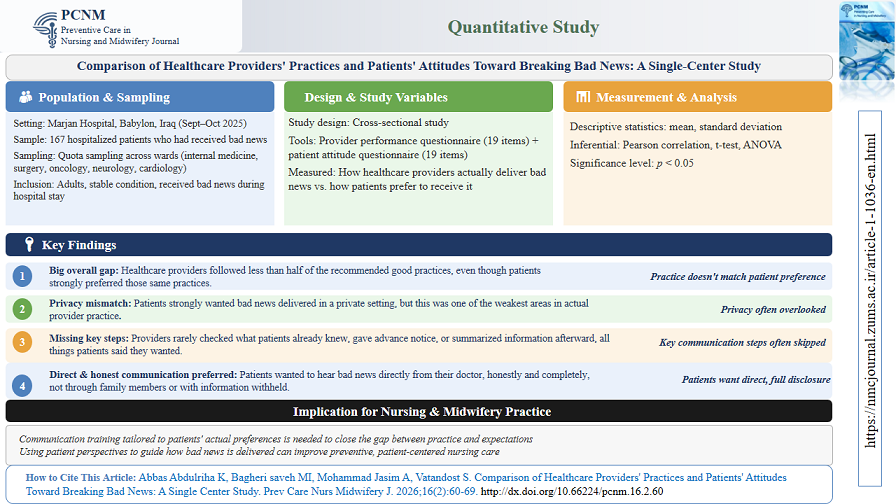
Graphical Abstract:
Reseach Highlights:
Knowledge Translation Statement
Audience: Nursing managers and clinical educators
Providers followed less than half of recommended bad-news practices, mismatching patient preferences on privacy, empathy, and gradual disclosure. Managers may consider integrating culturally adapted communication training such as SPIKES into continuing education.
Type of Study: Orginal research |
Subject:
Multidisciplinary
References
1. Aghamohammadi M, Alefbaei A, Babaei F, Biazar N, Gardashkhani S. The attitude of patients and families toward the delivery of bad news in oncology wards. Nursing and Midwifery Journal. 2020;17(12):1-10. [https://www.sid.ir/paper/406096/en]
2. Siraco S, Bitter C, Chen T. Breaking bad news in the emergency department. Journal of Education & Teaching in Emergency Medicine. 2022;7(2):1-47. [https://doi.org/10.5070/M57257168] [PMID]
3. Francis L, Robertson N. Healthcare practitioners' experiences of breaking bad news: a critical interpretative meta-synthesis. Patient Education and Counseling. 2023;107:107574. [https://doi.org/10.1016/j.pec.2022.107574] [PMID]
4. Warnock C, Tod A, Foster J, Soreny C. Breaking bad news in inpatient clinical settings: role of the nurse. Journal of Advanced Nursing. 2010;66(7):1543-1555. [https://doi.org/10.1111/j.1365-2648.2010.05325.x] [PMID]
5. González-Cabrera M, Ortega-Martínez AR, Martínez-Galiano JM, Hernández-Martínez A, Parra-Anguita L, Frías-Osuna A. Design and validation of a questionnaire on communicating bad news in nursing: a pilot study. International Journal of Environmental Research and Public Health. 2020;17(2):457. [https://doi.org/10.3390/ijerph17020457] [PMID]
6. Imanipour M, Karim Z, Bahrani N. Role, perspective and knowledge of Iranian critical care nurses about breaking bad news. Australian Critical Care. 2016;29(2):77-82. [https://doi.org/10.1016/j.aucc.2015.07.003] [PMID]
7. Shakeriniya I. Telling bad news: the necessity of its training. Iranian Journal of Medical Ethics and History of Medicine. 2010;3(1):29-38. [http://ijme.tums.ac.ir/article-1-246-en.html]
8. Yousuf AA, Stewart DC, Kane T, Soltani A, Al-Khal A, Sethi A. Health professionals' views and experiences of breaking bad news in the Eastern Mediterranean Region: a scoping review. Frontiers in Medicine. 2024;11:1440867. [https://doi.org/10.3389/fmed.2024.1440867] [PMID]
9. Al-Sabaawi WH, Ibraheem NM, Abdulrahman ZN. Knowledge of doctors regarding breaking bad news to patients. Iraq Medical Journal. 2021;5(4):112-116. [https://doi.org/10.22317/imj.v5i4.1137]
10. Mohsen A, Baiee HA. Breaking bad news to patients and their families among a sample of Iraqi nurses in Babylon Governorate. Latin American Journal of Pharmacy. 2024;43(Special Issue).
11. Seifart C, Hofmann M, Bär T, Knorrenschild JR, Seifart U, Rief W. Breaking bad news-what patients want and what they get: evaluating the SPIKES protocol in Germany. Annals of Oncology. 2014;25(3):707-711. [https://doi.org/10.1093/annonc/mdt582] [PMID]
12. Saqib SU, Pal KMI. Disclosing bad news of cancer diagnosis: patients' preference for communication. Journal of the Pakistan Medical Association. 2021;71(4):1239-1242. [https://doi.org/10.47391/JPMA.03-414] [PMID]
13. Managheb SE, Hosseinpour M, Mehrabi F. Patients' viewpoints about how to break bad news. Iranian Journal of Microbiology. 2013;5(4):1-12. [https://ijme.tums.ac.ir/article-1-5184-en.html]
14. Rao A, Ekstrand M, Heylen E, Raju G, Shet A. Breaking bad news: patient preferences and the role of family members when delivering a cancer diagnosis. Asian Pacific Journal of Cancer Prevention. 2016;17(4):1779-1784. [https://doi.org/10.7314/APJCP.2016.17.4.1779] [PMID]
15. Wahyuni S, Gautama MS, Simamora TY. A literature review of nurses' challenges and barriers in assisting patients and families facing breaking bad news. Indian Journal of Palliative Care. 2023;29(3):243-249. [https://doi.org/10.25259/IJPC_128_2023] [PMID]
16. Gholami M, Valiee S, Kamyari N, Vatandost S. Comparing the performance of emergency department personnel and patients' preferences in breaking bad news. Bulletin of Emergency and Trauma. 2023;11(3):146-153. [https://doi.org/10.30476/BEAT.2023.97965.1439]
17. Labaf A, Jahanshir A, Baradaran H, Shahvaraninasab A. Is it appropriate to use Western guidelines for breaking bad news in non-Western emergency departments? A patient's perspective. Clinical Ethics. 2015;10(1-2):13-21. [https://doi.org/10.1177/1477750915581797]
18. Amini K, Meshkini S, Ramezanibadr F. Patients' preferences on breaking bad news: a cross-sectional study from Iran. Indian Journal of Medical Ethics. 2023;8(4):284-292. [https://doi.org/10.20529/IJME.2023.039] [PMID]
19. Nader IH, Hasan LA, Al-Naqqash MA, Tahir SD. Patients' preferences in breaking bad news: a cross-sectional study. Journal of the Faculty of Medicine Baghdad. 2025;67(1):19-26. [https://doi.org/10.32007/jfacmedbaghdad2387]
20. Adeniyi AO, Arowoogun JO, Okolo CA, Chidi R, Babawarun O. Ethical considerations in healthcare IT: a review of data privacy and patient consent issues. World Journal of Advanced Research and Reviews. 2024;21(2):1660-1668. [https://doi.org/10.30574/wjarr.2024.21.2.0593]
21. Krieger T, Salm S, Dresen A, Cecon N. Cancer patients' experiences and preferences when receiving bad news: a qualitative study. Journal of Cancer Research and Clinical Oncology. 2023;149(7):3859-3870. [https://doi.org/10.1007/s00432-022-04311-8] [PMID]
22. Barikani A, Negarandeh R, Ghasemi E. The patients' preferences in breaking bad news: a scoping review. Nursing Practice Today. 2024;11(2):92-106. [https://doi.org/10.18502/npt.v11i2.15402]
23. Sobczak K, Leoniuk K, Janaszczyk A. Delivering bad news: patient's perspective and opinions. Patient Preference and Adherence. 2018;12:2397-2404. [https://doi.org/10.2147/PPA.S183106] [PMID]
24. Berkey FJ, Wiedemer JP, Vithalani ND. Delivering bad or life-altering news. American Family Physician. 2018;98(2):99-104. [https://www.aafp.org/afp/2018/0715/p99.html]
25. Buckman RA. Breaking bad news: the SPIKES strategy. Community Oncology. 2005;2(2):138-142. [https://doi.org/10.1016/S1548-5315(11)70867-1]
26. Guven R, Kaykisiz EK, Onturk H, Sasmaz MI, Ari A, Eyupoglu G, et al. Breaking bad news in the emergency department: how do the patients want it? Eurasian Journal of Emergency Medicine. 2018;17(3):97-102. [https://doi.org/10.5152/eajem.2018.27146]
27. Karim Z, Imanipour M, Bahrani N. Bad news in critical care and emergency units and nurses' participation in the process of breaking bad news in affiliated hospitals of Tehran University of Medical Sciences. Nursing and Midwifery Journal. 2015;13(5):385-392. [http://unmf.umsu.ac.ir/article-1-2033-en.html]
28. Baile WF, Buckman R, Lenzi R, Glober G, Beale EA, Kudelka AP. SPIKES-a six-step protocol for delivering bad news: application to the patient with cancer. The Oncologist. 2000;5(4):302-311. [https://doi.org/10.1634/theoncologist.5-4-302] [PMID]
Send email to the article author
| Rights and permissions | |
 |
This work is licensed under a Creative Commons Attribution-NonCommercial 4.0 International License. |