
Preventive Care in Nursing and Midwifery

Volume 16, Issue 2 (4-2026)
Prev Care Nurs Midwifery 2026, 16(2): 97-117 |
Back to browse issues page


Ethics code: IR.ZUMS.REC.1400.398


Download citation:
BibTeX | RIS | EndNote | Medlars | ProCite | Reference Manager | RefWorks
Send citation to:


BibTeX | RIS | EndNote | Medlars | ProCite | Reference Manager | RefWorks
Send citation to:
Aligholipour M, Babaivahed N, Costeira C, Hanifi N. Death Anxiety During the COVID-19 Pandemic: A Hybrid Concept Analysis. Prev Care Nurs Midwifery 2026; 16 (2) :97-117
URL: http://nmcjournal.zums.ac.ir/article-1-1051-en.html
URL: http://nmcjournal.zums.ac.ir/article-1-1051-en.html

Social Determinants of Health Research Center, Health and Metabolic Diseases Research Institute, Zanjan University of Medical Sciences, Zanjan, Iran , nasrinhanifi@zums.ac.ir
Abstract: (529 Views)
Background: Death anxiety is a distressing fear related to Death or the dying process, shaped by sociocultural and individual factors. During acute global health crises such as COVID-19, this anxiety may intensify and assume context-specific characteristics.
Objectives: This study aimed to analyze the concept of death anxiety during COVID-19 and develop a conceptual definition using Schwartz-Barcott and Kim's hybrid model of concept analysis.
Methods: A hybrid concept analysis with three phases (theoretical, fieldwork, analytical) was conducted. The theoretical phase reviewed literature from electronic databases, yielding 67 articles for analysis. The fieldwork phase involved semi-structured interviews with 14 COVID-19 survivors. The analytical phase integrated these findings to develop a comprehensive conceptual definition.
Results: Hybrid concept analysis identified death anxiety during COVID-19 as a multidimensional response involving emotional impairment and faith-anger struggle. Key antecedents included information chaos and social isolation, while consequences ranged from psychological distress to transformative outcomes like rebirth and spiritual integration.
Conclusion: Grounded in Schwartz-Barcott and Kim's model, this analysis reveals death anxiety as a multidimensional phenomenon with a dual trajectory of consequences, from psychological distress to transformative "rebirth", within the Iranian context.
Objectives: This study aimed to analyze the concept of death anxiety during COVID-19 and develop a conceptual definition using Schwartz-Barcott and Kim's hybrid model of concept analysis.
Methods: A hybrid concept analysis with three phases (theoretical, fieldwork, analytical) was conducted. The theoretical phase reviewed literature from electronic databases, yielding 67 articles for analysis. The fieldwork phase involved semi-structured interviews with 14 COVID-19 survivors. The analytical phase integrated these findings to develop a comprehensive conceptual definition.
Results: Hybrid concept analysis identified death anxiety during COVID-19 as a multidimensional response involving emotional impairment and faith-anger struggle. Key antecedents included information chaos and social isolation, while consequences ranged from psychological distress to transformative outcomes like rebirth and spiritual integration.
Conclusion: Grounded in Schwartz-Barcott and Kim's model, this analysis reveals death anxiety as a multidimensional phenomenon with a dual trajectory of consequences, from psychological distress to transformative "rebirth", within the Iranian context.
Keywords: Death Anxiety, COVID-19, Hybrid Concept Analysis, Schwartz-Barcott and Kim's Model, Spiritual Care.
Full-Text [PDF 970 kb]
(139 Downloads)
| | Full-Text (HTML) (91 Views)
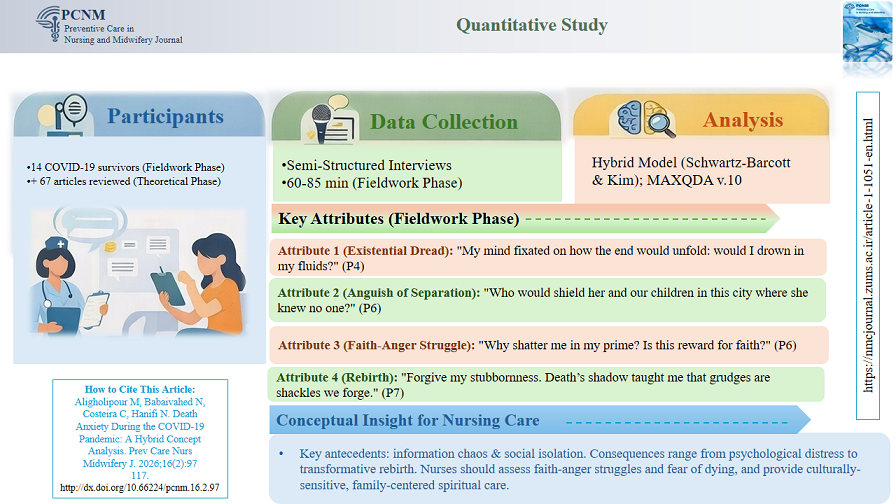
Graphical Abstract:
Reseach Highlights:
Knowledge Translation Statement
Audience: Nursing managers and mental health policymakers
Death anxiety during COVID-19 involved information chaos, isolation, and a faith-anger struggle, with outcomes ranging from distress to rebirth. Managers may consider integrating existential and culturally sensitive spiritual care into crisis preparedness.
Type of Study: Orginal research |
Subject:
Nursing
References
1. Davidov J, Russo-Netzer P. Exploring the Phenomenological Structure of Existential Anxie-ty as Lived Through Transformative Life Experiences. Anxiety, Stress and Coping. 2022;35(2):232-247. [http://doi.org/10.1080/10615806.2021.1921162] [PMID]
2. Iverach L, Menzies RG, Menzies RE. Death Anxiety and Its Role in Psychopathology: Re-viewing the Status of a Transdiagnostic Construct. Clinical Psychology Review. 2014;34(7):580-593. [http://doi.org/10.1016/j.cpr.2014.09.002] [PMID]
3. Balaji M, Ramya R. A Sententious Review Article on Thanatophobia: Perceptive Death Anxiety. RGUHS Journal of Nursing Sciences. 2024;14(1). [http://doi.org/10.26463/rjns.14_1_11]
4. Soleimani MA, Bahrami N, Allen KA, Alimoradi Z. Death Anxiety in Patients with Cancer: A Systematic Review and Meta-Analysis. European Journal of Oncology Nursing. 2020;48:101803. [http://doi.org/10.1016/j.ejon.2020.101803] [PMID]
5. Soleimani MA, Bahrami N, Zarabadi-Pour S, Motalebi SA, Parker A, Chan YH. Predictors of Death Anxiety Among Patients with Heart Disease. Death Studies. 2020;44(3):160-167. [http://doi.org/10.1080/07481187.2018.1527416] [PMID]
6. Almeida M, Shrestha AD, Stojanac D, Miller LJ. The Impact of the COVID-19 Pandemic on Women's Mental Health. Archives of Women's Mental Health. 2020;23(6):741-748. [http://doi.org/10.1007/s00737-020-01092-2] [PMID]
7. Alimoradi Z, Ohayon MM, Griffiths MD, Lin CY, Pakpour AH. Fear of COVID-19 and Its Association with Mental Health-Related Factors: Systematic Review and Meta-Analysis. BJPsych Open. 2022;8(2):e73. [http://doi.org/10.1192/bjo.2022.26] [PMID]
8. Patra I, Muda I, Dwijendra NKA, Najm MA, Alshahrani SH, Kadhim SS, et al. A Systematic Review and Meta-Analysis on Death Anxiety During COVID-19 Pandemic. OMEGA-Journal of Death and Dying. 2025;91(3):1079-1097. [http://doi.org/10.1177/00302228221144791] [PMID]
9. Mani A, Fereidooni R, Salehi-Marzijarani M, Ardekani A, Sasannia S, Habibi P, et al. The Prevalence and Risk Factors of Death Anxiety and Fear of COVID-19 in an Iranian Com-munity: A Cross-Sectional Study. Health Science Reports. 2022;5(4):e706. [http://doi.org/10.1002/hsr2.706] [PMID]
10. Mirhosseini S, Dadgari A, Basirinezhad MH, Mohammadpourhodki R, Ebrahimi H. The Proportion of Death Anxiety and Its Related Factors During the COVID-19 Pandemic in the Iranian Population. Family Medicine and Primary Care Review. 2021;23(1). [http://doi.org/10.5114/fmpcr.2021.103154]
11. Bakhtiari-Dovvombaygi H, Askari M, Rahimkhani M, Abdollahi M, Baladastian M, Alipour A, et al. Prevalence of Death Anxiety and Its Related Factors in the Population of Eastern Iran: A Cross-Sectional Study in the Era of COVID-19. Frontiers in Public Health. 2024;12:1427995. [http://doi.org/10.3389/fpubh.2024.1427995] [PMID]
12. Chalhoub Z, Koubeissy H, Fares Y, Abou-Abbas L. Fear and Death Anxiety in the Shadow of COVID-19 Among the Lebanese Population: A Cross-Sectional Study. PLOS ONE. 2022;17(7):e0270567. [http://doi.org/10.1371/journal.pone.0270567] [PMID]
13. Firouzkouhi M, Abdollahimohammad A, Alimohammadi N, Naderifar M, Akbarizadeh M. Lived Experiences of Critically Ill COVID-19 Patients About Death and Dying: A Descrip-tive Phenomenology. OMEGA-Journal of Death and Dying. 2024;89(1):333-346. [http://doi.org/10.1177/00302228211073269] [PMID]
14. Heidaranlu E, Moayed MS, Parandeh A. Spiritual-Cultural Needs as the Main Causative Factor of Death Anxiety in Iranian COVID-19 Patients: A Qualitative Study. Journal of Re-ligion and Health. 2024;63(1):817-837. [http://doi.org/10.1007/s10943-023-01972-8] [PMID]
15. Rababa M, Hayajneh AA, Bani-Iss W. Association of Death Anxiety with Spiritual Well-Being and Religious Coping in Older Adults During the COVID-19 Pandemic. Journal of Religion and Health. 2021;60(1):50-63. [http://doi.org/10.1007/s10943-020-01166-6] [PMID]
16. Guner TA, Erdogan Z, Demir I. The Effect of Loneliness on Death Anxiety in the Elderly During the COVID-19 Pandemic. OMEGA-Journal of Death and Dying. 2023;87(1):262-282. [http://doi.org/10.1177/00302228211010587] [PMID]
17. Yang D, Xia Y, Wu W, Feng Y, Liang J, Zhang J. Death Anxiety During COVID-19 and Its Related Factors Among Chinese Elderly People. OMEGA-Journal of Death and Dying. 2025;91(3):1509-1527. [http://doi.org/10.1177/00302228231157446] [PMID]
18. Meleis AI. Theoretical Nursing: Development and Progress. 5th ed. Philadelphia (PA): Lip-pincott Williams & Wilkins; 2011.
19. Graneheim UH, Lundman B. Qualitative Content Analysis in Nursing Research: Concepts, Procedures and Measures to Achieve Trustworthiness. Nurse Education Today. 2004;24(2):105-112. [http://doi.org/10.1016/j.nedt.2003.10.001] [PMID]
20. Polit DF, Beck CT. Nursing Research: Generating and Assessing Evidence for Nursing Prac-tice. 8th ed. Philadelphia (PA): Lippincott Williams & Wilkins; 2008.
21. Walker LO, Avant KC. Strategies for Theory Construction in Nursing. 4th ed. Upper Saddle River (NJ): Pearson Prentice Hall; 2005.
22. Damirchi ES, Mojarrad A, Pireinaladin S, Grjibovski AM. The Role of Self-Talk in Predict-ing Death Anxiety, Obsessive-Compulsive Disorder, and Coping Strategies in the Face of Coronavirus Disease (COVID-19). Iranian Journal of Psychiatry. 2020;15(3):182-188. [http://doi.org/10.18502/ijps.v15i3.3810] [PMID]
23. Weisskirch RS, Crossman KA. The Impact of Death and Dying Education for Undergradu-ate Students During the COVID-19 Pandemic. OMEGA-Journal of Death and Dying. 2024;89(3):998-1009. [http://doi.org/10.1177/00302228221089818] [PMID]
24. Mena C, Cortes F, Romero M. Supporting a Double Hospitalization During the Pandemic: The Experience of Fathers Whose Infants Were Hospitalized While Their Mothers Were Al-so Hospitalized Due to COVID-19. Archivos Argentinos de Pediatría. 2024;122(1):e202202969. h [ttp://doi.org/10.5546/aap.2022-02969.eng]
25. Machado MH, Coelho MCR, Pereira EJ, Telles AO, Soares Neto JJ, Ximenes Neto FRG, et al. Work Conditions and Biosafety of Health Professionals and Invisible Health Workers in the Context of COVID-19 in Brazil. Ciência & Saúde Coletiva. 2023;28(10):2809-2822. [http://doi.org/10.1590/1413-812320232810.10072023] [PMID]
26. Canales BDB, Huamán DB. Ansiedad ante la Muerte en Adultos Peruanos, Durante la Pan-demia de la COVID-19. Revista Cubana de Enfermería. 2020;36(Suppl 1). [https://revenfermeria.sld.cu/index.php/enf/article/view/3778]
27. AlZaben M, Al Adwan F. The Effectiveness of a Counseling Program in Reducing Death Anxiety and Improving Self-Efficacy Among a Sample of Female Middle-Aged Teachers Recovered from COVID-19 Virus. OMEGA-Journal of Death and Dying. 2024;89(4):1366-1384. [http://doi.org/10.1177/00302228221086704] [PMID]
28. Gholami S, Omidi Moghadam E, Ghadampour E, Bavazin F. The Prediction of Death Anxi-ety Based on Expressed Emotion, Intolerance of Uncertainty and Experiential Avoidance in Patients Recovered from COVID-19 Hospitalization. Journal of Health and Care. 2024;26(3):265-279. [http://hcjournal.arums.ac.ir/article-1-1583-fa.html]
29. Aghaei V, Kazemi R, Taklovi S, Nazari V. The Effect of Treatment Based on Acceptance and Commitment on Pathological Worry and Death Anxiety in Nurses with the Experience of Complicated Grief Caused by COVID-19. Journal of Health and Care. 2024;26(1):52-62. [https://hcjournal.arums.ac.ir/article-1-2096-en.html]
30. Tavakkoli S, Daman PV, Pourmosavi SM. Evaluation of Death Anxiety of Nurses Working in Intensive Care Units During the Coronavirus Epidemic. Qom University of Medical Sci-ences. 2021. [https://journal.muq.ac.ir/article-1-2575-en.html]
31. Shirkavand L, Abbaszadeh A, Borhani F, Momenyan S. Correlation Between Spiritual Well-Being with Satisfaction with Life and Death Anxiety Among the Elderly Suffering from Cancer. Electronic Journal of General Medicine. 2018;15(3):1-7. [http://doi.org/10.29333/ejgm/85501]
32. Khademi F, Moayedi S, Golitaleb M, Karbalaie N. The COVID-19 Pandemic and Death Anxiety in the Elderly. International Journal of Mental Health Nursing. 2021;30(1):346-349. [http://doi.org/10.1111/inm.12824] [PMID]
33. Wass H, Neimeyer RA. Dying: Facing the Facts. 3rd ed. Washington (DC): Taylor & Fran-cis; 1995.
34. de Oliveira DC, da Silva KP, Machado YY, Stefaisk RLM, Domingues JP, de Pontes APM, et al. Representação Social da COVID-19 para a População de uma Cidade de Pequeno Porte. Revista Enfermagem UERJ. 2024;32:e76360. [http://doi.org/10.12957/reuerj.2024.76360]
35. Galbadage T, Peterson BM, Wang DC, Wang JS, Gunasekera RS. Biopsychosocial and Spir-itual Implications of Patients with COVID-19 Dying in Isolation. Frontiers in Psychology. 2020;11:588623. [http://doi.org/10.3389/fpsyg.2020.588623] [PMID]
36. Parvin A, Sadeghiyan E, Tapak L, Shamsaei F. Comparison of Death Anxiety and Happi-ness of Nurses Working in Corona Wards with Those of Nurses Working in Other Wards in Educational-Medical Centers of Shiraz, Iran, in 2020. Avicenna Journal of Nursing and Midwifery Care. 2022;30(4):270-279. [http://doi.org/10.32592/ajnmc.30.4.270]
37. Rostami P, Ebrahimi LS, Asl AM, Allahverdipour H. The Relationship Between Feeling of Loneliness, Source of Control, and Intolerance of Ambiguity with Death Anxiety in the El-derly During the COVID-19 Era. Medical Journal of Tabriz University of Medical Sciences. 2023;45(6):528-538. [http://doi.org/10.34172/mj.2024.005]
38. Shakil M, Ashraf F, Muazzam A, Amjad M, Javed S. Work Status, Death Anxiety and Psy-chological Distress During COVID-19 Pandemic: Implications of the Terror Management Theory. Death Studies. 2022;46(5):1100-1105. [http://doi.org/10.1080/07481187.2020.1865479] [PMID]
39. Kiyak S, Turkben Polat H. The Relationship Between Death Anxiety and COVID-19 Fear and Anxiety in Women with Breast Cancer. OMEGA-Journal of Death and Dying. 2024;89(3):1128-1141. [http://doi.org/10.1177/00302228221086056] [PMID]
40. Sadeghi A, Mohamadzadeh M, Shoraka HR, Pirouzeh R, Rahimi Khalifeh Kandi Z. The Re-lationship Between the Perception of Aging and Death Anxiety in the Older Adults of East-ern Iran During COVID-19. Health and Social Care in the Community. 2024;2024:3236251. [http://doi.org/10.1155/2024/3236251]
41. Ghazanfari MJ, Chaghian Arani R, Mollaei A, Mollaei A, Falakdami A, Takasi P, et al. Death Anxiety and Related Factors in Nurses During the COVID-19 Pandemic: A Systemat-ic Review. Jorjani Biomedicine Journal. 2022;10(3):35-42. [https://jorjanibiomedj.com/article-1-795-en.html]
42. Fathian B, Payami Bousari M, Ahmadi F. Relationship Between Death Anxiety and Happi-ness of Undergraduate Students of Zanjan University of Medical Sciences During the Coro-navirus Disease (COVID-19) Pandemic. Preventive Care in Nursing and Midwifery Journal. 2023;13(3):49-58. [http://doi.org/10.61186/pcnm.13.3.49]
43. Belash I, Barzagar F, Mousavi G, Janbazian K, Aghasi Z, Ladari AT, et al. COVID-19 Pan-demic and Death Anxiety Among Intensive Care Nurses Working at the Hospitals Affiliated to Tehran University of Medical Sciences. Journal of Family Medicine and Primary Care. 2021;10(7):2499-2502. [http://doi.org/10.4103/jfmpc.jfmpc_2105_20] [PMID]
44. Martínez-López JÁ, Lázaro-Pérez C, Gómez-Galán J. Death Anxiety in Social Workers as a Consequence of the COVID-19 Pandemic. Behavioral Sciences. 2021;11(5):61. [http://doi.org/10.3390/bs11050061] [PMID]
45. Strang P, Bergström J, Martinsson L, Lundström S. Dying From COVID-19: Loneliness, End-of-Life Discussions, and Support for Patients and Their Families in Nursing Homes and Hospitals: A National Register Study. Journal of Pain and Symptom Management. 2020;60(4):e2-e13. [http://doi.org/10.1016/j.jpainsymman.2020.07.020] [PMID]
46. Toulabi T, Pour FJ, Veiskramian A, Heydari H. Exploring COVID-19 Patients' Experiences of Psychological Distress During the Disease Course: A Qualitative Study. BMC Psychiatry. 2021;21(1):625. [http://doi.org/10.1186/s12888-021-03626-z] [PMID]
47. Ehsani S, Shahvardi A, Firouzi M, Soltani F. The Effect of Anxiety and the Risk of Death on the Mother-Child Conflict During the Period of Home Quarantine Due to COVID-19. Journal Women's Studies Sociological and Psychological.2023; 21(1):22-30. [https://journals.alzahra.ac.ir/article_7162_a0769c1d1509160ae97fc8a16765a7e7.pdf]
48. Chen X, Liu T, Li P, Wei W, Chao M. The Relationship Between Media Involvement and Death Anxiety of Self-Quarantined People in the COVID-19 Outbreak in China: The Medi-ating Roles of Empathy and Sympathy. OMEGA-Journal of Death and Dying. 2022;85(4):974-989. [http://doi.org/10.1177/0030222820960283] [PMID]
49. Zarabadi Poor F, Mohammadi F, Hosseinkhani Z, Motalebi SA. Association Between Fear of COVID-19 and Death Anxiety with the Moderator Role of Self-Regulation Among Older Adults Residing in Qazvin. Iranian Journal of Epidemiology. 2022;18(3):204-213. [https://irje.tums.ac.ir/article-1-7073-en.html]
50. Erbesler ZA, Demir G. Determination of Death Anxiety and Death-Related Depression Lev-els in the Elderly During the COVID-19 Pandemic. OMEGA-Journal of Death and Dying. 2023;88(1):274-286. [http://doi.org/10.1177/00302228221082429] [PMID]
51. Nekhlyudov L, Duijts S, Hudson SV, Jones JM, Keogh J, Love B, et al. Addressing the Needs of Cancer Survivors During the COVID-19 Pandemic. Cancer. 2020;126(6):601-606. [http://doi.org/10.1002/cncr.32635] [PMID]
52. Noroziyan K, Peyadekoohsar A. Prediction of Death Anxiety Based on Personality Traits and God Image in Patients with COVID-19. Journal of Research in Behavioural Sciences. 2022;20(2):204-219. [https://rbs.mui.ac.ir/article-1-1595-en.html]
53. Choobsaz A, Taher M, Tabatabaee SM, Hoosseinkhanzadeh AA. The Effectiveness of Vir-tual Acceptance and Commitment Therapy Based on Compassion in Perfectionism and Death Anxiety in Nurses with Obsessive-Compulsive Personality Traits: A Quasi-Experimental Study. Journal of Rafsanjan University of Medical Sciences. 2023;22(3):259-276. [https://journal.rums.ac.ir/article-1-6948-en.html]
54. Mirhosseini S, Nouhi S, Janbozorgi M, Mohajer H, Naseryfadafan M. The Role of Spiritual Health and Religious Coping in Predicting Death Anxiety Among Patients with Coronavirus. Studies in Islam and Psychology. 2020;14(26):29-42. [http://doi.org/10.30471/psy.2020.6545.1701]
55. Chegini N, Soltani S, Noorian S, Amiri M, Rashvand F, Rahmani S, et al. Investigating the Role of Predictive Death Anxiety in the Job Satisfaction of Pre-Hospital Emergency Per-sonnel During the COVID-19 Pandemic. BMC Emergency Medicine. 2022;22(1):196. [http://doi.org/10.1186/s12873-022-00762-x] [PMID]
56. Rahmatinejad P, Yazdi M, Khosravi Z, Shahisadrabadi F. Lived Experience of Patients with Coronavirus (COVID-19): A Phenomenological Study. Journal of Research in Psychologi-cal Health. 2020;14(1):71-86. [https://rph.khu.ac.ir/article-1-3308-en.html]
57. Ozer O, Ozkan O, Ozmen S, Ercoban N. Investigation of the Effect of COVID-19 Per-ceived Risk on Death Anxiety, Satisfaction With Life, and Psychological Well-Being. OMEGA-Journal of Death and Dying. 2023;87(2):572-590. [http://doi.org/10.1177/00302228211026169] [PMID]
58. Mirzapour AM, Sharmi AF, Hasanzadeh M, Mirzapour AF. Predicting Death Anxiety and Quality of Life Based on Cognitive Emotion Regulation Strategies in the COVID-19 Epi-demic. 2022. No DOI or publisher URL available.
59. Mushtaque I, Awais EYM, Zahra R, Anas M. Quality of Life and Illness Acceptance Among End-Stage Renal Disease Patients on Hemodialysis: The Moderating Effect of Death Anxiety During the COVID-19 Pandemic. OMEGA-Journal of Death and Dying. 2024;89(2):567-586. [http://doi.org/10.1177/00302228221075202] [PMID]
60. Rasouli Magham Z, Salehi S. The Mediating Role of Death Anxiety and Corona Anxiety in the Relationship Between Resilience and Hypochondriasis Among Nurses in Tehran: A De-scriptive Study. Journal of Rafsanjan University of Medical Sciences. 2023;22(2):111-128. [https://journal.rums.ac.ir/article-1-6805-en.html]
61. Eren N, Zararsiz Y, Medetalibeyoglu A, Polat I. Relationship Between Psychological Resili-ence, Perceived Stress, Death Anxiety and Progression of Disease in Individuals with COVID-19. Archives of Neuropsychiatry. 2023;60(3):245-251. [http://doi.org/10.29399/npa.28264]
62. Akbari Balootbangan A, Talepasand S, Rezaei AM, Rahimian Boogar I. Effectiveness of Victims' Assertiveness Training Program on Health Promoting Behaviors of Bullying Victim Adolescents. Clinical Psychology Studies. 2024;14(53):76-92.
63. Farahifar A, Aryaeenezhad A, Nasiriani K. Relationship Between COVID-19 Anxiety with Sleep Quality and Death Anxiety in Zoroastrian Elderly: A Structural Equation Approach. Quarterly Journal of Caspian Health and Aging. 2021;6(2):101-114. [http://doi.org/10.22088/cjhaa.6.2.8]
64. Galon T, Navarro VL, Gonçalves AMS. Percepções de Profissionais de Enfermagem Sobre Suas Condições de Trabalho e Saúde no Contexto da Pandemia de COVID-19. Revista Bra-sileira de Saúde Ocupacional. 2022;47:eCov2. [http://doi.org/10.1590/2317-6369/15821PT2022v47ecov2]
65. Seyedfatemi N, Abbasi Z, Bahrami R, Siah Mansour Khorin Z. The Association Between Caring Behavior and Death Anxiety Among Iranian Nurses Working in COVID-19 Wards. SAGE Open Nursing. 2023;9:23779608231219125. [http://doi.org/10.1177/23779608231219125] [PMID]
66. Doustinouri M, Rahnama M, Abdollahimohammad A, Moghadam MP, Moghadam ES, Asa-di-Bidmeshki E. Effect of Positive Thinking Skills on Optimism and Death Anxiety of COVID-19 Nurses: A Quasi-Experimental Study. Ethiopian Journal of Health Sciences. 2024;34(2):143-148. [http://doi.org/10.4314/ejhs.v34i2.5] [PMID]
67. Farhadi A, Javadian H, Farokhnezhad Afshar P. Prediction of Mental Health by Religious Orientation and the Mediating Role of Death Anxiety Among Nurses in the COVID-19 Pan-demic. Journal of Health Sciences and Surveillance System. 2022;10(4):495-501. [http://doi.org/10.30476/jhsss.2021.92795.1390]
68. Veisi R, Kakabarai K, Chehri A, Arefi M. The Role of Death Anxiety as a Mediator in the Relationship Between Personality Types and Psychological Well-Being in Coronavirus Dis-ease-2019 Patients. Journal of Education and Health Promotion. 2023;12(1):104. [http://doi.org/10.4103/jehp.jehp_195_22] [PMID]
69. Asadi N, Royani Z, Pourkhajoei S. Care Intertwined with Anxiety and Helplessness: The Experiences of ICU Nurses from COVID-19 Disease's End of Life-A Qualitative Study. BMJ Open. 2025;15(1):e087329. [http://doi.org/10.1136/bmjopen-2024-087329] [PMID]
70. Shahbazi A, Mehrabadi MS, Ghahari S, Davoodi R, Farokhnezhad Afshar P. Predictors of Corona Anxiety in Patients with COVID-19. Iranian Journal of Psychiatric Nursing. 2023;11(4):1-8. [http://doi.org/10.22034/IJPN.11.4.1]
71. Yarahmadi F, Goudarzi F, Namdari S, Mokhayeri Y, Znoori S. Investigating the Anxiety of the Coronavirus and Its Relationship with Death Anxiety and Emotional Intelligence in Nurses Working in Government Medical Centers in Borujerd City in 2020. Military Caring Sciences. 2024;11(1):59-67. [http://doi.org/10.22034/11.1.59]
72. Joneghani NA, Sajjaian I. The Mediating Role of Perceived Stress in the Relationship Be-tween Neuroticism and Death Anxiety Among Women in Isfahan During the Coronavirus Pandemic. Journal of Education and Health Promotion. 2023;12(1):78. [http://doi.org/10.4103/jehp.jehp_505_22] [PMID]
73. Mohammadi F, Masoumi Z, Oshvandi K, Khazaei S, Bijani M. Death Anxiety, Moral Cour-age, and Resilience in Nursing Students Who Care for COVID-19 Patients: A Cross-Sectional Study. BMC Nursing. 2022;21(1):150. [http://doi.org/10.1186/s12912-022-00931-0] [PMID]
74. Jazaiery M, Rezaeifar K, Sayyah M, Cheraghi M. Relationship Between Mental Health and Death Anxiety During the COVID-19 Pandemic in Dental Staff and Students: A Cross-Sectional Study. Frontiers in Psychiatry. 2022;13:849868. [http://doi.org/10.3389/fpsyt.2022.849868] [PMID]
75. Yousefi Afrashteh M, Masoumi S. Psychological Well-Being and Death Anxiety Among Breast Cancer Survivors During the COVID-19 Pandemic: The Mediating Role of Self-Compassion. BMC Women's Health. 2021;21(1):387. [http://doi.org/10.1186/s12905-021-01533-9] [PMID]
76. Hamidi R, Ghodsi P, Taghiloo S. The Mediating Role of Psychological Well-Being in Ex-plaining the Effect of a Health-Promoting Lifestyle on Death Anxiety in Seniors with COVID-19 Experience. Health Nexus. 2024;2(1):89-98. [http://doi.org/10.61838/kman.hn.2.1.10]
77. Sepidnameh K, Hosseinabadi-Farahani MJ, Norouzi M, Norouzi Tabrizi K. The Relation-ship of Loneliness and Death Anxiety in the Post-COVID-19 Era Among Older People in Ilam Province in 2023. Iranian Journal of Psychiatric Nursing. 2024;11(6):1-12. [http://doi.org/10.22034/IJPN.11.6.9]
78. Aghaee V, Kazemi R, Taklavi S, Nazari V. The Effectiveness of Existential Therapy on Pathological Worry and Death Anxiety of Nurses Who Experienced Sorrow Due to the COVID-19 Pandemic: A Semi-Experimental Study. Nursing Development in Health. 2024;14(2):50-61. [https://ndhj.lums.ac.ir/article-1-557-en.html]
79. Soleimani MA, Lehto RH, Negarandeh R, Bahrami N, Nia HS. Relationships Between Death Anxiety and Quality of Life in Iranian Patients with Cancer. Asia-Pacific Journal of Oncol-ogy Nursing. 2016;3(2):183-191. [http://doi.org/10.4103/2347-5625.182935] [PMID]
80. Pandya AK, Kathuria T. Death Anxiety, Religiosity and Culture: Implications for Therapeu-tic Process and Future Research. Religions. 2021;12(1):61. [http://doi.org/10.3390/rel12010061]
81. Karabağ Aydin A, Fidan H. The Effect of Nurses' Death Anxiety on Life Satisfaction Dur-ing the COVID-19 Pandemic in Turkey. Journal of Religion and Health. 2022;61(1):811-826. [http://doi.org/10.1007/s10943-021-01357-9] [PMID]
82. Tedeschi RG, Calhoun LG. Posttraumatic Growth: Conceptual Foundations and Empirical Evidence. Psychological Inquiry. 2004;15(1):1-18. [http://doi.org/10.1207/s15327965pli1501_01]
83. Chan CS, Lowe SR, Weber E, Rhodes JE. The Contribution of Pre- and Postdisaster Social Support to Short- and Long-Term Mental Health After Hurricanes Katrina: A Longitudinal Study of Low-Income Survivors. Social Science & Medicine. 2015;138:38-43. [http://doi.org/10.1016/j.socscimed.2015.05.037] [PMID]
84. Nienaber K, Goedereis E. Death Anxiety and Education: A Comparison Among Undergrad-uate and Graduate Students. Death Studies. 2015;39(8):483-490. [http://doi.org/10.1080/07481187.2015.1047057] [PMID]
85. Menzies RE, Menzies RG. Death Anxiety in the Time of COVID-19: Theoretical Explana-tions and Clinical Implications. The Cognitive Behaviour Therapist. 2020;13:e19. [http://doi.org/10.1017/S1754470X20000215] [PMID]
86. Sousa AR, Carvalho ESS, Santana TDS, Sousa AFL, Figueiredo TFG, Escobar OJV, et al. Men's Feelings and Emotions in the COVID-19 Framing. Ciência & Saúde Coletiva. 2020;25(9):3481-3491. [http://doi.org/10.1590/1413-81232020259.18772020] [PMID]
87. Lok N, Aydin Z, Uzun G, Kayaaslan B, Selcuk Tosun A. Relationship of Depression, Hopelessness and Life Satisfaction with Death Anxiety in Individuals Who Have Had COVID-19. OMEGA-Journal of Death and Dying. 2023;87(4). [http://doi.org/10.1177/00302228231174602] [PMID]
Send email to the article author
| Rights and permissions | |
 |
This work is licensed under a Creative Commons Attribution-NonCommercial 4.0 International License. |