Preventive Care in Nursing and Midwifery Journal
Volume 16, Issue 1 (1-2026)
Prev Care Nurs Midwifery J 2026, 16(1): 105-119 |
Back to browse issues page


Ethics code: IR.ZUMS.REC.1400.392


Download citation:
BibTeX | RIS | EndNote | Medlars | ProCite | Reference Manager | RefWorks
Send citation to:


BibTeX | RIS | EndNote | Medlars | ProCite | Reference Manager | RefWorks
Send citation to:
Esmaeilbeigi D, Kalantari S, Aligholipour M, Alipour R, Mohammadi M, Nasseri S, et al . Effectiveness of Nurse-Led Motivational Interviewing on Self-Management and Self-Care in Patients with Chronic Diseases: A Systematic Review of Randomized Controlled Trials. Prev Care Nurs Midwifery J 2026; 16 (1) :105-119
URL: http://nmcjournal.zums.ac.ir/article-1-1052-en.html
URL: http://nmcjournal.zums.ac.ir/article-1-1052-en.html
Darya Esmaeilbeigi  , Saba Kalantari , Mahtab Aligholipour , Razie Alipour , Maryam Mohammadi , Sepideh Nasseri , Vesal Karimiaslchors , Zahra Khezerlou *
, Saba Kalantari , Mahtab Aligholipour , Razie Alipour , Maryam Mohammadi , Sepideh Nasseri , Vesal Karimiaslchors , Zahra Khezerlou *
Medical Surgical Nursing Department, Nursing and Midwifery School, Zanjan University of Medical Sciences, Zanjan, Iran , zahrakhezerloo8@gmail.com
Abstract: (250 Views)
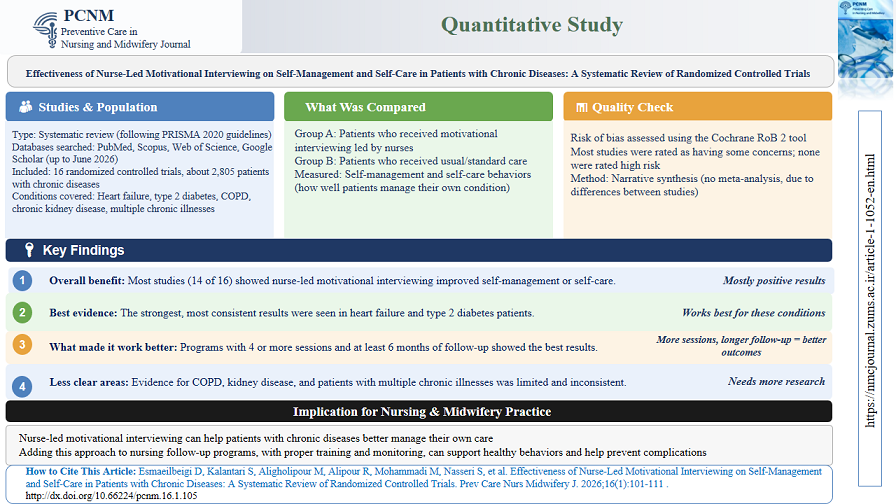
Background: Chronic diseases impose a significant burden on health systems. Self-management, including self-care behaviors, plays a key role in their control. Motivational interviewing (MI) is an evidence-based approach used by nurses to enhance intrinsic motivation and facilitate behavior change in patients with chronic conditions. However, no comprehensive systematic review has specifically synthesized the effectiveness of nurse-led MI on self-management and self-care in chronic diseases.
Objectives: This systematic review aimed to assess and synthesize evidence from randomized trials on the effectiveness of nurse-led MI in improving self-management and self-care among patients with chronic diseases.
Methods: A systematic search was conducted in PubMed, Scopus, Web of Science, and Google Scholar up to June 2026. Randomized trials that provided a nurse-led MI intervention and reported self-management or self-care outcomes were included. Risk of bias was assessed using the RoB 2 tool. Due to significant heterogeneity in the intervention types, study populations, and outcome measures, meta‑analysis was not feasible; findings are therefore reported as a narrative synthesis.
Results: Of 423 records identified, 16 RCTs with 2805 participants were included. Fourteen studies (87.5%) reported statistically significant improvements in at least one self-management or self-care outcome favoring the intervention group. The most consistent evidence was observed in patients with heart failure and type 2 diabetes. Interventions comprising four or more sessions with a follow‑up of at least six months were associated with the greatest improvements. Six studies were rated at low risk of bias, while ten had some concerns.
Conclusion: Current evidence suggests that nurse-led MI may enhance self-management and self-care behaviors in certain chronic diseases, particularly heart failure and type 2 diabetes. However, variability in interventions and outcomes, along with methodological limitations in some studies, reduces the certainty of this evidence. Rigorous randomized trials with standardized designs and extended follow‑up periods are needed to strengthen the evidence base.
Objectives: This systematic review aimed to assess and synthesize evidence from randomized trials on the effectiveness of nurse-led MI in improving self-management and self-care among patients with chronic diseases.
Methods: A systematic search was conducted in PubMed, Scopus, Web of Science, and Google Scholar up to June 2026. Randomized trials that provided a nurse-led MI intervention and reported self-management or self-care outcomes were included. Risk of bias was assessed using the RoB 2 tool. Due to significant heterogeneity in the intervention types, study populations, and outcome measures, meta‑analysis was not feasible; findings are therefore reported as a narrative synthesis.
Results: Of 423 records identified, 16 RCTs with 2805 participants were included. Fourteen studies (87.5%) reported statistically significant improvements in at least one self-management or self-care outcome favoring the intervention group. The most consistent evidence was observed in patients with heart failure and type 2 diabetes. Interventions comprising four or more sessions with a follow‑up of at least six months were associated with the greatest improvements. Six studies were rated at low risk of bias, while ten had some concerns.
Conclusion: Current evidence suggests that nurse-led MI may enhance self-management and self-care behaviors in certain chronic diseases, particularly heart failure and type 2 diabetes. However, variability in interventions and outcomes, along with methodological limitations in some studies, reduces the certainty of this evidence. Rigorous randomized trials with standardized designs and extended follow‑up periods are needed to strengthen the evidence base.
Type of Study: Review Articels |
Subject:
Nursing
References
1. World Health Organization. Noncommunicable diseases [Internet]. Geneva: World Health Organization; 2025. [https://www.who.int/news-room/fact-sheets/detail/noncommunicable-diseases]
2. Allegrante JP, Wells MT, Peterson JC. Interventions to support behavioral self-management of chronic diseases. Annual Review of Public Health. 2019;40:127-46. [https://doi.org/10.1146/annurev-publhealth-040218-044008] [PMID]
3. Freihat O, Sipos D, Aamir M, Kovacs A. Global burden and future projections of noncommunicable diseases (2000-2050): progress toward SDG 3.4 and disparities across regions and risk factors. PLoS One. 2025;20(12):1-17. [https://doi.org/10.1371/journal.pone.0336036] [PMID]
4. Polanco B, Oña A, Gemperli A, Pacheco Barzallo D. Excess healthcare utilization and costs linked to chronic conditions: a comparative study of nine European countries. European Journal of Public Health. 2025;35(2):216-27. [https://doi.org/10.1093/eurpub/ckaf012] [PMID]
5. Schulman-Green D, Jaser S, Martin F, Alonzo A, Grey M, McCorkle R, et al. Processes of self-management in chronic illness. Journal of Nursing Scholarship. 2012;44(2):136-44. [https://doi.org/10.1111/j.1547-5069.2012.01444.x] [PMID]
6. Udlis KJ. Self-management in chronic illness: concept and dimensional analysis. Journal of Nursing and Healthcare of Chronic Illness. 2011;3(2):90-9. [https://doi.org/10.1111/j.1752-9824.2011.01085.x]
7. Iovino P, Uchmanowicz I, Vellone E. Self-care: an effective strategy to manage chronic diseases. Advances in Clinical and Experimental Medicine. 2024;33(8):767-71. [https://doi.org/10.17219/acem/191102] [PMID]
8. Lawless MT, Tieu M, Chan RJ, Hendriks JM, Kitson A. Instruments measuring self-care and self-management of chronic conditions by community-dwelling older adults: a scoping review. Journal of Applied Gerontology. 2023;42(7):1687-709. [https://doi.org/10.1177/07334648231161929] [PMID]
9. Barlow J, Wright C, Sheasby J, Turner A, Hainsworth J. Self-management approaches for people with chronic conditions: a review. Patient Education and Counseling. 2002;48(2):177-87. [https://doi.org/10.1016/S0738-3991(02)00032-0] [PMID]
10. Grady PA, Gough LL. Self-management: a comprehensive approach to management of chronic conditions. American Journal of Public Health. 2014;104(8):e25-31. [https://doi.org/10.2105/AJPH.2014.302041] [PMID]
11. Riegel B, Jaarsma T, Strömberg A. A middle-range theory of self-care of chronic illness. Advances in Nursing Science. 2012;35(3):194-204. [https://doi.org/10.1097/ANS.0b013e318261b1ba] [PMID]
12. Bahroodi PS, Safa A, Mirbagher Ajorpaz N. Self-care neglect in chronic diseases: a concept analysis. Nursing and Midwifery Studies. 2026;15(1):58-66. [https://doi.org/10.4103/nms.nms_45_2025]
13. Farley H. Promoting self-efficacy in patients with chronic disease beyond traditional education: a literature review. Nursing Open. 2020;7(1):30-41. [https://doi.org/10.1002/nop2.382] [PMID]
14. Miller WR, Rollnick S. Motivational interviewing: helping people change. 3rd ed. New York: Guilford Press; 2013.
15. Uzun S, Gürhan N. The effect of motivational interviewing on quality of life and self-efficacy behaviors of individuals with chronic illness: a meta-analysis study. Public Health Nursing. 2024;41(5):901-22. [https://doi.org/10.1111/phn.13345]
16. Ghizzardi G, Arrigoni C, Dellafiore F, Vellone E, Caruso R. Efficacy of motivational interviewing on enhancing self-care behaviors among patients with chronic heart failure: a systematic review and meta-analysis of randomized controlled trials. Heart Failure Reviews. 2022;27(4):1029-41. [https://doi.org/10.1007/s10741-021-10110-z] [PMID]
17. Bilgin A, Muz G, Yuce GE. The effect of motivational interviewing on metabolic control and psychosocial variables in individuals diagnosed with diabetes: systematic review and meta-analysis. Patient Education and Counseling. 2022;105(9):2806-23. [https://doi.org/10.1016/j.pec.2022.04.008] [PMID]
18. Xu J, Gu X, Gu J, Zhao L, Li M, Hong C. Motivational interviewing intervention for the management of hypertension: a meta-analysis. Frontiers in Cardiovascular Medicine. 2024;11:1-11. [https://doi.org/10.3389/fcvm.2024.1457039] [PMID]
19. Substance Abuse and Mental Health Services Administration. Enhancing motivation for change in substance use disorder treatment. Treatment Improvement Protocol (TIP) Series No. 35. Rockville (MD): Substance Abuse and Mental Health Services Administration; 2019.
20. Miller WR, Rose GS. Toward a theory of motivational interviewing. American Psychologist. 2009;64(6):527-37. [https://doi.org/10.1037/a0016830] [PMID]
21. Gosak L, Vrbnjak D, Pajnkihar M. Self-management of chronic diseases: a concept analysis. Nursing in the 21st Century. 2022;21(2):115-21. [https://doi.org/10.2478/pielxxiw-2022-0006]
22. Berardinelli D, Conti A, Hasnaoui A, Casabona E, Martin B, Campagna S, et al. Nurse-led interventions for improving medication adherence in chronic diseases: a systematic review. Healthcare. 2024;12(23):1-26. [https://doi.org/10.3390/healthcare12232427] [PMID]
23. Tharani A, Van Hecke A, Ali TS, Duprez V. Factors influencing nurses' provision of self-management support for patients with chronic illnesses: a systematic mixed studies review. International Journal of Nursing Studies. 2021;120:103983. [https://doi.org/10.1016/j.ijnurstu.2021.103983] [PMID]
24. Alfarisi NR, Lestari D, Sujianto U. Motivational interviewing in patients with chronic conditions. Indonesian Journal of Global Health Research. 2025;7(3):529-36. [https://doi.org/10.37287/ijghr.v7i3.5123]
25. Page MJ, McKenzie JE, Bossuyt PM, Boutron I, Hoffmann TC, Mulrow CD, et al. The PRISMA 2020 statement: an updated guideline for reporting systematic reviews. Revista Panamericana de Salud Pública. 2022;46:1-9. [https://doi.org/10.26633/RPSP.2022.112] [PMID]
26. Higgins JPT, Thomas J, Chandler J, Cumpston M, Li T, Page MJ, et al., editors. Cochrane handbook for systematic reviews of interventions. Version 6.4. London: Cochrane; 2023. [https://www.training.cochrane.org/handbook]
27. Sterne JA, Savović J, Page MJ, Elbers RG, Blencowe NS, Boutron I, et al. RoB 2: a revised tool for assessing risk of bias in randomised trials. BMJ. 2019;366:1-8. [https://doi.org/10.1136/bmj.l4898] [PMID]
28. Locatelli G, Zeffiro V, Occhino G, Rebora P, Caggianelli G, Ausili D, et al. Effectiveness of motivational interviewing on contribution to self-care, self-efficacy, and preparedness in caregivers of patients with heart failure: a secondary outcome analysis of the MOTIVATE-HF randomized controlled trial. European Journal of Cardiovascular Nursing. 2022;21(8):801-11. [https://doi.org/10.1093/eurjcn/zvac019] [PMID]
29. Vellone E, Rebora P, Ausili D, Zeffiro V, Pucciarelli G, Caggianelli G, et al. Motivational interviewing to improve self-care in heart failure patients (MOTIVATE-HF): a randomized controlled trial. ESC Heart Failure. 2020;7(3):1309-18. [https://doi.org/10.1002/ehf2.12633] [PMID]
30. Dellafiore F, Ghizzardi G, Vellone E, Magon A, Conte G, Baroni I, et al. A single-center, randomized controlled trial to test the efficacy of nurse-led motivational interviewing for enhancing self-care in adults with heart failure. Healthcare. 2023;11(5):1-14. [https://doi.org/10.3390/healthcare11050673] [PMID]
31. Chen J, Zhao H, Hao S, Xie J, Ouyang Y, Zhao S. Motivational interviewing to improve the self-care behaviors for patients with chronic heart failure: a randomized controlled trial. International Journal of Nursing Sciences. 2018;5(3):213-7. [https://doi.org/10.1016/j.ijnss.2018.04.008] [PMID]
32. Paradis V, Cossette S, Frasure-Smith N, Heppell S, Guertin MC. The efficacy of a motivational nursing intervention based on the stages of change on self-care in heart failure patients. Journal of Cardiovascular Nursing. 2010;25(2):130-41. [https://doi.org/10.1097/JCN.0b013e3181c52497] [PMID]
33. Nolan RP, Ross HJ, Farkouh ME, Huszti E, Chan S, Toma M, et al. Automated e-counseling for chronic heart failure: CHF-CePPORT trial. Circulation: Heart Failure. 2021;14(1):e007073. [https://doi.org/10.1161/CIRCHEARTFAILURE.120.007073] [PMID]
34. Creber RMM, Patey M, Lee CS, Riegel B. Motivational interviewing to improve self-care for patients with chronic heart failure: MITI-HF randomized controlled trial. Journal of Cardiac Failure. 2015;21(8 Suppl):1-21. [https://doi.org/10.1016/j.cardfail.2015.06.308]
35. İşleyen EK, Özdemir İN, Yoldemır ŞA. The effect of tele-nursing based motivational interviewing on self-efficacy, self-management and metabolic control parameters in individuals with type 2 diabetes: randomized controlled study. Irish Journal of Medical Science. 2025;194(2):563-73. [https://doi.org/10.1007/s11845-025-03916-5] [PMID]
36. Dogru A, Ovayolu N, Ovayolu O. The effect of motivational interview on persons with diabetes on self-management and metabolic variables. Journal of the Pakistan Medical Association. 2019;69(3):294-300. [https://pubmed.ncbi.nlm.nih.gov/30890817]
37. Chen SM, Creedy D, Lin HS, Wollin J. Effects of motivational interviewing intervention on self-management, psychological and glycemic outcomes in type 2 diabetes: a randomized controlled trial. International Journal of Nursing Studies. 2012;49(6):637-44. [https://doi.org/10.1016/j.ijnurstu.2011.11.011] [PMID]
38. Holmen H, Torbjørnsen A, Wahl AK, Jenum AK, Småstuen MC, Årsand E, et al. A mobile health intervention for self-management and lifestyle change for persons with type 2 diabetes, part 2: one-year results from the Norwegian randomized controlled trial RENEWING HEALTH. JMIR mHealth and uHealth. 2014;2(4):1-15. [https://doi.org/10.2196/mhealth.3882] [PMID]
39. Song HY, Yong SJ, Hur HK. Effectiveness of a brief self-care support intervention for pulmonary rehabilitation among elderly patients with chronic obstructive pulmonary disease in Korea. Rehabilitation Nursing. 2014;39(3):147-56. [https://doi.org/10.1002/rnj.130] [PMID]
40. Borge CR, Larsen MH, Osborne RH, Aas E, Kolle IT, Reinertsen R, et al. Impacts of a health literacy-informed intervention in people with chronic obstructive pulmonary disease (COPD) on hospitalization, health literacy, self-management, quality of life, and health costs: a randomized controlled trial. Patient Education and Counseling. 2024;123:108178. [https://doi.org/10.1016/j.pec.2024.108178] [PMID]
41. Cui Y, Li JY, Liu N, Li R, Li XY, Li FQ, et al. Effects of psychological empowerment-based motivational interviewing program on self-management behavior in patients with early chronic kidney disease: a mixed methods study. Journal of Nursing Management. 2025;2025(1):1-18. [https://doi.org/10.1155/jonm/6822744] [PMID]
42. Zuo M, Zhu W, Lin J, Zhuo J, He X, Jing X, et al. The impact of nurse-led nonpharmacological multidisciplinary holistic nursing care on fatigue in patients receiving hemodialysis: a randomized, parallel-group, controlled trial. BMC Nursing. 2022;21(1):1-9. [https://doi.org/10.1186/s12912-022-01126-3] [PMID]
43. Fortin M, Stewart M, Ngangue P, Almirall J, Bélanger M, Brown JB, et al. Scaling up patient-centered interdisciplinary care for multimorbidity: a pragmatic mixed-methods randomized controlled trial. Annals of Family Medicine. 2021;19(2):126-34. [https://doi.org/10.1370/afm.2662] [PMID]
44. Timmermans L, Golder E, Decat P, Foulon V, Van Hecke A, Schoenmakers B. Characteristics of self-management support interventions and their impact on quality of life in adults with chronic diseases: an umbrella review of systematic reviews. Health Policy. 2023;135:104880. [https://doi.org/10.1016/j.healthpol.2023.104880] [PMID]
45. Almutairi KA, Almalki AM, Alrashidi RR, Aldhabani EBH, Aldhabani NBH, Aljohani SMR, et al. The role of nurse-led interventions in managing chronic diseases: a systematic review. Review of Diabetic Studies. 2024;20(2):116-28. [https://doi.org/10.1900/RDS.2024.20.116]
46. Adynski G, Bjøro K, Acorn M. Advanced practice nurse networking to enhance global health. In: International Council of Nurses Leadership Perspectives. Cham: Springer; 2024. p. 215-27. [https://doi.org/10.1007/978-3-031-39740-0_11] [PMID]
47. Miller WR. The evolution of motivational interviewing. Behavioural and Cognitive Psychotherapy. 2023;51(6):616-32. [https://doi.org/10.1017/S1352465822000431] [PMID]
48. Ryan RM, Deci EL. Intrinsic and extrinsic motivation from a self-determination theory perspective: definitions, theory, practices, and future directions. Contemporary Educational Psychology. 2020;61:101860. [https://doi.org/10.1016/j.cedpsych.2020.101860]
49. Yang Z, Huang H, Xu L, Gao Y, Zhang C, Wang A. From need to action: decoding the role of motivation in adherence to home-based cardiac rehabilitation exercise in chronic heart failure patients. BMC Nursing. 2024;23(1):1-13. [https://doi.org/10.1186/s12912-024-02617-1] [PMID]
50. Razavi SB, Aboalghasimi S, Akbari B, Nadirinabi B. The effectiveness of cognitive therapy on hope and pain management in women with chronic pain. Preventive Care in Nursing and Midwifery Journal. 2022;12(2):18-23. [https://doi.org/10.52547/pcnm.12.2.18]
51. Virani SS, Alonso A, Benjamin EJ, Bittencourt MS, Callaway CW, Carson AP, et al. Heart disease and stroke statistics---2020 update: a report from the American Heart Association. Circulation. 2020;141(9):e139-596. [https://doi.org/10.1161/CIR.0000000000000757]
52. Mabayoje A. The role of digital technology in the self-management of type 2 diabetes among the aging population in the United Kingdom: a systematic literature review [dissertation]. Lampeter: University of Wales Trinity Saint David; 2025. [https://repository.uwtsd.ac.uk/id/eprint/2455]
53. Smith SM, Wallace E, Clyne B, Boland F, Fortin M. Interventions for improving outcomes in patients with multimorbidity in primary care and community settings: a systematic review. Systematic Reviews. 2021;10(1):1-23. [https://doi.org/10.1186/s13643-021-01789-0] [PMID]
Send email to the article author
| Rights and permissions | |
 |
This work is licensed under a Creative Commons Attribution-NonCommercial 4.0 International License. |