
Preventive Care in Nursing and Midwifery

Volume 15, Issue 4 (10-2025)
Prev Care Nurs Midwifery 2025, 15(4): 19-27 |
Back to browse issues page


Ethics code: IR.IAU.Z.REC.1403.008


Download citation:
BibTeX | RIS | EndNote | Medlars | ProCite | Reference Manager | RefWorks
Send citation to:


BibTeX | RIS | EndNote | Medlars | ProCite | Reference Manager | RefWorks
Send citation to:
Khanbabaei F, Sobhi A. Comparison of Emotional Expressivity and Tolerance of Ambiguity in Patients with Chronic Kidney Disease and Healthy Controls: A Cross-Sectional Study. Prev Care Nurs Midwifery 2025; 15 (4) :19-27
URL: http://nmcjournal.zums.ac.ir/article-1-960-en.html
URL: http://nmcjournal.zums.ac.ir/article-1-960-en.html

Department of Clinical Psychology, Faculty of Nursing and Midwifery, Islamic Azad University, Zanjan Branch, Zanjan, Iran , fatemehkhanbabaie@yahoo.com
Abstract: (712 Views)
Background: Emotional expressivity and tolerance of ambiguity are psychological factors linked to adjustment in chronic illness. Chronic kidney disease (CKD), characterized by long-term treatment and uncertainty, may significantly impact these variables. Identifying differences between patients and healthy individuals can inform targeted psychological support.
Objective: This study compared emotional expressivity and tolerance of ambiguity between adults with CKD and healthy controls.
Methods: In this cross-sectional study, 180 CKD patients were purposively recruited from renal care centers in Zanjan (spring-summer 2024). A matched group of 180 healthy individuals was selected via convenience sampling. Participants completed the Emotional Expressivity Questionnaire (EEQ) and the Multiple Stimulus Types Ambiguity Tolerance Scale-II (MSTAT-II). Group comparisons were performed using independent sample t-tests, with Cohen’s d for effect sizes (α = 0.05).
Results: Emotional expressivity was significantly lower in the CKD group (M = 48.5, SD = 13.4) than in controls (M = 52.4, SD = 9.7), with a mean difference of -3.9 (95% CI: -6.4 to -1.4; p = 0.002) and a moderate effect size (d=0.33). In contrast, no significant difference was found in tolerance of ambiguity between CKD patients (M = 40.9, SD = 9.86) and controls (M = 39.43, SD = 8.72), with a mean difference of 1.47 (95% CI: -0.36 to 3.30; p = 0.56) and a small effect size (d = 0.16).
Conclusion: While ambiguity tolerance was similar between groups, CKD patients exhibited notably reduced emotional expressivity. This underscores the emotional burden of CKD and highlights the need for integrative care models that promote emotional awareness and expression as part of standard clinical management.
Objective: This study compared emotional expressivity and tolerance of ambiguity between adults with CKD and healthy controls.
Methods: In this cross-sectional study, 180 CKD patients were purposively recruited from renal care centers in Zanjan (spring-summer 2024). A matched group of 180 healthy individuals was selected via convenience sampling. Participants completed the Emotional Expressivity Questionnaire (EEQ) and the Multiple Stimulus Types Ambiguity Tolerance Scale-II (MSTAT-II). Group comparisons were performed using independent sample t-tests, with Cohen’s d for effect sizes (α = 0.05).
Results: Emotional expressivity was significantly lower in the CKD group (M = 48.5, SD = 13.4) than in controls (M = 52.4, SD = 9.7), with a mean difference of -3.9 (95% CI: -6.4 to -1.4; p = 0.002) and a moderate effect size (d=0.33). In contrast, no significant difference was found in tolerance of ambiguity between CKD patients (M = 40.9, SD = 9.86) and controls (M = 39.43, SD = 8.72), with a mean difference of 1.47 (95% CI: -0.36 to 3.30; p = 0.56) and a small effect size (d = 0.16).
Conclusion: While ambiguity tolerance was similar between groups, CKD patients exhibited notably reduced emotional expressivity. This underscores the emotional burden of CKD and highlights the need for integrative care models that promote emotional awareness and expression as part of standard clinical management.
Full-Text [PDF 713 kb]
(341 Downloads)
| | Full-Text (HTML) (184 Views)
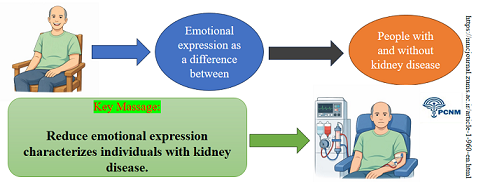
Graphical Abstract:
Reseach Highlights:
Knowledge Translation Statement
Audience: Nursing managers and hospital administrators
Patients with chronic kidney disease (CKD) show significantly lower emotional expressivity compared to healthy individuals, while tolerance of ambiguity does not differ between groups. Nursing managers should integrate structured emotional expression training into routine CKD care to help patients process emotions, secure social support, and improve psychosocial adjustment. Routine screening for emotional suppression is also recommended during hospital visits.
Type of Study: Orginal research |
Subject:
other
References
1. Johansen KL, Chertow GM, Gilbertson DT, Ishani A, Israni A, Ku E, et al. US Renal Data System 2022 Annual Data Report: Epidemiology of Kidney Disease in the United States. Am J Kidney Dis. 2023;81(3 Suppl1):8-11. [https://doi.org/10.1053/j.ajkd.2022.12.001] [PMID]
2. van Haalen H, Jackson J, Spinowitz B, Milligan G, Moon R. Impact of chronic kidney disease and anemia on health-related quality of life and work productivity: analysis of multinational real-world data. BMC Nephrology. 2020;21(1):88. [https://doi.org/10.1186/s12882-020-01746-4] [PMID]
3. Abassi MR, Safavi A, Haghverdi M, Saedi B. Sleep disorders in ESRD patients undergoing hemodialysis. Acta Medica Iranica. 2016:176 84. [https://acta.tums.ac.ir/index.php/acta/article/view/5551]
4. Rhee CM, Edwards D. Living well with kidney disease and effective symptom management: consensus conference proceedings. Kidney International Reports. 2022;7(9):1951-1963. [https://doi.org/10.1016/j.ekir.2022.06.015] [PMID]
5. Rydén A, Nolan S, Maher J, et al. Understanding the patient experience of chronic kidney disease stages 2-3b: a qualitative interview study with Kidney Disease Quality of Life (KDQOL-36) debrief. BMC Nephrology. 2022;23(1):201. [https://doi.org/10.1186/s12882-022-02826-3] [PMID]
6. Slavich GM. Life stress and health: a review of conceptual issues and recent findings. Teaching of Psychology. 2016;43(4):346-355. [https://doi.org/10.1177/0098628316662768] [PMID]
7. Asadizaker B, Gheibizadeh M, Ghanbari S, Araban M. Predictors of adherence to treatment in hemodialysis patients: a structural equation modeling. Medical Journal of the Islamic Republic of Iran. 2022; 36:23. [https://doi.org/10.47176/mjiri.36.23] [PMID]
8. Cedillo-Couvert EA, Ricardo AC, Chen J, et al. Self-reported medication adherence and CKD progression. Kidney International Reports. 2018;3(3):645-651. [https://doi.org/10.1016/j.ekir.2018.01.007] [PMID]
9. Tittler M. Affiliative stimuli elicit negative emotion and expressive suppression in high self-critics: a study using video stimuli. Motivation and Emotion. 2023;47(2):282-294. [https://doi.org/10.1007/s11031-023-10005-6]
10. Gross JJ. Handbook of Emotion Regulation. New York: Guilford Press; 2007. p. 95-120.
11. Reeve JM. Motivation and Emotion. 7th ed. New York: McGraw-Hill Education; 2019. p. 275-320.
12. Tanaka Y, Fujino J. Are ambiguity aversion and ambiguity intolerance identical? A neuroeconomics investigation. Frontiers in Psychology. 2015; 5:1550. [https://doi.org/10.3389/fpsyg.2014.01550] [PMID]
13. Masià-Plana A, Sitjar-Suñer M, Mantas-Jiménez S, Suñer-Soler R. The influence of emotional intelligence on quality of life in patients undergoing chronic hemodialysis focused on age and gender. Behavioral Sciences. 2024;14(3):220. [https://doi.org/10.3390/bs14030220] [PMID]
14. Konishi H. Family context and children's early literacy skills: the role of marriage quality and emotional expressiveness of mothers and fathers. Early Childhood Research Quarterly. 2018; 42:183-192. [https://doi.org/10.1016/j.ecresq.2017.10.008]
15. McMahon MA, Dluhy NM. Ambiguity within nursing practice: an evolutionary concept analysis. Research and Theory for Nursing Practice. 2017;31(1):56-74. [https://doi.org/10.1891/1541-6577.31.1.56] [PMID]
16. Hirsch CR. Resolving ambiguity in emotional disorders: the nature and role of interpretation biases. Annual Review of Clinical Psychology. 2016; 12:281-305. [https://doi.org/10.1146/annurev-clinpsy-021815-093436] [PMID]
17. Dimmock SG. Estimating ambiguity preferences and perceptions in multiple prior models: evidence from the field. Journal of Risk and Uncertainty. 2015;51(3):219-244. [https://doi.org/10.1007/s11166-015-9227-2] [PMID]
18. Sahib A, Chen J, Cárdenas D, Calear AL. Intolerance of uncertainty and emotion regulation: a meta-analytic and systematic review. Clinical Psychology Review. 2023; 101:102270. [https://doi.org/10.1016/j.cpr.2023.102270] [PMID]
19. Szcześniak M. The big five personality traits and positive orientation in Polish adults with multiple sclerosis: the role of meaning in life. International Journal of Environmental Research and Public Health. 2022;19(9):5426. [https://doi.org/10.3390/ijerph19095426] [PMID]
20. Halpern DF. Critical thinking: a model of intelligence for solving real-world problems. Journal of Intelligence. 2021;9(2):22. [https://doi.org/10.3390/jintelligence9020022] [PMID]
21. Yang Y. The role of ambiguity tolerance and enthusiasm on Chinese university teachers' burnout. Frontiers in Psychology. 2022 Jun 23; 13:910598. [https://doi.org/10.3389/fpsyg.2022.910598] [PMID]
22. Baussay A, Di L. The capacity of cognitive tests to detect generalized anxiety disorder (GAD): a pilot study. Journal of Psychiatric Research. 2024; 174:94-100. [https://doi.org/10.1016/j.jpsychires.2024.04.006] [PMID]
23. Selker RJDM, Koppert TY, Houtveen JH, Geenen R. Psychological flexibility in somatic symptom and related disorders: a case control study. Journal of Psychiatric Research. 2024; 73:398-404. [https://doi.org/10.1016/j.jpsychires.2024.03.036] [PMID]
24. McCracken LM. Psychological flexibility, chronic pain, and health. Annual Review of Psychology. 2024;75(1):601-624. [https://doi.org/10.1146/annurev-psych-020223-124335] [PMID]
25. Cho OH, Hong I, Kim H. Effect of uncertainty in illness and fatigue on health-related quality of life of patients on dialysis: a cross-sectional correlation study. Healthcare (Basel). 2022 Oct 16;10(10):2043. [https://doi.org/10.3390/healthcare10102043] [PMID]
26. Pourmohseni Koluri F, Shojaee A, Jafari I, Mowlaie M. Comparison of personality profiles, tolerance for ambiguity and religious coping in leukemia patients and healthy people. Journal of Health Psychology. 2020;9(33):45-60. [https://magiran.com/p2126709]
27. Yousefi Afrashteh M, Golmohammadi F, Tamjidi N. The path analysis of mediating role of hope of life in relationship between psychological hardiness and the power to tolerate ambiguity and death anxiety for MS patients. Medical Journal of Mashhad University of Medical Sciences. 2020;63(5):2768-2778. [https://doi.org/10.22038/mjms.2021.17396]
28. Mikaeili N, Ahmadi S, Habibi Y, Fallahi V, Moradi A, Hashemi J. Role of death anxiety and anxiety sensitivity in prediction of tolerance of ambiguity in patients with lung cancer. Nursing and Midwifery Journal. 2018;16(8):612-621. [http://unmf.umsu.ac.ir/article-1-3475-en.html]
29. Rafieinia P. The relationship between emotional expression styles and general health in students. Journal of Psychology. 2006;10(1):84-105. [https://sid.ir/paper/54587/fa]
30. McLain DL. Evidence of the properties of an ambiguity tolerance measure: the Multiple Stimulus Types Ambiguity Tolerance Scale-II (MSTAT-II). Psychological Reports. 2009;105(3 Pt 1):975-988. [https://doi.org/10.2466/PR0.105.3.975-988] [PMID]
31. Amiri S, Ghasemi Gheshlagh M, Abbaszadeh Z. Comparison of emotional structures (ambivalence and emotional alexithymia) and personality traits based on brain-behavioral systems in patients and normal individuals. Journal of Shahid Sadoughi University of Medical Sciences. 2018;26(1):16-26. [http://jssu.ssu.ac.ir/article-1-4183-en.html]
32. Shafiei R, Salehzadeh M, Dehghani F, Mortazavizadeh SMR. The role of emotional expressiveness and fear of expressing intimacy in predicting the quality of interpersonal relationships in patients with cancer. Journal of Research in Mental Health. 2019;13(2):33-44. [https://doi.org/10.52547/rph.13.2.33]
33. Samira E, Gafar H, Alireza M. Comparing cognitive emotion regulation strategies in patients with coronary artery disease, implantable cardioverter defibrillator recipients, and normal subjects. Journal of Neyshabur University of Medical Sciences. 2015;3(3):29-38.
34. Mahdavi E, Menshaei G. Comparison of emotional alexithymia and emotional expression in patients with coronary artery disease and healthy individuals. Feyz Journal. 2016;20(3):260-266. [http://feyz.kaums.ac.ir/article-1-3089-en.html]
35. Chilcot J, Pearce CJ, Hall N, et al. Depression and anxiety in people with kidney disease: understanding symptom variability, patient experience and preferences for mental health support. Journal of Nephrology. 2025;38(1):675-686. [DOI:10.1007/s40620-024-02194-1] [PMID]
36. Maghsoodi S, Garousi S, Khajooie Z. The correlation between social support and social health of patients on hemodialysis in the city of Kerman. Journal of Health Promotion Management. 2018;7(1):44-51. [http://jhpm.ir/article-1-817-fa.html]
37. Abrishamkesh S, Kafi Masoleh SM, Fallahi Khesht Masjedi M. Styles of expressing emotion in women suffering from breast cancer compared to healthy women. Journal of Guilan University of Medical Sciences. 2016;25(99):34-42. [http://journal.gums.ac.ir/article-1-1283-fa.html]
38. Doyle L, Sheridan A, Treacy MP. Motivations for adolescent self-harm and the implications for mental health nurses. Journal of Psychiatric and Mental Health Nursing. 2017;24(2-3):134-142. [https://doi.org/10.1111/jpm.12360] [PMID]
39. Jordan MR, Gebert T, Looser CE. Perspective taking failures in the valuation of mind and body. Journal of Experimental Psychology: General. 2019;148(3):407-420. [https://doi.org/10.1037/xge0000571] [PMID]
40. Waroquier P, Delevallez F. Psychological factors associated with clinical fear of cancer recurrence in breast cancer patients in the early survivorship period. Psycho-Oncology. 2022;31(11):1877-1885. [https://doi.org/10.1002/pon.5976]
41. Taghizadeh Afshari A, Ghare Aghaji Asl R, Kazemnejad A. Investigation of the effect of kidney transplantation on improving the quality of life of dialysis patients referred to Urmia medical centers. Journal of Medical Sciences Studies. 2006;17(3):9-15. [http://umj.umsu.ac.ir/article-1-149-fa.html]
42. Mammashli L. Investigation of the level of hope in patients undergoing hemodialysis treatment in educational and medical centers of Golestan University of Medical Sciences. Nursing Development in Health. 2018;9(2):55-64. [http://ndhj.lums.ac.ir/article-1-207-en.html]
43. Tong D. Association between regional white and gray matter volume and ambiguity tolerance: evidence from voxel-based morphometry. Psychophysiology. 2015;52(8):983-989. [https://doi.org/10.1111/psyp.12433]
44. Smithson M, Priest D. Ambiguity and conflict aversion when uncertainty is in the outcomes. Frontiers in Psychology. 2019;29(10):539. [https://doi.org/10.3389/fpsyg.2019.00539]
Send email to the article author
| Rights and permissions | |
 |
This work is licensed under a Creative Commons Attribution-NonCommercial 4.0 International License. |