
Preventive Care in Nursing and Midwifery

Volume 15, Issue 4 (10-2025)
Prev Care Nurs Midwifery 2025, 15(4): 6-18 |
Back to browse issues page


Ethics code: IR.ZUMS.REC.1396.334


Download citation:
BibTeX | RIS | EndNote | Medlars | ProCite | Reference Manager | RefWorks
Send citation to:


BibTeX | RIS | EndNote | Medlars | ProCite | Reference Manager | RefWorks
Send citation to:
Azadi Z, Kharghani R, Emamgholi khooshehchin T, Ebrahimi L. Effect of Cognitive Behavioral Counseling on Stress and Quality of Life of Pregnant Women With a History of Spontaneous Abortion: A Randomized Controlled Trial. Prev Care Nurs Midwifery 2025; 15 (4) :6-18
URL: http://nmcjournal.zums.ac.ir/article-1-980-en.html
URL: http://nmcjournal.zums.ac.ir/article-1-980-en.html

Department of Midwifery, School of Nursing and Midwifery, Zanjan University of Medical Sciences, Zanjan, Iran , khoosheh@zums.ac.ir
Abstract: (890 Views)
Background: Spontaneous abortion is a physically and psychologically distressing event, often necessitating psychological support in subsequent pregnancies to mitigate adverse mental health outcomes.
Objectives: This study aimed to evaluate the effectiveness of individual cognitive-behavioral therapy (CBT) counseling in reducing stress and improving the quality of life among pregnant women with a history of spontaneous abortion.
Methods: A parallel-group randomized controlled trial was conducted with 72 pregnant women at 6–10 weeks of gestation, all of whom had a prior spontaneous abortion and exhibited stress symptoms. Participants were randomly assigned to an intervention group (n = 36) receiving 10 individual CBT sessions or a control group (n = 36) receiving routine prenatal care. Stress and quality of life were assessed at baseline, post-intervention, and two-month follow-up. Nonparametric statistical analyses were performed, with significance set at p < 0.05.
Results: Post-intervention, the CBT group showed a significant reduction in stress levels compared to controls (from 28.3 to 19.9 post-intervention and 19.7 at follow-up; p < 0.001). Significant improvements were also observed in psychological, social, environmental, and general health domains of quality of life (QOL) (overall QOL increased from 60.4 to 70.8; p < 0.001). These benefits were largely maintained at the two-month follow-up, although no significant change occurred in the physical domain.
Conclusion: Individual CBT counseling is an effective intervention for reducing stress and enhancing quality of life in pregnant women with a history of spontaneous abortion, supporting its integration into prenatal mental health care for this vulnerable group.
Objectives: This study aimed to evaluate the effectiveness of individual cognitive-behavioral therapy (CBT) counseling in reducing stress and improving the quality of life among pregnant women with a history of spontaneous abortion.
Methods: A parallel-group randomized controlled trial was conducted with 72 pregnant women at 6–10 weeks of gestation, all of whom had a prior spontaneous abortion and exhibited stress symptoms. Participants were randomly assigned to an intervention group (n = 36) receiving 10 individual CBT sessions or a control group (n = 36) receiving routine prenatal care. Stress and quality of life were assessed at baseline, post-intervention, and two-month follow-up. Nonparametric statistical analyses were performed, with significance set at p < 0.05.
Results: Post-intervention, the CBT group showed a significant reduction in stress levels compared to controls (from 28.3 to 19.9 post-intervention and 19.7 at follow-up; p < 0.001). Significant improvements were also observed in psychological, social, environmental, and general health domains of quality of life (QOL) (overall QOL increased from 60.4 to 70.8; p < 0.001). These benefits were largely maintained at the two-month follow-up, although no significant change occurred in the physical domain.
Conclusion: Individual CBT counseling is an effective intervention for reducing stress and enhancing quality of life in pregnant women with a history of spontaneous abortion, supporting its integration into prenatal mental health care for this vulnerable group.
Keywords: Individual Counseling, Cognitive-Behavioral Approach, Stress, Quality of Life, Spontaneous Abortion.
Full-Text [PDF 991 kb]
(355 Downloads)
| | Full-Text (HTML) (503 Views)
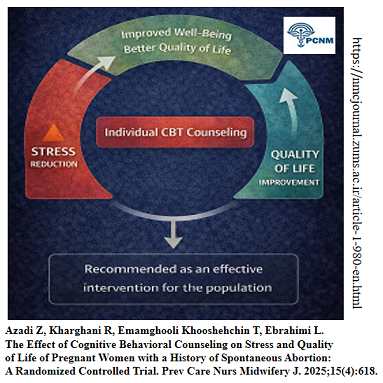
Graphical Abstract:
Reseach Highlights:
Knowledge Translation Statement
Audience: Nursing managers and hospital administrators
Individual cognitive-behavioral therapy (CBT) significantly reduces stress and improves psychological, social, and environmental quality of life in pregnant women with a prior miscarriage, with effects sustained for at least two months. Nursing managers should facilitate referral pathways to trained CBT counselors during early prenatal visits (6–10 weeks) and allocate time for 10 structured sessions. Psychological support should complement standard obstetric care.
Type of Study: Orginal research |
Subject:
Midwifery
References
1. Cunningham FG, Leveno KJ, Bloom SL, Spong CY, Dash JS, Hoffman BL, et al. Williams Obstetrics. 26th ed. New York: McGraw-Hill; 2022.
2. Huss B. Well-being before and after pregnancy termination: the consequences of abortion and miscarriage on satisfaction with various domains of life. Journal of Happiness Studies. 2021;22(6):2803-28. [https://doi.org/10.1007/s10902-020-00350-5]
3. Hosseini Haji Z, Aradmehr M, Irani M, Namazi Nia M. Comparison of the relative risk of stress, anxiety, and depression in women after miscarriage, ectopic pregnancy, and normal pregnancy: A cross-sectional study. Iranian Journal of Gynecology, Obstetrics And Infertility. 2023;26(5):49-60. [https://doi.org/10.22038/ijogi.2023.22960]
4. Herbert D, Young K, Pietrusińska M, MacBeth A. The mental health impact of perinatal loss: A systematic review and meta-analysis. Journal of Affective Disorders. 2022;297:118-29. [https://doi.org/10.1016/j.jad.2021.10.026] [PMID]
5. Masten M, Campbell O, Horvath S, Zahedi-Spung L. Abortion and Mental Health and Wellbeing: A Contemporary Review of the Literature. Current Psychiatry Reports. 2024;26(12):877-84. [https://doi.org/10.1007/s11920-024-01557-6] [PMID]
6. Carthew J, Gannon K. Barriers to Accessing Psychological Support Following Early Miscarriage: Perspectives of the IAPT Perinatal Champion. Journal of Reproductive and Infant Psychology. 2024 Nov 21;23:1-17. [https://doi.org/10.1080/02646838.2024.2433155] [PMID]
7. Kukulskienė M, Žemaitienė N. Postnatal depression and post-traumatic stress risk following miscarriage. International Journal of Environmental Research and Public Health. 2022;19(11):6515. [https://doi.org/10.3390/ijerph19116515] [PMID]
8. Cranwell-Ward J, Abbey A. What is Stress? In: Organizational Stress. London: Palgrave Macmillan; 2005. p. 27-38. [https://doi.org/10.1057/9780230522800]
9. Updegraff JA, Taylor SE. From vulnerability to growth: Positive and negative effects of stressful life events. In: Loss and trauma. Routledge; 2021. p. 3-28. [https://doi.org/10.4324/9781315783345-2]
10. Collins JM, Keane JM, Deady C, Khashan AS, McCarthy FP, O'Keeffe GW, et al. Prenatal stress impacts foetal neurodevelopment: Temporal windows of gestational vulnerability. Neuroscience and Biobehavioral Reviews. 2024;164:105793. [https://doi.org/10.1016/j.neubiorev.2024.105793] [PMID]
11. Kulathilaka S, Hanwella R, De Silva V. Depressive Disorder and Grief Following Spontaneous Abortion. BMC Psychiatry. 2016;16:100. [https://doi.org/10.1186/s12888-016-0812-y] [PMID]
12. Campillo ISL, Meaney S, McNamara K, O'Donoghue K. Psychological and support interventions to reduce levels of stress, anxiety or depression on women's subsequent pregnancy with a history of miscarriage: an empty systematic review. BMJ Open. 2017;7(9):e017802. [https://doi.org/10.1136/bmjopen-2017-017802] [PMID]
13. Díaz-Pérez E, Haro G, Echeverria I. Psychopathology Present in Women after Miscarriage or Perinatal Loss: A Systematic Review. Psychiatry International. 2023;4(2):126-35. [https://doi.org/10.3390/psychiatryint4020015]
14. Mergl R, Quaatz SM, Lemke V, Allgaier AK. Prevalence of depression and depressive symptoms in women with previous miscarriages or stillbirths - A systematic review. Journal of Psychiatric Research. 2024;169:84-96. [https://doi.org/10.1016/j.jpsychires.2023.11.021] [PMID]
15. Melo-Oliveira ME, Sá-Caputo D, Bachur JA, Paineiras-Domingos LL, Sonza A, Lacerda AC, et al. Reported quality of life in countries with cases of COVID19: a systematic review. Expert Review of Respiratory Medicine. 2021;15(2):213-20. [https://doi.org/10.1080/17476348.2021.1826315] [PMID]
16. Theofilou P. Quality of life: definition and measurement. Europe's Journal of Psychology. 2013;9(1):150-62. [https://doi.org/10.5964/ejop.v9i1.337]
17. Santacreu M, Bustillos A, Fernandez-Ballesteros R. Multidimensional/multisystems/multinature indicators of quality of life: Cross-cultural evidence from Mexico and Spain. Social Indicators Research. 2016;126(2):467-82. [https://doi.org/10.1007/s11205-015-0906-9]
18. Lagadec N, Steinecker M, Kapassi A, Magnier AM, Chastang J, Robert S, et al. Factors influencing the quality of life of pregnant women: a systematic review. BMC Pregnancy and Childbirth. 2018;18(1):455. [https://doi.org/10.1186/s12884-018-2087-4] [PMID]
19. Salarfard M, Ghannadkafi M, Vaghee S, Behnam Vashani H, Mirzakhani K. Investigating the effect of emotional disclosure on the quality of life of women after abortion: a randomized controlled clinical trial. BMC Psychology. 2025;13(1):1051. [https://doi.org/10.1186/s40359-025-03355-y] [PMID]
20. Iwanowicz-Palus G, Mróz M, Bień A. Quality of life, social support and self-efficacy in women after a miscarriage. Health and Quality of Life Outcomes. 2021;19(1):16. [https://doi.org/10.1186/s12955-020-01662-z] [PMID]
21. Nikčević AV, Kuczmierczyk AR, Nicolaides KH. The influence of medical and psychological interventions on women's distress after miscarriage. Journal of Psychosomatic Research. 2007;63(3):283-90. [https://doi.org/10.1016/j.jpsychores.2007.04.004] [PMID]
22. Kong G, Chung T, Lok I. The impact of supportive counselling on women's psychological wellbeing after miscarriage-a randomised controlled trial. BJOG: An International Journal of Obstetrics and Gynaecology. 2014;121(10):1253-62. [https://doi.org/10.1111/1471-0528.12908] [PMID]
23. Shereda HMA, Rashed A, Shokr E. Effect of psychological intervention on post-traumatic stress symptoms and pregnancy outcomes among women with previous recurrent abortion. Journal of Nursing Education and Practice. 2018;8(12):123-34. [https://doi.org/10.5430/jnep.v8n12p123]
24. Heratzadeh FM. The Effectiveness of Self-Compassion Training on Anxiety and Quality of Life in Pregnant Women with Abortion in 1395-96 in Yazd. International Conference on Psychology Shandiz Higher Education Institute; 2017.
25. Silva ACdO, Nardi AE. Cognitive-behavioral therapy to miscarriage: results from the use of a grief therapy protocol. Archives of Clinical Psychiatry (São Paulo).2011;38:122-4. [https://doi.org/10.1590/S0101-60832011000300007]
26. Cully JA, Teten AL. A Therapist's Guide to Brief Cognitive Behavioral Therapy. Houston: Department of Veterans Affairs South Central MIRECC; 2008. Chapter 1, p. 6.
27. Jabari Z, Hashemi H, Haghayegh A. Effect of cognitive-behavioral stress management on stress, anxiety and Depression in pregnant women. Journal of Health System Research. 2013;8(7):1341-8. [http://hsr.mui.ac.ir/article-1-479-fa.html]
28. Anthony M, Ironson G, Schneiderman N. A practical guide to managing stress through cognitive-behavioral methods. Translated by Jokar S, Al-Mohammad SJ, Taher Neshatdoost H. 1st ed. Isfahan: Isfahan University of Science and Technology; 2010.
29. Cohen S, Kamarck T, Mermelstein R. A global measure of perceived stress. Journal of Health and Social Behavior. 1983;24(4):385-96. [https://doi.org/10.2307/2136404] [PMID]
30. World Health Organization. The World Health Organization Quality of Life assessment (WHO/QOL): position paper from the World Health Organization. Social Science and Medicine. 1995;41(10):1403-9. [https://doi.org/10.1016/0277-9536(95)00112-k] [PMID]
31. Noorbala A, Mohammad K. The validation of general health questionnaire-28 as a psychiatric screening tool. Hakim Research Journal. 2009;11(4):47-53. [http://hakim.tums.ac.ir/article-1-464-en.html]
32. Hiltunen AJ, Kocys E, Perrin‐Wallqvist R. Effectiveness of cognitive behavioral therapy: An evaluation of therapies provided by trainees at a university psychotherapy training center. PsyCh Journal. 2013;2(2):101-12. [https://doi.org/10.1002/pchj.23] [PMID]
33. Shirazian S, Smaldone A, Rao MK, Silberzweig J, Jacobson AM, Fazzari M, et al. A protocol for a pilot randomized controlled trial to assess the feasibility and effect of a cognitive behavioral intervention on quality of life for patients on hemodialysis. Contemporary Clinical Trials. 2018;73:51-60. [https://doi.org/10.1016/j.cct.2018.08.012] [PMID]
34. de Beurs E, Carlier I, van Hemert A. Psychopathology and health-related quality of life as patient-reported treatment outcomes: evaluation of concordance between the brief symptom inventory (BSI) and the short form-36 (SF-36) in psychiatric outpatients. Quality of Life Research. 2022;31(5):1461-71. [https://doi.org/10.1007/s11136-021-03019-5] [PMID]
Send email to the article author
| Rights and permissions | |
 |
This work is licensed under a Creative Commons Attribution-NonCommercial 4.0 International License. |