
Preventive Care in Nursing and Midwifery Journal

Volume 15, Issue 4 (10-2025)
Prev Care Nurs Midwifery J 2025, 15(4): 85-95 |
Back to browse issues page


Ethics code: Not applicable. This study is a systematic review of published literature and did not require ethica


Download citation:
BibTeX | RIS | EndNote | Medlars | ProCite | Reference Manager | RefWorks
Send citation to:


BibTeX | RIS | EndNote | Medlars | ProCite | Reference Manager | RefWorks
Send citation to:
mohamadi S, Jalali A. Impact of Artificial Intelligence–Based Educational Programs on Clinical Decision‑Making and Medical Errors Among Nursing Students: A Systematic Review and Narrative Synthesis. Prev Care Nurs Midwifery J 2025; 15 (4) :85-95
URL: http://nmcjournal.zums.ac.ir/article-1-1011-en.html
URL: http://nmcjournal.zums.ac.ir/article-1-1011-en.html

Department of Nursing, School of Nursing and Midwifery, Kermanshah University of Medical Sciences, Kermanshah, Iran. , parastari137464@gmail.com
Abstract: (412 Views)
Background: Preventable medical errors are a major concern in clinical care, highlighting the importance of effective nursing education for clinical decision-making. Recently, AI-based educational strategies have emerged, but their actual impact on nursing students has not been systematically assessed.
Objective: This systematic review aimed to synthesize the available evidence on the impact of AI‑based educational programs on clinical decision‑making and medical errors among nursing students.
Methods: This systematic review was conducted according to PRISMA 2020. PubMed, Scopus, Web of Science, Cochrane CENTRAL, and Embase were searched for relevant studies (2019–2024). Eligible studies were randomized controlled trials (RCTs) and quasi-experimental designs comparing AI-based interventions with traditional education in undergraduate nursing students. Study selection, data extraction, and quality appraisal (RoB-2 and ROBINS-I) were performed independently. Due to substantial heterogeneity among the included studies, a narrative synthesis was performed.
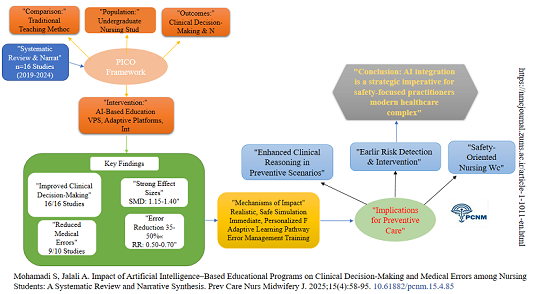
Results: The initial search identified 1,487 records, of which 16 studies involving approximately 1,590 nursing students met the inclusion criteria. AI‑based interventions, mainly virtual patient simulations and adaptive learning systems, significantly enhanced clinical decision‑making skills in all included studies. Moreover, most studies assessing medical errors (9 of 10) reported notable reductions in medication miscalculations and diagnostic inaccuracies. Overall, the methodological quality of the included studies was rated as moderate to good.
Conclusion: AI-based education shows strong potential to improve clinical judgment and promote patient safety in nursing students. Careful, context-sensitive integration into nursing curricula is recommended, with future research needed to address methodological heterogeneity and long-term effectiveness.
Objective: This systematic review aimed to synthesize the available evidence on the impact of AI‑based educational programs on clinical decision‑making and medical errors among nursing students.
Methods: This systematic review was conducted according to PRISMA 2020. PubMed, Scopus, Web of Science, Cochrane CENTRAL, and Embase were searched for relevant studies (2019–2024). Eligible studies were randomized controlled trials (RCTs) and quasi-experimental designs comparing AI-based interventions with traditional education in undergraduate nursing students. Study selection, data extraction, and quality appraisal (RoB-2 and ROBINS-I) were performed independently. Due to substantial heterogeneity among the included studies, a narrative synthesis was performed.
Results: The initial search identified 1,487 records, of which 16 studies involving approximately 1,590 nursing students met the inclusion criteria. AI‑based interventions, mainly virtual patient simulations and adaptive learning systems, significantly enhanced clinical decision‑making skills in all included studies. Moreover, most studies assessing medical errors (9 of 10) reported notable reductions in medication miscalculations and diagnostic inaccuracies. Overall, the methodological quality of the included studies was rated as moderate to good.
Conclusion: AI-based education shows strong potential to improve clinical judgment and promote patient safety in nursing students. Careful, context-sensitive integration into nursing curricula is recommended, with future research needed to address methodological heterogeneity and long-term effectiveness.
Keywords: Artificial Intelligence, Nursing Education, Clinical Decision-Making, Medical Errors, Patient Safety, Systematic Review, Narrative Synthesis.
Full-Text [PDF 788 kb]
(171 Downloads)
| | Full-Text (HTML) (125 Views)
Knowledge Translation Statement
Audience: Nursing managers and hospital administrators
AI-based educational programs (virtual patient simulators, adaptive learning platforms, VR with intelligent avatars, and chatbots) improve clinical decision-making and reduce medication and diagnostic errors among nursing students compared to traditional methods, though evidence is emerging with methodological heterogeneity. Nursing managers should strategically invest in AI simulation labs and faculty development for AI integration, but currently use AI as a supplement to, not replacement for, clinical placement, as long-term skill retention and transfer to real settings remain unverified.
Type of Study: Review Articels |
Subject:
Nursing
References
1. Tanner CA. Thinking like a nurse: a research-based model of clinical judgment in nursing. Journal of Nursing Education. 2023;62(2):63-74. [https://doi.org/10.3928/01484834-20230101-01]
2. World Health Organization. Patient safety [Internet]. 2023 [cited 2024 Jun 1]. [https://www.who.int/health-topics/patient-safety]
3. Kohn LT, Corrigan JM, Donaldson MS, editors. To err is human: building a safer health system. Washington (DC): National Academies Press; 2000.
4. Benner P, Sutphen M, Leonard V, Day L. Educating nurses: a call for radical transformation. San Francisco: Jossey-Bass; 2010.
5. Jeffries PR. Simulation in nursing education: from conceptualization to evaluation. 4th ed. Philadelphia: Lippincott Williams & Wilkins; 2022.
6. Wartman SA, Combs CD. Reimagining medical education in the age of artificial intelligence. Academic Medicine. 2023;98(1):66-71. [https://doi.org/10.1097/ACM.0000000000004533] [PMID]
7. Bajwa J, Munir U, Nori A, Williams B. Artificial intelligence in healthcare: transforming the practice of medicine. Future Healthcare Journal. 2021;8(2):e188-e194. [https://doi.org/10.7861/fhj.2021-0095] [PMID]
8. Foronda CL, Fernandez-Burgos M, Nadeau C, Kelley CN, Henry MN. Virtual simulation in nursing education: a systematic review spanning 1996 to 2018. Simulation in Healthcare. 2020;15(1):46-54. [https://doi.org/10.1097/SIH.0000000000000411] [PMID]
9. Cook DA, Triola MM. Virtual patients: a critical literature review and proposed next steps. Medical Education. 2020;54(9):786-795. [https://doi.org/10.1111/medu.14172] [PMID]
10. Padilha JM, Machado PP, Ribeiro A, Ramos J, Costa P. Clinical virtual simulation in nursing education: randomized controlled trial. Journal of Medical Internet Research. 2021;23(3):e25466. [https://doi.org/10.2196/25466] [PMID]
11. Kardong-Edgren S, Farra SL, Alinier G, Young HM. Using virtual reality and augmented reality in nursing and medical education: a call for action. Clinical Simulation in Nursing. 2021;50:1-4. [https://doi.org/10.1016/j.ecns.2020.12.002]
12. Chen FQ, Leng YF, Ge JF, Wang DW, Li C, Chen B. Effectiveness of artificial intelligence in nursing education: a systematic review and meta-analysis. Nurse Education Today. 2024;135:106118. [https://doi.org/10.1016/j.nedt.2024.106118] [PMID]
13. Han ER, Yeo S, Kim MJ, Lee YH, Park KH, Roh H. The use of artificial intelligence in medical education: a systematic review and meta-analysis. PLOS ONE. 2023;18(5):e0285982. [https://doi.org/10.1371/journal.pone.0285982] [PMID]
14. Page MJ, McKenzie JE, Bossuyt PM, Boutron I, Hoffmann TC, Mulrow CD, et al. The PRISMA 2020 statement: an updated guideline for reporting systematic reviews. BMJ. 2021;372:n71. [https://doi.org/10.1136/bmj.n71] [PMID]
15. Sterne JAC, Savović J, Page MJ, Elbers RG, Blencowe NS, Boutron I, et al. RoB 2: a revised tool for assessing risk of bias in randomised trials. BMJ. 2019;366:l4898. [https://doi.org/10.1136/bmj.l4898] [PMID]
16. Kolb DA. Experiential learning: experience as the source of learning and development. 2nd ed. Upper Saddle River: FT Press; 2014.
17. Lapkin S, Levett-Jones T, Bellchambers H, Fernandez R. Effectiveness of patient simulation manikins in teaching clinical reasoning skills to undergraduate nursing students: a systematic review. Clinical Simulation in Nursing. 2021;46:1-14. [https://doi.org/10.1016/j.ecns.2020.08.010]
18. Hattie J, Timperley H. The power of feedback. Review of Educational Research. 2007;77(1):81-112. [https://doi.org/10.3102/003465430298487]
19. Sweller J, van Merriënboer JJG, Paas F. Cognitive architecture and instructional design: 20 years later. Educational Psychology Review. 2019;31(2):261-292. [https://doi.org/10.1007/s10648-019-09465-5]
20. Reason J. Managing the risks of organizational accidents. London: Routledge; 2016. [https://doi.org/10.4324/9781315543543]
21. O'Neill T, Lopes S. Error management training: a review and meta-analysis. Journal of Applied Psychology. 2022;107(12):2157-2184. [https://doi.org/10.1037/apl0001021] [PMID]
22. Shorey S, Ng ED. The use of virtual reality simulation among nursing students and registered nurses: a systematic review. Nurse Education Today. 2021;98:104662. [https://doi.org/10.1016/j.nedt.2020.104662] [PMID]
Send email to the article author
| Rights and permissions | |
 |
This work is licensed under a Creative Commons Attribution-NonCommercial 4.0 International License. |