
Preventive Care in Nursing and Midwifery

Volume 15, Issue 4 (10-2025)
Prev Care Nurs Midwifery 2025, 15(4): 19-27 |
Back to browse issues page


Ethics code: IR.IAU.Z.REC.1403.008


Download citation:
BibTeX | RIS | EndNote | Medlars | ProCite | Reference Manager | RefWorks
Send citation to:


BibTeX | RIS | EndNote | Medlars | ProCite | Reference Manager | RefWorks
Send citation to:
Khanbabaei F, Sobhi A. Comparison of Emotional Expressivity and Tolerance of Ambiguity in Patients with Chronic Kidney Disease and Healthy Controls: A Cross-Sectional Study. Prev Care Nurs Midwifery 2025; 15 (4) :19-27
URL: http://nmcjournal.zums.ac.ir/article-1-960-en.html
URL: http://nmcjournal.zums.ac.ir/article-1-960-en.html

Department of Clinical Psychology, Faculty of Nursing and Midwifery, Islamic Azad University, Zanjan Branch, Zanjan, Iran , fatemehkhanbabaie@yahoo.com
Full-Text [PDF 713 kb]
(341 Downloads)
| Abstract (HTML) (711 Views)
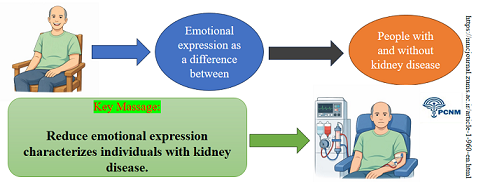
Graphical Abstract:
Reseach Highlights:
Knowledge Translation Statement
Audience: Nursing managers and hospital administrators
Patients with chronic kidney disease (CKD) show significantly lower emotional expressivity compared to healthy individuals, while tolerance of ambiguity does not differ between groups. Nursing managers should integrate structured emotional expression training into routine CKD care to help patients process emotions, secure social support, and improve psychosocial adjustment. Routine screening for emotional suppression is also recommended during hospital visits.
Full-Text: (182 Views)
Introduction
Chronic kidney disease (CKD) is one of the most important public health concerns worldwide [1]. According to statistics, the global prevalence of CKD is approximately 10% of the total population, and this rate is rapidly increasing [2]. Chronic diseases such as kidney failure, due to the prolonged involvement of individuals with the illness and its treatment, not only impair physical health and impose an economic burden but also affect all social and psychological aspects of 'patients' lives. Consequently, they lead to reduced quality of life, depression and anxiety, sleep disturbances, and decreased hope for life among patients and their caregivers [3]. Psychological parameters are associated with adverse health outcomes in patients with chronic kidney disease [4]. These patients often experience worry, shock, distrust, abandonment, social isolation, anger, and fear [5]. Chronic exposure to negative emotions and prolonged stress activates immune responses, which in turn predispose individuals to psychological disorders such as anxiety and depression [6]. The presence of these disorders, particularly depression, significantly reduces treatment adherence among kidney patients [7], thereby exacerbating the disease and increasing mortality rates [8]. Persistent experience of negative emotions often leads to the suppression of emotional expression, which in turn heightens stress and contributes to the development of psychological disorders [9]. Conversely, 'individuals' ability to express emotions is an important component that fosters emotional awareness [10]. Emotional expressivity, as a core component of emotion, refers to the outward display of feelings regardless of their valence (positive or negative) or mode of expression (facial, verbal, or bodily) [11]. Emotional expression plays a crucial role in maintaining interpersonal relationships. Emotional approach coping, such as actively processing and expressing emotions, can elicit positive social responses and secure social support, which acts as a protective buffer against illness and enhances adjustment in patients with chronic diseases such as breast cancer [12]. Evidence indicates that individuals with chronic kidney disease have lower emotional awareness than healthy individuals [13], experience higher levels of emotional ambivalence and alexithymia, and are therefore more susceptible to psychosomatic disorders [14]. Moreover, research in other chronic illnesses, including cancer and cardiovascular disease, has demonstrated that emotional expressivity predicts the quality of interpersonal relationships and contributes to a better understanding of 'patients' psychological pathology [15-17].
On the other hand, emotion regulation through changes in emotional expression may influence tolerance of ambiguity [18]. Tolerance of ambiguity refers to the degree to which an individual can accept and manage the cognitive challenges associated with ambiguous situations. In today's complex world, tolerance of ambiguity functions as an essential skill that enables individuals to respond swiftly and adapt effectively to uncertain circumstances [19]. Reactions to ambiguity manifest in cognitive forms (a tendency to perceive situations dichotomously), emotional forms (feelings of disgust, distress, anger, or anxiety), and behavioral forms (avoidance of ambiguous situations) [20]. Individuals with low tolerance of ambiguity tend to feel discomfort when facing complex or uncertain situations and, due to deficiencies in cognitive processing, struggle to find appropriate solutions. Such individuals often become overwhelmed by anxiety and mental rumination in ambiguous contexts and fail to process new information effectively [21]. This condition is characterized by rigid cognitive patterns, confirmation bias, and a persistent sense of threat, which together increase the likelihood of generalized anxiety disorder [22]. Patients with chronic physical symptoms exhibit lower levels of psychological flexibility [23], whereas individuals with higher psychological flexibility report better quality of life in the context of chronic kidney disease [24]. Moreover, low tolerance of ambiguity has been associated with poorer adaptation to medical care in these patients [25]. Similar findings have been reported in other chronic illnesses; for instance, patients with leukemia exhibit lower tolerance of ambiguity than healthy individuals [26]. Among patients with multiple sclerosis, greater tolerance of ambiguity has been linked to higher life expectancy and reduced death anxiety [27]. In patients with lung cancer, anxiety sensitivity and death anxiety have been identified as major predictors of intolerance of ambiguity [28].
Objectives
This study aimed to compare emotional expressivity and tolerance of ambiguity between individuals diagnosed with chronic kidney disease (CKD) and healthy controls.
It was hypothesized that patients with CKD would demonstrate lower levels of both emotional expressivity and ambiguity tolerance compared to individuals without the disease.
Methods
Study Design and Setting
A descriptive-comparative, cross-sectional study was conducted in Zanjan, Iran, between the spring and summer of 2024. The study setting included three major renal care centers: The Kidney Association Center, Valiasr Hospital, and Bahman Hospital.
Participants and Sampling
The sample consisted of 360 participants divided into two independent groups.
The patient group included 180 adults with a confirmed diagnosis of chronic kidney disease (CKD), purposively recruited from the aforementioned clinical centers. The control group comprised 180 healthy adults without kidney disease, selected via convenience sampling from the general population of Zanjan.
Inclusion and Exclusion Criteria
Inclusion criteria for all participants were: (1) residency in Zanjan, and (2) basic literacy (ability to read and write).
For the patient group, an additional mandatory criterion was a CKD diagnosis formally confirmed by an internist or nephrologist. For the healthy control group, the key inclusion criterion was the absence of any kidney disease. The primary exclusion criterion for both groups, applied during data cleaning, was the submission of an incomplete questionnaire.
Instruments and Measures
Data were collected using two validated self-report questionnaires:
Emotional Expressivity Questionnaire (EEQ): Developed by King and Emmons (1990), this 16-item scale measures three dimensions of emotional expressivity (positive, intimate, and negative) on a 5-point Likert scale. Total scores range from 16 to 80, with higher scores indicating greater expressivity. In this study, the scale demonstrated good internal consistency (Cronbach’s α = 0.76) [29].
Multiple Stimulus Types Ambiguity Tolerance Scale-II (MSTAT-II): Developed by McLain (2009), this 13-item instrument assesses an individual's tolerance for ambiguous situations on a 5-point Likert scale. Scores range from 13 to 65, with higher scores reflecting greater tolerance. In the present study, the scale showed high internal consistency (Cronbach’s α = 0.83) [30].
Demographic and clinical data (e.g., age, gender, education, CKD duration, etiology) were also collected.
Data Analysis
All statistical analyses were performed using SPSS software (Version 24). Descriptive statistics were used to summarize demographic characteristics. The normality of data distribution for the main variables was confirmed using the Kolmogorov-Smirnov test. The primary analysis involved independent-sample t-tests to compare the mean scores of emotional expressivity and tolerance of ambiguity between the CKD and control groups. Effect sizes were calculated using Cohen's d, and a p-value of less than 0.05 was considered statistically significant. Results are reported as mean (M) ± standard deviation (SD).
Results
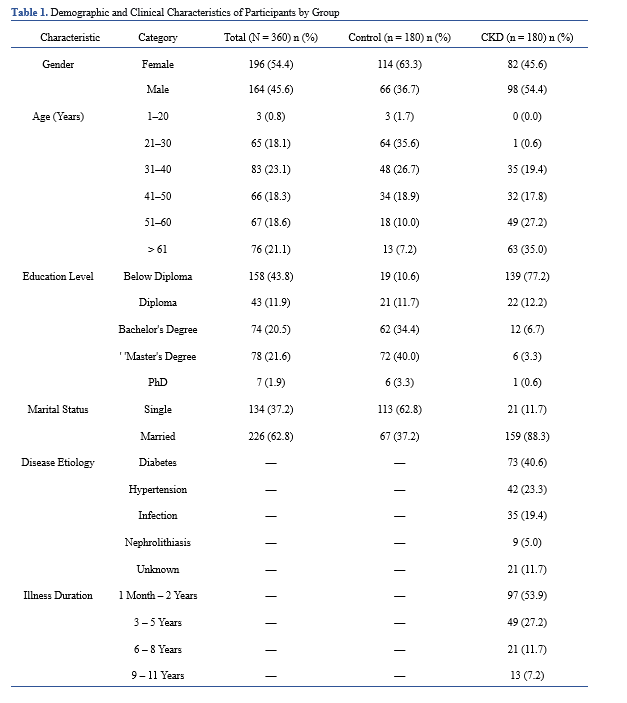
A total of 360 participants (180 CKD patients, 180 healthy controls) were included in the analysis. The majority of the overall sample were female (54.4%), married (62.8%), and had an education level below a high school diploma (43.8%). The mean age was 50.8 years (SD = 13.1) in the CKD group and 49.6 years (SD = 11.4) in the control group. Among CKD patients, the mean duration of illness was 2.8 years (SD = 2.1), with diabetes (40.6%) and hypertension (23.3%) being the most common etiologies. The full demographic and clinical profile of the sample is presented in Table 1.
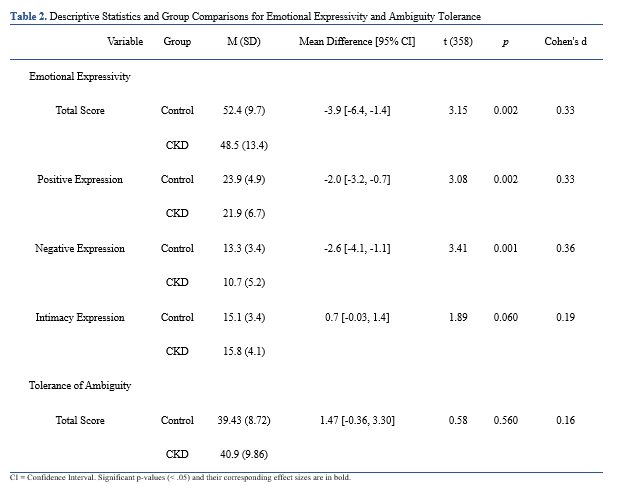
Descriptive statistics and the results of independent samples t-tests comparing the main study variables between groups are detailed in Table 2. A significant between-group difference was found in the total score for emotional expressivity, t (358) = 3.15t (358) = 3.15, p = .002 p = .002. Patients with CKD (M = 48.5 M = 48.5, SD = 13.4 SD = 13.4) reported significantly lower overall emotional expressivity than healthy controls (M = 52.4 M = 52.4, SD = 9.7 SD = 9.7), with a mean difference of -3.9 (95% CI [-6.4, -1.4]) and a moderate effect size (Cohen's d = 0.33 d = 0.33). This pattern was consistent for the subscales of positive emotional expression (p = .002, p = .002) and negative emotional expression (p = .001, p = .001), but not for the expression of intimacy subscale (p = .060, p = .060).
In contrast, no statistically significant difference was observed between the groups in tolerance of ambiguity, t (358) = 0.58t (358) = 0.58, p = .560 p = .560. The CKD group (M = 40.9 M = 40.9, SD = 9.86 SD = 9.86) and the control group (M=39.43 M = 39.43, SD = 8.72 SD = 8.72) scored similarly, with a mean difference of 1.47 (95% CI [-0.36, 3.30]) and a negligible effect size (Cohen's d = 0.16 d = 0.16).
Discussion
The present study aimed to compare emotional expressivity and tolerance of ambiguity between individuals with chronic kidney disease (CKD) and healthy controls. The primary finding indicated that healthy participants demonstrated significantly higher levels of emotional expressivity compared to patients with CKD.
This result aligns with prior research on chronic illnesses. The findings are consistent with Amiri et al. [31], who reported significantly higher levels of emotional ambivalence and alexithymia in patients compared to healthy individuals, noting these maladaptive emotional patterns may predispose individuals to psychosomatic disorders. Similarly, Shafiei et al. [32] identified emotional expressivity as a significant predictor of interpersonal relationship quality in cancer patients. Eram [33] found that individuals with heart disease were more inclined to use cognitive reappraisal for emotion regulation and less likely to suppress emotions compared to non-patients. Furthermore, Mahdavi and Menshaei [34] highlighted the key role of emotional expressivity and alexithymia in understanding the psychopathology of coronary artery disease patients.
These findings can be interpreted within the context of the CKD experience. Patients endure substantial physiological changes and considerable psychological distress. Awareness of the disease's progressive nature and the burdens of long-term treatment, such as dialysis, generates significant stress. Prolonged illness often impairs psychosocial functioning, leading to anxiety, depression, and social withdrawal [35]. Emotional expression is crucial for maintaining relationships and securing social support, which acts as a protective buffer [36, 37]. Faced with physical and psychological challenges, CKD patients may experience a gradual erosion of social connectivity and a consequent impairment in emotional expressivity. Conversely, the free expression of emotions is associated with better mental health [38], while emotional suppression may contribute to psychological and physical morbidity [39]. Thus, the current study confirms that, similar to other chronic conditions like cancer and cardiovascular disease [31-34], CKD is associated with diminished emotional expressivity.
Conversely, the study found no significant difference in tolerance of ambiguity between CKD patients and healthy controls. No prior study has directly examined this construct in a CKD population, but research on other chronic illnesses presents mixed findings. For instance, Pourmohseni Koluri et al. [26] reported lower ambiguity tolerance in leukemia patients compared to healthy individuals. Similarly, Waroquier et al. [40] noted that intolerance of ambiguity negatively impacted treatment quality in patients with breast cancer and heart disease.
The current null finding may be explained by several factors specific to the CKD trajectory. Kidney transplantation can significantly improve quality of life [41], and levels of hope among CKD patients are often relatively high [42]. Although CKD and its treatments (e.g., hemodialysis) create uncertainty in daily life [35], patients may develop adaptive coping mechanisms over time, enhancing their ability to tolerate ambiguity. Tolerance of ambiguity allows individuals to function effectively despite uncertainty and engage in problem-solving [43, 44]. For CKD patients facing uncertainties around transplantation and disease progression, this capacity may be a crucial component of psychological adaptation. This study has several limitations. Its descriptive-comparative design and limited geographic scope (confined to Zanjan, Iran) restrict causal inference and generalizability. Convenience and voluntary sampling may introduce self-selection bias. The healthy control group was not screened for other chronic conditions, potentially confounding results. The use of self-report measures carries risks of social desirability bias and item misinterpretation. The cross-sectional design cannot track changes over time, and several confounding variables (e.g., socioeconomic status, psychotherapy history, social support) were not controlled.
Despite these limitations, the study possesses notable strengths. It employed standardized, validated instruments with good reliability. The sample was well-defined, encompassing the accessible CKD population in the region. The study adhered to strict ethical principles. Finally, the findings have practical implications, underscoring the need for psychological interventions, such as emotional expression training, within multidisciplinary CKD care.
Conclusion
The findings of the present study revealed no significant difference in tolerance of ambiguity between individuals with chronic kidney disease and those without the disease. However, a significant difference was observed in emotional expressivity, with patients demonstrating lower levels of emotional expression compared to healthy individuals.
This suggests that the presence of CKD may specifically impair emotional expressivity, likely due to the cumulative psychological burden associated with chronic illness.
These results underscore the necessity of integrating psychological and emotional care into the standard management of chronic medical conditions such as CKD. It is therefore recommended that healthcare providers, including physicians, nurses, and psychotherapists, along with family members, actively attend to patients' emotional well-being. Implementing targeted psychological interventions, such as structured emotional expression training, could promote adaptive emotion regulation, enhance psychosocial adjustment, and ultimately support better overall health outcomes in this population.
Ethical Considerations
This research was reviewed and approved by the Ethics Committee of Islamic Azad University, Zanjan Branch, and registered under the identifier IR.IAU.Z.REC.1403.008 on April 18, 2024.
All participants provided informed consent, and the study was conducted in accordance with the ethical standards of the Declaration of Helsinki.
Acknowledgment
This study was approved by the Research Council of Islamic Azad University, Zanjan Branch, under the research code 13892400569361924021162818790 on October 11, 2024, and is registered on the Pajouheshyar website at: https://ris.iau.ir.
The authors would like to sincerely thank all individuals who contributed to the completion of this study.
Conflict of Interest
The authors of the present article report no conflicts of interest.
Funding
The research was self-funded by the principal investigator.
Authors' Contributions
Conceptualization: F. Khanbabaei, A. Sobhi
Methodology: F. Khanbabaei, A. Sobhi
Investigation: F. Khanbabaei, A. Sobhi
Data Curation: F. Khanbabaei, A. Sobhi
Formal Analysis: F. Khanbabaei, A. Sobhi
Writing – Original Draft: F. Khanbabaei, A. Sobhi
Writing – Review & Editing: All authors
All authors approved the final version of the manuscript.
Artificial Intelligence Utilization for Article Writing
No artificial intelligence tools were used in writing the manuscript. AI assistance was only used to help revise responses to reviewer comments.
Data Availability Statement
The datasets used and/or analyzed during the current study are available from the corresponding author upon reasonable request.
Chronic kidney disease (CKD) is one of the most important public health concerns worldwide [1]. According to statistics, the global prevalence of CKD is approximately 10% of the total population, and this rate is rapidly increasing [2]. Chronic diseases such as kidney failure, due to the prolonged involvement of individuals with the illness and its treatment, not only impair physical health and impose an economic burden but also affect all social and psychological aspects of 'patients' lives. Consequently, they lead to reduced quality of life, depression and anxiety, sleep disturbances, and decreased hope for life among patients and their caregivers [3]. Psychological parameters are associated with adverse health outcomes in patients with chronic kidney disease [4]. These patients often experience worry, shock, distrust, abandonment, social isolation, anger, and fear [5]. Chronic exposure to negative emotions and prolonged stress activates immune responses, which in turn predispose individuals to psychological disorders such as anxiety and depression [6]. The presence of these disorders, particularly depression, significantly reduces treatment adherence among kidney patients [7], thereby exacerbating the disease and increasing mortality rates [8]. Persistent experience of negative emotions often leads to the suppression of emotional expression, which in turn heightens stress and contributes to the development of psychological disorders [9]. Conversely, 'individuals' ability to express emotions is an important component that fosters emotional awareness [10]. Emotional expressivity, as a core component of emotion, refers to the outward display of feelings regardless of their valence (positive or negative) or mode of expression (facial, verbal, or bodily) [11]. Emotional expression plays a crucial role in maintaining interpersonal relationships. Emotional approach coping, such as actively processing and expressing emotions, can elicit positive social responses and secure social support, which acts as a protective buffer against illness and enhances adjustment in patients with chronic diseases such as breast cancer [12]. Evidence indicates that individuals with chronic kidney disease have lower emotional awareness than healthy individuals [13], experience higher levels of emotional ambivalence and alexithymia, and are therefore more susceptible to psychosomatic disorders [14]. Moreover, research in other chronic illnesses, including cancer and cardiovascular disease, has demonstrated that emotional expressivity predicts the quality of interpersonal relationships and contributes to a better understanding of 'patients' psychological pathology [15-17].
On the other hand, emotion regulation through changes in emotional expression may influence tolerance of ambiguity [18]. Tolerance of ambiguity refers to the degree to which an individual can accept and manage the cognitive challenges associated with ambiguous situations. In today's complex world, tolerance of ambiguity functions as an essential skill that enables individuals to respond swiftly and adapt effectively to uncertain circumstances [19]. Reactions to ambiguity manifest in cognitive forms (a tendency to perceive situations dichotomously), emotional forms (feelings of disgust, distress, anger, or anxiety), and behavioral forms (avoidance of ambiguous situations) [20]. Individuals with low tolerance of ambiguity tend to feel discomfort when facing complex or uncertain situations and, due to deficiencies in cognitive processing, struggle to find appropriate solutions. Such individuals often become overwhelmed by anxiety and mental rumination in ambiguous contexts and fail to process new information effectively [21]. This condition is characterized by rigid cognitive patterns, confirmation bias, and a persistent sense of threat, which together increase the likelihood of generalized anxiety disorder [22]. Patients with chronic physical symptoms exhibit lower levels of psychological flexibility [23], whereas individuals with higher psychological flexibility report better quality of life in the context of chronic kidney disease [24]. Moreover, low tolerance of ambiguity has been associated with poorer adaptation to medical care in these patients [25]. Similar findings have been reported in other chronic illnesses; for instance, patients with leukemia exhibit lower tolerance of ambiguity than healthy individuals [26]. Among patients with multiple sclerosis, greater tolerance of ambiguity has been linked to higher life expectancy and reduced death anxiety [27]. In patients with lung cancer, anxiety sensitivity and death anxiety have been identified as major predictors of intolerance of ambiguity [28].
Objectives
This study aimed to compare emotional expressivity and tolerance of ambiguity between individuals diagnosed with chronic kidney disease (CKD) and healthy controls.
It was hypothesized that patients with CKD would demonstrate lower levels of both emotional expressivity and ambiguity tolerance compared to individuals without the disease.
Methods
Study Design and Setting
A descriptive-comparative, cross-sectional study was conducted in Zanjan, Iran, between the spring and summer of 2024. The study setting included three major renal care centers: The Kidney Association Center, Valiasr Hospital, and Bahman Hospital.
Participants and Sampling
The sample consisted of 360 participants divided into two independent groups.
The patient group included 180 adults with a confirmed diagnosis of chronic kidney disease (CKD), purposively recruited from the aforementioned clinical centers. The control group comprised 180 healthy adults without kidney disease, selected via convenience sampling from the general population of Zanjan.
Inclusion and Exclusion Criteria
Inclusion criteria for all participants were: (1) residency in Zanjan, and (2) basic literacy (ability to read and write).
For the patient group, an additional mandatory criterion was a CKD diagnosis formally confirmed by an internist or nephrologist. For the healthy control group, the key inclusion criterion was the absence of any kidney disease. The primary exclusion criterion for both groups, applied during data cleaning, was the submission of an incomplete questionnaire.
Instruments and Measures
Data were collected using two validated self-report questionnaires:
Emotional Expressivity Questionnaire (EEQ): Developed by King and Emmons (1990), this 16-item scale measures three dimensions of emotional expressivity (positive, intimate, and negative) on a 5-point Likert scale. Total scores range from 16 to 80, with higher scores indicating greater expressivity. In this study, the scale demonstrated good internal consistency (Cronbach’s α = 0.76) [29].
Multiple Stimulus Types Ambiguity Tolerance Scale-II (MSTAT-II): Developed by McLain (2009), this 13-item instrument assesses an individual's tolerance for ambiguous situations on a 5-point Likert scale. Scores range from 13 to 65, with higher scores reflecting greater tolerance. In the present study, the scale showed high internal consistency (Cronbach’s α = 0.83) [30].
Demographic and clinical data (e.g., age, gender, education, CKD duration, etiology) were also collected.
Data Analysis
All statistical analyses were performed using SPSS software (Version 24). Descriptive statistics were used to summarize demographic characteristics. The normality of data distribution for the main variables was confirmed using the Kolmogorov-Smirnov test. The primary analysis involved independent-sample t-tests to compare the mean scores of emotional expressivity and tolerance of ambiguity between the CKD and control groups. Effect sizes were calculated using Cohen's d, and a p-value of less than 0.05 was considered statistically significant. Results are reported as mean (M) ± standard deviation (SD).
Results
A total of 360 participants (180 CKD patients, 180 healthy controls) were included in the analysis. The majority of the overall sample were female (54.4%), married (62.8%), and had an education level below a high school diploma (43.8%). The mean age was 50.8 years (SD = 13.1) in the CKD group and 49.6 years (SD = 11.4) in the control group. Among CKD patients, the mean duration of illness was 2.8 years (SD = 2.1), with diabetes (40.6%) and hypertension (23.3%) being the most common etiologies. The full demographic and clinical profile of the sample is presented in Table 1.
Descriptive statistics and the results of independent samples t-tests comparing the main study variables between groups are detailed in Table 2. A significant between-group difference was found in the total score for emotional expressivity, t (358) = 3.15t (358) = 3.15, p = .002 p = .002. Patients with CKD (M = 48.5 M = 48.5, SD = 13.4 SD = 13.4) reported significantly lower overall emotional expressivity than healthy controls (M = 52.4 M = 52.4, SD = 9.7 SD = 9.7), with a mean difference of -3.9 (95% CI [-6.4, -1.4]) and a moderate effect size (Cohen's d = 0.33 d = 0.33). This pattern was consistent for the subscales of positive emotional expression (p = .002, p = .002) and negative emotional expression (p = .001, p = .001), but not for the expression of intimacy subscale (p = .060, p = .060).
In contrast, no statistically significant difference was observed between the groups in tolerance of ambiguity, t (358) = 0.58t (358) = 0.58, p = .560 p = .560. The CKD group (M = 40.9 M = 40.9, SD = 9.86 SD = 9.86) and the control group (M=39.43 M = 39.43, SD = 8.72 SD = 8.72) scored similarly, with a mean difference of 1.47 (95% CI [-0.36, 3.30]) and a negligible effect size (Cohen's d = 0.16 d = 0.16).
Discussion
The present study aimed to compare emotional expressivity and tolerance of ambiguity between individuals with chronic kidney disease (CKD) and healthy controls. The primary finding indicated that healthy participants demonstrated significantly higher levels of emotional expressivity compared to patients with CKD.
This result aligns with prior research on chronic illnesses. The findings are consistent with Amiri et al. [31], who reported significantly higher levels of emotional ambivalence and alexithymia in patients compared to healthy individuals, noting these maladaptive emotional patterns may predispose individuals to psychosomatic disorders. Similarly, Shafiei et al. [32] identified emotional expressivity as a significant predictor of interpersonal relationship quality in cancer patients. Eram [33] found that individuals with heart disease were more inclined to use cognitive reappraisal for emotion regulation and less likely to suppress emotions compared to non-patients. Furthermore, Mahdavi and Menshaei [34] highlighted the key role of emotional expressivity and alexithymia in understanding the psychopathology of coronary artery disease patients.
These findings can be interpreted within the context of the CKD experience. Patients endure substantial physiological changes and considerable psychological distress. Awareness of the disease's progressive nature and the burdens of long-term treatment, such as dialysis, generates significant stress. Prolonged illness often impairs psychosocial functioning, leading to anxiety, depression, and social withdrawal [35]. Emotional expression is crucial for maintaining relationships and securing social support, which acts as a protective buffer [36, 37]. Faced with physical and psychological challenges, CKD patients may experience a gradual erosion of social connectivity and a consequent impairment in emotional expressivity. Conversely, the free expression of emotions is associated with better mental health [38], while emotional suppression may contribute to psychological and physical morbidity [39]. Thus, the current study confirms that, similar to other chronic conditions like cancer and cardiovascular disease [31-34], CKD is associated with diminished emotional expressivity.
Conversely, the study found no significant difference in tolerance of ambiguity between CKD patients and healthy controls. No prior study has directly examined this construct in a CKD population, but research on other chronic illnesses presents mixed findings. For instance, Pourmohseni Koluri et al. [26] reported lower ambiguity tolerance in leukemia patients compared to healthy individuals. Similarly, Waroquier et al. [40] noted that intolerance of ambiguity negatively impacted treatment quality in patients with breast cancer and heart disease.
The current null finding may be explained by several factors specific to the CKD trajectory. Kidney transplantation can significantly improve quality of life [41], and levels of hope among CKD patients are often relatively high [42]. Although CKD and its treatments (e.g., hemodialysis) create uncertainty in daily life [35], patients may develop adaptive coping mechanisms over time, enhancing their ability to tolerate ambiguity. Tolerance of ambiguity allows individuals to function effectively despite uncertainty and engage in problem-solving [43, 44]. For CKD patients facing uncertainties around transplantation and disease progression, this capacity may be a crucial component of psychological adaptation. This study has several limitations. Its descriptive-comparative design and limited geographic scope (confined to Zanjan, Iran) restrict causal inference and generalizability. Convenience and voluntary sampling may introduce self-selection bias. The healthy control group was not screened for other chronic conditions, potentially confounding results. The use of self-report measures carries risks of social desirability bias and item misinterpretation. The cross-sectional design cannot track changes over time, and several confounding variables (e.g., socioeconomic status, psychotherapy history, social support) were not controlled.
Despite these limitations, the study possesses notable strengths. It employed standardized, validated instruments with good reliability. The sample was well-defined, encompassing the accessible CKD population in the region. The study adhered to strict ethical principles. Finally, the findings have practical implications, underscoring the need for psychological interventions, such as emotional expression training, within multidisciplinary CKD care.
Conclusion
The findings of the present study revealed no significant difference in tolerance of ambiguity between individuals with chronic kidney disease and those without the disease. However, a significant difference was observed in emotional expressivity, with patients demonstrating lower levels of emotional expression compared to healthy individuals.
This suggests that the presence of CKD may specifically impair emotional expressivity, likely due to the cumulative psychological burden associated with chronic illness.
These results underscore the necessity of integrating psychological and emotional care into the standard management of chronic medical conditions such as CKD. It is therefore recommended that healthcare providers, including physicians, nurses, and psychotherapists, along with family members, actively attend to patients' emotional well-being. Implementing targeted psychological interventions, such as structured emotional expression training, could promote adaptive emotion regulation, enhance psychosocial adjustment, and ultimately support better overall health outcomes in this population.
Ethical Considerations
This research was reviewed and approved by the Ethics Committee of Islamic Azad University, Zanjan Branch, and registered under the identifier IR.IAU.Z.REC.1403.008 on April 18, 2024.
All participants provided informed consent, and the study was conducted in accordance with the ethical standards of the Declaration of Helsinki.
Acknowledgment
This study was approved by the Research Council of Islamic Azad University, Zanjan Branch, under the research code 13892400569361924021162818790 on October 11, 2024, and is registered on the Pajouheshyar website at: https://ris.iau.ir.
The authors would like to sincerely thank all individuals who contributed to the completion of this study.
Conflict of Interest
The authors of the present article report no conflicts of interest.
Funding
The research was self-funded by the principal investigator.
Authors' Contributions
Conceptualization: F. Khanbabaei, A. Sobhi
Methodology: F. Khanbabaei, A. Sobhi
Investigation: F. Khanbabaei, A. Sobhi
Data Curation: F. Khanbabaei, A. Sobhi
Formal Analysis: F. Khanbabaei, A. Sobhi
Writing – Original Draft: F. Khanbabaei, A. Sobhi
Writing – Review & Editing: All authors
All authors approved the final version of the manuscript.
Artificial Intelligence Utilization for Article Writing
No artificial intelligence tools were used in writing the manuscript. AI assistance was only used to help revise responses to reviewer comments.
Data Availability Statement
The datasets used and/or analyzed during the current study are available from the corresponding author upon reasonable request.
Type of Study: Orginal research |
Subject:
other
References
1. Johansen KL, Chertow GM, Gilbertson DT, Ishani A, Israni A, Ku E, et al. US Renal Data System 2022 Annual Data Report: Epidemiology of Kidney Disease in the United States. Am J Kidney Dis. 2023;81(3 Suppl1):8-11. [https://doi.org/10.1053/j.ajkd.2022.12.001] [PMID]
2. van Haalen H, Jackson J, Spinowitz B, Milligan G, Moon R. Impact of chronic kidney disease and anemia on health-related quality of life and work productivity: analysis of multinational real-world data. BMC Nephrology. 2020;21(1):88. [https://doi.org/10.1186/s12882-020-01746-4] [PMID]
3. Abassi MR, Safavi A, Haghverdi M, Saedi B. Sleep disorders in ESRD patients undergoing hemodialysis. Acta Medica Iranica. 2016:176 84. [https://acta.tums.ac.ir/index.php/acta/article/view/5551]
4. Rhee CM, Edwards D. Living well with kidney disease and effective symptom management: consensus conference proceedings. Kidney International Reports. 2022;7(9):1951-1963. [https://doi.org/10.1016/j.ekir.2022.06.015] [PMID]
5. Rydén A, Nolan S, Maher J, et al. Understanding the patient experience of chronic kidney disease stages 2-3b: a qualitative interview study with Kidney Disease Quality of Life (KDQOL-36) debrief. BMC Nephrology. 2022;23(1):201. [https://doi.org/10.1186/s12882-022-02826-3] [PMID]
6. Slavich GM. Life stress and health: a review of conceptual issues and recent findings. Teaching of Psychology. 2016;43(4):346-355. [https://doi.org/10.1177/0098628316662768] [PMID]
7. Asadizaker B, Gheibizadeh M, Ghanbari S, Araban M. Predictors of adherence to treatment in hemodialysis patients: a structural equation modeling. Medical Journal of the Islamic Republic of Iran. 2022; 36:23. [https://doi.org/10.47176/mjiri.36.23] [PMID]
8. Cedillo-Couvert EA, Ricardo AC, Chen J, et al. Self-reported medication adherence and CKD progression. Kidney International Reports. 2018;3(3):645-651. [https://doi.org/10.1016/j.ekir.2018.01.007] [PMID]
9. Tittler M. Affiliative stimuli elicit negative emotion and expressive suppression in high self-critics: a study using video stimuli. Motivation and Emotion. 2023;47(2):282-294. [https://doi.org/10.1007/s11031-023-10005-6]
10. Gross JJ. Handbook of Emotion Regulation. New York: Guilford Press; 2007. p. 95-120.
11. Reeve JM. Motivation and Emotion. 7th ed. New York: McGraw-Hill Education; 2019. p. 275-320.
12. Tanaka Y, Fujino J. Are ambiguity aversion and ambiguity intolerance identical? A neuroeconomics investigation. Frontiers in Psychology. 2015; 5:1550. [https://doi.org/10.3389/fpsyg.2014.01550] [PMID]
13. Masià-Plana A, Sitjar-Suñer M, Mantas-Jiménez S, Suñer-Soler R. The influence of emotional intelligence on quality of life in patients undergoing chronic hemodialysis focused on age and gender. Behavioral Sciences. 2024;14(3):220. [https://doi.org/10.3390/bs14030220] [PMID]
14. Konishi H. Family context and children's early literacy skills: the role of marriage quality and emotional expressiveness of mothers and fathers. Early Childhood Research Quarterly. 2018; 42:183-192. [https://doi.org/10.1016/j.ecresq.2017.10.008]
15. McMahon MA, Dluhy NM. Ambiguity within nursing practice: an evolutionary concept analysis. Research and Theory for Nursing Practice. 2017;31(1):56-74. [https://doi.org/10.1891/1541-6577.31.1.56] [PMID]
16. Hirsch CR. Resolving ambiguity in emotional disorders: the nature and role of interpretation biases. Annual Review of Clinical Psychology. 2016; 12:281-305. [https://doi.org/10.1146/annurev-clinpsy-021815-093436] [PMID]
17. Dimmock SG. Estimating ambiguity preferences and perceptions in multiple prior models: evidence from the field. Journal of Risk and Uncertainty. 2015;51(3):219-244. [https://doi.org/10.1007/s11166-015-9227-2] [PMID]
18. Sahib A, Chen J, Cárdenas D, Calear AL. Intolerance of uncertainty and emotion regulation: a meta-analytic and systematic review. Clinical Psychology Review. 2023; 101:102270. [https://doi.org/10.1016/j.cpr.2023.102270] [PMID]
19. Szcześniak M. The big five personality traits and positive orientation in Polish adults with multiple sclerosis: the role of meaning in life. International Journal of Environmental Research and Public Health. 2022;19(9):5426. [https://doi.org/10.3390/ijerph19095426] [PMID]
20. Halpern DF. Critical thinking: a model of intelligence for solving real-world problems. Journal of Intelligence. 2021;9(2):22. [https://doi.org/10.3390/jintelligence9020022] [PMID]
21. Yang Y. The role of ambiguity tolerance and enthusiasm on Chinese university teachers' burnout. Frontiers in Psychology. 2022 Jun 23; 13:910598. [https://doi.org/10.3389/fpsyg.2022.910598] [PMID]
22. Baussay A, Di L. The capacity of cognitive tests to detect generalized anxiety disorder (GAD): a pilot study. Journal of Psychiatric Research. 2024; 174:94-100. [https://doi.org/10.1016/j.jpsychires.2024.04.006] [PMID]
23. Selker RJDM, Koppert TY, Houtveen JH, Geenen R. Psychological flexibility in somatic symptom and related disorders: a case control study. Journal of Psychiatric Research. 2024; 73:398-404. [https://doi.org/10.1016/j.jpsychires.2024.03.036] [PMID]
24. McCracken LM. Psychological flexibility, chronic pain, and health. Annual Review of Psychology. 2024;75(1):601-624. [https://doi.org/10.1146/annurev-psych-020223-124335] [PMID]
25. Cho OH, Hong I, Kim H. Effect of uncertainty in illness and fatigue on health-related quality of life of patients on dialysis: a cross-sectional correlation study. Healthcare (Basel). 2022 Oct 16;10(10):2043. [https://doi.org/10.3390/healthcare10102043] [PMID]
26. Pourmohseni Koluri F, Shojaee A, Jafari I, Mowlaie M. Comparison of personality profiles, tolerance for ambiguity and religious coping in leukemia patients and healthy people. Journal of Health Psychology. 2020;9(33):45-60. [https://magiran.com/p2126709]
27. Yousefi Afrashteh M, Golmohammadi F, Tamjidi N. The path analysis of mediating role of hope of life in relationship between psychological hardiness and the power to tolerate ambiguity and death anxiety for MS patients. Medical Journal of Mashhad University of Medical Sciences. 2020;63(5):2768-2778. [https://doi.org/10.22038/mjms.2021.17396]
28. Mikaeili N, Ahmadi S, Habibi Y, Fallahi V, Moradi A, Hashemi J. Role of death anxiety and anxiety sensitivity in prediction of tolerance of ambiguity in patients with lung cancer. Nursing and Midwifery Journal. 2018;16(8):612-621. [http://unmf.umsu.ac.ir/article-1-3475-en.html]
29. Rafieinia P. The relationship between emotional expression styles and general health in students. Journal of Psychology. 2006;10(1):84-105. [https://sid.ir/paper/54587/fa]
30. McLain DL. Evidence of the properties of an ambiguity tolerance measure: the Multiple Stimulus Types Ambiguity Tolerance Scale-II (MSTAT-II). Psychological Reports. 2009;105(3 Pt 1):975-988. [https://doi.org/10.2466/PR0.105.3.975-988] [PMID]
31. Amiri S, Ghasemi Gheshlagh M, Abbaszadeh Z. Comparison of emotional structures (ambivalence and emotional alexithymia) and personality traits based on brain-behavioral systems in patients and normal individuals. Journal of Shahid Sadoughi University of Medical Sciences. 2018;26(1):16-26. [http://jssu.ssu.ac.ir/article-1-4183-en.html]
32. Shafiei R, Salehzadeh M, Dehghani F, Mortazavizadeh SMR. The role of emotional expressiveness and fear of expressing intimacy in predicting the quality of interpersonal relationships in patients with cancer. Journal of Research in Mental Health. 2019;13(2):33-44. [https://doi.org/10.52547/rph.13.2.33]
33. Samira E, Gafar H, Alireza M. Comparing cognitive emotion regulation strategies in patients with coronary artery disease, implantable cardioverter defibrillator recipients, and normal subjects. Journal of Neyshabur University of Medical Sciences. 2015;3(3):29-38.
34. Mahdavi E, Menshaei G. Comparison of emotional alexithymia and emotional expression in patients with coronary artery disease and healthy individuals. Feyz Journal. 2016;20(3):260-266. [http://feyz.kaums.ac.ir/article-1-3089-en.html]
35. Chilcot J, Pearce CJ, Hall N, et al. Depression and anxiety in people with kidney disease: understanding symptom variability, patient experience and preferences for mental health support. Journal of Nephrology. 2025;38(1):675-686. [DOI:10.1007/s40620-024-02194-1] [PMID]
36. Maghsoodi S, Garousi S, Khajooie Z. The correlation between social support and social health of patients on hemodialysis in the city of Kerman. Journal of Health Promotion Management. 2018;7(1):44-51. [http://jhpm.ir/article-1-817-fa.html]
37. Abrishamkesh S, Kafi Masoleh SM, Fallahi Khesht Masjedi M. Styles of expressing emotion in women suffering from breast cancer compared to healthy women. Journal of Guilan University of Medical Sciences. 2016;25(99):34-42. [http://journal.gums.ac.ir/article-1-1283-fa.html]
38. Doyle L, Sheridan A, Treacy MP. Motivations for adolescent self-harm and the implications for mental health nurses. Journal of Psychiatric and Mental Health Nursing. 2017;24(2-3):134-142. [https://doi.org/10.1111/jpm.12360] [PMID]
39. Jordan MR, Gebert T, Looser CE. Perspective taking failures in the valuation of mind and body. Journal of Experimental Psychology: General. 2019;148(3):407-420. [https://doi.org/10.1037/xge0000571] [PMID]
40. Waroquier P, Delevallez F. Psychological factors associated with clinical fear of cancer recurrence in breast cancer patients in the early survivorship period. Psycho-Oncology. 2022;31(11):1877-1885. [https://doi.org/10.1002/pon.5976]
41. Taghizadeh Afshari A, Ghare Aghaji Asl R, Kazemnejad A. Investigation of the effect of kidney transplantation on improving the quality of life of dialysis patients referred to Urmia medical centers. Journal of Medical Sciences Studies. 2006;17(3):9-15. [http://umj.umsu.ac.ir/article-1-149-fa.html]
42. Mammashli L. Investigation of the level of hope in patients undergoing hemodialysis treatment in educational and medical centers of Golestan University of Medical Sciences. Nursing Development in Health. 2018;9(2):55-64. [http://ndhj.lums.ac.ir/article-1-207-en.html]
43. Tong D. Association between regional white and gray matter volume and ambiguity tolerance: evidence from voxel-based morphometry. Psychophysiology. 2015;52(8):983-989. [https://doi.org/10.1111/psyp.12433]
44. Smithson M, Priest D. Ambiguity and conflict aversion when uncertainty is in the outcomes. Frontiers in Psychology. 2019;29(10):539. [https://doi.org/10.3389/fpsyg.2019.00539]
Send email to the article author
| Rights and permissions | |
 |
This work is licensed under a Creative Commons Attribution-NonCommercial 4.0 International License. |