
Preventive Care in Nursing and Midwifery

Volume 15, Issue 3 (7-2025)
Prev Care Nurs Midwifery 2025, 15(3): 91-93 |
Back to browse issues page


Ethics code: 000000


Download citation:
BibTeX | RIS | EndNote | Medlars | ProCite | Reference Manager | RefWorks
Send citation to:


BibTeX | RIS | EndNote | Medlars | ProCite | Reference Manager | RefWorks
Send citation to:
Amiri E, Amini Kordkandi B, Koohi Garebag M, Khezerlou Z, Azimzadeh R. The importance of psychiatric hospital architecture in promoting mental health: The neglected preventive approach. Prev Care Nurs Midwifery 2025; 15 (3) :91-93
URL: http://nmcjournal.zums.ac.ir/article-1-969-en.html
URL: http://nmcjournal.zums.ac.ir/article-1-969-en.html
Elham Amiri  , Behrouz Amini Kordkandi , Mahsa Koohi Garebag , Zahra Khezerlou , Roghaieh Azimzadeh *
, Behrouz Amini Kordkandi , Mahsa Koohi Garebag , Zahra Khezerlou , Roghaieh Azimzadeh *
Department of Medical Surgical Nursing, School of Nursing and Midwifery, Urmia University of Medical Sciences, Urmia, Iran. , azimzadeh20@gmail.com
Keywords: Psychiatric Hospitals, Hospital Design and Construction, Mental Health, Environment Design, Patient Care Planning
Full-Text [PDF 554 kb]
(319 Downloads)
| Abstract (HTML) (1390 Views)
Audience: Psychiatric nurses, mental health administrators, healthcare architects, policymakers
The design of psychiatric hospitals is a critical yet overlooked preventive tool. Incorporating therapeutic elements like natural light and safe spaces directly promotes patient well-being and aids recovery. Therefore, architects, clinicians, and policymakers must collaborate from the start to ensure the physical environment is a fundamental part of treatment.
Graphical Abstract:
Reseach Highlights:
Knowledge Translation StatementAudience: Psychiatric nurses, mental health administrators, healthcare architects, policymakers
The design of psychiatric hospitals is a critical yet overlooked preventive tool. Incorporating therapeutic elements like natural light and safe spaces directly promotes patient well-being and aids recovery. Therefore, architects, clinicians, and policymakers must collaborate from the start to ensure the physical environment is a fundamental part of treatment.
Full-Text: (184 Views)
We are writing this letter to highlight a critical and often overlooked issue in psychiatric care: the neglect of therapeutic architectural design as a fundamental component of patient recovery and safety. At the same time, attention to the physical environment has a historical background in nursing. For instance, a century ago, Florence Nightingale emphasized that a suitable environment plays a significant role in the prevention of harm and the recovery of patients [1]. This foundational principle remains alarmingly absent in modern psychiatric ward design. We contend that the physical environment of psychiatric wards is a crucial but often neglected component of psychiatric care, largely overlooked by policymakers, and this neglect results in insufficient attention and resources devoted to creating therapeutic and safe ward environments [2].
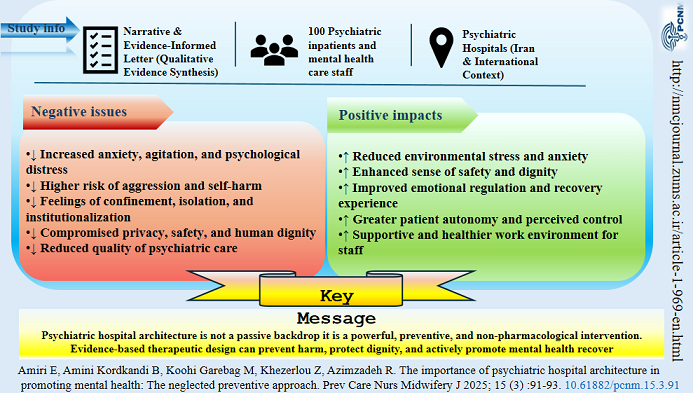
This practical approach is strongly supported by a recent qualitative meta-analysis by Schlee et al. (2022), which systematically reviewed the effects of therapeutic landscapes in psychiatric care. The study confirms that the physical (built and natural), social, and symbolic dimensions of the environment are fundamental to the health and recovery of service users and contribute to healthy workplaces for staff [3]. Moreover, recent research in psychiatric care shows that prevention is a key aspect of environmental design. Careful environmental design can help reduce risky behaviors, lower anxiety, and give patients more control. This preventive approach operates through several key mechanisms: For instance, reducing environmental stressors (such as lowering noise and providing calming visuals) directly lowers physiological arousal and anxiety, mitigating the risk of aggressive behavior. Furthermore, design elements that increase patients' perceived control (such as allowing them to personalize their space) can alleviate feelings of helplessness and institutionalization, thereby preventing critical incidents and reducing agitation.
Finally, the proactive removal of environmental hazards (e.g., eliminating ligature points and breakable glass) constitutes a primary prevention strategy against self-harm and suicide attempts [4].
Successful global examples of therapeutic environmental design in psychiatric hospitals, such as the Eskenazi Hospital in the United States and Sydney Hospital, demonstrate how integrating healing gardens, natural elements, and social interaction spaces can significantly enhance patient recovery. These hospitals prioritize connection with nature, sensory stimulation, and flexible social environments, which reduce stress and accelerate healing. Such design approaches highlight the importance of incorporating therapeutic landscapes and environmental control in improving mental health treatments internationally [5].
Conversely, research from the Iranian context provides empirical support for these challenges. Qualitative studies have consistently documented poor ventilation, lack of open spaces, and an overall prison-like atmosphere due to locked doors, which, although reducing escape attempts, evidence indicates they significantly contribute to patients' feelings of confinement and institutionalization [6,7]. Further corroborating this, a study by Yahyavi et al. (2020) analyzing the experiences of residents in a psychiatric hospital highlighted profound patient dissatisfaction directly linked to inadequate facilities and the carceral environment [8].
A growing body of recent evidence continues to document significant environmental shortcomings in psychiatric ward design. These deficiencies, including unpleasant odors, lack of amenities, overcrowding, and inadequate facilities (such as narrow doors and unsuitable bathrooms), directly compromise patient safety, privacy, and dignity, which are fundamental rights [3,9,11]. Additionally, the absence of specialized and forensic psychiatric wards, along with limited community-based care, poses risks to both patients and staff [7]. Many wards also fail to meet safety standards, with hazards like breakable glass and exposed wiring, and lack measures to prevent suicide or other incidents [6].
These environmental issues not only reduce comfort but also increase preventable risks, including heightened anxiety, aggression, and likelihood of self-harm, demonstrating the critical preventive role of proper design (3-4). To address these issues, it is essential to promote architectural design regulations that prioritize patient safety, dignity, and privacy, while also supporting staff working conditions. Establishing specialized wards and expanding community care can further improve safety and quality of care. Improving psychiatric hospital environments requires better ventilation and access to open spaces to enhance air quality. Overcrowding should be reduced by optimizing ward design to ensure patient privacy and safety. Facilities need upgrading to meet safety standards, including removing environmental hazards. Creating a home-like atmosphere with comfortable furniture and recreational activities can aid recovery. Specialized wards and reconsideration of locked door policies will improve safety and dignity. Finally, expanding community-based services and strengthening regulatory oversight are essential for sustainable improvement.
In conclusion, the evidence compellingly demonstrates that the physical environment of psychiatric wards plays a vital and undeniable role not merely as a backdrop, but as an active, preventive, and non-pharmacological intervention in mental health care. Ignoring this critical dimension undermines patient safety, dignity, and recovery outcomes. It is therefore imperative that health policymakers and healthcare administrators move beyond mere recognition of this issue and transition to decisive action.
This must involve the development, mandatory implementation, and rigorous monitoring of evidence-based architectural standards specifically designed for psychiatric facilities. By proactively integrating therapeutic design principles, we can transform these wards from mere holding spaces into genuine healing environments that uphold fundamental human rights and significantly enhance the quality of care for some of the most vulnerable members of our society.
Ethical Considerations
N/A
Acknowledgments
N/A
Conflict of Interest
The authors declare no conflicts of interest.
Funding
No funding was received for this research.
Authors' Contributions
All authors contributed to the conception and design of the study and conducted the literature search. Amiri E and Azimzadeh R: drafted the manuscript. All authors critically revised it for important intellectual content, approved the final version, and agreed to be accountable for all aspects of the work.
Artificial Intelligence Utilization
ChatGPT (OpenAI) was used only for minor grammar, clarity editing, and limited translation support. The authors confirm full responsibility for the final version.
Data Availability Statement
N/A
This practical approach is strongly supported by a recent qualitative meta-analysis by Schlee et al. (2022), which systematically reviewed the effects of therapeutic landscapes in psychiatric care. The study confirms that the physical (built and natural), social, and symbolic dimensions of the environment are fundamental to the health and recovery of service users and contribute to healthy workplaces for staff [3]. Moreover, recent research in psychiatric care shows that prevention is a key aspect of environmental design. Careful environmental design can help reduce risky behaviors, lower anxiety, and give patients more control. This preventive approach operates through several key mechanisms: For instance, reducing environmental stressors (such as lowering noise and providing calming visuals) directly lowers physiological arousal and anxiety, mitigating the risk of aggressive behavior. Furthermore, design elements that increase patients' perceived control (such as allowing them to personalize their space) can alleviate feelings of helplessness and institutionalization, thereby preventing critical incidents and reducing agitation.
Finally, the proactive removal of environmental hazards (e.g., eliminating ligature points and breakable glass) constitutes a primary prevention strategy against self-harm and suicide attempts [4].
Successful global examples of therapeutic environmental design in psychiatric hospitals, such as the Eskenazi Hospital in the United States and Sydney Hospital, demonstrate how integrating healing gardens, natural elements, and social interaction spaces can significantly enhance patient recovery. These hospitals prioritize connection with nature, sensory stimulation, and flexible social environments, which reduce stress and accelerate healing. Such design approaches highlight the importance of incorporating therapeutic landscapes and environmental control in improving mental health treatments internationally [5].
Conversely, research from the Iranian context provides empirical support for these challenges. Qualitative studies have consistently documented poor ventilation, lack of open spaces, and an overall prison-like atmosphere due to locked doors, which, although reducing escape attempts, evidence indicates they significantly contribute to patients' feelings of confinement and institutionalization [6,7]. Further corroborating this, a study by Yahyavi et al. (2020) analyzing the experiences of residents in a psychiatric hospital highlighted profound patient dissatisfaction directly linked to inadequate facilities and the carceral environment [8].
A growing body of recent evidence continues to document significant environmental shortcomings in psychiatric ward design. These deficiencies, including unpleasant odors, lack of amenities, overcrowding, and inadequate facilities (such as narrow doors and unsuitable bathrooms), directly compromise patient safety, privacy, and dignity, which are fundamental rights [3,9,11]. Additionally, the absence of specialized and forensic psychiatric wards, along with limited community-based care, poses risks to both patients and staff [7]. Many wards also fail to meet safety standards, with hazards like breakable glass and exposed wiring, and lack measures to prevent suicide or other incidents [6].
These environmental issues not only reduce comfort but also increase preventable risks, including heightened anxiety, aggression, and likelihood of self-harm, demonstrating the critical preventive role of proper design (3-4). To address these issues, it is essential to promote architectural design regulations that prioritize patient safety, dignity, and privacy, while also supporting staff working conditions. Establishing specialized wards and expanding community care can further improve safety and quality of care. Improving psychiatric hospital environments requires better ventilation and access to open spaces to enhance air quality. Overcrowding should be reduced by optimizing ward design to ensure patient privacy and safety. Facilities need upgrading to meet safety standards, including removing environmental hazards. Creating a home-like atmosphere with comfortable furniture and recreational activities can aid recovery. Specialized wards and reconsideration of locked door policies will improve safety and dignity. Finally, expanding community-based services and strengthening regulatory oversight are essential for sustainable improvement.
In conclusion, the evidence compellingly demonstrates that the physical environment of psychiatric wards plays a vital and undeniable role not merely as a backdrop, but as an active, preventive, and non-pharmacological intervention in mental health care. Ignoring this critical dimension undermines patient safety, dignity, and recovery outcomes. It is therefore imperative that health policymakers and healthcare administrators move beyond mere recognition of this issue and transition to decisive action.
This must involve the development, mandatory implementation, and rigorous monitoring of evidence-based architectural standards specifically designed for psychiatric facilities. By proactively integrating therapeutic design principles, we can transform these wards from mere holding spaces into genuine healing environments that uphold fundamental human rights and significantly enhance the quality of care for some of the most vulnerable members of our society.
Ethical Considerations
N/A
Acknowledgments
N/A
Conflict of Interest
The authors declare no conflicts of interest.
Funding
No funding was received for this research.
Authors' Contributions
All authors contributed to the conception and design of the study and conducted the literature search. Amiri E and Azimzadeh R: drafted the manuscript. All authors critically revised it for important intellectual content, approved the final version, and agreed to be accountable for all aspects of the work.
Artificial Intelligence Utilization
ChatGPT (OpenAI) was used only for minor grammar, clarity editing, and limited translation support. The authors confirm full responsibility for the final version.
Data Availability Statement
N/A
Type of Study: Letter to editor |
Subject:
Nursing
References
1. 1. McEwan M, Wills EM. Theoretical basis for nursing: Lippincott Williams & Wilkins; 2021. https://lccn.loc.gov/2017049174 [https://lccn.loc.gov/2017049174]
2. Edwards ML, Morris NPJAjoe. How inpatient psychiatric units can be both safe and therapeutic. 2024;26(3):248-56. [https://doi.org/10.1001/amajethics.2024.248.] [PMID]
3. Oeljeklaus L, Schmid H-L, Kornfeld Z, Hornberg C, Norra C, Zerbe S, et al. Therapeutic landscapes and psychiatric care facilities: a qualitative meta-analysis. International journal of environmental research and public health. 2022;19(3):1490-515. [https://doi.org/10.3390/ijerph19031490] [PMID]
4. Rodríguez-Labajos L, Kinloch J, Grant S, O'Brien G. The role of the built environment as a therapeutic intervention in mental health facilities: A systematic literature review. HERD: Health Environments Research & Design Journal. 2024;17(2):281-308. [https://doi.org/10.1177/19375867231219031] [PMID]
5. Zahedan A, Eraghi SGJM-TSJOL. The landscape of hospitals areas continuity of treatment. Manzar Journal. 2017;9(38):38-45.
6. Ebrahimi H, Namdar AH, Asghari JM, Vahidi M. An accident-free environment: Perceptions of patients and employees toward the features of a safe physical environment in psychiatric wards. HAYAT: Journal of Faculty of Nursing & Midwifery, Tehran University of Medical Sciences. 2019;25(3 ):289-308. [https://sid.ir/paper/394988/en]
7. Amiri E, Ebrahimi H, Habibzadeh H, Baghaei RJNe. Organizational silence and hidden threats to patients' dignity with schizophrenia: A qualitative study. Nursing Ethics. 2024;31(7):1205-19. [https://doi.org/10.1177/09697330241262312] [PMID]
8. Yahyavi ST, Amini M, Sheikhmoonesi FJJoAiME, Professionalism. Psychiatric residents' experience about Balint groups: A qualitative study using phenomenological approach in Iran. J Adv Med Educ Prof. 2020 Jul; 8(3): 134-139. [https://doi.org/10.30476/jamp.2020.85161.1164]
9. Amiri E, Galehdarifard A, Baghaei R, Ebrahimi H, Habibzadeh H, Habibpour ZJN, et al. Revitalizing open-door policies in psychiatric institutions: A strategy for preserving patient dignity-A letter to the editor-in-chief. Nursing and Midwifery Journal. 2024;22(4):337-40. [https://doi.org/10.61186/unmf.22.4.337]
10. Amiri E, Ebrahimi H, Habibzadeh H, Baghaei RJNE. Family caregivers' role in dignity of people with schizophrenia: A qualitative study. Nursing Ethics. 2025;32(6):1911-1925. [https://doi.org/10.1177/09697330251319372] [PMID]
11. Amiri E, Baghaei R, Ebrahimi H, Habibzadeh HJNe. Barriers to maintaining dignity for patients with schizophrenia: A qualitative study. Nursing Ethics. 2024;32(2):560-74 [https://doi.org/10.1177/09697330241262320.] [PMID]
Send email to the article author
| Rights and permissions | |
 |
This work is licensed under a Creative Commons Attribution-NonCommercial 4.0 International License. |