
Preventive Care in Nursing and Midwifery Journal

Volume 16, Issue 1 (1-2026)
Prev Care Nurs Midwifery J 2026, 16(1): 15-26 |
Back to browse issues page


Ethics code: IR.ARUMS.REC.1401.252


Download citation:
BibTeX | RIS | EndNote | Medlars | ProCite | Reference Manager | RefWorks
Send citation to:


BibTeX | RIS | EndNote | Medlars | ProCite | Reference Manager | RefWorks
Send citation to:
Hosseini Marznakii Z, Hakimi M H. ICU Nurses' Knowledge, Attitudes, and Performance Regarding Endotracheal Suctioning and Oral Care in Intubated Patients: A Cross-Sectional Study. Prev Care Nurs Midwifery J 2026; 16 (1) :15-26
URL: http://nmcjournal.zums.ac.ir/article-1-996-en.html
URL: http://nmcjournal.zums.ac.ir/article-1-996-en.html

Department of Nursing, Institute of Health Education, Ardabil University of Medical Sciences, Ardabil, Iran , mhha5479@gmail.com
Keywords: Knowledge, Attitude, Task Performance, Nursing Care, Oral Hygiene, Endotracheal Suctioning.
Full-Text [PDF 811 kb]
(375 Downloads)
| Abstract (HTML) (872 Views)
Nurses' Knowledge, Attitude, and Performance in Oral Care
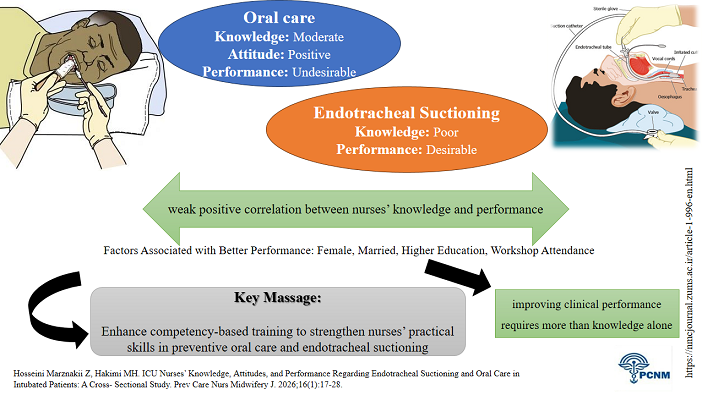
The overall level of knowledge regarding oral care was moderate, and only 11% of nurses demonstrated poor knowledge. The mean attitude score toward oral care in mechanically ventilated patients was 39.22 (SD = 3.57) out of 60, indicating a relatively positive attitude. Scores ranged from 32 to 48, and none of the nurses exhibited extremely negative or extremely positive attitudes. Regarding performance, 30.6% of nurses achieved desirable scores, while less than half (45.7%) received an undesirable score. Furthermore, the mean number of correct answers on the oral care knowledge and performance instruments was 6.6 (1.55) and 5 (2.4), respectively [Table 2].
Nurses' Knowledge and Performance in Proper Endotracheal Suctioning
Regarding knowledge of proper suctioning techniques, more than half of the nurses scored below 50%, indicating poor knowledge. In contrast, performance scores were more favorable [Table 2].
Although fewer than half of the nurses had adequate knowledge of proper suctioning techniques, most participants answered several items correctly. Specifically, 91.7% of nurses correctly identified methods to minimize airway trauma during suctioning. Approximately 70% responded accurately regarding the timing and technique of suctioning, and 68% had correct knowledge of the maximum allowable suction duration [Table 3].
Knowledge Translation Statement
Audience: Nursing managers and hospital administrators
A significant gap exists between ICU nurses' knowledge and performance in endotracheal suctioning and oral care, with 45.7% showing poor oral care performance despite favorable attitudes. Performance is influenced by gender, education, and workshop attendance, not knowledge alone. Managers should implement competency-based training with supervised practice and regular evaluations using checklists, shifting from theory to hands-on skill development.
Full-Text: (156 Views)
Introduction
Patients admitted to intensive care units (ICUs) are exposed to a wide range of secondary complications due to their critical physical conditions, inability to express needs, and dependence on advanced medical equipment [1]. Among mechanically ventilated patients, the presence of an endotracheal tube and impaired clearance of secretions can lead to oral mucosal damage and increased accumulation of airway secretions [2]. This situation may predispose patients to serious infections, prolonged hospitalization, reduced effectiveness of medical treatments, and significantly compromised quality of life [3]. One of the fundamental nursing interventions in such conditions is proper endotracheal suctioning, a procedure aimed at maintaining airway patency and removing excessive secretions [4].
However, incorrect execution of this procedure can result in serious complications such as bleeding, airway narrowing, hypoxia, cardiac arrest, and even sudden death [2]. Beyond its therapeutic purpose, endotracheal suctioning plays a critical preventive role by reducing secretion retention, preventing airway obstruction, and improving gas exchange [4]. Effecting suctioning decreases the risk of respiratory infections, particularly ventilator associated pneumonia, which remains one of the most common and life threatening complications among mechanically ventilated patients [5] Despite substantial evidence indicating that suctioning based on clinical assessment and actual patient need is considerably safer and more effective than routine, non-assessed suctioning, many nurses continue to perform this procedure routinely without adherence to guidelines or scientific principles [6]. This gap between theoretical knowledge and clinical performance may stem from various factors, including a lack of specialized training, challenges in the clinical environment, and insufficient collaboration between academic institutions and clinical settings [7]. Since endotracheal suctioning and oral care are usually performed together in ICU patients, examining both practices together can provide a clearer picture of the quality of nursing care.
On the other hand, oral health in ICU patients faces significant challenges and can deteriorate rapidly [8]. Factors such as the presence of an endotracheal tube, reduced consciousness, and inability to perform personal hygiene contribute to increased dental plaque formation and oral mucosal damage [9]. Moreover, inadequate oral care by nurses can exacerbate oral health issues, negatively affect recovery, and prolong hospital stays [10].
Despite the critical role of nurses in providing oral care to ICU patients, this area is often overlooked [8], potentially due to limited knowledge, resource constraints, and time constraints [11]. Furthermore, few studies have comprehensively examined nurses' knowledge, attitudes, and performance in this domain. For instance, a study conducted in India reported that nurses lacked sufficient knowledge regarding oral care. Although oral care ranked low among nursing priorities, more than half of the participating nurses demonstrated suboptimal performance in this area [12]. Therefore, maintaining and enhancing nursing performance, including both direct and indirect care, is particularly crucial for patients with complex conditions and directly impacts their recovery [13]. Studies have shown that nurses' awareness and performance are influenced by various factors [14], such as the work environment [13] and individual characteristics [15]. For example, nursing performance tends to improve with age and experience, and nurses with greater decision-making capacity are more likely to implement effective care interventions [16]. Alternatively, other studies have indicated that improving nurses' working conditions, as well as fostering a positive and supportive organizational culture, have a significant impact on critical aspects of the nursing profession, including enhancing service quality [17, 18]. Although proper endotracheal suctioning and oral care are essential components of safe management in mechanically ventilated patients, improper execution can lead to multiple complications, including hypoxia, mucosal damage, and airway narrowing [2]. According to a study by Mohammad et al., complications from improper endotracheal tube suctioning are common, occurring in approximately 25% of cases [19].
All these complications can be reduced by improving nurses' knowledge and performance regarding the correct principles of endotracheal suctioning [20].
In other words, if nurses have sufficient competence and their knowledge and performance are evidence-based and aligned with care standards, patient recovery is more likely [21].
Proper oral care and endotracheal suctioning are essential for maintaining high-quality care in ICU patients, with nurses playing a central role in managing these interventions. Despite their importance, few studies have examined both aspects simultaneously, highlighting a clear gap in the literature.
Objectives
This study aimed to assess the knowledge, attitudes, and performance of intensive care unit (ICU) nurses regarding proper suctioning techniques and oral care in patients with endotracheal tubes, as well as the factors associated with these domains.
Methods
Study Design and Participants
This was a cross-sectional study conducted between May and November 2023 across the intensive care units (ICUs) of hospitals affiliated with Ardabil University of Medical Sciences in northwestern Iran. The study population consisted of all nurses working in eight ICUs from five hospitals (N=210). Based on the study objective and assuming a minimum correlation coefficient of 0.2, the required sample size was estimated at 194 participants, with a type I error rate of 0.05 and 80% power. To account for potential attrition, a total of 210 nurses were targeted for inclusion in the study.
Following sample size determination, eligible nurses who met the inclusion criteria were selected via convenience sampling. The inclusion criteria were holding at least a bachelor's degree in nursing and having at least six months of work experience in the intensive care unit at the time of the study. The exclusion criterion was defined as withdrawal of consent or submission of incomplete questionnaires before the data collection process was finalized.
Data Sources
Data were collected using a three-part questionnaire:
Demographic Information
This section included items on age, gender, marital status, education level, work experience, and history of participation in relevant training workshops.
Assessment of Nurses' Knowledge and Performance Regarding Proper Endotracheal Suctioning Principles
The first section consisted of a questionnaire designed to assess nurses' knowledge of proper suctioning techniques. This scale, developed by Mwakanyanga et al. in 2014, comprised 19 multiple-choice questions. Each question offered four response options: one correct answer and three distractors. Scoring was as follows: each correct response was worth 1 point, and incorrect answers received 0 points. The total knowledge score was then calculated as the proportion of correct responses, expressed as a percentage [22]. The second, developed by Jansson et al. in 2010, was a performance-based, 25-item observational checklist designed to evaluate correct endotracheal tube suctioning technique. This checklist was divided into four sections: pre-suctioning actions, infection control measures, actions during suctioning, and post-suctioning actions. Scoring for the performance section was also calculated as a percentage, based on the proportion of items correctly performed. Participants received 1 point for each recommended guideline they correctly followed and 0 points for any item they did not perform or performed incorrectly. Finally, for both the knowledge and performance scales of correct endotracheal suctioning techniques, the scores obtained were expressed as percentages and categorized into three levels: desirable knowledge/ performance (76–100%), moderate knowledge/ performance (50–75%), and undesirable knowledge/ performance (<50%). The validity and reliability of this instrument were previously confirmed by Jansson et al. Its content validity was confirmed through evaluation by two critical care experts (one physician and one registered nurse) in Finland, and the instrument was developed and utilized among critical care nurses in a single academic center with an intensive care unit in Finland [22, 23].
The Scale for Assessing Nurses' Knowledge, Attitude, and Performance Regarding Oral Patient Care
This scale was developed by Philip et al in 2016. This self-report scale consists of three sections: Oral Care Knowledge, Oral Care Attitude, and Oral Care Performance. Knowledge was measured using 10 items, comprising multiple-choice questions (with yes/no/unsure response options) and open-ended questions. Each correct answer was awarded one point. The total knowledge score was then calculated as the proportion of correct responses, expressed as a percentage. The resulting scores were categorized into three levels: desirable knowledge (76–100%), moderate knowledge (50–75%), and undesirable knowledge (< 50%). Attitudes were evaluated using 12 items on a five-point Likert scale, ranging from 1 (strongly disagree) to 5 (strongly agree). The maximum possible score in this section was 60, with higher scores indicating a more positive attitude toward oral patient care. Performance was assessed using 9 multiple-choice questions (with yes/no/unsure response options). As in the knowledge section, each correct response earned 1 point. The performance score was calculated as the percentage of correct answers and categorized into three levels: desirable performance (76–100%), moderate performance (50–75%), and undesirable performance (<50%) [24]. The validity and reliability of this instrument were previously confirmed, and it was adapted for use in India. Specifically, its reliability was assessed in a study conducted among nursing staff at a major hospital in Bangalore, India, and internal consistency was calculated using Cronbach's alpha [25].
Since these instruments had not been psychometrically validated in Iran, a rigorous translation and validation process was undertaken. After the initial translation into Persian, the tools were back-translated by a subject-matter expert to ensure accuracy [26]. Upon approval of the translation, the instruments were reviewed by 15 expert faculty members to ensure semantic consistency. Content and face validity indices were assessed. Face validity was assessed by having ICU nurses provide feedback on the appearance and phrasing of the questions. To ensure content validity for both instruments, the Content Validity Index (CVI) was used separately to assess the relevance of the items. The S-CVI obtained for the relevance of items in the endotracheal suctioning knowledge and performance scale was 0.76, and for the oral care knowledge, attitude, and performance scale, it was 0.80. Instrument reliability was also assessed using internal consistency, calculated as Cronbach's alpha. The reliability coefficients were 0.72 for the endotracheal suctioning knowledge scale and 0.75 for the oral care knowledge and attitude scale, which are considered acceptable. For the observational performance checklist, reliability was ensured through a standardized observation protocol with clearly defined criteria for each item before data collection. A single trained observer conducted all observations to maintain consistency. To assess intra-rater reliability and ensure consistency of observations over time, the Intraclass Correlation Coefficient (ICC) was employed. For this purpose, the scores from two independent observation sessions recorded for each nurse were analyzed. The calculated ICC value was 0.85, indicating excellent reliability of the observer's judgments over time.
Data were collected across various work shifts (morning, evening, and night) and on different days of the week to ensure a more representative sample of routine nursing performance.
Questionnaires were completed individually at the workplace. The nurses completed the knowledge and attitude sections in person through self-report, while performance was assessed during actual patient procedures using a standardized checklist. All nurses who completed the questionnaire also underwent performance observation as part of the study. To increase measurement reliability, two observation sessions were conducted for each participant across two different shifts, and the average score of these two observations was recorded as the final performance score. These repeated observations were made to reduce the potential impact of situational and environmental factors on nurses' performance.
The principal investigator conducted all observations and completed the checklists to ensure consistency in performance assessment. Furthermore, to ensure confidentiality, a unique identification code was assigned to each nurse rather than their name. While the nurses were aware that they were being observed as part of the study, they were not informed of the specific criteria in the evaluation checklist to prevent any conscious alteration of behavior.
On average, each questionnaire took approximately 30 minutes to complete during work shifts. Data collection was carried out over seven months.
Statistical Analysis
Data were analyzed using SPSS software version 23. Descriptive statistics, including frequencies, percentages, means, and standard deviations, were used to describe the data.
The Shapiro–Wilk test confirmed the normality of data distribution (p > 0.05). Subsequently, inferential statistics, including Pearson correlation, independent t-test, and one-way ANOVA, were employed to examine relationships among variables. A p-value of less than 0.05 was considered statistically significant for all tests.
Result
Out of 210 nurses working in the intensive care units (ICUs) of affiliated hospitals, 200 met the inclusion criteria and were enrolled in the study. Ten were excluded for not meeting the inclusion criteria. The mean age of participants was 33.1 (7) years, ranging from 22 to 49 years. Most nurses were female (80%) and married (60.3%).
Regarding educational background, 93.3% held a bachelor's degree in nursing.
The mean work experience in intensive care units was 4.6 (3.0) years, and approximately 47.3% had previously attended training workshops on proper suctioning techniques for mechanically ventilated patients [Table 1].
Table 1. Demographic and Professional Characteristics of ICU Nurses (N=200)
Patients admitted to intensive care units (ICUs) are exposed to a wide range of secondary complications due to their critical physical conditions, inability to express needs, and dependence on advanced medical equipment [1]. Among mechanically ventilated patients, the presence of an endotracheal tube and impaired clearance of secretions can lead to oral mucosal damage and increased accumulation of airway secretions [2]. This situation may predispose patients to serious infections, prolonged hospitalization, reduced effectiveness of medical treatments, and significantly compromised quality of life [3]. One of the fundamental nursing interventions in such conditions is proper endotracheal suctioning, a procedure aimed at maintaining airway patency and removing excessive secretions [4].
However, incorrect execution of this procedure can result in serious complications such as bleeding, airway narrowing, hypoxia, cardiac arrest, and even sudden death [2]. Beyond its therapeutic purpose, endotracheal suctioning plays a critical preventive role by reducing secretion retention, preventing airway obstruction, and improving gas exchange [4]. Effecting suctioning decreases the risk of respiratory infections, particularly ventilator associated pneumonia, which remains one of the most common and life threatening complications among mechanically ventilated patients [5] Despite substantial evidence indicating that suctioning based on clinical assessment and actual patient need is considerably safer and more effective than routine, non-assessed suctioning, many nurses continue to perform this procedure routinely without adherence to guidelines or scientific principles [6]. This gap between theoretical knowledge and clinical performance may stem from various factors, including a lack of specialized training, challenges in the clinical environment, and insufficient collaboration between academic institutions and clinical settings [7]. Since endotracheal suctioning and oral care are usually performed together in ICU patients, examining both practices together can provide a clearer picture of the quality of nursing care.
On the other hand, oral health in ICU patients faces significant challenges and can deteriorate rapidly [8]. Factors such as the presence of an endotracheal tube, reduced consciousness, and inability to perform personal hygiene contribute to increased dental plaque formation and oral mucosal damage [9]. Moreover, inadequate oral care by nurses can exacerbate oral health issues, negatively affect recovery, and prolong hospital stays [10].
Despite the critical role of nurses in providing oral care to ICU patients, this area is often overlooked [8], potentially due to limited knowledge, resource constraints, and time constraints [11]. Furthermore, few studies have comprehensively examined nurses' knowledge, attitudes, and performance in this domain. For instance, a study conducted in India reported that nurses lacked sufficient knowledge regarding oral care. Although oral care ranked low among nursing priorities, more than half of the participating nurses demonstrated suboptimal performance in this area [12]. Therefore, maintaining and enhancing nursing performance, including both direct and indirect care, is particularly crucial for patients with complex conditions and directly impacts their recovery [13]. Studies have shown that nurses' awareness and performance are influenced by various factors [14], such as the work environment [13] and individual characteristics [15]. For example, nursing performance tends to improve with age and experience, and nurses with greater decision-making capacity are more likely to implement effective care interventions [16]. Alternatively, other studies have indicated that improving nurses' working conditions, as well as fostering a positive and supportive organizational culture, have a significant impact on critical aspects of the nursing profession, including enhancing service quality [17, 18]. Although proper endotracheal suctioning and oral care are essential components of safe management in mechanically ventilated patients, improper execution can lead to multiple complications, including hypoxia, mucosal damage, and airway narrowing [2]. According to a study by Mohammad et al., complications from improper endotracheal tube suctioning are common, occurring in approximately 25% of cases [19].
All these complications can be reduced by improving nurses' knowledge and performance regarding the correct principles of endotracheal suctioning [20].
In other words, if nurses have sufficient competence and their knowledge and performance are evidence-based and aligned with care standards, patient recovery is more likely [21].
Proper oral care and endotracheal suctioning are essential for maintaining high-quality care in ICU patients, with nurses playing a central role in managing these interventions. Despite their importance, few studies have examined both aspects simultaneously, highlighting a clear gap in the literature.
Objectives
This study aimed to assess the knowledge, attitudes, and performance of intensive care unit (ICU) nurses regarding proper suctioning techniques and oral care in patients with endotracheal tubes, as well as the factors associated with these domains.
Methods
Study Design and Participants
This was a cross-sectional study conducted between May and November 2023 across the intensive care units (ICUs) of hospitals affiliated with Ardabil University of Medical Sciences in northwestern Iran. The study population consisted of all nurses working in eight ICUs from five hospitals (N=210). Based on the study objective and assuming a minimum correlation coefficient of 0.2, the required sample size was estimated at 194 participants, with a type I error rate of 0.05 and 80% power. To account for potential attrition, a total of 210 nurses were targeted for inclusion in the study.
Following sample size determination, eligible nurses who met the inclusion criteria were selected via convenience sampling. The inclusion criteria were holding at least a bachelor's degree in nursing and having at least six months of work experience in the intensive care unit at the time of the study. The exclusion criterion was defined as withdrawal of consent or submission of incomplete questionnaires before the data collection process was finalized.
Data Sources
Data were collected using a three-part questionnaire:
Demographic Information
This section included items on age, gender, marital status, education level, work experience, and history of participation in relevant training workshops.
Assessment of Nurses' Knowledge and Performance Regarding Proper Endotracheal Suctioning Principles
The first section consisted of a questionnaire designed to assess nurses' knowledge of proper suctioning techniques. This scale, developed by Mwakanyanga et al. in 2014, comprised 19 multiple-choice questions. Each question offered four response options: one correct answer and three distractors. Scoring was as follows: each correct response was worth 1 point, and incorrect answers received 0 points. The total knowledge score was then calculated as the proportion of correct responses, expressed as a percentage [22]. The second, developed by Jansson et al. in 2010, was a performance-based, 25-item observational checklist designed to evaluate correct endotracheal tube suctioning technique. This checklist was divided into four sections: pre-suctioning actions, infection control measures, actions during suctioning, and post-suctioning actions. Scoring for the performance section was also calculated as a percentage, based on the proportion of items correctly performed. Participants received 1 point for each recommended guideline they correctly followed and 0 points for any item they did not perform or performed incorrectly. Finally, for both the knowledge and performance scales of correct endotracheal suctioning techniques, the scores obtained were expressed as percentages and categorized into three levels: desirable knowledge/ performance (76–100%), moderate knowledge/ performance (50–75%), and undesirable knowledge/ performance (<50%). The validity and reliability of this instrument were previously confirmed by Jansson et al. Its content validity was confirmed through evaluation by two critical care experts (one physician and one registered nurse) in Finland, and the instrument was developed and utilized among critical care nurses in a single academic center with an intensive care unit in Finland [22, 23].
The Scale for Assessing Nurses' Knowledge, Attitude, and Performance Regarding Oral Patient Care
This scale was developed by Philip et al in 2016. This self-report scale consists of three sections: Oral Care Knowledge, Oral Care Attitude, and Oral Care Performance. Knowledge was measured using 10 items, comprising multiple-choice questions (with yes/no/unsure response options) and open-ended questions. Each correct answer was awarded one point. The total knowledge score was then calculated as the proportion of correct responses, expressed as a percentage. The resulting scores were categorized into three levels: desirable knowledge (76–100%), moderate knowledge (50–75%), and undesirable knowledge (< 50%). Attitudes were evaluated using 12 items on a five-point Likert scale, ranging from 1 (strongly disagree) to 5 (strongly agree). The maximum possible score in this section was 60, with higher scores indicating a more positive attitude toward oral patient care. Performance was assessed using 9 multiple-choice questions (with yes/no/unsure response options). As in the knowledge section, each correct response earned 1 point. The performance score was calculated as the percentage of correct answers and categorized into three levels: desirable performance (76–100%), moderate performance (50–75%), and undesirable performance (<50%) [24]. The validity and reliability of this instrument were previously confirmed, and it was adapted for use in India. Specifically, its reliability was assessed in a study conducted among nursing staff at a major hospital in Bangalore, India, and internal consistency was calculated using Cronbach's alpha [25].
Since these instruments had not been psychometrically validated in Iran, a rigorous translation and validation process was undertaken. After the initial translation into Persian, the tools were back-translated by a subject-matter expert to ensure accuracy [26]. Upon approval of the translation, the instruments were reviewed by 15 expert faculty members to ensure semantic consistency. Content and face validity indices were assessed. Face validity was assessed by having ICU nurses provide feedback on the appearance and phrasing of the questions. To ensure content validity for both instruments, the Content Validity Index (CVI) was used separately to assess the relevance of the items. The S-CVI obtained for the relevance of items in the endotracheal suctioning knowledge and performance scale was 0.76, and for the oral care knowledge, attitude, and performance scale, it was 0.80. Instrument reliability was also assessed using internal consistency, calculated as Cronbach's alpha. The reliability coefficients were 0.72 for the endotracheal suctioning knowledge scale and 0.75 for the oral care knowledge and attitude scale, which are considered acceptable. For the observational performance checklist, reliability was ensured through a standardized observation protocol with clearly defined criteria for each item before data collection. A single trained observer conducted all observations to maintain consistency. To assess intra-rater reliability and ensure consistency of observations over time, the Intraclass Correlation Coefficient (ICC) was employed. For this purpose, the scores from two independent observation sessions recorded for each nurse were analyzed. The calculated ICC value was 0.85, indicating excellent reliability of the observer's judgments over time.
Data were collected across various work shifts (morning, evening, and night) and on different days of the week to ensure a more representative sample of routine nursing performance.
Questionnaires were completed individually at the workplace. The nurses completed the knowledge and attitude sections in person through self-report, while performance was assessed during actual patient procedures using a standardized checklist. All nurses who completed the questionnaire also underwent performance observation as part of the study. To increase measurement reliability, two observation sessions were conducted for each participant across two different shifts, and the average score of these two observations was recorded as the final performance score. These repeated observations were made to reduce the potential impact of situational and environmental factors on nurses' performance.
The principal investigator conducted all observations and completed the checklists to ensure consistency in performance assessment. Furthermore, to ensure confidentiality, a unique identification code was assigned to each nurse rather than their name. While the nurses were aware that they were being observed as part of the study, they were not informed of the specific criteria in the evaluation checklist to prevent any conscious alteration of behavior.
On average, each questionnaire took approximately 30 minutes to complete during work shifts. Data collection was carried out over seven months.
Statistical Analysis
Data were analyzed using SPSS software version 23. Descriptive statistics, including frequencies, percentages, means, and standard deviations, were used to describe the data.
The Shapiro–Wilk test confirmed the normality of data distribution (p > 0.05). Subsequently, inferential statistics, including Pearson correlation, independent t-test, and one-way ANOVA, were employed to examine relationships among variables. A p-value of less than 0.05 was considered statistically significant for all tests.
Result
Out of 210 nurses working in the intensive care units (ICUs) of affiliated hospitals, 200 met the inclusion criteria and were enrolled in the study. Ten were excluded for not meeting the inclusion criteria. The mean age of participants was 33.1 (7) years, ranging from 22 to 49 years. Most nurses were female (80%) and married (60.3%).
Regarding educational background, 93.3% held a bachelor's degree in nursing.
The mean work experience in intensive care units was 4.6 (3.0) years, and approximately 47.3% had previously attended training workshops on proper suctioning techniques for mechanically ventilated patients [Table 1].
Table 1. Demographic and Professional Characteristics of ICU Nurses (N=200)
| Variable | n | % | M (SD) |
| Gender | |||
| Female | 160 | 80.0 | |
| Male | 40 | 20.0 | |
| Marital Status | |||
| Married | 121 | 60.3 | |
| Single/Other | 79 | 39.7 | |
| Education Level | |||
| Bachelor's | 186 | 93.0 | |
| Master’s+ | 14 | 7.0 | |
| Relevant Training | |||
| Yes | 95 | 47.3 | |
| No | 105 | 52.7 | |
| Years of Work Experience | 9.2 (6.9) | ||
| Years of ICU Experience | 4.6 (3.0) | ||
| Age (Years) | 33.1 (7.0) |
Note. Data are presented as n (%) for categorical variables and mean (standard deviation) for continuous variables.
Table 2. Nurses' Knowledge, Attitude, and Performance in Oral Care (N = 200)
Table 2. Nurses' Knowledge, Attitude, and Performance in Oral Care (N = 200)
| Variable | M (SD) | Score Levels [n (%)] | ||
| Desirable | Moderate | Undesirable | ||
| Oral Care in Intubated Patients | ||||
| Knowledge | 6.6 (1.55) | 44 (22.0) | 134 (67.0) | 22 (11.0) |
| Attitude | 39.2 (3.5) | — | — | — |
| Performance | 5 (2.4) | 61 (30.6) | 48 (23.7) | 91 (45.7) |
| Proper Endotracheal Suctioning | ||||
| Knowledge | 6.3 (1.9) | 41 (20.5) | 48 (24.0) | 111 (55.5) |
| Performance | 17.8 (3.7) | 92 (46) | 85 (42.5) | 23 (11.5) |
Note. Knowledge and performance scores are presented as percentages and categorized into desirable (76–100%), moderate (50–75%), and undesirable (<50%). Attitude scores are presented as raw scores (range 12–60).
Nurses' Knowledge, Attitude, and Performance in Oral Care
The overall level of knowledge regarding oral care was moderate, and only 11% of nurses demonstrated poor knowledge. The mean attitude score toward oral care in mechanically ventilated patients was 39.22 (SD = 3.57) out of 60, indicating a relatively positive attitude. Scores ranged from 32 to 48, and none of the nurses exhibited extremely negative or extremely positive attitudes. Regarding performance, 30.6% of nurses achieved desirable scores, while less than half (45.7%) received an undesirable score. Furthermore, the mean number of correct answers on the oral care knowledge and performance instruments was 6.6 (1.55) and 5 (2.4), respectively [Table 2].
Nurses' Knowledge and Performance in Proper Endotracheal Suctioning
Regarding knowledge of proper suctioning techniques, more than half of the nurses scored below 50%, indicating poor knowledge. In contrast, performance scores were more favorable [Table 2].
Although fewer than half of the nurses had adequate knowledge of proper suctioning techniques, most participants answered several items correctly. Specifically, 91.7% of nurses correctly identified methods to minimize airway trauma during suctioning. Approximately 70% responded accurately regarding the timing and technique of suctioning, and 68% had correct knowledge of the maximum allowable suction duration [Table 3].
| Knowledge Item | Correct Responses | Incorrect Responses |
| 1. What is the priority indication for endotracheal suctioning? | 104 (52.0) | 96 (48.0) |
| 2. Complications of endotracheal suctioning include all the following except: | 130 (65.0) | 70 (35.0) |
| 3. How often should patients be suctioned? | 140 (70.0) | 60 (30.0) |
| 4. What is the normal range of negative pressure for adult suctioning? | 85 (42.7) | 115 (57.3) |
| 5. What is the normal range of negative pressure for pediatric suctioning? | 41 (20.3) | 159 (79.7) |
| 6. What is the maximum catheter diameter for pediatric suctioning? | 61 (30.7) | 139 (69.3) |
| 7. What is the maximum catheter diameter for adult suctioning? | 56 (28.0) | 144 (72.0) |
| 8. To what depth should the suctioning catheter be inserted? | 113 (56.3) | 87 (43.7) |
| 9. What is the initial step to prevent hypoxemia during suctioning? | 113 (56.3) | 87 (43.7) |
| 10. What action helps maintain PEEP and high FiO₂ during suctioning? | 138 (69.0) | 62 (31.0) |
| 11. What is the maximum duration for endotracheal suctioning in adults? | 137 (68.7) | 63 (31.3) |
| 12. What is the appropriate way of endotracheal suctioning? | 142 (71.0) | 58 (29.0) |
| 13. What should be done if ECG waveforms change during suctioning? | 103 (51.3) | 97 (48.7) |
| 14. What action reduces the risk of atelectasis caused by suctioning? | 48 (24.0) | 152 (76.0) |
| 15. What action minimizes airway trauma during suctioning? | 183 (91.7) | 17 (8.3) |
| 16. What signs indicate normal saline is functioning properly during suctioning? | 43 (21.3) | 157 (78.7) |
| 17. At which stage should normal saline be used during suctioning? | 80 (40.0) | 120 (60.0) |
| 18. What is the normal amount of normal saline to be instilled in adult patients? | 62 (31.0) | 138 (69.0) |
| 19. What is the normal amount of normal saline to be instilled in an infant patient? | 70 (35.0) | 130 (65.0) |
Note. Data are presented as n (%). Correct responses reflect knowledge of proper endotracheal suctioning techniques.
Performance assessments revealed several strengths. All nurses (100%) adhered to basic infection control measures, including wearing gloves, maintaining catheter sterility during insertion, and proper disposal of contaminated equipment. Additionally, over 90% of nurses administered oxygen therapy before and after suctioning, and about 70% adhered to the recommended suction duration. Furthermore, 96% of nurses disinfected their hands before and after suctioning. However, some performances were less consistently followed: only 28% used protective gowns during suctioning, and just 5% sought assistance from colleagues during the procedure [Table 4].
| Performance Item | Performed N (%) |
Not Performed N (%) |
| 1. Patient assessment: Auscultation of chest before suctioning | 142 (71.0) | 58 (29.0) |
| 2. Patient preparation: Explaining the procedure to conscious patients | 131 (65.7) | 69 (34.3) |
| 3. Pre-suction oxygenation (hyperventilation) | 191 (95.7) | 9 (4.3) |
| 4. Cuff pressure control (pre-suction) | 119 (59.7) | 81 (40.3) |
| 5. Eye protection from secretions | 155 (77.3) | 45 (22.7) |
| 6. Protection of central venous catheter from secretions | 37 (18.3) | 163 (81.7) |
| 7. Use of analgesics | 13 (6.5) | 187 (93.5) |
| 8. Hand disinfection before suctioning | 192 (96.0) | 8 (4.0) |
| 9. Wearing gloves | 200 (100) | 0 (0) |
| 10. Wearing gown | 57 (28.7) | 143 (71.3) |
| 11. Wearing face shield | 139 (69.7) | 61 (30.3) |
| 12. Maintaining catheter sterility until insertion | 200 (100) | 0 (0) |
| 13. Instillation of normal saline | 90 (45.0) | 110 (55.0) |
| 14. Catheter size: <½ internal diameter of endotracheal tube | 128 (64.0) | 72 (36.0) |
| 15. Number of suction passes: ≤ two passes | 178 (89.0) | 22 (11.0) |
| 16. Duration of suctioning: < 15 seconds | 138 (69.0) | 62 (31.0) |
| 17. Suction pressure: 80–150 mmHg | 111 (55.3) | 89 (44.7) |
| 18. Two-nurse collaboration during suctioning | 11 (5.3) | 189 (94.7) |
| 19. Reconnect to oxygen within 10 seconds | 193 (96.7) | 7 (3.3) |
| 20. Post-suction hyperventilation | 189 (94.7) | 11 (5.3) |
| 21. Patient assessment: Auscultation of chest after suctioning | 174 (87.0) | 26 (13.0) |
| 22. Reassurance of conscious patients | 181 (90.7) | 19 (9.3) |
| 23. Cuff pressure control (post-suction) | 124 (62.0) | 76 (38.0) |
| 24. Hand disinfection after suctioning | 193 (96.7) | 7 (3.3) |
| 25. Proper disposal of used catheter and gloves | 200 (100) | 0 (0) |
Note. Data are presented as n (%). Performance items reflect Adherence to recommended endotracheal suctioning procedures.
A weak positive correlation was found between nurses' knowledge and performance. Those with slightly higher knowledge tended to perform a little better in oral care (r = 0.128, p = 0.027) and showed similar trends in suctioning techniques (r = 0.113, p = 0.050). However, no significant correlation was found between attitude and knowledge (r = 0.037, p = 0.525) or between attitude and performance (r = 0.080, p = 0.169) in oral care. Further analysis showed significant correlations between age and work experience with both knowledge and performance in oral care and suctioning. Specifically, age and work experience were positively correlated with performance in oral care (r = 0.305, p < 0.001 and r = 0.288, p < 0.001, respectively), knowledge of proper suctioning (r = 0.121, p = 0.036 and r = 0.194, p = 0.001, respectively), and performance in proper suctioning (r = 0.397, p = 0.001 and r = 0.345, p = 0.001). Independent t-test results indicated that attitude scores toward oral care differed significantly only by marital status (p = 0.024), with married nurses showing more favorable attitudes. Performance scores in oral care varied significantly by gender (p = 0.011), marital status (p = 0.002), education level (p < 0.001), and prior workshop attendance (p < 0.001).
Specifically, female nurses, those who were married, held higher degrees, or had attended relevant workshops demonstrated better performance. Finally, knowledge of proper suctioning techniques differed significantly only by gender (p = 0.010), with female nurses scoring higher.
Performance in proper suctioning differed significantly by gender (p = 0.011) and workshop attendance (p < 0.001), with female nurses and those who had attended workshops demonstrating better performance [Table 5].
Performance in proper suctioning differed significantly by gender (p = 0.011) and workshop attendance (p < 0.001), with female nurses and those who had attended workshops demonstrating better performance [Table 5].
Variable |
Group |
N |
Knowledge of Oral Care | Attitude Toward Oral Care | Performance in Oral Care | Knowledge of Suctioning | Performance in Suctioning |
| M (SD) | M (SD) | M (SD) | M (SD) | M (SD) | |||
| Gender | Male | 40 | 69.0 (17.9) | 38.7 (3.4) | 46.8 (21.5) | 30.1 (11.5) | 70.0 (15.5) |
| Female | 160 | 64.3 (14.7) | 39.3 (3.6) | 56.5 (27.3) | 34.1 (10.6) | 74.7 (11.9) | |
| t-test (p) | 1.62 (0.535) | -1.07 (0.288) | -2.96 (0.004) | -2.61 (0.010) | -2.58 (0.011) | ||
| Marital Status | Single/Other | 79 | 64.8 (13.5) | 38.6 (2.7) | 48.8 (25.1) | 33.7 (11.2) | 70.0 (11.3) |
| Married | 121 | 65.5 (16.6) | 39.5 (3.9) | 58.4 (26.7) | 33.1 (10.7) | 71.5 (16.9) | |
| t-test (p) | -0.42 (0.676) | -2.28 (0.024) | -2.98 (0.002) | 0.47 (0.639) | -0.91 (0.365) | ||
| Education | Bachelor's | 186 | 65.5 (15.5) | 39.5 (3.9) | 53.0 (26.0) | 33.4 (11.0) | 70.6 (14.2) |
| Master's or Higher | 14 | 61.5 (14.6) | 40.4 (4.7) | 77.2 (22.6) | 32.8 (10.0) | 74.6 (23.6) | |
| t-test (p) | 1.12 (0.265) | -0.72 (0.236) | -3.66 (< 0.001) | 0.22 (0.831) | -0.72 (0.473) | ||
| Training Workshop | Attended | 95 | 66.8 (15.8) | 39.1 (3.7) | 67.9 (24.7) | 34.1 (9.3) | 79.3 (12.5) |
| Not Attended | 105 | 63.9 (15.0) | 39.4 (3.4) | 42.6 (21.9) | 32.7 (12.2) | 63.4 (12.9) | |
| t-test (p) | 1.63 (0.105) | -0.54 (0.592) | 7.53 (< 0.001) | 1.12 (.267) | 9.12 (< 0.001) |
Note. Data are presented as mean (SD). p reflects independent t-test comparisons between groups.
Discussion
This study aimed to assess ICU nurses' knowledge, attitudes, and performance regarding proper suctioning techniques and oral care for patients with endotracheal tubes, and to identify factors associated with these domains. The findings revealed that while nurses demonstrated moderate to favorable levels of knowledge and attitudes toward oral care and correct endotracheal suctioning techniques, their clinical performance in certain areas still needs improvement. Findings from the present study revealed that while nurses' knowledge and attitudes toward oral care were moderate to favorable, their clinical performance in this area was undesirable. This is consistent with the study by Dagnew et al., which similarly reported low performance levels despite positive attitudes toward oral care among participants [27]. In contrast, another study found that nurses' overall knowledge and attitudes regarding oral care were insufficient [28]. This discrepancy may be attributed to differences in the scales used to assess knowledge or in the quality of foundational training programs across the distinct study settings. Yet, a related study indicated that although oral care is a challenging responsibility in intensive care units, nurses demonstrated moderate knowledge and favorable attitudes toward this task [29].
Oral care for hospitalized patients is a critical preventive measure aimed at preserving and promoting the health of oral tissues. In this study, although nurses exhibited relatively favorable knowledge and attitudes and acknowledged oral care as part of their professional duties, only a small proportion demonstrated satisfactory performance. This discrepancy between knowledge, attitude, and performance may be attributed to factors such as inadequate supervision and performance evaluation [30], lack of equipment, absence of standardized protocols, or high workload in intensive care units, which hinder the proper implementation of care protocols [27].
Regarding proper suctioning techniques, although more than half of the nurses had poor knowledge, their clinical performance was relatively satisfactory. Supporting this finding, similar research showed that nurses lacked adequate awareness of several essential principles of suctioning. For instance, many were unaware of the differences between open and closed suctioning systems, highlighting a gap between knowledge and performance [31].
Ahmed's study revealed that nurses had low knowledge in some areas and high knowledge in others; for example, they scored poorly on contraindications for suctioning but performed well in understanding the recommended timing and duration of suctioning procedures [32]. Conversely, another study found that fewer than half of the nurses demonstrated appropriate suctioning performance [6]. As previously mentioned, these discrepancies may stem from various factors, including the absence of standardized training programs, low sensitivity or awareness among nurses, and insufficient supervision and ongoing performance evaluation [30].
A key strength identified in this study was complete adherence to essential infection control measures, including consistent use of sterile gloves and maintenance of catheter sterility during suctioning. This finding stood in stark contrast to research conducted in Ethiopia, which reported that only 9.7% of intensive care unit nurses used sterile gloves during suctioning. In that context, the predominant rationale cited for preferring non-sterile gloves was procedural convenience [6].
It can be argued that this discrepancy in findings underscores the decisive influence of contextual and systemic factors, such as reliable access to sterile equipment, a robust institutional patient safety culture, and effective supervisory mechanisms for ensuring protocol adherence within the specific study environment.
A weak but positive relationship was observed between nurses' knowledge and their performance in oral care and suctioning techniques, suggesting that higher knowledge may be modestly associated with better performance. This is consistent with previous studies showing a small positive association between knowledge and clinical performance. For instance, one study demonstrated that nurses with greater knowledge of oral care exhibited superior performance, thereby reducing the risk of complications in patients [29]. According to Mwakanyanga et al., nurses' knowledge and performance regarding suctioning are interrelated and can be improved through needs-based training aligned with existing protocols, indicating that enhancing knowledge can lead to improved performance [22].
Although knowledge and performance were significantly related, the correlations were weak, indicating that education alone may contribute only modestly to better performance, and other personal or organizational factors likely play a role. Individual and organizational factors also play a crucial role [33]. In this study, nurses' knowledge and performance in oral care and suctioning were modestly associated with age and work experience, suggesting that experience may play a limited supportive role in clinical performance. Similarly, another study found that older nurses had higher levels of knowledge regarding oral care [34]. Tekle et al. reported that greater work experience and older age significantly contributed to improved knowledge and performance in suctioning techniques [35]. Another study showed that more experienced nurses performed better in suctioning, underscoring the impact of clinical experience on functional competence [36]. It can be inferred that as nurses gain more experience, they perform slightly better in patient care, possibly because they have become more adaptable to the work environment and more attentive to patients' needs over time [37].
In this study, female nurses, those with higher education levels, and those who had attended relevant training workshops demonstrated better performance in oral care. Female nurses may be more successful in executing clinical interventions due to individual traits [38]. However, a study in Saudi Arabia found that despite positive attitudes among female nurses, their performance in oral care was undesirable [39]. This contradiction may be attributed to differences in organizational factors between the two research settings, such as variations in workload. A study in Hong Kong revealed a direct relationship between nurses' education level and their performance in oral care, with those who had received prior training in oral care protocols performing better [40]. Another study confirmed that higher education levels among nurses are associated with improved clinical performance in oral care [33]. It can be concluded that higher education and participation in seminars and workshops provide access to diverse scientific resources and opportunities to update knowledge and performance in oral care [28].
Ultimately, this study showed that female nurses had higher knowledge and performance scores on proper suctioning techniques. That performance was better among those who had previously attended relevant training workshops. Consistent with this finding, Chen et al. reported that nurses who had received training in suctioning techniques performed better than their peers [31]. Another study found that nurses who had completed relevant training programs demonstrated superior suctioning performance, highlighting the role of prior education in enhancing nurses' competence and confidence [35].
One limitation of this study was the potential for bias and social desirability in participants' performance. While the nurses were aware that they were being observed as part of the study, they were not informed of the specific criteria in the evaluation checklist to prevent any conscious alteration of behavior. However, despite this precaution, awareness of being observed and evaluated may still have led some nurses to exhibit idealized rather than realistic behaviors in caring for patients with endotracheal tubes, potentially affecting the accuracy and generalizability of the findings.
Moreover, the study was conducted in a specific geographic region and among nurses working in intensive care units; therefore, caution is warranted when generalizing the results to other healthcare settings.
Furthermore, the knowledge and attitude sections of the questionnaire were self-reported, which may introduce response bias. Additionally, the cross-sectional design of this study limits the ability to draw causal inferences regarding the relationships between nurses' knowledge, attitudes, and performance.
Future research should adopt longitudinal designs to assess the sustained impact of nurses' knowledge and performance on improving clinical outcomes in patients with endotracheal tubes, including the prevention of ventilator-associated complications. Additionally, conducting qualitative studies to identify cultural and organizational barriers and facilitators affecting nurses' knowledge, attitudes, and performance is essential, as understanding these factors enables the design and development of tailored educational programs and interventions. Finally, future studies should evaluate a broader scope of nurses' awareness, including an understanding of the risks associated with suctioning and additional preventive strategies.
Conclusion
This study showed that although ICU nurses generally had favorable knowledge and attitudes toward oral care and endotracheal suctioning, a noticeable gap remains between what they know and how they perform, particularly in oral care for mechanically ventilated patients. The weak relationship between knowledge and performance suggests that improving care cannot rely on knowledge alone. Individual factors such as gender, education level, and prior participation in training workshops also influence performance. To support high-quality preventive nursing care and reduce patient complications, it is important to design continuous, evidence-based, and personalized training programs that account for individual characteristics. Future studies across diverse healthcare settings are recommended to develop educational interventions that are sensitive to organizational and cultural contexts, helping nurses translate knowledge into safer, more effective patient care.
Ethical Considerations
The present study is derived from a research project approved by the Ethics Committee of Ardabil University of Medical Sciences with the ethics code: IR.ARUMS.REC.1401.252.
The purpose and procedures of the research were explained to all participating nurses. Informed consent was obtained from all participants, who were assured of the confidentiality of the information collected, and all ethical considerations regarding participants were strictly described and adhered to in accordance with the established principles of the Declaration of Helsinki.
Acknowledgements
We hereby express our gratitude and appreciation to all the research participants for their sincere cooperation.
Conflict of Interest
The authors have no conflict of interest to disclose.
Funding
The present study is derived from a research project and financially supported by the Research and Technology Vice-Chancellor of Ardabil University of Medical Sciences.
Authors' Contributions
Conceptualization: Z. Hosseini Marznaki, M.H. Hakimi
Methodology: Z. Hosseini Marznaki, M.H. Hakimi
Investigation (Data Collection): Z. Hosseini Marznaki, M.H. Hakimi
Formal Analysis (Data Analysis): M.H. Hakimi
Writing – Original Draft: Z. Hosseini Marznaki, M.H. Hakimi
Writing – Review & Editing: Z. Hosseini Marznaki, M.H. Hakimi
All authors read and approved the final manuscript.
Artificial Intelligence Utilization
We used ChatGPT-4o exclusively for language polishing and fluency improvement. The authors performed all scientific work, including study design, data analysis, and interpretation.
Data Availability Statement
The data are available from the corresponding author.
This study aimed to assess ICU nurses' knowledge, attitudes, and performance regarding proper suctioning techniques and oral care for patients with endotracheal tubes, and to identify factors associated with these domains. The findings revealed that while nurses demonstrated moderate to favorable levels of knowledge and attitudes toward oral care and correct endotracheal suctioning techniques, their clinical performance in certain areas still needs improvement. Findings from the present study revealed that while nurses' knowledge and attitudes toward oral care were moderate to favorable, their clinical performance in this area was undesirable. This is consistent with the study by Dagnew et al., which similarly reported low performance levels despite positive attitudes toward oral care among participants [27]. In contrast, another study found that nurses' overall knowledge and attitudes regarding oral care were insufficient [28]. This discrepancy may be attributed to differences in the scales used to assess knowledge or in the quality of foundational training programs across the distinct study settings. Yet, a related study indicated that although oral care is a challenging responsibility in intensive care units, nurses demonstrated moderate knowledge and favorable attitudes toward this task [29].
Oral care for hospitalized patients is a critical preventive measure aimed at preserving and promoting the health of oral tissues. In this study, although nurses exhibited relatively favorable knowledge and attitudes and acknowledged oral care as part of their professional duties, only a small proportion demonstrated satisfactory performance. This discrepancy between knowledge, attitude, and performance may be attributed to factors such as inadequate supervision and performance evaluation [30], lack of equipment, absence of standardized protocols, or high workload in intensive care units, which hinder the proper implementation of care protocols [27].
Regarding proper suctioning techniques, although more than half of the nurses had poor knowledge, their clinical performance was relatively satisfactory. Supporting this finding, similar research showed that nurses lacked adequate awareness of several essential principles of suctioning. For instance, many were unaware of the differences between open and closed suctioning systems, highlighting a gap between knowledge and performance [31].
Ahmed's study revealed that nurses had low knowledge in some areas and high knowledge in others; for example, they scored poorly on contraindications for suctioning but performed well in understanding the recommended timing and duration of suctioning procedures [32]. Conversely, another study found that fewer than half of the nurses demonstrated appropriate suctioning performance [6]. As previously mentioned, these discrepancies may stem from various factors, including the absence of standardized training programs, low sensitivity or awareness among nurses, and insufficient supervision and ongoing performance evaluation [30].
A key strength identified in this study was complete adherence to essential infection control measures, including consistent use of sterile gloves and maintenance of catheter sterility during suctioning. This finding stood in stark contrast to research conducted in Ethiopia, which reported that only 9.7% of intensive care unit nurses used sterile gloves during suctioning. In that context, the predominant rationale cited for preferring non-sterile gloves was procedural convenience [6].
It can be argued that this discrepancy in findings underscores the decisive influence of contextual and systemic factors, such as reliable access to sterile equipment, a robust institutional patient safety culture, and effective supervisory mechanisms for ensuring protocol adherence within the specific study environment.
A weak but positive relationship was observed between nurses' knowledge and their performance in oral care and suctioning techniques, suggesting that higher knowledge may be modestly associated with better performance. This is consistent with previous studies showing a small positive association between knowledge and clinical performance. For instance, one study demonstrated that nurses with greater knowledge of oral care exhibited superior performance, thereby reducing the risk of complications in patients [29]. According to Mwakanyanga et al., nurses' knowledge and performance regarding suctioning are interrelated and can be improved through needs-based training aligned with existing protocols, indicating that enhancing knowledge can lead to improved performance [22].
Although knowledge and performance were significantly related, the correlations were weak, indicating that education alone may contribute only modestly to better performance, and other personal or organizational factors likely play a role. Individual and organizational factors also play a crucial role [33]. In this study, nurses' knowledge and performance in oral care and suctioning were modestly associated with age and work experience, suggesting that experience may play a limited supportive role in clinical performance. Similarly, another study found that older nurses had higher levels of knowledge regarding oral care [34]. Tekle et al. reported that greater work experience and older age significantly contributed to improved knowledge and performance in suctioning techniques [35]. Another study showed that more experienced nurses performed better in suctioning, underscoring the impact of clinical experience on functional competence [36]. It can be inferred that as nurses gain more experience, they perform slightly better in patient care, possibly because they have become more adaptable to the work environment and more attentive to patients' needs over time [37].
In this study, female nurses, those with higher education levels, and those who had attended relevant training workshops demonstrated better performance in oral care. Female nurses may be more successful in executing clinical interventions due to individual traits [38]. However, a study in Saudi Arabia found that despite positive attitudes among female nurses, their performance in oral care was undesirable [39]. This contradiction may be attributed to differences in organizational factors between the two research settings, such as variations in workload. A study in Hong Kong revealed a direct relationship between nurses' education level and their performance in oral care, with those who had received prior training in oral care protocols performing better [40]. Another study confirmed that higher education levels among nurses are associated with improved clinical performance in oral care [33]. It can be concluded that higher education and participation in seminars and workshops provide access to diverse scientific resources and opportunities to update knowledge and performance in oral care [28].
Ultimately, this study showed that female nurses had higher knowledge and performance scores on proper suctioning techniques. That performance was better among those who had previously attended relevant training workshops. Consistent with this finding, Chen et al. reported that nurses who had received training in suctioning techniques performed better than their peers [31]. Another study found that nurses who had completed relevant training programs demonstrated superior suctioning performance, highlighting the role of prior education in enhancing nurses' competence and confidence [35].
One limitation of this study was the potential for bias and social desirability in participants' performance. While the nurses were aware that they were being observed as part of the study, they were not informed of the specific criteria in the evaluation checklist to prevent any conscious alteration of behavior. However, despite this precaution, awareness of being observed and evaluated may still have led some nurses to exhibit idealized rather than realistic behaviors in caring for patients with endotracheal tubes, potentially affecting the accuracy and generalizability of the findings.
Moreover, the study was conducted in a specific geographic region and among nurses working in intensive care units; therefore, caution is warranted when generalizing the results to other healthcare settings.
Furthermore, the knowledge and attitude sections of the questionnaire were self-reported, which may introduce response bias. Additionally, the cross-sectional design of this study limits the ability to draw causal inferences regarding the relationships between nurses' knowledge, attitudes, and performance.
Future research should adopt longitudinal designs to assess the sustained impact of nurses' knowledge and performance on improving clinical outcomes in patients with endotracheal tubes, including the prevention of ventilator-associated complications. Additionally, conducting qualitative studies to identify cultural and organizational barriers and facilitators affecting nurses' knowledge, attitudes, and performance is essential, as understanding these factors enables the design and development of tailored educational programs and interventions. Finally, future studies should evaluate a broader scope of nurses' awareness, including an understanding of the risks associated with suctioning and additional preventive strategies.
Conclusion
This study showed that although ICU nurses generally had favorable knowledge and attitudes toward oral care and endotracheal suctioning, a noticeable gap remains between what they know and how they perform, particularly in oral care for mechanically ventilated patients. The weak relationship between knowledge and performance suggests that improving care cannot rely on knowledge alone. Individual factors such as gender, education level, and prior participation in training workshops also influence performance. To support high-quality preventive nursing care and reduce patient complications, it is important to design continuous, evidence-based, and personalized training programs that account for individual characteristics. Future studies across diverse healthcare settings are recommended to develop educational interventions that are sensitive to organizational and cultural contexts, helping nurses translate knowledge into safer, more effective patient care.
Ethical Considerations
The present study is derived from a research project approved by the Ethics Committee of Ardabil University of Medical Sciences with the ethics code: IR.ARUMS.REC.1401.252.
The purpose and procedures of the research were explained to all participating nurses. Informed consent was obtained from all participants, who were assured of the confidentiality of the information collected, and all ethical considerations regarding participants were strictly described and adhered to in accordance with the established principles of the Declaration of Helsinki.
Acknowledgements
We hereby express our gratitude and appreciation to all the research participants for their sincere cooperation.
Conflict of Interest
The authors have no conflict of interest to disclose.
Funding
The present study is derived from a research project and financially supported by the Research and Technology Vice-Chancellor of Ardabil University of Medical Sciences.
Authors' Contributions
Conceptualization: Z. Hosseini Marznaki, M.H. Hakimi
Methodology: Z. Hosseini Marznaki, M.H. Hakimi
Investigation (Data Collection): Z. Hosseini Marznaki, M.H. Hakimi
Formal Analysis (Data Analysis): M.H. Hakimi
Writing – Original Draft: Z. Hosseini Marznaki, M.H. Hakimi
Writing – Review & Editing: Z. Hosseini Marznaki, M.H. Hakimi
All authors read and approved the final manuscript.
Artificial Intelligence Utilization
We used ChatGPT-4o exclusively for language polishing and fluency improvement. The authors performed all scientific work, including study design, data analysis, and interpretation.
Data Availability Statement
The data are available from the corresponding author.
Type of Study: Orginal research |
Subject:
Nursing
References
1. Alaparthi GK, Gatty A, Samuel SR, Amaravadi SK. Effectiveness, safety, and barriers to early mobilization in the intensive care unit. Critical Care Research and Practice. 2020;2020 (1): 1-14. [https://doi.org/10.1155/2020/7840743] [PMID]
2. Stacy KM. Endotracheal tube and tracheostomy tube suctioning. St. Louis: Elsevier. 2020.
3. Saad FAM, Ahmed H, Rezk N, Kandeel NA. Endotracheal tube nursing care: Current evidence. Mansoura Nursing Journal. 2022;9(1):177-187. [https://doi.org/10.21608/mnj.2022.259016]
4. Amin N, Naik SH. Endotracheal tube suctioning: a brief analysis of a lifesaving procedure. Indian Journal of Holistic Nursing. 2022;13(2):25-28. [https://doi.org/10.13140/RG.2.2.21671.42409]
5. Astasio-Picado Á, Jiménez FJP, López-Sánchez M, Jurado-Palomo J, Zabala-Baños MdC. Pneumonia associated with mechanical ventilation: management and preventive aspects. Applied Sciences. 2022;12(20):1-17. [https://doi.org/10.3390/app122010633]
6. Alkubati SA, Al-Sayaghi KM, Alrubaiee GG, Hamid MA, Saleh KA, Al-Qalah T, et al. Adherence of critical care nurses to endotracheal suctioning guidelines: a cross-sectional study. BMC Nursing. 2022; 21(1): 1-8. [https://doi.org/10.1186/s12912-022-01092-w] [PMID]
7. Singh K, Alomari AMA, Sayed HMA, Mannethodi K, Kunjavara J, Joy GV, et al. Barriers and solutions to the gap between theory and practice in nursing services: a systematic review of qualitative evidence. Nursing Forum. 2024; 2024:1-10. [https://doi.org/10.1155/2024/7522900]
8. Winning L, Lundy FT, Blackwood B, McAuley DF, El Karim I. Oral health care for the critically ill: a narrative review. Critical Care. 2021; 25(1):1-8. [https://doi.org/10.1186/s13054-021-03765-5] [PMID]
9. Arkia M, Rezaei J, Salari N, Vaziri S, Abdi A. Oral status and affecting factors in Iranian ICU patients: a cross-sectional study. BMC Oral Health. 2023; 23(1):1-10. [https://doi.org/10.1186/s12903-023-02867-6] [PMID]
10. Steinle EC, Pinesso JAM, Bellançon LB, de Paula Ramos S, Seixas GF. The association of oral health with length of stay and mortality in the intensive care unit. Clinical Oral Investigations. 2023; 27(7):3875-3884. [https://doi.org/10.1007/s00784-023-05008-z] [PMID]
11. Rawson H, Dawson S, Madhuvu A, McDonagh J, Browne K, Tehan PE, et al. Nurses' experiences of providing oral care to hospitalised patients: a qualitative study. Infection, Disease & Health.2025; 30(4):343-352. [https://doi.org/10.1016/j.idh.2025.05.002] [PMID]
12. Tsui PK, Chau PH, Wong JYH, Wang MP, Gao X, Lam OLT, et al. Oral care knowledge,attitude and practice among nursing staff in acute hospital settings in Hong Kong. PLoS ONE. 2023; 18(8): 1-18. [https://doi.org/10.1371/journal.pone.0289953] [PMID]
13. Cha C, Sung C. Factors related to nursing performance in South Korean intensive care units. International Journal of Nursing Practice. 2020;26(6): 1-8. [https://doi.org/10.1111/ijn.12874] [PMID]
14. Leng M, Wei L, Shi X, Cao G, Wei Y, Xu H, et al. Mental distress and influencing factors in nurses caring for patients with COVID‐19. Nursing in Critical Care. 2021;26(2):94-101. [https://doi.org/10.1111/nicc.12528] [PMID]
15. Wei H, Sewell KA, Woody G, Rose MA. The state of the science of nurse work environments in the United States: a systematic review. International Journal of Nursing Sciences. 2018;5(3):287-300. [https://doi.org/10.1016/j.ijnss.2018.04.010] [PMID]
16. Khan N, Jackson D, Stayt L, Walthall H. Factors influencing nurses' intentions to leave adult critical care settings. Nursing in Critical Care. 2019;24(1):24-32. [https://doi.org/10.1111/nicc.12348] [PMID]
17. Ardian I, Nu'im Haiya N, Azizah IR. Investigating the complex relationships between nurses' work factors, Sharia-based nursing care, and patient satisfaction in an Islamic hospital: a PLS-SEM approach. Belitung Nursing Journal. 2023;9(6):530-538. [https://doi.org/10.33546/bnj.2865] [PMID]
18. Aydogdu ALF. The impact of organizational culture on nursing: a comprehensive analysis. World Academics Journal of Management. 2023;11 (4):32-41. [https://www.isroset.org/journal/WAJM/full_paper_view.php?paper_id=3378]
19. Mohamed SS, Ahmed SM. Effect of clinical guidelines about endotracheal tube suctioning on nurses' knowledge and practice at neonatal intensive care unit. Assiut Scientific Nursing Journal. 2022;10(31):190-203. [https://doi.org/10.21608/asnj.2022.144550.1396]
20. Bano H, Hussain M, Afzal M, Gilani SA. Measurement of knowledge and performance of pediatric ICU nurses about endotracheal suctioning. Measurement. 2020;73. 80-88. [https://doi.org/10.7176/JHMN/73-09]
21. Dahlberg K, Sundqvist A-S, Nilsson U, Jaensson M. Nurse competence in the post-anaesthesia care unit in Sweden: A qualitative study of the nurse's perspective. BMC Nursing. 2022; 21:1-12. [https://doi.org/10.1186/s12912-021-00792-z] [PMID]
22. Mwakanyanga ET, Masika GM, Tarimo EA. Intensive care nurses' knowledge and practice on endotracheal suctioning of the intubated patient: a quantitative cross-sectional observational study. PloS ONE. 2018;13(8): 1-13. [https://doi.org/10.1371/journal.pone.0201743] [PMID]
23. Jansson M, Ala-Kokko T, Ylipalosaari P, Kyngäs H. Evaluation of endotracheal-suctioning practices of critical care nurses: an observational correlation study. Journal of Nursing Education and Practice. 2013;3(7):99-105. [https://doi.org/10.5430/jnep.v3n7p99]
24. Philip P, Villarosa A, Gopinath A, Elizabeth C, Norman G, George A. Oral health knowledge, attitude and practices among nurses in a tertiary care hospital in Bangalore, India: a cross-sectional survey. Contemporary Nurse. 2019;55(2-3):261-274. [https://doi.org/10.1080/10376178.2019.1647790] [PMID]
25. Kelleher S, Andrews T. An observational study on the open‐system endotracheal suctioning practices of critical care nurses. Journal of Clinical Nursing. 2008; 17(3):360-369. [https://doi.org/10.1111/j.1365-2702.2007.01990.x] [PMID]
26. Sousa VD, Rojjanasrirat W. Translation, adaptation and validation of instruments or scales for use in cross‐cultural health care research: a clear and user‐friendly guideline. Journal of Evaluation in Clinical Practice. 2011;17(2):268-274. [https://doi.org/10.1111/j.1365-2753.2010.01434.x] [PMID]
27. Dagnew ZA, Abraham IA, Beraki GG, Tesfamariam EH, Mittler S, Tesfamichael YZ. Nurses' attitude towards oral care and their practicing level for hospitalized patients in Orotta National Referral Hospital, Asmara-Eritrea: a cross-sectional study. BMC Nursing. 2020; 19(1):1-9. [https://doi.org/10.1186/s12912-020-00457-3] [PMID]
28. Andargie ST, Kassahun CW. Knowledge and attitude of nurses' towards patient's oral care at University of Gondar comprehensive specialized hospital, Northwest Ethiopia. International Journal of Africa Nursing Sciences. 2019;11:1-7. [https://doi.org/10.1016/j.ijans.2019.100165]
29. Asadi N, Jahanimoghadam F. Oral care of intubated patients, challenging task of ICU nurses: a survey of knowledge, attitudes and practices. BMC Oral Health. 2024; 24(1):1-9. [https://doi.org/10.1186/s12903-024-04652-5] [PMID]
30. Wahba M, Qalawa S, El-Ata ABA, khalik Gouda RA. Nurses' performance for orthopedic patients with traction or internal fixation. Port Said Scientific Journal of Nursing. 2017;4(2):193-218. [https://doi.org/10.21608/pssjn.2017.33082]
31. Chen W, Hu S, Liu X, Wang N, Zhao J, Liu P, et al. Intensive care nurses' knowledge and practice of evidence-based recommendations for endotracheal suctioning: a multisite cross-sectional study in Changsha, China. BMC Nursing. 2021; 20 (1):1-12. [https://doi.org/10.1186/s12912-021-00715-y] [PMID]
32. Ahmed REA. Knowledge and practice of nurses regarding endotracheal suctioning procedure. International Journal of Multidisciplinary Research and Publications.2024; 6(10):36-40. [https://ijmrap.com/wp-content/uploads/2024/03/IJMRAP-V6N10P43Y24.pdf]
33. Askari M, Rahimkhani M, Abdollahi M, Mohammadabadi A, Yaghoobi H, Namazinia M. Nurses' role in oral healthcare: a descriptive-analytical cross-sectional study in northeastern Iran. BMC Oral Health. 2025; 25:1-6. [https://doi.org/10.1186/s12903-025-06363-x] [PMID]
34. Thapa B, Shrestha R. Nurses' knowledge and practice regarding oral care in intubated patients at selected teaching hospitals, Chitwan. International Journal of Innovative Science and Research Technology. 2019;4 (5). 868-875. [https://ijisrt.com/nurses-knowledge-and-practice-regarding-oral-care-in-intubated-patients-at-select]
35. Tekle L, Sultan M, Yimer S, Kidane M. Knowledge, attitude and practice of endotracheal tube suctioning and associated factors among intensive care unit nurses in selected public hospitals in Addis Ababa, Ethiopia. Community and Public Wellness Nursing. 2024;1(1). 1-14. [https://doi.org/10.9567/3064-7061/WSJ.111]
36. Ross P, Jaspers R, Watterson J, Topple M, Birthisel T, Rosenow M, et al. The impact of nursing workforce skill-mix on patient outcomes in intensive care units in Victoria, Australia. Critical Care and Resuscitation. 2024;26(2):135-152. [https://doi.org/10.1016/j.ccrj.2024.03.002] [PMID]
37. Ebrahimi F, Jafarjalal E, Ghezeljeh TN, Haghani S. The quality of nursing care in nurses working in the intensive care unit of COVID-19 in Arak medical training centers in 2021-2022. Hayat. 2023; 29(1): 89-100. [http://hayat.tums.ac.ir/article-1-4825-en.html]
38. Gouda RAK. Nurses' performance for orthopedic patients with traction or internal fixation. Port Said Scientific Journal of Nursing. 2017;4(2):193-218. [https://doi.org/ 10.21608/pssjn.2017.33082]
39. Al Rababah DM, Nassani MZ, Baker OG, Alhelih EM, Almomani SA, Rastam S. Attitudes and practices of nurses toward oral care of hospitalized patients: A cross-sectional survey in Riyadh, Saudi Arabia. Journal of Education and Health Promotion. 2018;7(1):1-7. [https://doi.org/10.4103/jehp.jehp_88_18] [PMID]
40. Tsui PK, Chau PH, Wong JYH, Wang MP, Gao X, Lam OLT, et al. Oral care knowledge, attitude and practice among nursing staff in acute hospital settings in Hong Kong. PLoS ONE. 2023;18(8): 1-12. [https://doi.org/10.1371/journal.pone.0289953] [PMID]
Send email to the article author
| Rights and permissions | |
 |
This work is licensed under a Creative Commons Attribution-NonCommercial 4.0 International License. |