
Preventive Care in Nursing and Midwifery Journal

Volume 16, Issue 1 (1-2026)
Prev Care Nurs Midwifery J 2026, 16(1): 15-26 |
Back to browse issues page


Ethics code: IR.ARUMS.REC.1401.252


Download citation:
BibTeX | RIS | EndNote | Medlars | ProCite | Reference Manager | RefWorks
Send citation to:


BibTeX | RIS | EndNote | Medlars | ProCite | Reference Manager | RefWorks
Send citation to:
Hosseini Marznakii Z, Hakimi M H. ICU Nurses' Knowledge, Attitudes, and Performance Regarding Endotracheal Suctioning and Oral Care in Intubated Patients: A Cross-Sectional Study. Prev Care Nurs Midwifery J 2026; 16 (1) :15-26
URL: http://nmcjournal.zums.ac.ir/article-1-996-en.html
URL: http://nmcjournal.zums.ac.ir/article-1-996-en.html

Department of Nursing, Institute of Health Education, Ardabil University of Medical Sciences, Ardabil, Iran , mhha5479@gmail.com
Abstract: (871 Views)
Background: Intensive care unit (ICU) nurses play a key role in preventive care. Their knowledge, attitudes, and performance regarding endotracheal suctioning and oral care are essential to prevent respiratory complications in intubated patients.
Objectives: This study aimed to assess ICU nurses’ knowledge, attitudes, and performance regarding endotracheal suctioning and oral care in intubated patients, and to identify factors associated with these domains.
Methods: This cross-sectional study was conducted between May and November 2023 using a census of all 200 ICU nurses working in hospitals affiliated with Ardabil University of Medical Sciences. Data were collected using demographic questionnaires and validated instruments. Knowledge and attitudes were assessed via self-report, while performance was observed using a checklist over two sessions. Data were analyzed in SPSS v.23 using Pearson correlation, independent t-test, and ANOVA.
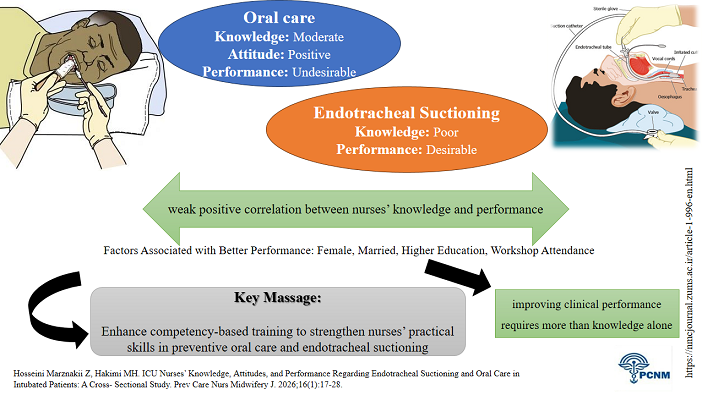
Results: Nurses' mean (SD) knowledge, attitudes, and performance were 65.2 (15.5), 39.2 (3.5), and 54.6 (26.5) for oral care, and 33.4 (10.9) and 70.9 (15.0) for endotracheal suctioning knowledge and performance. Significant differences were observed in oral care performance by gender (p = 0.004), marital status (attitude: p = 0.024; performance: p = 0.002), and education (p < 0.001), and in suctioning knowledge (p = 0.010) and performance (gender: p = 0.011; workshop: p < 0.01).
Conclusion: A gap was observed between nurses’ knowledge and performance, especially in oral care, highlighting that improving clinical performance requires more than knowledge alone and may be influenced by factors such as gender, marital status, education, and training experience.
Objectives: This study aimed to assess ICU nurses’ knowledge, attitudes, and performance regarding endotracheal suctioning and oral care in intubated patients, and to identify factors associated with these domains.
Methods: This cross-sectional study was conducted between May and November 2023 using a census of all 200 ICU nurses working in hospitals affiliated with Ardabil University of Medical Sciences. Data were collected using demographic questionnaires and validated instruments. Knowledge and attitudes were assessed via self-report, while performance was observed using a checklist over two sessions. Data were analyzed in SPSS v.23 using Pearson correlation, independent t-test, and ANOVA.
Results: Nurses' mean (SD) knowledge, attitudes, and performance were 65.2 (15.5), 39.2 (3.5), and 54.6 (26.5) for oral care, and 33.4 (10.9) and 70.9 (15.0) for endotracheal suctioning knowledge and performance. Significant differences were observed in oral care performance by gender (p = 0.004), marital status (attitude: p = 0.024; performance: p = 0.002), and education (p < 0.001), and in suctioning knowledge (p = 0.010) and performance (gender: p = 0.011; workshop: p < 0.01).
Conclusion: A gap was observed between nurses’ knowledge and performance, especially in oral care, highlighting that improving clinical performance requires more than knowledge alone and may be influenced by factors such as gender, marital status, education, and training experience.
Keywords: Knowledge, Attitude, Task Performance, Nursing Care, Oral Hygiene, Endotracheal Suctioning.
Full-Text [PDF 811 kb]
(375 Downloads)
| | Full-Text (HTML) (156 Views)
Knowledge Translation Statement
Audience: Nursing managers and hospital administrators
A significant gap exists between ICU nurses' knowledge and performance in endotracheal suctioning and oral care, with 45.7% showing poor oral care performance despite favorable attitudes. Performance is influenced by gender, education, and workshop attendance, not knowledge alone. Managers should implement competency-based training with supervised practice and regular evaluations using checklists, shifting from theory to hands-on skill development.
Type of Study: Orginal research |
Subject:
Nursing
References
1. Alaparthi GK, Gatty A, Samuel SR, Amaravadi SK. Effectiveness, safety, and barriers to early mobilization in the intensive care unit. Critical Care Research and Practice. 2020;2020 (1): 1-14. [https://doi.org/10.1155/2020/7840743] [PMID]
2. Stacy KM. Endotracheal tube and tracheostomy tube suctioning. St. Louis: Elsevier. 2020.
3. Saad FAM, Ahmed H, Rezk N, Kandeel NA. Endotracheal tube nursing care: Current evidence. Mansoura Nursing Journal. 2022;9(1):177-187. [https://doi.org/10.21608/mnj.2022.259016]
4. Amin N, Naik SH. Endotracheal tube suctioning: a brief analysis of a lifesaving procedure. Indian Journal of Holistic Nursing. 2022;13(2):25-28. [https://doi.org/10.13140/RG.2.2.21671.42409]
5. Astasio-Picado Á, Jiménez FJP, López-Sánchez M, Jurado-Palomo J, Zabala-Baños MdC. Pneumonia associated with mechanical ventilation: management and preventive aspects. Applied Sciences. 2022;12(20):1-17. [https://doi.org/10.3390/app122010633]
6. Alkubati SA, Al-Sayaghi KM, Alrubaiee GG, Hamid MA, Saleh KA, Al-Qalah T, et al. Adherence of critical care nurses to endotracheal suctioning guidelines: a cross-sectional study. BMC Nursing. 2022; 21(1): 1-8. [https://doi.org/10.1186/s12912-022-01092-w] [PMID]
7. Singh K, Alomari AMA, Sayed HMA, Mannethodi K, Kunjavara J, Joy GV, et al. Barriers and solutions to the gap between theory and practice in nursing services: a systematic review of qualitative evidence. Nursing Forum. 2024; 2024:1-10. [https://doi.org/10.1155/2024/7522900]
8. Winning L, Lundy FT, Blackwood B, McAuley DF, El Karim I. Oral health care for the critically ill: a narrative review. Critical Care. 2021; 25(1):1-8. [https://doi.org/10.1186/s13054-021-03765-5] [PMID]
9. Arkia M, Rezaei J, Salari N, Vaziri S, Abdi A. Oral status and affecting factors in Iranian ICU patients: a cross-sectional study. BMC Oral Health. 2023; 23(1):1-10. [https://doi.org/10.1186/s12903-023-02867-6] [PMID]
10. Steinle EC, Pinesso JAM, Bellançon LB, de Paula Ramos S, Seixas GF. The association of oral health with length of stay and mortality in the intensive care unit. Clinical Oral Investigations. 2023; 27(7):3875-3884. [https://doi.org/10.1007/s00784-023-05008-z] [PMID]
11. Rawson H, Dawson S, Madhuvu A, McDonagh J, Browne K, Tehan PE, et al. Nurses' experiences of providing oral care to hospitalised patients: a qualitative study. Infection, Disease & Health.2025; 30(4):343-352. [https://doi.org/10.1016/j.idh.2025.05.002] [PMID]
12. Tsui PK, Chau PH, Wong JYH, Wang MP, Gao X, Lam OLT, et al. Oral care knowledge,attitude and practice among nursing staff in acute hospital settings in Hong Kong. PLoS ONE. 2023; 18(8): 1-18. [https://doi.org/10.1371/journal.pone.0289953] [PMID]
13. Cha C, Sung C. Factors related to nursing performance in South Korean intensive care units. International Journal of Nursing Practice. 2020;26(6): 1-8. [https://doi.org/10.1111/ijn.12874] [PMID]
14. Leng M, Wei L, Shi X, Cao G, Wei Y, Xu H, et al. Mental distress and influencing factors in nurses caring for patients with COVID‐19. Nursing in Critical Care. 2021;26(2):94-101. [https://doi.org/10.1111/nicc.12528] [PMID]
15. Wei H, Sewell KA, Woody G, Rose MA. The state of the science of nurse work environments in the United States: a systematic review. International Journal of Nursing Sciences. 2018;5(3):287-300. [https://doi.org/10.1016/j.ijnss.2018.04.010] [PMID]
16. Khan N, Jackson D, Stayt L, Walthall H. Factors influencing nurses' intentions to leave adult critical care settings. Nursing in Critical Care. 2019;24(1):24-32. [https://doi.org/10.1111/nicc.12348] [PMID]
17. Ardian I, Nu'im Haiya N, Azizah IR. Investigating the complex relationships between nurses' work factors, Sharia-based nursing care, and patient satisfaction in an Islamic hospital: a PLS-SEM approach. Belitung Nursing Journal. 2023;9(6):530-538. [https://doi.org/10.33546/bnj.2865] [PMID]
18. Aydogdu ALF. The impact of organizational culture on nursing: a comprehensive analysis. World Academics Journal of Management. 2023;11 (4):32-41. [https://www.isroset.org/journal/WAJM/full_paper_view.php?paper_id=3378]
19. Mohamed SS, Ahmed SM. Effect of clinical guidelines about endotracheal tube suctioning on nurses' knowledge and practice at neonatal intensive care unit. Assiut Scientific Nursing Journal. 2022;10(31):190-203. [https://doi.org/10.21608/asnj.2022.144550.1396]
20. Bano H, Hussain M, Afzal M, Gilani SA. Measurement of knowledge and performance of pediatric ICU nurses about endotracheal suctioning. Measurement. 2020;73. 80-88. [https://doi.org/10.7176/JHMN/73-09]
21. Dahlberg K, Sundqvist A-S, Nilsson U, Jaensson M. Nurse competence in the post-anaesthesia care unit in Sweden: A qualitative study of the nurse's perspective. BMC Nursing. 2022; 21:1-12. [https://doi.org/10.1186/s12912-021-00792-z] [PMID]
22. Mwakanyanga ET, Masika GM, Tarimo EA. Intensive care nurses' knowledge and practice on endotracheal suctioning of the intubated patient: a quantitative cross-sectional observational study. PloS ONE. 2018;13(8): 1-13. [https://doi.org/10.1371/journal.pone.0201743] [PMID]
23. Jansson M, Ala-Kokko T, Ylipalosaari P, Kyngäs H. Evaluation of endotracheal-suctioning practices of critical care nurses: an observational correlation study. Journal of Nursing Education and Practice. 2013;3(7):99-105. [https://doi.org/10.5430/jnep.v3n7p99]
24. Philip P, Villarosa A, Gopinath A, Elizabeth C, Norman G, George A. Oral health knowledge, attitude and practices among nurses in a tertiary care hospital in Bangalore, India: a cross-sectional survey. Contemporary Nurse. 2019;55(2-3):261-274. [https://doi.org/10.1080/10376178.2019.1647790] [PMID]
25. Kelleher S, Andrews T. An observational study on the open‐system endotracheal suctioning practices of critical care nurses. Journal of Clinical Nursing. 2008; 17(3):360-369. [https://doi.org/10.1111/j.1365-2702.2007.01990.x] [PMID]
26. Sousa VD, Rojjanasrirat W. Translation, adaptation and validation of instruments or scales for use in cross‐cultural health care research: a clear and user‐friendly guideline. Journal of Evaluation in Clinical Practice. 2011;17(2):268-274. [https://doi.org/10.1111/j.1365-2753.2010.01434.x] [PMID]
27. Dagnew ZA, Abraham IA, Beraki GG, Tesfamariam EH, Mittler S, Tesfamichael YZ. Nurses' attitude towards oral care and their practicing level for hospitalized patients in Orotta National Referral Hospital, Asmara-Eritrea: a cross-sectional study. BMC Nursing. 2020; 19(1):1-9. [https://doi.org/10.1186/s12912-020-00457-3] [PMID]
28. Andargie ST, Kassahun CW. Knowledge and attitude of nurses' towards patient's oral care at University of Gondar comprehensive specialized hospital, Northwest Ethiopia. International Journal of Africa Nursing Sciences. 2019;11:1-7. [https://doi.org/10.1016/j.ijans.2019.100165]
29. Asadi N, Jahanimoghadam F. Oral care of intubated patients, challenging task of ICU nurses: a survey of knowledge, attitudes and practices. BMC Oral Health. 2024; 24(1):1-9. [https://doi.org/10.1186/s12903-024-04652-5] [PMID]
30. Wahba M, Qalawa S, El-Ata ABA, khalik Gouda RA. Nurses' performance for orthopedic patients with traction or internal fixation. Port Said Scientific Journal of Nursing. 2017;4(2):193-218. [https://doi.org/10.21608/pssjn.2017.33082]
31. Chen W, Hu S, Liu X, Wang N, Zhao J, Liu P, et al. Intensive care nurses' knowledge and practice of evidence-based recommendations for endotracheal suctioning: a multisite cross-sectional study in Changsha, China. BMC Nursing. 2021; 20 (1):1-12. [https://doi.org/10.1186/s12912-021-00715-y] [PMID]
32. Ahmed REA. Knowledge and practice of nurses regarding endotracheal suctioning procedure. International Journal of Multidisciplinary Research and Publications.2024; 6(10):36-40. [https://ijmrap.com/wp-content/uploads/2024/03/IJMRAP-V6N10P43Y24.pdf]
33. Askari M, Rahimkhani M, Abdollahi M, Mohammadabadi A, Yaghoobi H, Namazinia M. Nurses' role in oral healthcare: a descriptive-analytical cross-sectional study in northeastern Iran. BMC Oral Health. 2025; 25:1-6. [https://doi.org/10.1186/s12903-025-06363-x] [PMID]
34. Thapa B, Shrestha R. Nurses' knowledge and practice regarding oral care in intubated patients at selected teaching hospitals, Chitwan. International Journal of Innovative Science and Research Technology. 2019;4 (5). 868-875. [https://ijisrt.com/nurses-knowledge-and-practice-regarding-oral-care-in-intubated-patients-at-select]
35. Tekle L, Sultan M, Yimer S, Kidane M. Knowledge, attitude and practice of endotracheal tube suctioning and associated factors among intensive care unit nurses in selected public hospitals in Addis Ababa, Ethiopia. Community and Public Wellness Nursing. 2024;1(1). 1-14. [https://doi.org/10.9567/3064-7061/WSJ.111]
36. Ross P, Jaspers R, Watterson J, Topple M, Birthisel T, Rosenow M, et al. The impact of nursing workforce skill-mix on patient outcomes in intensive care units in Victoria, Australia. Critical Care and Resuscitation. 2024;26(2):135-152. [https://doi.org/10.1016/j.ccrj.2024.03.002] [PMID]
37. Ebrahimi F, Jafarjalal E, Ghezeljeh TN, Haghani S. The quality of nursing care in nurses working in the intensive care unit of COVID-19 in Arak medical training centers in 2021-2022. Hayat. 2023; 29(1): 89-100. [http://hayat.tums.ac.ir/article-1-4825-en.html]
38. Gouda RAK. Nurses' performance for orthopedic patients with traction or internal fixation. Port Said Scientific Journal of Nursing. 2017;4(2):193-218. [https://doi.org/ 10.21608/pssjn.2017.33082]
39. Al Rababah DM, Nassani MZ, Baker OG, Alhelih EM, Almomani SA, Rastam S. Attitudes and practices of nurses toward oral care of hospitalized patients: A cross-sectional survey in Riyadh, Saudi Arabia. Journal of Education and Health Promotion. 2018;7(1):1-7. [https://doi.org/10.4103/jehp.jehp_88_18] [PMID]
40. Tsui PK, Chau PH, Wong JYH, Wang MP, Gao X, Lam OLT, et al. Oral care knowledge, attitude and practice among nursing staff in acute hospital settings in Hong Kong. PLoS ONE. 2023;18(8): 1-12. [https://doi.org/10.1371/journal.pone.0289953] [PMID]
Send email to the article author
| Rights and permissions | |
 |
This work is licensed under a Creative Commons Attribution-NonCommercial 4.0 International License. |