
Preventive Care in Nursing and Midwifery Journal

Volume 15, Issue 4 (10-2025)
Prev Care Nurs Midwifery J 2025, 15(4): 52-59 |
Back to browse issues page


Ethics code: IR.LARUMS.REC.1403.015


Download citation:
BibTeX | RIS | EndNote | Medlars | ProCite | Reference Manager | RefWorks
Send citation to:


BibTeX | RIS | EndNote | Medlars | ProCite | Reference Manager | RefWorks
Send citation to:
Sookhak F, Asadi A, Monjazeb N, Safarpour N, Sheikh ali Khani M S, Razavi M, et al . Identifying Challenges and Policy Strategies to Improve Working Conditions for Women in Pre-Hospital Emergency Operations: A Qualitative Study. Prev Care Nurs Midwifery J 2025; 15 (4) :52-59
URL: http://nmcjournal.zums.ac.ir/article-1-1009-en.html
URL: http://nmcjournal.zums.ac.ir/article-1-1009-en.html
Fatemeh Sookhak  , Ali Asadi , Negin Monjazeb , Nasim Safarpour , Mohammad Sina Sheikh ali Khani , Mohammadreza Razavi , Ali Mohammad Parviniannasab , Mohammad-Rafi Bazrafshan *
, Ali Asadi , Negin Monjazeb , Nasim Safarpour , Mohammad Sina Sheikh ali Khani , Mohammadreza Razavi , Ali Mohammad Parviniannasab , Mohammad-Rafi Bazrafshan *
Department of Nursing, School of Nursing, Larestan University of Medical Sciences, Larestan, Iran , Seeder2007@gmail.com
Abstract: (685 Views)
Background: Pre-hospital emergency medical services play a vital role in saving patients' lives, and women's participation in this field is increasing; however, qualitative evidence regarding the lived experiences and occupational challenges of female emergency medical technicians (EMTs) in Iran remains limited.
Objectives: This study aimed to qualitatively explore these challenges, identify participant-proposed solutions, and develop a phased policy framework.
Methods: This conventional content analysis research involved 32 participants, who were purposively chosen from women in pre-hospital emergency operations across Iran between September and December 2024. Data collection was carried out through face-to-face, semi-structured, and in-depth interviews lasting between 30 and 60 minutes until data saturation was reached. The gathered data were analyzed following the methodology proposed by Graneheim and Lundman. Additionally, MAXQDA software version 2010 was utilized for data organization.
Results: Analysis revealed three primary themes characterizing the occupational challenges of female EMTs: (1) Socio-cultural challenges, including fear of public non-acceptance, cultural sensitivities in patient care, lack of family acceptance, and issues with culturally appropriate uniforms; (2) Physical-Ergonomic challenges, primarily difficulties in moving patients and handling heavy equipment; and (3) Organizational-Supportive challenges, where job satisfaction was closely tied to the level of managerial support. Despite these challenges, participants reported positive public reception and strong collegial relationships.
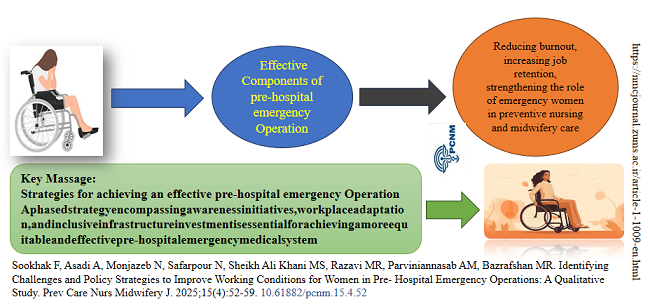
Conclusion: Effective reform requires leveraging existing public legitimacy to enable institutional change. A phased strategy encompassing awareness initiatives, workplace adaptation, and inclusive infrastructure investment is essential for achieving a more equitable and effective pre-hospital emergency medical system.
Objectives: This study aimed to qualitatively explore these challenges, identify participant-proposed solutions, and develop a phased policy framework.
Methods: This conventional content analysis research involved 32 participants, who were purposively chosen from women in pre-hospital emergency operations across Iran between September and December 2024. Data collection was carried out through face-to-face, semi-structured, and in-depth interviews lasting between 30 and 60 minutes until data saturation was reached. The gathered data were analyzed following the methodology proposed by Graneheim and Lundman. Additionally, MAXQDA software version 2010 was utilized for data organization.
Results: Analysis revealed three primary themes characterizing the occupational challenges of female EMTs: (1) Socio-cultural challenges, including fear of public non-acceptance, cultural sensitivities in patient care, lack of family acceptance, and issues with culturally appropriate uniforms; (2) Physical-Ergonomic challenges, primarily difficulties in moving patients and handling heavy equipment; and (3) Organizational-Supportive challenges, where job satisfaction was closely tied to the level of managerial support. Despite these challenges, participants reported positive public reception and strong collegial relationships.
Conclusion: Effective reform requires leveraging existing public legitimacy to enable institutional change. A phased strategy encompassing awareness initiatives, workplace adaptation, and inclusive infrastructure investment is essential for achieving a more equitable and effective pre-hospital emergency medical system.
Keywords: Emergency Medical Technicians, Women Working, Emergency Medical Services, Occupational Stress, Gender Equity
Full-Text [PDF 702 kb]
(171 Downloads)
| | Full-Text (HTML) (110 Views)
Knowledge Translation Statement
Audience: Nursing managers and hospital administrators
Female emergency medical technicians in Iran face socio-cultural challenges (fear of public non-acceptance, cultural sensitivities, lack of family acceptance, inappropriate uniforms), physical-ergonomic challenges (difficulty moving patients and handling heavy equipment), and organizational challenges where job satisfaction depends on managerial support. Nursing managers should redesign gender-appropriate ergonomic uniforms, procure lighter equipment, formalize dispatch protocols prioritizing female crews for female patients, and launch targeted social media campaigns highlighting female EMT competencies.
Type of Study: Orginal research |
Subject:
Nursing
References
1. Haghani F, Sadeghi N. Training in pre-hospital emergency: needs and truths. Iranian Journal Of Medical Education. 2011;10(5):1273-80. [http://ijme.mui.ac.ir/article-1-1636-en.html]
2. Al-Shaqsi S. Models of international emergency medical service (ems) systems. Oman Medical Journal. 2010;25(4):320-3. [https://doi.org/10.5001/omj.2010.92]
3. Luiz T. Emergency medicine tomorrow. Anasthesiologie Intensivmedizin Notfallmedizin Schmerztherapie AINS. 2003;38(4):296-302. [https://europepmc.org/article/med/12728923]
4. Khankeh H, Alinia S, Masoumi G, Khorasani zavareh D, Ranjbar M, Daddoost L, et al. Prehospital services by focus on road traffic accidents: assessment in developed and developing countries. Journal Of Health Promotion Management. 2013;2(2):71-9. [http://jhpm.ir/article-1-74-en.html]
5. Mehmood A, Rowther AA, Kobusingye O, Hyder AA. Assessment of pre-hospital emergency medical services in low-income settings using a health systems approach. International Journal Of Emergency Medicine. 2018;11(1):53. [https://doi.org/10.1186/s12245-018-0207-6] [PMID]
6. Zimmer M, Czarniecki DM, Sahm S. Gender-sensitive considerations of prehospital teamwork in critical situations. Philosophy, Ethics, And Humanities In Medicine. 2024;19(1):3. [https://doi.org/10.1186/s13010-024-00153-z] [PMID]
7. Aziznejhad E, Dadashzadeh A, Sarbakhsh P, Asghari E, Jabbarzadeh F. The presence of women in pre-hospital emergency medical services from the perspective of the staff: a cross-sectional feasibility study. Critical Care Nursing. 2024;17(1):45-54. [https://doi.org/10.30491/jcc.17.1.45]
8. Ericsson C, Lindström V, Andersen JV, Jørgensen TM, Alex J, Venesoja A. Gender (in)equality in nordic ambulance services: do ambulances have glass ceilings? Scandinavian Journal Of Trauma, Resuscitation And Emergency Medicine. 2025;33(1):45. [https://doi.org/10.1186/s13049-025-01358-7] [PMID]
9. Roth K, Köppen J, Henschke C. Workplace violence and burnout among emergency medical service workers and nurses in Germany: a cross-sectional study. Human Resources For Health. 2025;23(1):66. [https://doi.org/10.1186/s12960-025-01026-y] [PMID]
10. Makkink AW, Nkhoma BE. Gender discrimination in the emergency services: female paramedic experiences in South Africa. African Journal Of Primary Health Care & Family Medicine. 2025;17(1):e1-e11. [https://doi.org/10.4102/phcfm.v17i1.4945] [PMID]
11. Rudman JS, Farcas A, Salazar GA, Hoff JJ, Crowe RP, Whitten-Chung K, et al. Diversity, equity, and inclusion in the United States emergency medical services workforce: a scoping review. Prehospital Emergency Care. 2023;27(4):385-97. [https://doi.org/10.1080/10903127.2022.2130485] [PMID]
12. McCann-Pineo M, Keating M, McEvoy T, Schwartz M, Schwartz RM, Washko J, et al. The female emergency medical services experience: a mixed methods study. Prehospital Emergency Care. 2024;28(4):626-34. [https://doi.org/10.1080/10903127.2024.2306248] [PMID]
13. Gonsoulin S, Palmer CE. Gender issues and partner preferences among a sample of emergency medical technicians. Prehospital And Disaster Medicine. 1998;13(1):41-7. [https://doi.org/10.1017/S1049023X0003301X]
Send email to the article author
| Rights and permissions | |
 |
This work is licensed under a Creative Commons Attribution-NonCommercial 4.0 International License. |