
Preventive Care in Nursing and Midwifery

Volume 15, Issue 4 (10-2025)
Prev Care Nurs Midwifery 2025, 15(4): 70-84 |
Back to browse issues page


Ethics code: non


Download citation:
BibTeX | RIS | EndNote | Medlars | ProCite | Reference Manager | RefWorks
Send citation to:


BibTeX | RIS | EndNote | Medlars | ProCite | Reference Manager | RefWorks
Send citation to:
Masaebi F, Maleki A, Farahmandkia Z. Trends in Maternal Mortality, Incidence and DALY Rates Associated With Abortion and Miscarriage Across SDI Levels: Insights From the GBD 2021 Dataset. Prev Care Nurs Midwifery 2025; 15 (4) :70-84
URL: http://nmcjournal.zums.ac.ir/article-1-1014-en.html
URL: http://nmcjournal.zums.ac.ir/article-1-1014-en.html

Social Determinants of Health Research Center, Health and Metabolic Diseases Research Institute, Zanjan University of Medical Sciences, Zanjan, Iran , malekia41@yahoo.com
Abstract: (845 Views)
Background: Abortion is considered a major public health issue, especially in low- and middle-income countries. There is a lack of recent global trend analyses stratified by Socio-demographic Index (SDI) that comprehensively assess maternal mortality, incidence, and disability-adjusted life years.
Objectives: This study examines global disparities in maternal mortality, incidence, and disability-adjusted life years (DALYs) related to abortion and miscarriage.
Methods: This secondary data analysis utilized the Global Burden of Disease (GBD) 2021 dataset to extract maternal mortality ratios (MMRs), incidence rates, and disability‑adjusted life years (DALYs) related to abortion and miscarriage from 1990 to 2021, all reported with 95% uncertainty intervals (UIs). Analyses were conducted using age‑standardized rates and among women aged 15–49 years, stratified by Socio‑Demographic Index (SDI) categories. Temporal trends in age‑standardized rates were assessed using Joinpoint Regression Software (version 4.8.0.1).
Results: Over the 31 year, Joinpoint trend analysis showed significant global declines in all indicators. DALY rates decreased from 104.39 to 25.73, maternal mortality ratios declined from 36.07 to 12.92, and incidence rates decreased from 1603.84 to 1001.64 per 100,000 population. High and high‑middle‑SDI countries experienced the steepest and most significant declines, whereas low‑SDI countries showed the smallest reductions and continued to bear the highest burden in 2021.
Conclusion: Maternal mortality, incidence, and DALY rates related to abortion and miscarriage have substantially declined worldwide. While high and high-middle SDI countries experienced the steepest declines, substantial inequalities persist, with low-SDI countries continuing to bear a disproportionately high burden in 2021. These persistent disparities highlight the need for continued action.
Objectives: This study examines global disparities in maternal mortality, incidence, and disability-adjusted life years (DALYs) related to abortion and miscarriage.
Methods: This secondary data analysis utilized the Global Burden of Disease (GBD) 2021 dataset to extract maternal mortality ratios (MMRs), incidence rates, and disability‑adjusted life years (DALYs) related to abortion and miscarriage from 1990 to 2021, all reported with 95% uncertainty intervals (UIs). Analyses were conducted using age‑standardized rates and among women aged 15–49 years, stratified by Socio‑Demographic Index (SDI) categories. Temporal trends in age‑standardized rates were assessed using Joinpoint Regression Software (version 4.8.0.1).
Results: Over the 31 year, Joinpoint trend analysis showed significant global declines in all indicators. DALY rates decreased from 104.39 to 25.73, maternal mortality ratios declined from 36.07 to 12.92, and incidence rates decreased from 1603.84 to 1001.64 per 100,000 population. High and high‑middle‑SDI countries experienced the steepest and most significant declines, whereas low‑SDI countries showed the smallest reductions and continued to bear the highest burden in 2021.
Conclusion: Maternal mortality, incidence, and DALY rates related to abortion and miscarriage have substantially declined worldwide. While high and high-middle SDI countries experienced the steepest declines, substantial inequalities persist, with low-SDI countries continuing to bear a disproportionately high burden in 2021. These persistent disparities highlight the need for continued action.
Keywords: Maternal Mortality, Abortion, Miscarriage, Disability-Adjusted Life Years, Global Burden of Disease.
Full-Text [PDF 1700 kb]
(314 Downloads)
| | Full-Text (HTML) (310 Views)
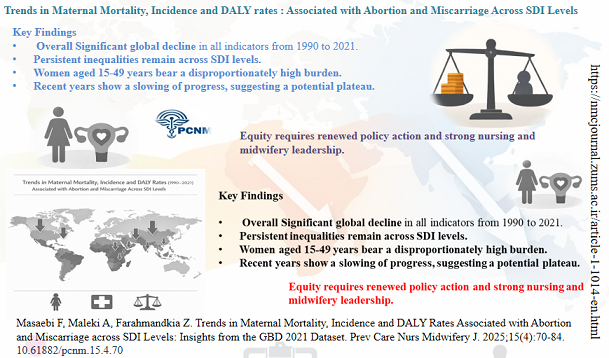
Graphical Abstract:
Reseach Highlights:
Knowledge Translation Statement
Audience: Nursing managers and hospital administrators
Global maternal mortality and DALY rates from abortion and miscarriage declined significantly from 1990 to 2021, but low-SDI countries still bear burdens over 100-fold higher than high-SDI countries, with incidence declining more slowly than mortality. Nursing managers in low-resource settings should strengthen post-abortion care, ensure access to safe family planning, train midwives in emergency obstetric care, and address sociocultural barriers, as recent progress has slowed and sustained targeted interventions remain critical for achieving SDG targets.
Type of Study: Orginal research |
Subject:
Midwifery
References
1. Patwardhan M, Eckert LO, Spiegel H, Pourmalek F, Cutland C, Kochhar S, et al. Maternal Death: Case Definition and Guidelines for Data Collection, Analysis, and Presentation of Immunization Safety Data. Vaccine. 2016;34(49):6077-83. [https://doi.org/10.1016/j.vaccine.2016.03.042] [PMID]
2. World Health Organization. Maternal Mortality [Fact Sheet]. Geneva: World Health Organization; 2023. [https://www.who.int/news-room/fact-sheets/detail/maternal-mortality]
3. Huang H, Ma J, Ling S, Han L, Jiang G, Xu W. Incidence and Disability-Adjusted Life Years of Maternal Disorders at the Global, Regional, and National Levels From 2007 to 2017: A Systematic Analysis for the Global Burden of Disease Study 2017. International Journal of Gynecology and Obstetrics. 2022;157(3):618-39. [https://doi.org/10.1002/ijgo.13889] [PMID]
4. Kubuka A, Abdulrahman H, Soa A, Kivishe P. Unsafe Abortion; The Hidden Cause of Maternal Death. International Journal of Family and Community Medicine. 2023;7(5):157-8. [https://doi.org/10.15406/ijfcm.2023.07.00331]
5. Araste A, Jafari E, Zenoozian S, Kharaghani R. Prevalence of Unplanned Pregnancy and Factors Related to Maternal-Fetal Attachment in Zanjan, 2017. Preventive Care in Nursing and Midwifery Journal. 2018;8(1):11-8. [https://doi.org/10.29252/pcnm.8.1.11]
6. Bearak J, Popinchalk A, Ganatra B, Moller A-B, Tunçalp Ö, Beavin C, et al. Unintended Pregnancy and Abortion by Income, Region, and the Legal Status of Abortion: Estimates From a Comprehensive Model for 1990-2019. The Lancet Global Health. 2020;8(9):e1152-61. [https://doi.org/10.1016/S2214-109X(20)30315-6] [PMID]
7. World Health Organization. Abortion [Fact Sheet]. Geneva: World Health Organization; 2021. [https://www.who.int/news-room/fact-sheets/detail/abortion]
8. Berg A. Abortion and Miscarriage. Philosophical Studies. 2017;174:1217-26. [https://doi.org/10.1007/s11098-016-0750-z]
9. Adler AJ, Filippi V, Thomas SL, Ronsmans C. Quantifying the Global Burden of Morbidity Due to Unsafe Abortion: Magnitude in Hospital‐Based Studies and Methodological Issues. International Journal of Gynecology and Obstetrics. 2012;118 Suppl:S65-77. [https://doi.org/10.1016/S0020-7292(12)60003-4] [PMID]
10. Raza S, Banik R, Noor STA, Jahan E, Sayeed A, Huq N, et al. Assessing Health Systems' Capacities to Provide Post-Abortion Care: Insights From Seven Low-and Middle-Income Countries. Journal of Global Health. 2025;15:04020. [https://doi.org/10.7189/jogh.15.04020] [PMID]
11. Aung EE, Liabsuetrakul T, Panichkriangkrai W, Makka N, Bundhamchareon K. Years of Healthy Life Lost Due to Adverse Pregnancy and Childbirth Outcomes Among Adolescent Mothers in Thailand. AIMS Public Health. 2018;5(4):463-76. [https://doi.org/10.3934/publichealth.2018.4.463] [PMID]
12. Musabwasoni S, Nyiringango G, Uwambaye P, Mukeshimana M, Ngoga E, Uhawenimana T, et al. Psychology of Abortion: A Qualitative Exploration of Women's Quality of Life After Termination of Pregnancy Service Provision. Rwanda Journal of Medicine and Health Sciences. 2024;7(1):116-30. [https://doi.org/10.4314/rjmhs.v7i1.9] [PMID]
13. Moore B, Poss C, Coast E, Lattof SR, van der Meulen Rodgers Y. The Economics of Abortion and Its Links With Stigma: A Secondary Analysis From a Scoping Review on the Economics of Abortion. PLoS One. 2021;16(2):e0246238. [https://doi.org/10.1371/journal.pone.0246238] [PMID]
14. Soleimani Movahed M, Barghazan SH, Askari F, Zozani MA. The Economic Burden of Abortion and Its Complication Treatment Cares: A Systematic Review. Journal of Family and Reproductive Health. 2020;14(2):60-7. [https://doi.org/10.18502/jfrh.v14i2.4354] [PMID]
15. Moradinazar M, Rostami R, Armaghan N, Shakiba M, Rai A, Abbasi Azizi S, et al. Epidemiological Features of Spontaneous Abortion in the North Africa and the Middle East From 1990 to 2019: Results From the Global Burden of Disease Study 2019. Journal of Family and Reproductive Health. 2022;16(3):183-91. [https://doi.org/10.18502/jfrh.v16i3.10579] [PMID]
16. Jolivet RR, Gausman J, Langer A. Measuring Social, Economic, Policy, and Health System Determinants of Maternal Health and Survival: An Urgent Global Priority. PLoS One. 2025;20(1):e0317095. [https://doi.org/10.1371/journal.pone.0317095] [PMID]
17. Moller AB, Patten JH, Hanson C, Morgan A, Say L, Diaz T, et al. Monitoring Maternal and Newborn Health Outcomes Globally: A Brief History of Key Events and Initiatives. Tropical Medicine and International Health. 2019;24(12):1342-68. [https://doi.org/10.1111/tmi.13313] [PMID]
18. Maternal Death - Definition and Classification. Cork, Ireland: National Perinatal Epidemiology Centre (NPEC), University College Cork; 2025. [https://www.ucc.ie/en/mde/definitionandclassificationofmaternaldeath/.]
19. Cresswell JA, Alexander M, Chong MY, Link HM, Pejchinovska M, Gazeley U, et al. Global and Regional Causes of Maternal Deaths 2009-20: A WHO Systematic Analysis. The Lancet Global Health. 2025;13(4):e626-34. [https://doi.org/10.1016/S2214-109X(24)00560-6] [PMID]
20. Sharma B, Smith R, Sharma BB, Pennell C. Maternal Mortality Ratios in Low-and Middle-Income Countries: A Comparison of Estimation Methods and Relationships With Sociodemographic Covariates. AJOG Global Reports. 2025;5(1):100438. [https://doi.org/10.1016/j.xagr.2024.100438] [PMID]
21. Ekwuazi EK, Chigbu CO, Ngene NC. Reducing Maternal Mortality in Low-and Middle-Income Countries. Case Reports in Women's Health. 2023;39:e00542. [https://doi.org/10.1016/j.crwh.2023.e00542] [PMID]
22. Olea-Ramirez LM, Leon-Larios F, Corrales-Gutierrez I. Intervention Strategies to Reduce Maternal Mortality in the Context of the Sustainable Development Goals: A Scoping Review. Women. 2024;4(4):387-405. [https://doi.org/10.3390/women4040030]
23. Wei Y, Luo H, Liu X, Sun G, Liu J, Wei X, et al. Global, Regional, and National Levels of Maternal Mortality, 1990-2021: A Systematic Analysis for the Global Burden of Disease Study 2021. BMC Pregnancy and Childbirth. 2025;25(1):1359. [https://doi.org/10.1186/s12884-025-08456-5] [PMID]
24. Tong F, Wang Y, Gao Q, Zhao Y, Zhang X, Li B, et al. The Epidemiology of Pregnancy Loss: Global Burden, Variable Risk Factors, and Predictions. Human Reproduction. 2024;39(4):834-48. [https://doi.org/10.1093/humrep/deae008] [PMID]
Send email to the article author
| Rights and permissions | |
 |
This work is licensed under a Creative Commons Attribution-NonCommercial 4.0 International License. |