Preventive Care in Nursing and Midwifery Journal
Volume 16, Issue 2 (4-2026)
Prev Care Nurs Midwifery J 2026, 16(2): 37-48 |
Back to browse issues page

Ethics code: IR.SSU.REC.1398.086


Download citation:
BibTeX | RIS | EndNote | Medlars | ProCite | Reference Manager | RefWorks
Send citation to:


BibTeX | RIS | EndNote | Medlars | ProCite | Reference Manager | RefWorks
Send citation to:
Barzegar M, javadi M, Hosseini S E. Explaining the Factors Influencing the Acceptance or Refusal of Organ Donation in Families of Brain-Death Patients: A Qualitative Study. Prev Care Nurs Midwifery J 2026; 16 (2) :37-48
URL: http://nmcjournal.zums.ac.ir/article-1-1029-en.html
URL: http://nmcjournal.zums.ac.ir/article-1-1029-en.html

Department of Medical Surgical Nursing, School of Nursing and Midwifery, Iran University of Medical Sciences, Tehran, Iran , esmat.hosseini_110@yahoo.com
Abstract: (739 Views)
Background: The issue of organ donation in brain-dead patients is a challenging topic. In most countries, the organ donation process depends on the decision of the deceased's family. Currently, the number of families who are unwilling to consent to organ donation is remains high.
Objectives: This study aimed to explore the factors influencing the acceptance or refusal of organ donation among families of brain-dead patients.
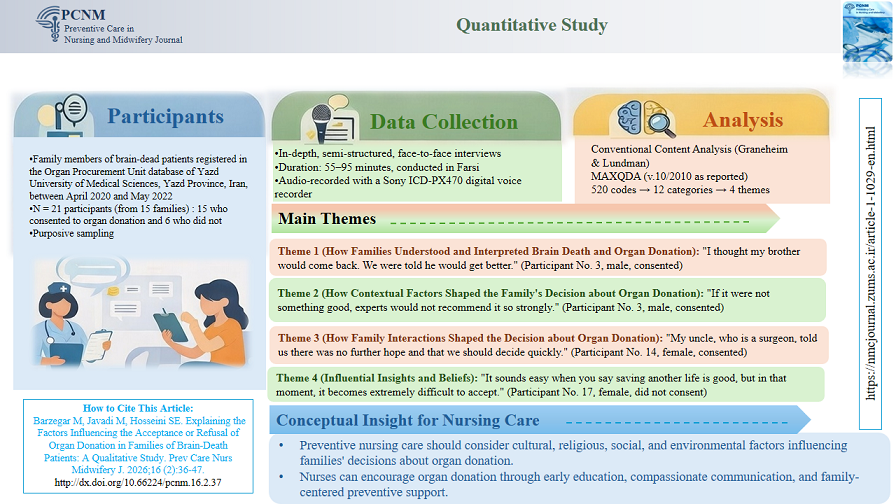
Methods: This descriptive qualitative study was conducted among 21 family members of brain-dead patients registered in the Organ Procurement Unit database of Yazd University of Medical Sciences, Iran, from April 2020 to May 2022. Participants were selected using purposive sampling. Data were collected through semi-structured interviews with 15 family members who consented to organ donation and 6 who did not, until data saturation was reached. Data analysis was performed simultaneously with data collection, using the conventional content analysis method proposed by Graneheim and Lundman in MAXQDA version 10.
Results: Data analysis resulted in the extraction of 520 initial conceptual codes, which were grouped into 12 categories and four main themes, including " How families understood and interpreted brain death and organ donation ", " How contextual factors shaped the family’s decision about organ donation ", " How family interactions shaped the decision about organ donation ", "Influential insights and beliefs".
Conclusion: Understanding families’ perceptions of brain death and the contextual, emotional, and cultural factors influencing decisions can guide nurses in providing preventive, family-centered care, improving communication, reducing misconceptions, and supporting informed organ donation decisions.
Objectives: This study aimed to explore the factors influencing the acceptance or refusal of organ donation among families of brain-dead patients.
Methods: This descriptive qualitative study was conducted among 21 family members of brain-dead patients registered in the Organ Procurement Unit database of Yazd University of Medical Sciences, Iran, from April 2020 to May 2022. Participants were selected using purposive sampling. Data were collected through semi-structured interviews with 15 family members who consented to organ donation and 6 who did not, until data saturation was reached. Data analysis was performed simultaneously with data collection, using the conventional content analysis method proposed by Graneheim and Lundman in MAXQDA version 10.
Results: Data analysis resulted in the extraction of 520 initial conceptual codes, which were grouped into 12 categories and four main themes, including " How families understood and interpreted brain death and organ donation ", " How contextual factors shaped the family’s decision about organ donation ", " How family interactions shaped the decision about organ donation ", "Influential insights and beliefs".
Conclusion: Understanding families’ perceptions of brain death and the contextual, emotional, and cultural factors influencing decisions can guide nurses in providing preventive, family-centered care, improving communication, reducing misconceptions, and supporting informed organ donation decisions.
Full-Text [PDF 761 kb]
(245 Downloads)
| | Full-Text (HTML) (43 Views)
Knowledge Translation Statement
Audience: Critical care nursing managers and organ procurement coordinators
Family organ donation decisions were shaped by understanding of brain death, trust in staff, media, religion, and fear. Managers may consider investing in compassionate communication training and culturally sensitive family support protocols.
Type of Study: Orginal research |
Subject:
Nursing
References
1. Chen X, Pan L, Zhou W, Ye S, He C, Xiong Y, et al. Management of the brain death organ donor: results of a comprehensive bibliometric analysis on research, 1992-2024. Experimental and Clinical Transplantation: Official Journal of the Middle East Society for Organ Transplantation. 2025;23(2):87-96. [https://doi.org/10.6002/ect.2024.0235]
2. Bery A, Marklin G, Itoh A, Kreisel D, Takahashi T, Meyers BF, et al. Specialized donor care facility model and advances in management of thoracic organ donors. The Annals of Thoracic Surgery. 2022;113(6):1778-1786. [https://doi.org/https://doi.org/10.1016/j.athoracsur.2020.12.026] [PMID]
3. Citerio G, Cypel M, Dobb GJ, Dominguez-Gil B, Frontera JA, Greer DM, et al. Organ donation in adults: a critical care perspective. Intensive Care Medicine. 2016;42(1):305-315. [https://doi.org/10.1007/s00134-015-4191-5] [PMID]
4. Chen X, Wei W, Ai W. Organ donation: Key factors influencing the younger generation's decision-making in China. Frontiers in Public Health. 2023;11(1):1-11. [https://doi.org/10.3389/fpubh.2023.1052875] [PMID]
5. Dibaba FK, Goro KK, Wolide AD, Fufa FG, Garedow AW, Tufa BE, Bobasa EM. Knowledge, attitude and willingness to donate organ among medical students of Jimma university, Jimma Ethiopia: cross-sectional study. BMC Public Health. 2020;20(1):1-7. [https://doi.org/10.1186/s12889-020-08931-y] [PMID]
6. Soqia J, Ataya J, Alhomsi R, Soqia H, Kakaje A, Saadoun R, Hamzeh A. Attitudes and factors influencing organ donation decision-making in Damascus, Syria: a cross-sectional study. Scientific Reports. 2023;13(1):1-9. [https://doi.org/10.1038/s41598-023-45388-6] [PMID]
7. Lewis A, Koukoura A, Tsianos G-I, Gargavanis AA, Nielsen AA, Vassiliadis E. Organ donation in the uS and europe: the supply vs demand imbalance. Transplantation Reviews. 2021;35(2):1-10. [https://doi.org/10.1016/j.trre.2020.100585] [PMID]
8. Han SY, Kim JI, Lee E-W, Jang H-Y, Han KH, Oh SW, et al. Factors associated with a family's delay of decision for organ donation after brain death. Annals of Transplantation. 2017;22(1):17-23. [https://doi.org/10.12659/AOT.901616] [PMID]
9. Miller C, Breakwell R. What factors influence a family's decision to agree to organ donation? a critical literature review. London Journal of Primary Care. 2018;10(4):103-107. [https://doi.org/10.1080/17571472.2018.1459226] [PMID]
10. Shadnoush M, Latifi M, Rahban H, Pourhosein E, Shadnoush A, Jafarian A, Dehghani S. Trends in organ donation and transplantation over the past eighteen years in Iran. Clinical Transplantation. 2023;37(2):1-7. [https://doi.org/10.1111/ctr.14889] [PMID]
11. Najafizadeh K, Latifi M, Ghobadi O. 332.4: What are the most important causes of family's refusal of organ donation from Iran's 10 provinces' organ donation coordinators? Transplantation. 2019;103(11S):S82-S83. [https://doi.org/10.1097/01.tp.0000612036.55662.30]
12. Pourhosein E, Bagherpour F, Latifi M, Pourhosein M, Pourmand G, Namdari F, et al. The influence of socioeconomic factors on deceased organ donation in Iran. Korean Journal of Transplantation. 2022;36(1):54-60. [https://doi.org/10.4285/kjt.21.0034] [PMID]
13. Carola V, Morale C, Vincenzo C, Cecchi V, Errico L, Nicolais G. Organ donation: psychosocial factors of the decision-making process. Frontiers in Psychology. 2023;14(1):1-7. [https://doi.org/10.3389/fpsyg.2023.1111328] [PMID]
14. Stadlbauer V, Zink C, Likar P, Zink M. Family discussions and demographic factors influence adolescent's knowledge and attitude towards organ donation after brain death: a questionnaire study. BMC Medical Ethics. 2020;21(1):1-11. [https://doi.org/10.1186/s12910-020-00499-x] [PMID]
15. Olawade DB, Marinze S, Qureshi N, Weerasinghe K, Teke JJEjoim. Transforming organ donation and transplantation: strategies for increasing donor participation and system efficiency. European Journal of Internal Medicine. 2025;133(1):14-24. [https://doi.org/10.1016/j.nedt.2003.10.001] [PMID]
16. Bjelland S, Jones KJPit. A systematic review on improving the family experience after consent for deceased organ donation. Progress in Transplantation. 2022;32(2):152-166. [https://doi.org/10.1177/15269248221087429] [PMID]
17. Molina-Perez A, Delgado J, Frunza M, Morgan M, Randhawa G, Reiger-Van de ea. Should the family have a role in deceased organ donation decision-making? a systematic review of public knowledge and attitudes towards organ procurement policies in Europe. Transplantation Reviews. 2022;36(1):1-21. [https://doi.org/10.1016/j.trre.2021.100673] [PMID]
18. Febrero B, Almela-Baeza J, Ros-Madrid I, Arias JA, Ruiz-Manzanera JJ, Jiménez-Mascuñán MI, et al. . The new age of organ donation-what factors have an influence on the attitude of older people? An attitudinal survey in southeastern Spain. International Journal of Environmental Research and Public Health. 2022;19(14):1-13. [https://doi.org/10.3390/ijerph19148524] [PMID]
19. Luo A, He H, Xu Z, Ouyang W, Chen Y, Li K, Xie WJTI. A qualitative study in family units on organ donation: attitude, influencing factors and communication patterns. Transplant International. 2022;35(1):1-8. [https://doi.org/10.3389/ti.2022.10411] [PMID]
20. Denise T, Cœur M, Martin-Lefevre L, Reignier J, Kentish-Barnes N, Laurent AJAoIC. Experience of clinicians and relatives with donation after controlled circulatory death: a prospective qualitative study. Annals of Intensive Care. 2025;16(1):1-11. [https://doi.org/10.1016/j.aicoj.2025.100002] [PMID]
21. Hsieh HF, Shannon SE. Three approaches to qualitative content analysis. Qualitative Health Research. 2005;15(9):1277-1288. [https://doi.org/10.1177/1049732305276687] [PMID]
22. Guba EG, Lincoln YS. Competing paradigms in qualitative research. Handbook of Qualitative Research. 1994;2(1):163-194. [https://miguelangelmartinez.net/IMG/pdf/1994_Guba_Lincoln_Paradigms_Quali_Research_chapter.]
23. Latifi M, Pourhosein E, Rahban H, Estebsari F, Pourhossein M, Dehghani SJSOM. Exploring grief and acceptance: Experiences and needs of family members of deceased organ donors. SAGE Open Medicine. 2025;13(1):1-10. [https://doi.org/10.1177/20503121251333973] [PMID]
24. Lalegani HA, Babaei S, Alimohammadi N, Yazdannik A, Sanei B, Ramezannezhad PJIJoN, Research M. A critical ethnographic study of families of brain-dead patients: Their experiences and attitudes to organ donation. Iranian Journal of Nursing and Midwifery Research. 2023;28(5):536-543. [https://doi.org/10.4103/ijnmr.ijnmr_267_22] [PMID]
25. Meyer A, Walabh P: Professional and Emotional Challenges Nurses Experience while Caring for Brain-Dead Donors. In., 12th edn.: IntechOpen; 2025. [https://doi.org/10.5772/intechopen.1007279]
26. Tocher J, Neades B, Smith GD, Kelly D. The role of specialist nurses for organ donation: a solution for maximising organ donation rates? Journal of Clinical Nursing. 2019;28(9-10):2020-2027. [https://doi.org/10.1111/jocn.14741] [PMID]
27. Witjes M, Jansen NE, van Dongen J, Herold IH, Otterspoor L, Haase‐Kromwijk BJ, et al. . Appointing nurses trained in organ donation to improve family consent rates. Nursing in Critical Care. 2020;25(5):299-304. [https://doi.org/10.1111/nicc.12462] [PMID]
28. Singh JM, Ball IM, Hartwick M, Malus E, Soliman K, Boyd JG, et al. Factors associated with consent for organ donation: a retrospective population-based study. CMAJ. 2021;193(45):E1725-E1732. [https://doi.org/10.1503/cmaj.210836]
29. Thilly Roth N, Åkerman EJNO. Critical care nurses' perceptions and experiences of the organ donation process: a systematic review. Nursing Open. 2026;13(1):1-11. [https://doi.org/10.1002/nop2.70420] [PMID]
30. Liu PL, Li Q, Zhao XJSS, Medicine. Organ donation information scanning, seeking, and discussing: Impacts on knowledge, attitudes, and donation intentions. Social Science & Medicine. 2025;365(1):1-11. [https://doi.org/10.1016/j.socscimed.2024.117543] [PMID]
31. Manzari ZS, Mohammadi E, Heidari A. Factors influencing organ donation decisions by brain death patients' families: a qualitative study. Payesh. 2012;11(6): 913-925. [https://payeshjournal.ir/browse.php?a_id=413&slc_lang=en&sid=1&printcase=1&hbnr=1&hmb=1]
32. Walker W, Broderick A, Sque M. Factors influencing bereaved families' decisions about organ donation: an integrative literature review. Western Journal of Nursing Research. 2013;35(10):1339-1359. [https://doi.org/10.1177/0193945913484987] [PMID]
33. Dahl AJ, Barber K, Peltier J. Social media's effectiveness for activating social declarations and motivating personal discussions to improve organ donation consent rates. Journal of Research in Interactive Marketing. 2019;13(1):47-61. [https://doi.org/10.1111/ajt.12312] [PMID]
34. Abbasi P, Yoosefi Lebni J, Nouri P, Ziapour A, Jalali A. The obstacles to organ donation following brain death in Iran: A qualitative study. BMC Medical Ethics. 2020;21(1):1-9. [https://doi.org/10.1186/s12910-020-00529-8] [PMID]
35. Dos Santos MJ, Feito L. Family perspectives on organ and tissue donation for transplantation: A principlist analysis. Nursing Ethics. 2018;25(8):1041-1050. [https://doi.org/10.1177/0969733016687156] [PMID]
36. Demırkiran O, Bozbay S, Elmaagac M, Agkoç M. Religious and Cultural Aspects of Organ Donation in the Turkish Population. Transplant Proceedings. 2019;51(7):2158-2162. [https://doi.org/10.1016/j.transproceed.2019.01.159] [PMID]
37. Soylu D, Özdemir A, Soylu A. Does religious attitude affect organ donation and transplantation? Transplant Immunology. 2022;71(1):1-9. [https://doi.org/10.1016/j.trim.2022.101555] [PMID]
Send email to the article author
| Rights and permissions | |
 |
This work is licensed under a Creative Commons Attribution-NonCommercial 4.0 International License. |