Preventive Care in Nursing and Midwifery
Volume 15, Issue 2 (4-2025)
Prev Care Nurs Midwifery 2025, 15(2): 72-83 |
Back to browse issues page


Ethics code: Systematic Review


Download citation:
BibTeX | RIS | EndNote | Medlars | ProCite | Reference Manager | RefWorks
Send citation to:


BibTeX | RIS | EndNote | Medlars | ProCite | Reference Manager | RefWorks
Send citation to:
Shabani F, mirghafourvand M, Montazeri M, Hasanzadeh R. The therapeutic effect of curcumin on episiotomy wound healing: A systematic review and meta-analysis. Prev Care Nurs Midwifery 2025; 15 (2) :72-83
URL: http://nmcjournal.zums.ac.ir/article-1-975-en.html
URL: http://nmcjournal.zums.ac.ir/article-1-975-en.html

Department of Nursing and Midwifery, Bon.C., Islamic Azad University, Bonab, Iran. , hasanzadehr@iau.ac.ir
Abstract: (1270 Views)
Background: Pain and infection after episiotomy are common challenges that hinder maternal recovery. Curcumin, with anti-inflammatory and antimicrobial properties, is a potential therapeutic agent, but its efficacy for episiotomy healing is unproven.
Objectives: This study aimed to systematically evaluate the effect of topical curcumin on episiotomy wound healing.
Methods: Databases including Google Scholar, PubMed, Cochrane, Web of Sciences, Scopus, Embase, ProQuest, SID, and Magiran were searched until March 11, 2025, using MeSH and Emtree keywords. Risk of bias was assessed with Cochrane RoB 1 and ROBINS-I tools. A random-effects meta-analysis calculated the mean difference (MD) with 95% CIs. Heterogeneity was quantified by the I² statistic, and evidence certainty was assessed using the GRADE framework.
Results: The search retrieved 2531 articles; after removing duplicates and ineligible studies, four articles were included in the systematic review. Meta-analysis of three studies showed no statistically significant effect of curcumin on perineal wound healing compared to controls (MD = -1.02; 95% CI: -2.39 to 0.35, P = 0.14), with substantial heterogeneity (I² = 83%, p = 0.003). Evidence quality was very low.
Conclusion: Based on a limited number of studies, available evidence is of very low quality and does not demonstrate a statistically significant effect of curcumin on episiotomy wound healing. Due to the scarcity and low quality of evidence, firm conclusions cannot be drawn. This review underscores a critical evidence gap, highlighting the urgent need for high-quality randomized
Objectives: This study aimed to systematically evaluate the effect of topical curcumin on episiotomy wound healing.
Methods: Databases including Google Scholar, PubMed, Cochrane, Web of Sciences, Scopus, Embase, ProQuest, SID, and Magiran were searched until March 11, 2025, using MeSH and Emtree keywords. Risk of bias was assessed with Cochrane RoB 1 and ROBINS-I tools. A random-effects meta-analysis calculated the mean difference (MD) with 95% CIs. Heterogeneity was quantified by the I² statistic, and evidence certainty was assessed using the GRADE framework.
Results: The search retrieved 2531 articles; after removing duplicates and ineligible studies, four articles were included in the systematic review. Meta-analysis of three studies showed no statistically significant effect of curcumin on perineal wound healing compared to controls (MD = -1.02; 95% CI: -2.39 to 0.35, P = 0.14), with substantial heterogeneity (I² = 83%, p = 0.003). Evidence quality was very low.
Conclusion: Based on a limited number of studies, available evidence is of very low quality and does not demonstrate a statistically significant effect of curcumin on episiotomy wound healing. Due to the scarcity and low quality of evidence, firm conclusions cannot be drawn. This review underscores a critical evidence gap, highlighting the urgent need for high-quality randomized
Full-Text [PDF 1035 kb]
(503 Downloads)
| | Full-Text (HTML) (472 Views)
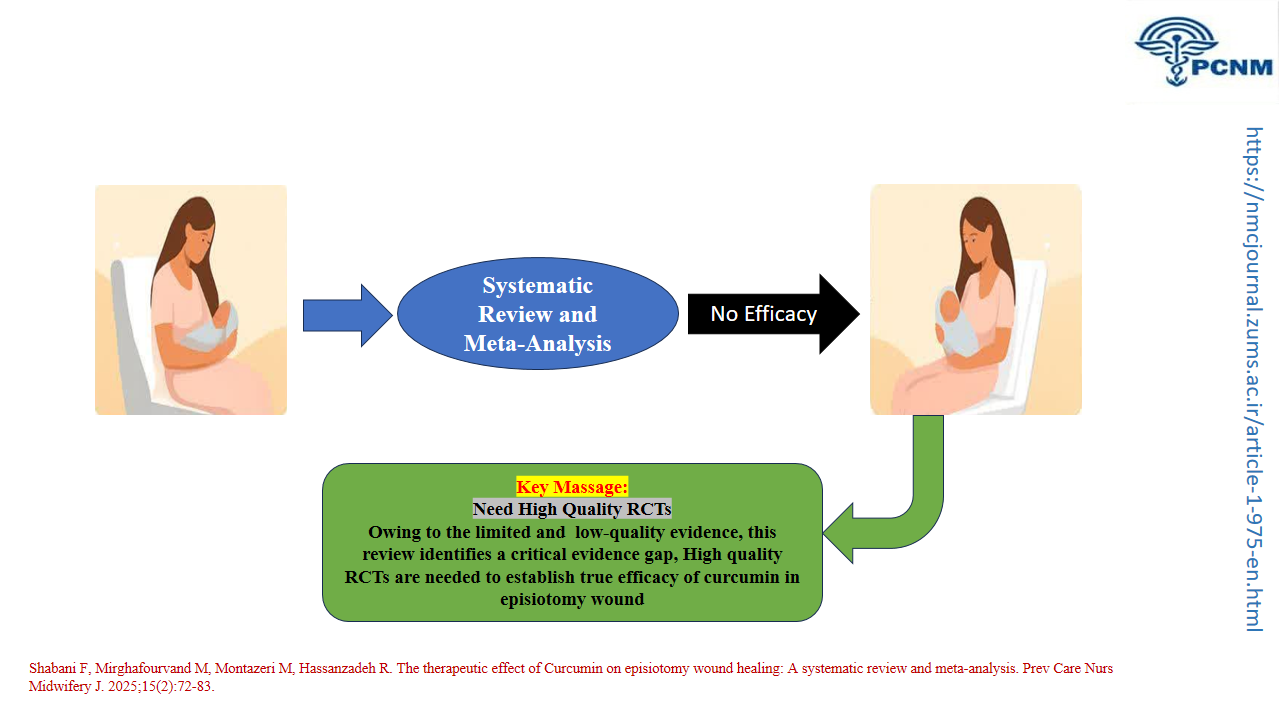
Graphical Abstract:
Reseach Highlights:
Knowledge Translation Statement
Audience: Midwives, obstetric nurses, clinical researchers, and complementary therapy educators
Current high-quality evidence does not demonstrate a statistically significant effect of topical curcumin on episiotomy wound healing compared to standard care. Clinicians and educators should prioritize evidence-based standard perineal care and inform patients that the therapeutic benefit of curcumin for this specific use is not yet established. This review highlights a critical gap in the literature, underscoring the urgent need for larger, high-quality randomized controlled trials to definitively evaluate curcumin's efficacy and safety for postpartum perineal healing.
Audience: Midwives, obstetric nurses, clinical researchers, and complementary therapy educators
Current high-quality evidence does not demonstrate a statistically significant effect of topical curcumin on episiotomy wound healing compared to standard care. Clinicians and educators should prioritize evidence-based standard perineal care and inform patients that the therapeutic benefit of curcumin for this specific use is not yet established. This review highlights a critical gap in the literature, underscoring the urgent need for larger, high-quality randomized controlled trials to definitively evaluate curcumin's efficacy and safety for postpartum perineal healing.
Type of Study: Review Articels |
Subject:
Midwifery
References
1. 1. Deyaso ZF, Chekole TT, Bedada RG, Molla W, Uddo EB, Mamo TT. Prevalence of episiotomy practice and factors associated with it in Ethiopia, systematic review and meta-analysis. Women's Health. 2022;18:1-10. [https://doi.org/10.1177/17455057221091659] [PMID]
2. Committee on Practice Bulletins-Obstetrics. ACOG Practice Bulletin No. 198: Prevention and management of obstetric lacerations at vaginal delivery. Obstetrics and Gynecology. 2018;132(3):e87-e102. [https://doi.org/10.1097/AOG.0000000000002841] [PMID]
3. Schmidt PC, Fenner DE. Repair of episiotomy and obstetrical perineal lacerations (first-fourth). American Journal of Obstetrics and Gynecology. 2024;230(3S):1005-1013. [https://doi.org/10.1016/j.ajog.2022.07.005] [PMID]
4. Fodstad K, Staff AC, Laine K. Episiotomy preferences, indication, and classification-a survey among Nordic doctors. Acta Obstetricia et Gynecologica Scandinavica. 2016;95(5):587-595. [https://doi.org/10.1111/aogs.12856] [PMID]
5. Luxey X, Lemoine A, Dewinter G. Acute pain management after vaginal delivery with perineal tears or episiotomy. Regional Anesthesia & Pain Medicine. 2025;50(6):503-513. [https://doi.org/10.1136/rapm-2024-105478] [PMID]
6. Spencer JP, Thomas S, Trondsen Pawlowski RH. Medication safety in breastfeeding. American Family Physician. 2022;106(6):638-644. [https://pubmed.ncbi.nlm.nih.gov/36521462/]
7. Childs C, Sandy-Hodgetts K, Broad C, Cooper R, Manresa M, Verdú-Soriano J. Risk, Prevention and management of complications After vaginal and caesarean section birth. Journal of Wound Care. 2020;29(Sup11a):1-48. [https://doi.org/10.12968/jowc.2020.29.Sup11a.S1] [PMID]
8. Okeahialam NA, Thakar R, Sultan AH. Postpartum perineal wound infection and its effect on anal sphincter integrity: Results of a prospective observational study. Acta Obstetricia et Gynecologica Scandinavica. 2023;102(4):473-479. [https://doi.org/10.1111/aogs.14515] [PMID]
9. Zhang P, Liu H, Yu Y, Peng S, Zhu S. Role of Curcuma longae Rhizoma in medical applications: research challenges and opportunities. Frontiers in Pharmacology. 2024;15:1430284. [https://doi.org/10.3389/fphar.2024.1430284] [PMID]
10. Barchitta M, Maugeri A, Favara G. Nutrition and Wound Healing: An overview focusing on the beneficial effects of curcumin. International Journal of Molecular Sciences. 2019;20(5):1119. [https://doi.org/10.3390/ijms20051119] [PMID]
11. Sharifi-Rad J, Rayess YE, Rizk AA, Sadaka C, Zgheib R, Zam W, et al. Turmeric and Its major compound curcumin on health: Bioactive effects and safety profiles for food, pharmaceutical, biotechnological and medicinal applications. Frontiers in Pharmacology. 2020;11:01021. [https://doi.org/10.3389/fphar.2020.01021] [PMID]
12. Deng X, Ratnayake J, Ali A. Curcumin-loaded drug delivery systems for acute and chronic Wound Management: A Review. Bioengineering. 2025;12(8):860. [https://doi.org/10.3390/bioengineering12080860] [PMID]
13. Alberts A, Lungescu IA, Niculescu AG, Grumezescu AM. Natural products for improving soft tissue healing: mechanisms, innovations, and clinical potential. Pharmaceutics. 2025;17(6):758. [https://doi.org/10.3390/pharmaceutics17060758] [PMID]
14. Abdolalipour S, Mohammad-Alizadeh Charandabi S, Mashayekh-Amiri S, Mirghafourvand M. The effectiveness of mindfulness-based interventions on self-efficacy and fear of childbirth in pregnant women: A systematic review and meta-analyses. Journal of Affective Disorders. 2023;333:257-270. [https://doi.org/10.1016/j.jad.2023.04.020] [PMID]
15. Higgins JPT, Thomas J, Chandler J, Cumpston M, Li T, Page MJ, et al., editors. Cochrane Handbook for Systematic Reviews of Interventions. 2nd Edition. Chichester: John Wiley & Sons; 2019. [https://www.cochrane.org/authors/handbooks-and-manuals/handbook]
16. Mutia WON, Usman AN, Jaqin N, Prihantono, Rahman L, Ahmad M. Potency of complemeter therapy to the healing process of perineal wound; turmeric (Curcuma longa Linn) Infusa. Gaceta Sanitaria. 2021;35(Suppl 2):322-326. [https://doi.org/10.1016/j.gaceta.2021.10.045] [PMID]
17. Vardanjani A, Sehati F, Mohebbi P, Deyhimi M, Dalazar A, Ghijazadeh M, et al. Wound healing benefits of curcumin for perineal repair after episiotomy: results of an Iranian randomized controlled trial. Life Science Journal. 2012;9(4):5536-5541.
18. Nikpour M, Agajani Delavar M, Khafri S, Ghanbarpour A, Moghadamnia AA, Esmaeilzadeh S, et al. The use of honey and curcumin for episiotomy pain relief and wound healing: A three-group double-blind randomized clinical trial. Nursing and Midwifery Studies. 2019;8(2):64-69. [https://nmsjournal.kaums.ac.ir/article_129034.html]
19. Golmakani N, Rabiei-Motlagh E, Tara F, Assili J, Shakeri MT. The effects of turmeric (Curcuma longa L) ointment on healing of episiotomy site in primiparous women. The Iranian Journal of Obstetrics, Gynecology and Infertility. 2008;11(4):29-39. [https://doi.org/10.22038/ijogi.2008.5909]
20. Akbik D, Ghadiri M, Chrzanowski W, Rohanizadeh R. Curcumin as a wound healing agent. Life Sciences. 2014;116(1):1-7. [https://doi.org/10.1016/j.lfs.2014.08.016] [PMID]
21. Fereydouni N, Darroudi M, Movaffagh J, Shahroodi A, Butler A, Ganjali SH, et al. Curcumin nanofibers for the purpose of wound healing. Journal of Cellular Physiology. 2019;234(5):5537-5554. [https://doi.org/10.1002/jcp.27362] [PMID]
22. Mohanty C, Sahoo SK. Curcumin and its topical formulations for wound healing applications. Drug Discovery Today. 2017;22(10):1582-1592. [https://doi.org/10.1016/j.drudis.2017.07.001] [PMID]
Send email to the article author
| Rights and permissions | |
 |
This work is licensed under a Creative Commons Attribution-NonCommercial 4.0 International License. |