
Preventive Care in Nursing and Midwifery

Volume 16, Issue 2 (4-2026)
Prev Care Nurs Midwifery 2026, 16(2): 60-69 |
Back to browse issues page


Ethics code: IR.MUK.REC.1404.109


Download citation:
BibTeX | RIS | EndNote | Medlars | ProCite | Reference Manager | RefWorks
Send citation to:


BibTeX | RIS | EndNote | Medlars | ProCite | Reference Manager | RefWorks
Send citation to:
Abbas Abdulriha K, Bagheri Saveh M I, Mohammad Jasim A, Vatandost S. Comparison of Healthcare Providers' Practices and Patients' Attitudes Toward Breaking Bad News: A Single-Center Study. Prev Care Nurs Midwifery 2026; 16 (2) :60-69
URL: http://nmcjournal.zums.ac.ir/article-1-1036-en.html
URL: http://nmcjournal.zums.ac.ir/article-1-1036-en.html

Social Determinants of Health Research Center, Research Institute for Health Development, Kurdistan University of Medical Sciences, Sanandaj,Iran , ggg@yahoo.com
Full-Text [PDF 739 kb]
(120 Downloads)
| Abstract (HTML) (461 Views)
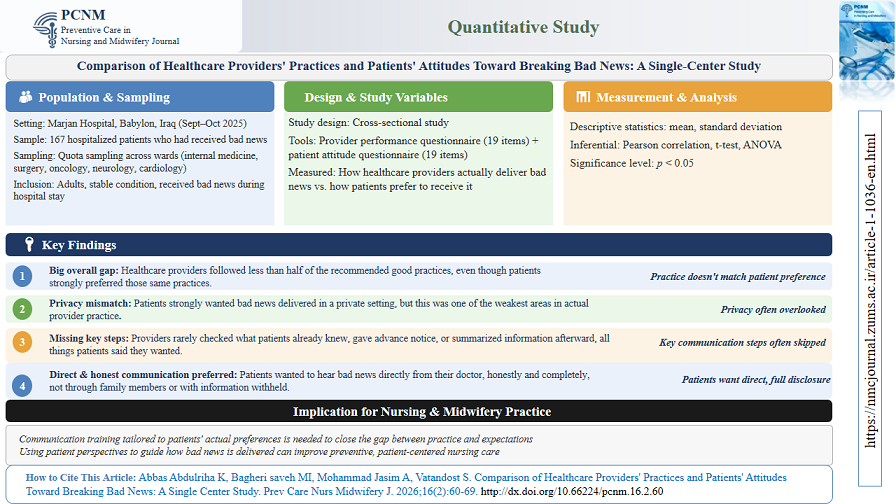
Graphical Abstract:
Reseach Highlights:
Knowledge Translation Statement
Audience: Nursing managers and clinical educators
Providers followed less than half of recommended bad-news practices, mismatching patient preferences on privacy, empathy, and gradual disclosure. Managers may consider integrating culturally adapted communication training such as SPIKES into continuing education.
Full-Text: (73 Views)
Introduction
Bad news is defined as any information or situation that causes individuals to perceive hopelessness, limitations in future life choices, and threats to their mental and physical well-being [1]. Examples of bad news reported in previous studies include the need for surgery, unfavorable clinical and para-clinical test results, loss of a limb, cancer, AIDS, and chronic illnesses [2, 3]. Breaking bad news is a complex communication process that requires appropriate skills to minimize its negative effects on patients, their families, and their future relationships with healthcare professionals [4]. Inappropriate delivery of bad news may lead to stress, misunderstanding of the diagnosis, treatment, and prognosis of the disease, and ultimately unfavorable outcomes [5]. Conversely, delivering bad news appropriately can reduce unrealistic expectations, disappointment, and confusion, while enabling patients to make informed decisions about their treatment and participate actively in their care [6].
Breaking Bad News is a collaborative process that should involve the healthcare team rather than being the sole responsibility of a single provider. However, because communication skills related to breaking bad news are often inadequately addressed in healthcare education, healthcare providers frequently rely on personal experience or observation of senior colleagues, which may increase the likelihood of inappropriate communication practices [7]. The results of a 2024 review of healthcare providers' experiences and perspectives on breaking bad news showed that the major barriers identified by healthcare providers were limited awareness of bad news protocols and inadequate training [8]. The results of a study by Al-Sabawi et al. showed that 63% of physicians were unfamiliar with bad news protocols and only 37% of physicians had sufficient knowledge of these protocols [9]. Another study in Iraq showed that 67% of healthcare providers had no experience receiving training in delivering bad news, only about 9% had academic training, and 4% had in-service training in breaking bad news. Furthermore, nearly 72% were not aware of the SPIKES protocol, one of the most well-known guidelines for Breaking Bad News [10].
Breaking Bad News is highly influenced by cultural norms, values, and societal beliefs [11]. Therefore, understanding the patients' preferences regarding how bad news should be communicated is essential for effective communication [12]. There are different views on telling the truth and breaking bad news across different cultures and societies. Patients' preferences regarding the delivery of bad news may differ significantly across cultures; therefore, cultural and social differences should be taken into account when breaking bad news [13]. In the study by Rao et al., most patients wanted to be informed about their cancer diagnosis, and the majority also wanted their families to participate in this process [14]. The factors considered important by patients and their families when receiving bad news include privacy, sufficient time without interruption, clarity and honesty in providing information, and an empathetic and caring attitude [15].
The results of a study by Gholami et al. in Iran showed significant differences between patients' attitudes and healthcare providers' performance in delivering bad news, indicating that the delivery of bad news was not aligned with patients' preferences [16].
In general, breaking bad news is a critical aspect of communication between healthcare providers and patients, requiring consideration of both patients' preferences and healthcare providers' competencies to optimize communication outcomes. Therefore, aligning patients' expectations with healthcare providers' practices is essential to reduce negative emotional reactions and improve trust and satisfaction with healthcare services. Assessing the alignment between healthcare providers' practices and patients' attitudes may help inform patient-centered communication in preventive nursing care. Given the limited evidence from Iraq, this study was conducted to compare healthcare providers' performance with patients' attitudes toward breaking bad news.
Objectives
The present study aimed to compare healthcare providers' performance with patients' attitudes toward breaking bad news.
Methods
Study Design
This cross-sectional study was conducted at Marjan Hospital in Babylon, Iraq, between September and October 2025.
Participants & Sampling
The study population consisted of hospitalized patients admitted to Marjan Hospital in Babylon, Iraq. Based on the cross-sectional design and data from a previous study [16], the minimum required sample size was estimated to be 135 participants, assuming a two-sided significance level of 5% (α = 0.05), a statistical power of 90% (1−β = 0.90), and an expected correlation coefficient of 0.275. To increase statistical power and compensate for potential missing data, 167 participants were ultimately included.
Participants were recruited using quota sampling proportional to the number of patients admitted to internal medicine, surgery, neurology, Oncology, and cardiology wards. Within each ward, participants were selected using convenience sampling.
The inclusion criteria were receipt of bad news during the current hospitalization (defined as an incurable disease, need for surgery, myocardial infarction, need for transfer, amputation, cancellation of surgery, CVA, Medication shortage, Hepatitis), age ≥18 years, orientation to time and place, and stable hemodynamic status. Questionnaires with incomplete responses were excluded from the final analysis.
Measurement Instruments
Data were collected using three instruments: a demographic information form, a questionnaire assessing healthcare providers' performance in breaking bad news, and a questionnaire evaluating patients' attitudes toward breaking bad news.
The performance questionnaire, developed and psychometrically validated by Gholami et al. (2023) in Iran (18), consists of 19 dichotomous items (Yes = 1, No = 0), with total scores ranging from 0 to 19. Higher scores indicate greater adherence to recommended practices for breaking bad news [16].
The attitude questionnaire, developed and validated by Labaf et al. (2015), includes 19 items rated on a five-point Likert scale (0 = strongly disagree to 4 = strongly agree), yielding total scores ranging from 0 to 76. Higher scores indicate more favorable attitudes toward the delivery of bad news [17].
Both questionnaires were translated into Arabic using the forward–backward translation method by two independent bilingual specialists. After reconciliation of the translated versions, the final Arabic version was submitted to the original instrument developer for approval. 10 patients and 10 experts assessed face validity. Content validity was evaluated qualitatively for cultural adaptation and quantitatively using the content validity ratio (CVR = 0.87) and content validity index (CVI = 0.89). Reliability was assessed in a pilot study involving 30 participants using Cronbach's alpha, yielding coefficients of 0.84 for the performance questionnaire and 0.88 for the attitude questionnaire.
Data Collection Procedure
Before data collection, the study objectives were explained to all participants, and written informed consent was obtained. Data were collected by the first author during morning, evening, and night shifts.
Statistical Analysis
Data were analyzed using SPSS version 21 (IBM Corp., Armonk, NY, USA). The Shapiro–Wilk test indicated that both performance scores (p = 0.11) and attitude scores (p = 0.08) were normally distributed. Descriptive statistics, including frequency, mean, and standard deviation, were used to summarize the data. Independent-samples t-test, one-way analysis of variance (ANOVA), and Pearson's correlation coefficient were applied for inferential analyses, as appropriate.
Result
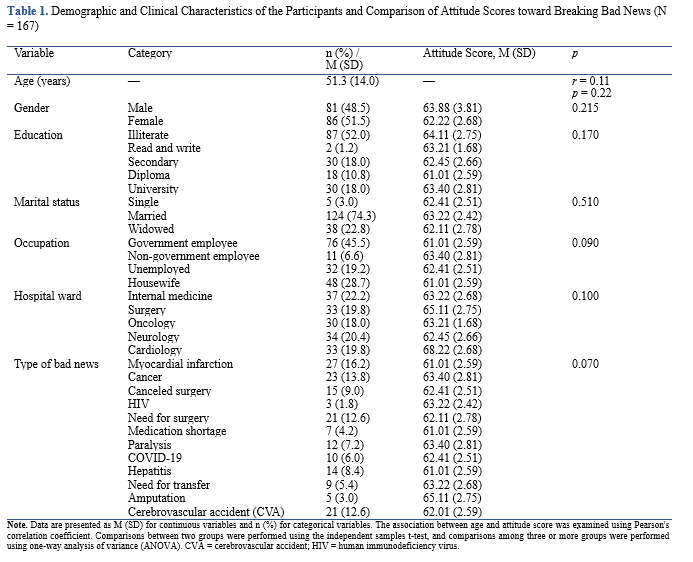
The mean (SD) age of the participants was 51.3 (14.0) years, and 51.5% were female. Most participants were married (74.3%) and illiterate (52.0%). No significant differences in attitude scores toward breaking bad news were observed according to gender, education level, marital status, occupation, hospital ward, or type of bad news (all p > 0.05). In addition, age was not significantly correlated with attitude scores (r = 0.11, p = 0.22) Table 1.
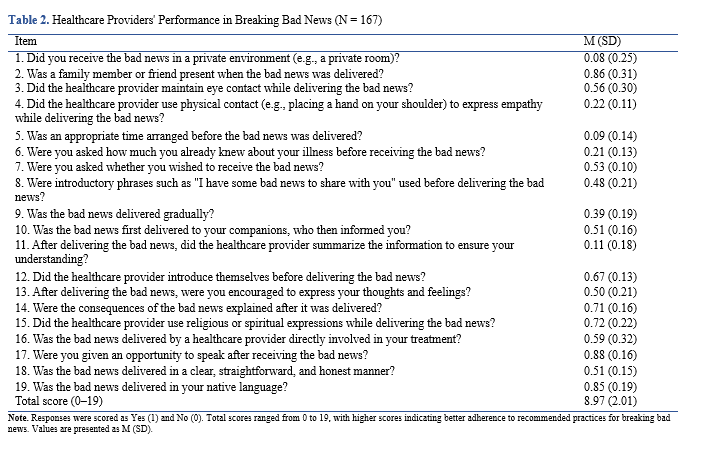
The mean (SD) healthcare providers' performance score for breaking bad news was 8.97 (2.01) out of 19 (95% CI: 8.66–9.28). Detailed item scores are presented in Table 2.
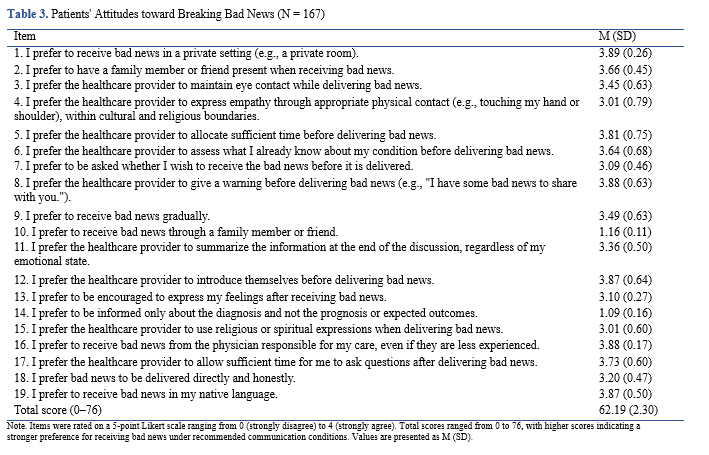
The mean (SD) total attitude score toward breaking bad news was 62.19 (2.30) out of 76 (95% confidence interval [CI]: 61.84–62.54). Among the questionnaire items, the highest mean score was observed for the preference to receive bad news in a private setting, 3.89 (0.26). In contrast, the lowest mean score was related to the preference for being informed only about the diagnosis without receiving information about the prognosis or outcomes, 1.09 (0.16) [Table 3].
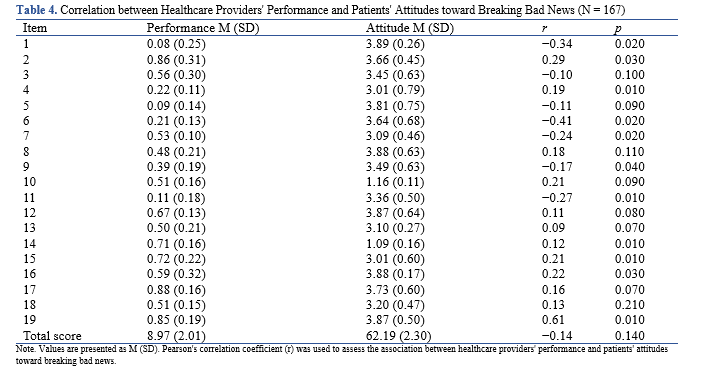
Pearson's correlation analysis showed no significant correlation between the total healthcare providers' performance score and the total patients' attitude score (r = −0.14, p = 0.14). However, significant correlations were observed for several individual questionnaire items, whereas others showed no statistically significant association [Table 4].
Discussion
This study aimed to compare healthcare provider performance and patients' attitudes toward breaking bad news. Healthcare providers adhered to less than half of the recommended practices for breaking bad news. In contrast, the overall attitude scores indicated a strong patient preference for receiving bad news according to the recommended principles. In the performance domain of the questionnaire, the lowest score was associated with maintaining privacy during bad news delivery, whereas this item received a high score in the attitude section. This discrepancy indicated a significant negative correlation, reflecting a mismatch between patients' expectations and healthcare providers' performance. Previous studies, including Gholami et al. [16], Amini et al. [18], and Nader et al. [19], consistently highlight patients' preference for receiving bad news in a private setting. Gholami et al. also reported a significant gap between patients' expectations and healthcare provider adherence to privacy during such conversations [17]. Violations of privacy not only contribute to increased anxiety and misconceptions but also undermine trust in medical healthcare providers. While ensuring privacy may be challenging in emergency contexts, in non-critical situations, feasible solutions include using a private room, reducing environmental distractions, and adopting low-tone verbal communication to maintain confidentiality.
Regarding the patient's right to be informed, the item assessing whether providers inquired about the patient's current knowledge received a low score in the performance section. In contrast, the corresponding attitude score was high. These findings suggest that patients expect providers to assess their baseline understanding before offering detailed information. The difference was statistically significant and negatively correlated. Consistent findings from other studies reinforce the need for gauging patient knowledge before disclosure [20, 21]. Overuse of medical jargon further hinders effective communication [22, 23]. Thus, information should align with the patient's cognitive capacity and informational needs. Miscommunication, whether due to excessive, inadequate, or incomprehensible information, can exacerbate confusion and emotional distress. In the present study, the high rate of illiteracy among participants underscores the importance of tailoring communication accordingly. Berkey et al. emphasized that information needs vary with cultural, educational, and demographic factors, all of which should guide communication strategies [24]. Gradual disclosure of bad news, another critical domain, received a low-performance score, while patients' attitude scores reflected a strong preference for such an approach. The discrepancy was statistically significant. This finding is supported by studies such as Nader et al. [19] and Gholami et al. [16], which reported that gradual delivery was among the most preferred communication styles. Evidence suggests that one-time disclosure is often inadequate and emotionally overwhelming for patients, impairing decision-making. Accordingly, a two-step communication strategy is recommended [25, 26]. It was also found that gradual delivery was among the most preferred communication styles. Abrupt disclosure can result in psychological trauma, confusion, reduced understanding, and even treatment avoidance. Structured communication protocols and targeted training for healthcare providers can mitigate these risks and enhance outcomes.
Another aspect with poor performance scores was scheduling a specific time for delivering bad news, which contrasted sharply with patients' strong preference for advance notice. Gholami et al. similarly found poor healthcare provider performance in this regard [16]. Warnock et al. reported that only 18.2% of patients had scheduled time slots for receiving bad news, often due to high workload and time constraints [4]. While emergencies may limit scheduling, non-urgent situations warrant prior coordination, allowing patients to involve family or trusted individuals for emotional support. Healthcare providers' performance in showing empathy and physical support also received low scores, despite patients' attitudes indicating a strong desire for compassionate communication. Nader et al. found that patients expect emotional consideration during bad news delivery [19]. Gholami et al. also highlighted inadequate performance in this domain [16]. In contrast, Guven et al. reported that 94% of patients valued emotional empathy from healthcare providers, though only 21% preferred physical contact [26]. Cultural and religious constraints in Islamic countries like Iraq may limit cross-gender physical contact.
Nevertheless, verbal and non-verbal expressions of empathy remain viable and essential. Failing to convey empathy appropriately may result in resentment, emotional distress, and reduced patient satisfaction. Thus, empathetic communication within culturally acceptable boundaries should be prioritized. Summarizing information following the disclosure of bad news received a low-performance score, whereas the corresponding attitude score was high. This difference was statistically significant. Although Gholami et al. reported a similar trend, the difference in their study was not statistically significant [16]. According to the SPIKES [25] and BREAKS [27] protocols, summarizing is a critical final step in delivering bad news. It helps reduce confusion, reinforces key points, and encourages patient participation in care planning by facilitating better understanding and memory retention. In the attitude domain, one of the lowest-scoring items was the preference to receive bad news indirectly through a partner. This finding indicates that patients prefer direct communication from healthcare providers, particularly physicians. Studies by Gholami et al. [16], Krieger et al. [21], and Nader et al. [19] all reported similar findings. The ethical and legal consensus now affirms that patients have the right to full disclosure about their health status. Concealing information may erode trust and contradict bioethical standards, although such practices still occur in some settings. Given patients' strong preference for direct communication, healthcare providers are ethically obligated to ensure transparency during bad news delivery.
Another low-scoring item in the attitude section pertained to not discussing the consequences of bad news. This finding suggests that patients wish to be informed about the implications of their diagnosis. Similar findings were reported by Gholami et al. [16] and supported by studies such as Barikani et al. [22], Baile et al. [28], and Nader et al. [19]. Patients expressed a desire to receive clear information regarding their disease, treatment options, side effects, and prognosis. Inadequate information can lead to misunderstanding, confusion, or even false hope among patients and their families. Despite the strengths of this study, several limitations should be considered when interpreting the findings. First, the study was conducted in a single hospital, which may limit the generalizability of the results to other healthcare settings and regions of Iraq. Second, the cross-sectional design prevents establishing causal relationships between patients' attitudes and healthcare providers' performance in breaking bad news. Third, data were collected using patients' self-reports, which may be subject to recall bias and social desirability bias. Fourth, healthcare providers' performance was assessed only from the patients' perspective and was not verified through direct observation or healthcare provider self-assessment. Future studies should include multiple healthcare settings, assess healthcare providers' perspectives in addition to patients' views, and use observational or longitudinal designs to better understand factors influencing the delivery of bad news. The findings of this study have important implications for clinical practice. Structured training programs based on established communication protocols, such as SPIKES, and adapted to the Iraqi cultural context may help improve healthcare providers' competence in breaking bad news. Given nurses' central role in patient communication, integrating patient-centered communication skills into undergraduate education and continuing professional development programs may enhance the quality of bad news delivery. In addition, involving family members in the disclosure process should be guided by patients' preferences rather than routine practice to support patient autonomy and culturally sensitive care.
Overall, the findings indicate that healthcare providers' performance in breaking bad news was not fully aligned with patients' attitudes and preferences. Although no significant correlation was observed between the overall performance and attitude scores, important discrepancies were identified across several key aspects of bad news delivery.
These findings underscore the need for culturally appropriate communication training to promote patient-centered care.
Conclusion
The findings indicate that patient-centered communication during the delivery of bad news remains suboptimal, with important discrepancies between patients' expectations and healthcare providers' practices. Addressing these gaps through culturally appropriate communication training and organizational support may facilitate more patient-centered care and improve the quality of healthcare communication.
Ethical Considerations
Ethics approval and consent to participate in the study were reviewed by the Research Ethics Committee at Kurdistan University of Medical Sciences (IR.MUK.REC.1404.109). All methods were carried out in accordance with the STROBE guidelines and the Declaration of Helsinki. Written informed consent was obtained from all the participants before enrollment in this study. For illiterate participants, verbal informed consent and a thumbprint were used. All authors have reviewed and approved the final manuscript and consent to its publication.
Acknowledgements
This article is the result of the dissertation for a master's degree in medical-surgical nursing and a research project approved by the research council of Kurdistan University of Medical Sciences.
I thank and appreciate the respected officials of the studied hospitals, head nurses of wards, dear participants, and the research council.
Conflict of Interest
The authors declared no conflict of interest.
Funding
This research did not receive any financial support.
Authors' Contributions
Conceptualization: A. Abdolreza K, M.I. Bagheri Saweh, S. Vatandost
Methodology: A. Abdolreza K, M.I. Bagheri Saweh, A. Mohammad Jasim
Investigation: A. Abdolreza K, M.I. Bagheri Saweh, A. Mohammad Jasim
Data Curation: A. Abdolreza K, S. Vatandost
Formal Analysis: A. Abdolreza K, S. Vatandost
Writing – Original Draft: A. Abdolreza K, M.I. Bagheri Saweh, A. Mohammad Jasim, S. Vatandost
Writing – Review & Editing: A. Abdolreza K, M.I. Bagheri Saweh, A. Mohammad Jasim, S. Vatandost
All authors read and approved the final manuscript.
Artificial Intelligence Utilization
The authors utilized [ChatGPT (GPT-5.6 Luna)] to assist with English language editing. All authors retain full responsibility for the scientific content and final approval of the manuscript.
Data Availability Statement
The data supporting the findings of this study are available from the corresponding author upon reasonable request.
Bad news is defined as any information or situation that causes individuals to perceive hopelessness, limitations in future life choices, and threats to their mental and physical well-being [1]. Examples of bad news reported in previous studies include the need for surgery, unfavorable clinical and para-clinical test results, loss of a limb, cancer, AIDS, and chronic illnesses [2, 3]. Breaking bad news is a complex communication process that requires appropriate skills to minimize its negative effects on patients, their families, and their future relationships with healthcare professionals [4]. Inappropriate delivery of bad news may lead to stress, misunderstanding of the diagnosis, treatment, and prognosis of the disease, and ultimately unfavorable outcomes [5]. Conversely, delivering bad news appropriately can reduce unrealistic expectations, disappointment, and confusion, while enabling patients to make informed decisions about their treatment and participate actively in their care [6].
Breaking Bad News is a collaborative process that should involve the healthcare team rather than being the sole responsibility of a single provider. However, because communication skills related to breaking bad news are often inadequately addressed in healthcare education, healthcare providers frequently rely on personal experience or observation of senior colleagues, which may increase the likelihood of inappropriate communication practices [7]. The results of a 2024 review of healthcare providers' experiences and perspectives on breaking bad news showed that the major barriers identified by healthcare providers were limited awareness of bad news protocols and inadequate training [8]. The results of a study by Al-Sabawi et al. showed that 63% of physicians were unfamiliar with bad news protocols and only 37% of physicians had sufficient knowledge of these protocols [9]. Another study in Iraq showed that 67% of healthcare providers had no experience receiving training in delivering bad news, only about 9% had academic training, and 4% had in-service training in breaking bad news. Furthermore, nearly 72% were not aware of the SPIKES protocol, one of the most well-known guidelines for Breaking Bad News [10].
Breaking Bad News is highly influenced by cultural norms, values, and societal beliefs [11]. Therefore, understanding the patients' preferences regarding how bad news should be communicated is essential for effective communication [12]. There are different views on telling the truth and breaking bad news across different cultures and societies. Patients' preferences regarding the delivery of bad news may differ significantly across cultures; therefore, cultural and social differences should be taken into account when breaking bad news [13]. In the study by Rao et al., most patients wanted to be informed about their cancer diagnosis, and the majority also wanted their families to participate in this process [14]. The factors considered important by patients and their families when receiving bad news include privacy, sufficient time without interruption, clarity and honesty in providing information, and an empathetic and caring attitude [15].
The results of a study by Gholami et al. in Iran showed significant differences between patients' attitudes and healthcare providers' performance in delivering bad news, indicating that the delivery of bad news was not aligned with patients' preferences [16].
In general, breaking bad news is a critical aspect of communication between healthcare providers and patients, requiring consideration of both patients' preferences and healthcare providers' competencies to optimize communication outcomes. Therefore, aligning patients' expectations with healthcare providers' practices is essential to reduce negative emotional reactions and improve trust and satisfaction with healthcare services. Assessing the alignment between healthcare providers' practices and patients' attitudes may help inform patient-centered communication in preventive nursing care. Given the limited evidence from Iraq, this study was conducted to compare healthcare providers' performance with patients' attitudes toward breaking bad news.
Objectives
The present study aimed to compare healthcare providers' performance with patients' attitudes toward breaking bad news.
Methods
Study Design
This cross-sectional study was conducted at Marjan Hospital in Babylon, Iraq, between September and October 2025.
Participants & Sampling
The study population consisted of hospitalized patients admitted to Marjan Hospital in Babylon, Iraq. Based on the cross-sectional design and data from a previous study [16], the minimum required sample size was estimated to be 135 participants, assuming a two-sided significance level of 5% (α = 0.05), a statistical power of 90% (1−β = 0.90), and an expected correlation coefficient of 0.275. To increase statistical power and compensate for potential missing data, 167 participants were ultimately included.
Participants were recruited using quota sampling proportional to the number of patients admitted to internal medicine, surgery, neurology, Oncology, and cardiology wards. Within each ward, participants were selected using convenience sampling.
The inclusion criteria were receipt of bad news during the current hospitalization (defined as an incurable disease, need for surgery, myocardial infarction, need for transfer, amputation, cancellation of surgery, CVA, Medication shortage, Hepatitis), age ≥18 years, orientation to time and place, and stable hemodynamic status. Questionnaires with incomplete responses were excluded from the final analysis.
Measurement Instruments
Data were collected using three instruments: a demographic information form, a questionnaire assessing healthcare providers' performance in breaking bad news, and a questionnaire evaluating patients' attitudes toward breaking bad news.
The performance questionnaire, developed and psychometrically validated by Gholami et al. (2023) in Iran (18), consists of 19 dichotomous items (Yes = 1, No = 0), with total scores ranging from 0 to 19. Higher scores indicate greater adherence to recommended practices for breaking bad news [16].
The attitude questionnaire, developed and validated by Labaf et al. (2015), includes 19 items rated on a five-point Likert scale (0 = strongly disagree to 4 = strongly agree), yielding total scores ranging from 0 to 76. Higher scores indicate more favorable attitudes toward the delivery of bad news [17].
Both questionnaires were translated into Arabic using the forward–backward translation method by two independent bilingual specialists. After reconciliation of the translated versions, the final Arabic version was submitted to the original instrument developer for approval. 10 patients and 10 experts assessed face validity. Content validity was evaluated qualitatively for cultural adaptation and quantitatively using the content validity ratio (CVR = 0.87) and content validity index (CVI = 0.89). Reliability was assessed in a pilot study involving 30 participants using Cronbach's alpha, yielding coefficients of 0.84 for the performance questionnaire and 0.88 for the attitude questionnaire.
Data Collection Procedure
Before data collection, the study objectives were explained to all participants, and written informed consent was obtained. Data were collected by the first author during morning, evening, and night shifts.
Statistical Analysis
Data were analyzed using SPSS version 21 (IBM Corp., Armonk, NY, USA). The Shapiro–Wilk test indicated that both performance scores (p = 0.11) and attitude scores (p = 0.08) were normally distributed. Descriptive statistics, including frequency, mean, and standard deviation, were used to summarize the data. Independent-samples t-test, one-way analysis of variance (ANOVA), and Pearson's correlation coefficient were applied for inferential analyses, as appropriate.
Result
The mean (SD) age of the participants was 51.3 (14.0) years, and 51.5% were female. Most participants were married (74.3%) and illiterate (52.0%). No significant differences in attitude scores toward breaking bad news were observed according to gender, education level, marital status, occupation, hospital ward, or type of bad news (all p > 0.05). In addition, age was not significantly correlated with attitude scores (r = 0.11, p = 0.22) Table 1.
The mean (SD) healthcare providers' performance score for breaking bad news was 8.97 (2.01) out of 19 (95% CI: 8.66–9.28). Detailed item scores are presented in Table 2.
The mean (SD) total attitude score toward breaking bad news was 62.19 (2.30) out of 76 (95% confidence interval [CI]: 61.84–62.54). Among the questionnaire items, the highest mean score was observed for the preference to receive bad news in a private setting, 3.89 (0.26). In contrast, the lowest mean score was related to the preference for being informed only about the diagnosis without receiving information about the prognosis or outcomes, 1.09 (0.16) [Table 3].
Pearson's correlation analysis showed no significant correlation between the total healthcare providers' performance score and the total patients' attitude score (r = −0.14, p = 0.14). However, significant correlations were observed for several individual questionnaire items, whereas others showed no statistically significant association [Table 4].
Discussion
This study aimed to compare healthcare provider performance and patients' attitudes toward breaking bad news. Healthcare providers adhered to less than half of the recommended practices for breaking bad news. In contrast, the overall attitude scores indicated a strong patient preference for receiving bad news according to the recommended principles. In the performance domain of the questionnaire, the lowest score was associated with maintaining privacy during bad news delivery, whereas this item received a high score in the attitude section. This discrepancy indicated a significant negative correlation, reflecting a mismatch between patients' expectations and healthcare providers' performance. Previous studies, including Gholami et al. [16], Amini et al. [18], and Nader et al. [19], consistently highlight patients' preference for receiving bad news in a private setting. Gholami et al. also reported a significant gap between patients' expectations and healthcare provider adherence to privacy during such conversations [17]. Violations of privacy not only contribute to increased anxiety and misconceptions but also undermine trust in medical healthcare providers. While ensuring privacy may be challenging in emergency contexts, in non-critical situations, feasible solutions include using a private room, reducing environmental distractions, and adopting low-tone verbal communication to maintain confidentiality.
Regarding the patient's right to be informed, the item assessing whether providers inquired about the patient's current knowledge received a low score in the performance section. In contrast, the corresponding attitude score was high. These findings suggest that patients expect providers to assess their baseline understanding before offering detailed information. The difference was statistically significant and negatively correlated. Consistent findings from other studies reinforce the need for gauging patient knowledge before disclosure [20, 21]. Overuse of medical jargon further hinders effective communication [22, 23]. Thus, information should align with the patient's cognitive capacity and informational needs. Miscommunication, whether due to excessive, inadequate, or incomprehensible information, can exacerbate confusion and emotional distress. In the present study, the high rate of illiteracy among participants underscores the importance of tailoring communication accordingly. Berkey et al. emphasized that information needs vary with cultural, educational, and demographic factors, all of which should guide communication strategies [24]. Gradual disclosure of bad news, another critical domain, received a low-performance score, while patients' attitude scores reflected a strong preference for such an approach. The discrepancy was statistically significant. This finding is supported by studies such as Nader et al. [19] and Gholami et al. [16], which reported that gradual delivery was among the most preferred communication styles. Evidence suggests that one-time disclosure is often inadequate and emotionally overwhelming for patients, impairing decision-making. Accordingly, a two-step communication strategy is recommended [25, 26]. It was also found that gradual delivery was among the most preferred communication styles. Abrupt disclosure can result in psychological trauma, confusion, reduced understanding, and even treatment avoidance. Structured communication protocols and targeted training for healthcare providers can mitigate these risks and enhance outcomes.
Another aspect with poor performance scores was scheduling a specific time for delivering bad news, which contrasted sharply with patients' strong preference for advance notice. Gholami et al. similarly found poor healthcare provider performance in this regard [16]. Warnock et al. reported that only 18.2% of patients had scheduled time slots for receiving bad news, often due to high workload and time constraints [4]. While emergencies may limit scheduling, non-urgent situations warrant prior coordination, allowing patients to involve family or trusted individuals for emotional support. Healthcare providers' performance in showing empathy and physical support also received low scores, despite patients' attitudes indicating a strong desire for compassionate communication. Nader et al. found that patients expect emotional consideration during bad news delivery [19]. Gholami et al. also highlighted inadequate performance in this domain [16]. In contrast, Guven et al. reported that 94% of patients valued emotional empathy from healthcare providers, though only 21% preferred physical contact [26]. Cultural and religious constraints in Islamic countries like Iraq may limit cross-gender physical contact.
Nevertheless, verbal and non-verbal expressions of empathy remain viable and essential. Failing to convey empathy appropriately may result in resentment, emotional distress, and reduced patient satisfaction. Thus, empathetic communication within culturally acceptable boundaries should be prioritized. Summarizing information following the disclosure of bad news received a low-performance score, whereas the corresponding attitude score was high. This difference was statistically significant. Although Gholami et al. reported a similar trend, the difference in their study was not statistically significant [16]. According to the SPIKES [25] and BREAKS [27] protocols, summarizing is a critical final step in delivering bad news. It helps reduce confusion, reinforces key points, and encourages patient participation in care planning by facilitating better understanding and memory retention. In the attitude domain, one of the lowest-scoring items was the preference to receive bad news indirectly through a partner. This finding indicates that patients prefer direct communication from healthcare providers, particularly physicians. Studies by Gholami et al. [16], Krieger et al. [21], and Nader et al. [19] all reported similar findings. The ethical and legal consensus now affirms that patients have the right to full disclosure about their health status. Concealing information may erode trust and contradict bioethical standards, although such practices still occur in some settings. Given patients' strong preference for direct communication, healthcare providers are ethically obligated to ensure transparency during bad news delivery.
Another low-scoring item in the attitude section pertained to not discussing the consequences of bad news. This finding suggests that patients wish to be informed about the implications of their diagnosis. Similar findings were reported by Gholami et al. [16] and supported by studies such as Barikani et al. [22], Baile et al. [28], and Nader et al. [19]. Patients expressed a desire to receive clear information regarding their disease, treatment options, side effects, and prognosis. Inadequate information can lead to misunderstanding, confusion, or even false hope among patients and their families. Despite the strengths of this study, several limitations should be considered when interpreting the findings. First, the study was conducted in a single hospital, which may limit the generalizability of the results to other healthcare settings and regions of Iraq. Second, the cross-sectional design prevents establishing causal relationships between patients' attitudes and healthcare providers' performance in breaking bad news. Third, data were collected using patients' self-reports, which may be subject to recall bias and social desirability bias. Fourth, healthcare providers' performance was assessed only from the patients' perspective and was not verified through direct observation or healthcare provider self-assessment. Future studies should include multiple healthcare settings, assess healthcare providers' perspectives in addition to patients' views, and use observational or longitudinal designs to better understand factors influencing the delivery of bad news. The findings of this study have important implications for clinical practice. Structured training programs based on established communication protocols, such as SPIKES, and adapted to the Iraqi cultural context may help improve healthcare providers' competence in breaking bad news. Given nurses' central role in patient communication, integrating patient-centered communication skills into undergraduate education and continuing professional development programs may enhance the quality of bad news delivery. In addition, involving family members in the disclosure process should be guided by patients' preferences rather than routine practice to support patient autonomy and culturally sensitive care.
Overall, the findings indicate that healthcare providers' performance in breaking bad news was not fully aligned with patients' attitudes and preferences. Although no significant correlation was observed between the overall performance and attitude scores, important discrepancies were identified across several key aspects of bad news delivery.
These findings underscore the need for culturally appropriate communication training to promote patient-centered care.
Conclusion
The findings indicate that patient-centered communication during the delivery of bad news remains suboptimal, with important discrepancies between patients' expectations and healthcare providers' practices. Addressing these gaps through culturally appropriate communication training and organizational support may facilitate more patient-centered care and improve the quality of healthcare communication.
Ethical Considerations
Ethics approval and consent to participate in the study were reviewed by the Research Ethics Committee at Kurdistan University of Medical Sciences (IR.MUK.REC.1404.109). All methods were carried out in accordance with the STROBE guidelines and the Declaration of Helsinki. Written informed consent was obtained from all the participants before enrollment in this study. For illiterate participants, verbal informed consent and a thumbprint were used. All authors have reviewed and approved the final manuscript and consent to its publication.
Acknowledgements
This article is the result of the dissertation for a master's degree in medical-surgical nursing and a research project approved by the research council of Kurdistan University of Medical Sciences.
I thank and appreciate the respected officials of the studied hospitals, head nurses of wards, dear participants, and the research council.
Conflict of Interest
The authors declared no conflict of interest.
Funding
This research did not receive any financial support.
Authors' Contributions
Conceptualization: A. Abdolreza K, M.I. Bagheri Saweh, S. Vatandost
Methodology: A. Abdolreza K, M.I. Bagheri Saweh, A. Mohammad Jasim
Investigation: A. Abdolreza K, M.I. Bagheri Saweh, A. Mohammad Jasim
Data Curation: A. Abdolreza K, S. Vatandost
Formal Analysis: A. Abdolreza K, S. Vatandost
Writing – Original Draft: A. Abdolreza K, M.I. Bagheri Saweh, A. Mohammad Jasim, S. Vatandost
Writing – Review & Editing: A. Abdolreza K, M.I. Bagheri Saweh, A. Mohammad Jasim, S. Vatandost
All authors read and approved the final manuscript.
Artificial Intelligence Utilization
The authors utilized [ChatGPT (GPT-5.6 Luna)] to assist with English language editing. All authors retain full responsibility for the scientific content and final approval of the manuscript.
Data Availability Statement
The data supporting the findings of this study are available from the corresponding author upon reasonable request.
Type of Study: Orginal research |
Subject:
Multidisciplinary
References
1. Aghamohammadi M, Alefbaei A, Babaei F, Biazar N, Gardashkhani S. The attitude of patients and families toward the delivery of bad news in oncology wards. Nursing and Midwifery Journal. 2020;17(12):1-10. [https://www.sid.ir/paper/406096/en]
2. Siraco S, Bitter C, Chen T. Breaking bad news in the emergency department. Journal of Education & Teaching in Emergency Medicine. 2022;7(2):1-47. [https://doi.org/10.5070/M57257168] [PMID]
3. Francis L, Robertson N. Healthcare practitioners' experiences of breaking bad news: a critical interpretative meta-synthesis. Patient Education and Counseling. 2023;107:107574. [https://doi.org/10.1016/j.pec.2022.107574] [PMID]
4. Warnock C, Tod A, Foster J, Soreny C. Breaking bad news in inpatient clinical settings: role of the nurse. Journal of Advanced Nursing. 2010;66(7):1543-1555. [https://doi.org/10.1111/j.1365-2648.2010.05325.x] [PMID]
5. González-Cabrera M, Ortega-Martínez AR, Martínez-Galiano JM, Hernández-Martínez A, Parra-Anguita L, Frías-Osuna A. Design and validation of a questionnaire on communicating bad news in nursing: a pilot study. International Journal of Environmental Research and Public Health. 2020;17(2):457. [https://doi.org/10.3390/ijerph17020457] [PMID]
6. Imanipour M, Karim Z, Bahrani N. Role, perspective and knowledge of Iranian critical care nurses about breaking bad news. Australian Critical Care. 2016;29(2):77-82. [https://doi.org/10.1016/j.aucc.2015.07.003] [PMID]
7. Shakeriniya I. Telling bad news: the necessity of its training. Iranian Journal of Medical Ethics and History of Medicine. 2010;3(1):29-38. [http://ijme.tums.ac.ir/article-1-246-en.html]
8. Yousuf AA, Stewart DC, Kane T, Soltani A, Al-Khal A, Sethi A. Health professionals' views and experiences of breaking bad news in the Eastern Mediterranean Region: a scoping review. Frontiers in Medicine. 2024;11:1440867. [https://doi.org/10.3389/fmed.2024.1440867] [PMID]
9. Al-Sabaawi WH, Ibraheem NM, Abdulrahman ZN. Knowledge of doctors regarding breaking bad news to patients. Iraq Medical Journal. 2021;5(4):112-116. [https://doi.org/10.22317/imj.v5i4.1137]
10. Mohsen A, Baiee HA. Breaking bad news to patients and their families among a sample of Iraqi nurses in Babylon Governorate. Latin American Journal of Pharmacy. 2024;43(Special Issue).
11. Seifart C, Hofmann M, Bär T, Knorrenschild JR, Seifart U, Rief W. Breaking bad news-what patients want and what they get: evaluating the SPIKES protocol in Germany. Annals of Oncology. 2014;25(3):707-711. [https://doi.org/10.1093/annonc/mdt582] [PMID]
12. Saqib SU, Pal KMI. Disclosing bad news of cancer diagnosis: patients' preference for communication. Journal of the Pakistan Medical Association. 2021;71(4):1239-1242. [https://doi.org/10.47391/JPMA.03-414] [PMID]
13. Managheb SE, Hosseinpour M, Mehrabi F. Patients' viewpoints about how to break bad news. Iranian Journal of Microbiology. 2013;5(4):1-12. [https://ijme.tums.ac.ir/article-1-5184-en.html]
14. Rao A, Ekstrand M, Heylen E, Raju G, Shet A. Breaking bad news: patient preferences and the role of family members when delivering a cancer diagnosis. Asian Pacific Journal of Cancer Prevention. 2016;17(4):1779-1784. [https://doi.org/10.7314/APJCP.2016.17.4.1779] [PMID]
15. Wahyuni S, Gautama MS, Simamora TY. A literature review of nurses' challenges and barriers in assisting patients and families facing breaking bad news. Indian Journal of Palliative Care. 2023;29(3):243-249. [https://doi.org/10.25259/IJPC_128_2023] [PMID]
16. Gholami M, Valiee S, Kamyari N, Vatandost S. Comparing the performance of emergency department personnel and patients' preferences in breaking bad news. Bulletin of Emergency and Trauma. 2023;11(3):146-153. [https://doi.org/10.30476/BEAT.2023.97965.1439]
17. Labaf A, Jahanshir A, Baradaran H, Shahvaraninasab A. Is it appropriate to use Western guidelines for breaking bad news in non-Western emergency departments? A patient's perspective. Clinical Ethics. 2015;10(1-2):13-21. [https://doi.org/10.1177/1477750915581797]
18. Amini K, Meshkini S, Ramezanibadr F. Patients' preferences on breaking bad news: a cross-sectional study from Iran. Indian Journal of Medical Ethics. 2023;8(4):284-292. [https://doi.org/10.20529/IJME.2023.039] [PMID]
19. Nader IH, Hasan LA, Al-Naqqash MA, Tahir SD. Patients' preferences in breaking bad news: a cross-sectional study. Journal of the Faculty of Medicine Baghdad. 2025;67(1):19-26. [https://doi.org/10.32007/jfacmedbaghdad2387]
20. Adeniyi AO, Arowoogun JO, Okolo CA, Chidi R, Babawarun O. Ethical considerations in healthcare IT: a review of data privacy and patient consent issues. World Journal of Advanced Research and Reviews. 2024;21(2):1660-1668. [https://doi.org/10.30574/wjarr.2024.21.2.0593]
21. Krieger T, Salm S, Dresen A, Cecon N. Cancer patients' experiences and preferences when receiving bad news: a qualitative study. Journal of Cancer Research and Clinical Oncology. 2023;149(7):3859-3870. [https://doi.org/10.1007/s00432-022-04311-8] [PMID]
22. Barikani A, Negarandeh R, Ghasemi E. The patients' preferences in breaking bad news: a scoping review. Nursing Practice Today. 2024;11(2):92-106. [https://doi.org/10.18502/npt.v11i2.15402]
23. Sobczak K, Leoniuk K, Janaszczyk A. Delivering bad news: patient's perspective and opinions. Patient Preference and Adherence. 2018;12:2397-2404. [https://doi.org/10.2147/PPA.S183106] [PMID]
24. Berkey FJ, Wiedemer JP, Vithalani ND. Delivering bad or life-altering news. American Family Physician. 2018;98(2):99-104. [https://www.aafp.org/afp/2018/0715/p99.html]
25. Buckman RA. Breaking bad news: the SPIKES strategy. Community Oncology. 2005;2(2):138-142. [https://doi.org/10.1016/S1548-5315(11)70867-1]
26. Guven R, Kaykisiz EK, Onturk H, Sasmaz MI, Ari A, Eyupoglu G, et al. Breaking bad news in the emergency department: how do the patients want it? Eurasian Journal of Emergency Medicine. 2018;17(3):97-102. [https://doi.org/10.5152/eajem.2018.27146]
27. Karim Z, Imanipour M, Bahrani N. Bad news in critical care and emergency units and nurses' participation in the process of breaking bad news in affiliated hospitals of Tehran University of Medical Sciences. Nursing and Midwifery Journal. 2015;13(5):385-392. [http://unmf.umsu.ac.ir/article-1-2033-en.html]
28. Baile WF, Buckman R, Lenzi R, Glober G, Beale EA, Kudelka AP. SPIKES-a six-step protocol for delivering bad news: application to the patient with cancer. The Oncologist. 2000;5(4):302-311. [https://doi.org/10.1634/theoncologist.5-4-302] [PMID]
Send email to the article author
| Rights and permissions | |
 |
This work is licensed under a Creative Commons Attribution-NonCommercial 4.0 International License. |