
Preventive Care in Nursing and Midwifery Journal

Volume 15, Issue 1 (1-2025)
Prev Care Nurs Midwifery J 2025, 15(1): 67-76 |
Back to browse issues page


Ethics code: IR.IAU.Z.REC.1403.047


Download citation:
BibTeX | RIS | EndNote | Medlars | ProCite | Reference Manager | RefWorks
Send citation to:


BibTeX | RIS | EndNote | Medlars | ProCite | Reference Manager | RefWorks
Send citation to:
Ahmadi M S, Masoomi Jahandizi H, Mohammadloo M, Alinejad M. Predicting the propensity for infidelity based on quality of life and emotional literacy with the mediating role of resilience in nurses. Prev Care Nurs Midwifery J 2025; 15 (1) :67-76
URL: http://nmcjournal.zums.ac.ir/article-1-950-en.html
URL: http://nmcjournal.zums.ac.ir/article-1-950-en.html

PhD in educational psychology, Assistant Professor, Department of Psychology and Counseling, Farhangian University, Tehran, Iran , ghavaghy57@cfu.ac.ir
Full-Text [PDF 810 kb]
(1218 Downloads)
| Abstract (HTML) (2675 Views)
Knowledge Translation Statement
Audience: Nurse managers, hospital counselors, and nursing policymakers.
Low quality of life and poor emotional literacy increase nurses' risk of infidelity, but resilience can mitigate this risk. Implement workplace programs that enhance emotional literacy, improve quality of life, and build resilience to reduce infidelity risk among nurses.
Table 4. Direct Effects between Research Variables
Knowledge Translation Statement
Audience: Nurse managers, hospital counselors, and nursing policymakers.
Low quality of life and poor emotional literacy increase nurses' risk of infidelity, but resilience can mitigate this risk. Implement workplace programs that enhance emotional literacy, improve quality of life, and build resilience to reduce infidelity risk among nurses.
Full-Text: (707 Views)
Introduction
Nursing is a high-stress and vital profession within the healthcare system. Due to its unique characteristics, such as irregular work shifts, high psychological pressure, emotional involvement with patients, and heavy responsibilities, it can profoundly impact the mental health and quality of life of those in this profession [1].
These pressures, particularly for women, can sometimes culminate in an inability to balance professional and family roles simultaneously and have been reported as a reason for female nurses leaving the profession [2]. Such conditions can also affect marital relationships, potentially leading to issues like emotional distance, marital conflicts, and even infidelity [3]. Research findings demonstrate that health-related professions, such as nursing and medicine, are prone to burnout, particularly during night shifts. This can negatively affect individuals' psychological and sexual functions, leading to an increased likelihood of infidelity [4,5].
Marital infidelity is one of the most damaging events in a couple's relationship, manifesting as emotional, sexual, or a combination of both [6]. This phenomenon leads to severe psychological consequences, such as depression, anxiety, reduced self-esteem, violence, divorce, and even suicidal ideation [7]. Statistics show that approximately 41% of married couples have experienced infidelity at least once. Men are more often involved in sexual infidelity, while women are more affected by emotional infidelity [8]. Additionally, some studies indicate that the incidence of marital infidelity is also on the rise in Iran [9], and this issue is more concerning in high-stress professions like nursing due to the specific characteristics of the job [6,10].
One factor that can either predispose or deter marital infidelity is quality of life. As a multifaceted concept, quality of life includes physical, psychological, and social well-being, referring to an individual's perception of their life satisfaction and functioning [11]. According to the findings of Beiromvand et al.'s research, marital quality is a significant negative predictor of the propensity for infidelity, and the propensity for sexual infidelity has negative relationships with quality of marital life and sexual satisfaction among women [12]. Similarly, Ferdowsi et al. observed a significant relationship between marital relationship quality and attitudes toward marital infidelity in married women [13].
Emotional literacy is another key variable in regulating couples' relationships. Emotional literacy refers to the ability to identify, manage, and appropriately express emotions, and it can be effective in reducing marital conflicts [14]. Couples with low emotional literacy are often unable to understand each other's emotional needs, which can lead to reduced intimacy and an increased likelihood of infidelity [15]. Some research has shown that emotional literacy has an indirect effect on reducing the tendency toward extramarital affairs by helping regulate negative emotions [16]. Additionally, it is associated with a decrease in emotional divorce and an improvement in quality of life, and significantly affects emotional divorce and the desire to leave the relationship among women affected by a spouse's infidelity [17].
A third significant factor contributing to marital stability is resilience. This psychological trait enhances an individual's ability to cope effectively with life's challenges and pressures, thereby helping to reduce marital conflicts [18]. Resilient individuals not only report higher marital satisfaction but also are less likely to consider destructive behaviors like infidelity [19]. Furthermore, research on resilience has highlighted its role in improving the quality of care and increasing patient satisfaction [20]. Findings reveal a significant positive relationship between resilience and quality of life, suggesting that developing resilience in nurses can improve their quality of life [21]. Additionally, resilience is associated with increased adaptability in couples [22], reduced emotional divorce [23], and decreased marital infidelity and harmful outcomes, such as emotional distance, decision to divorce, and marital infidelity. It has also been found that women who have been exposed to infidelity tend to have lower levels of resilience [24].
Although there are no precise statistics on the rate of marital infidelity in Iran, this does not mean the social problem is nonexistent. The increasing number of individuals seeking counseling for this issue indicates the growing prevalence of this phenomenon in recent years. Studies have also shown that public culture is more accepting of male infidelity than female infidelity, and this disparity increases women's psychological vulnerability [25]. Physical separation from a spouse for work-related reasons, such as in healthcare professions like nursing, can be associated with infidelity. The spouses of these individuals often worry that their spouse may have committed infidelity during their absence. Individuals who discover a spouse’s infidelity frequently exhibit post-traumatic stress disorder (PTSD) and symptoms of severe depression. Because physicians and nurses spend long hours away from home for work, this may increase the incidence of infidelity [26].
Despite the high importance of marital infidelity and the determining role of psychological factors, such as quality of life, emotional literacy, and resilience, there are limited comprehensive and systematic studies that simultaneously investigate these variables within the nursing population. The extensive psychological and social consequences of infidelity, including anxiety, depression, decreased marital satisfaction, and increased divorce rates, further highlight the importance of conducting applied research in this area. Furthermore, due to the specific nature of their work, nurses are exposed to additional psychological and social pressures that may predispose them to familial distress. Therefore, a precise examination of the factors influencing infidelity, along with identifying the mediating role of resilience, can facilitate the development of targeted psychological and educational interventions, thereby improving the mental and marital health of this vital group. Accordingly, the present study was conducted to predict the propensity for infidelity based on quality of life and emotional literacy, with resilience serving as a mediating role in nurses.
Methods
Study Design
This research, as an applied study in terms of purpose, employs a descriptive-correlational design methodologically, utilizing structural equation modeling (SEM).
Participants
The statistical population comprised all nurses working in hospitals in an urban area of Iran during 2023-2024. A convenience sampling method was used to select 300 participants. Since the minimum sample size for SEM studies is 200 [27], we chose 300 participants to increase the precision of the research. Nurses with a minimum education of a bachelor's degree, an age range of 25 to 60, employment in the specified city's hospitals, and at least three years of work experience were included in the study. Questionnaires with incomplete or corrupted responses were not included in the analysis.
Sampling Method
A convenience sampling method was used to select 300 participants.
Measurement Tools
In this study, four standardized questionnaires were used to collect data:
The Scale of Marital Infidelity
This scale was developed by Habibi et al. (2018) and consists of 45 questions across three subscales: Individual (15 questions), Family (22 questions), and Social (8 questions). Responses are scored on a 5-point Likert scale ranging from "very low" (1) to "very high" (5). The total score ranges from 45 to 225, with a higher score indicating a greater propensity for infidelity. In the present study, the reliability of this questionnaire was confirmed with a Cronbach's alpha of 0.83 [28].
The Medical Outcomes Study (MOS) 36-item, Short-Form Health Survey (SF-36)
This 36-item questionnaire was designed by Ware and Sherbourne (1992) and measures eight dimensions: physical functioning, role limitations due to physical health, role limitations due to emotional problems, vitality, mental health, social functioning, bodily pain, and general health perceptions. The score for each subscale ranges from 0 to 100, with a higher score indicating a better quality of life in that dimension. In this current study, the reliability of the instrument was confirmed with a Cronbach's alpha of 0.88 [29, 30].
The Emotional Literacy Scale
This scale is a 10-item subscale of the broader Iranian Family Psychological Function Scale (IFPFS), which was developed by Kimiyaee (2012). This subscale is scored on a 7-point Likert scale, ranging from 1 (strongly disagree) to 7 (strongly agree), with a total score ranging from 10 to 70. A higher score indicates a more favorable status in family emotional functioning. In the current research, overall reliability was established at 0.79 through internal consistency, as measured by Cronbach's alpha [31].
The Connor-Davidson Resilience Scale (CD-RISC)
This 25-item questionnaire is designed to measure resilience in adults. The scale uses a 5-point Likert scale, ranging from 0 (completely incorrect) to 4 (completely correct). The total score is calculated by summing the scores of all items, with possible scores ranging from 0 to 100. Higher scores denote greater resilience. In the current study, a Cronbach's alpha of 0.93 was obtained [32, 33].
Statistical Analysis
The Kolmogorov-Smirnov test was used to assess the normality of the data distribution. The results demonstrated that the significance levels for the research variables, quality of life (0.319), emotional literacy (0.287), resilience (0.163), and propensity for infidelity (0.252), were all greater than 0.05. This indicates that the data follow a normal distribution, thus confirming the normality assumption for performing statistical tests. Descriptive analyses, including mean, standard deviation, skewness, and kurtosis, were then conducted using SPSS version 25.
To examine the relationships among the research variables, Pearson's correlation test was employed. To test the conceptual model and investigate the mediating role of resilience, SEM was performed using LISREL version 8.8. The model's fit was evaluated using several indices, including the Comparative Fit Index (CFI), Goodness-of-Fit Index (GFI), Normed Fit Index (NFI), and Root Mean Square Error of Approximation (RMSEA).
Results
Of the questionnaires collected, 35 were excluded due to incomplete or corrupted responses, leaving 265 questionnaires for the final analysis. Among the 265 participating nurses, 182 (68.7%) were female and 83 (31.3%) were male, responding to the study questions. Regarding marital status, 56 (21.1%) were single, 185 (69.8%) were married, and 24 (9.1%) were divorced or widowed. In terms of education level, 195 (73.6%) held a bachelor's degree, 64 (24.2%) held a master's degree, and 6 (2.3%) held a doctoral degree. Regarding work experience, 57 (21.5%) had less than 5 years, 51 (19.2%) had 5 to 10 years, 73 (27.5%) had 10 to 15 years, 50 (18.9%) had 15 to 20 years, 28 (10.6%) had 20 to 25 years, and 6 (2.3%) had 25 or more years of work experience.
The results of Table 1 reveal that in the components of the propensity for infidelity, the family dimension has the highest mean score of 34.28 (9.62), and the social dimension has the lowest mean score of 16.19 (4.26).
In terms of quality of life, physical functioning has the highest mean score of 21.77 (5.33), and bodily pain has the lowest mean score of 5.46 (1.41). The total mean scores for quality of life, emotional literacy, and resilience are 86.18 (12.08), 27.92 (6.81), and 63.62 (15.51), respectively.
The results of Pearson’s correlation coefficient reveal that the propensity for infidelity has significant negative relationships with quality of life, emotional literacy, and resilience (p < 0.01). Additionally, significant positive relationships were observed among quality of life, emotional literacy, and resilience (p < 0.01) (Table 2).
Table 1. Descriptive Indicators of Research Variables (Propensity for Infidelity, Quality of Life, Emotional Literacy, and Resilience)
Nursing is a high-stress and vital profession within the healthcare system. Due to its unique characteristics, such as irregular work shifts, high psychological pressure, emotional involvement with patients, and heavy responsibilities, it can profoundly impact the mental health and quality of life of those in this profession [1].
These pressures, particularly for women, can sometimes culminate in an inability to balance professional and family roles simultaneously and have been reported as a reason for female nurses leaving the profession [2]. Such conditions can also affect marital relationships, potentially leading to issues like emotional distance, marital conflicts, and even infidelity [3]. Research findings demonstrate that health-related professions, such as nursing and medicine, are prone to burnout, particularly during night shifts. This can negatively affect individuals' psychological and sexual functions, leading to an increased likelihood of infidelity [4,5].
Marital infidelity is one of the most damaging events in a couple's relationship, manifesting as emotional, sexual, or a combination of both [6]. This phenomenon leads to severe psychological consequences, such as depression, anxiety, reduced self-esteem, violence, divorce, and even suicidal ideation [7]. Statistics show that approximately 41% of married couples have experienced infidelity at least once. Men are more often involved in sexual infidelity, while women are more affected by emotional infidelity [8]. Additionally, some studies indicate that the incidence of marital infidelity is also on the rise in Iran [9], and this issue is more concerning in high-stress professions like nursing due to the specific characteristics of the job [6,10].
One factor that can either predispose or deter marital infidelity is quality of life. As a multifaceted concept, quality of life includes physical, psychological, and social well-being, referring to an individual's perception of their life satisfaction and functioning [11]. According to the findings of Beiromvand et al.'s research, marital quality is a significant negative predictor of the propensity for infidelity, and the propensity for sexual infidelity has negative relationships with quality of marital life and sexual satisfaction among women [12]. Similarly, Ferdowsi et al. observed a significant relationship between marital relationship quality and attitudes toward marital infidelity in married women [13].
Emotional literacy is another key variable in regulating couples' relationships. Emotional literacy refers to the ability to identify, manage, and appropriately express emotions, and it can be effective in reducing marital conflicts [14]. Couples with low emotional literacy are often unable to understand each other's emotional needs, which can lead to reduced intimacy and an increased likelihood of infidelity [15]. Some research has shown that emotional literacy has an indirect effect on reducing the tendency toward extramarital affairs by helping regulate negative emotions [16]. Additionally, it is associated with a decrease in emotional divorce and an improvement in quality of life, and significantly affects emotional divorce and the desire to leave the relationship among women affected by a spouse's infidelity [17].
A third significant factor contributing to marital stability is resilience. This psychological trait enhances an individual's ability to cope effectively with life's challenges and pressures, thereby helping to reduce marital conflicts [18]. Resilient individuals not only report higher marital satisfaction but also are less likely to consider destructive behaviors like infidelity [19]. Furthermore, research on resilience has highlighted its role in improving the quality of care and increasing patient satisfaction [20]. Findings reveal a significant positive relationship between resilience and quality of life, suggesting that developing resilience in nurses can improve their quality of life [21]. Additionally, resilience is associated with increased adaptability in couples [22], reduced emotional divorce [23], and decreased marital infidelity and harmful outcomes, such as emotional distance, decision to divorce, and marital infidelity. It has also been found that women who have been exposed to infidelity tend to have lower levels of resilience [24].
Although there are no precise statistics on the rate of marital infidelity in Iran, this does not mean the social problem is nonexistent. The increasing number of individuals seeking counseling for this issue indicates the growing prevalence of this phenomenon in recent years. Studies have also shown that public culture is more accepting of male infidelity than female infidelity, and this disparity increases women's psychological vulnerability [25]. Physical separation from a spouse for work-related reasons, such as in healthcare professions like nursing, can be associated with infidelity. The spouses of these individuals often worry that their spouse may have committed infidelity during their absence. Individuals who discover a spouse’s infidelity frequently exhibit post-traumatic stress disorder (PTSD) and symptoms of severe depression. Because physicians and nurses spend long hours away from home for work, this may increase the incidence of infidelity [26].
Despite the high importance of marital infidelity and the determining role of psychological factors, such as quality of life, emotional literacy, and resilience, there are limited comprehensive and systematic studies that simultaneously investigate these variables within the nursing population. The extensive psychological and social consequences of infidelity, including anxiety, depression, decreased marital satisfaction, and increased divorce rates, further highlight the importance of conducting applied research in this area. Furthermore, due to the specific nature of their work, nurses are exposed to additional psychological and social pressures that may predispose them to familial distress. Therefore, a precise examination of the factors influencing infidelity, along with identifying the mediating role of resilience, can facilitate the development of targeted psychological and educational interventions, thereby improving the mental and marital health of this vital group. Accordingly, the present study was conducted to predict the propensity for infidelity based on quality of life and emotional literacy, with resilience serving as a mediating role in nurses.
Methods
Study Design
This research, as an applied study in terms of purpose, employs a descriptive-correlational design methodologically, utilizing structural equation modeling (SEM).
Participants
The statistical population comprised all nurses working in hospitals in an urban area of Iran during 2023-2024. A convenience sampling method was used to select 300 participants. Since the minimum sample size for SEM studies is 200 [27], we chose 300 participants to increase the precision of the research. Nurses with a minimum education of a bachelor's degree, an age range of 25 to 60, employment in the specified city's hospitals, and at least three years of work experience were included in the study. Questionnaires with incomplete or corrupted responses were not included in the analysis.
Sampling Method
A convenience sampling method was used to select 300 participants.
Measurement Tools
In this study, four standardized questionnaires were used to collect data:
The Scale of Marital Infidelity
This scale was developed by Habibi et al. (2018) and consists of 45 questions across three subscales: Individual (15 questions), Family (22 questions), and Social (8 questions). Responses are scored on a 5-point Likert scale ranging from "very low" (1) to "very high" (5). The total score ranges from 45 to 225, with a higher score indicating a greater propensity for infidelity. In the present study, the reliability of this questionnaire was confirmed with a Cronbach's alpha of 0.83 [28].
The Medical Outcomes Study (MOS) 36-item, Short-Form Health Survey (SF-36)
This 36-item questionnaire was designed by Ware and Sherbourne (1992) and measures eight dimensions: physical functioning, role limitations due to physical health, role limitations due to emotional problems, vitality, mental health, social functioning, bodily pain, and general health perceptions. The score for each subscale ranges from 0 to 100, with a higher score indicating a better quality of life in that dimension. In this current study, the reliability of the instrument was confirmed with a Cronbach's alpha of 0.88 [29, 30].
The Emotional Literacy Scale
This scale is a 10-item subscale of the broader Iranian Family Psychological Function Scale (IFPFS), which was developed by Kimiyaee (2012). This subscale is scored on a 7-point Likert scale, ranging from 1 (strongly disagree) to 7 (strongly agree), with a total score ranging from 10 to 70. A higher score indicates a more favorable status in family emotional functioning. In the current research, overall reliability was established at 0.79 through internal consistency, as measured by Cronbach's alpha [31].
The Connor-Davidson Resilience Scale (CD-RISC)
This 25-item questionnaire is designed to measure resilience in adults. The scale uses a 5-point Likert scale, ranging from 0 (completely incorrect) to 4 (completely correct). The total score is calculated by summing the scores of all items, with possible scores ranging from 0 to 100. Higher scores denote greater resilience. In the current study, a Cronbach's alpha of 0.93 was obtained [32, 33].
Statistical Analysis
The Kolmogorov-Smirnov test was used to assess the normality of the data distribution. The results demonstrated that the significance levels for the research variables, quality of life (0.319), emotional literacy (0.287), resilience (0.163), and propensity for infidelity (0.252), were all greater than 0.05. This indicates that the data follow a normal distribution, thus confirming the normality assumption for performing statistical tests. Descriptive analyses, including mean, standard deviation, skewness, and kurtosis, were then conducted using SPSS version 25.
To examine the relationships among the research variables, Pearson's correlation test was employed. To test the conceptual model and investigate the mediating role of resilience, SEM was performed using LISREL version 8.8. The model's fit was evaluated using several indices, including the Comparative Fit Index (CFI), Goodness-of-Fit Index (GFI), Normed Fit Index (NFI), and Root Mean Square Error of Approximation (RMSEA).
Results
Of the questionnaires collected, 35 were excluded due to incomplete or corrupted responses, leaving 265 questionnaires for the final analysis. Among the 265 participating nurses, 182 (68.7%) were female and 83 (31.3%) were male, responding to the study questions. Regarding marital status, 56 (21.1%) were single, 185 (69.8%) were married, and 24 (9.1%) were divorced or widowed. In terms of education level, 195 (73.6%) held a bachelor's degree, 64 (24.2%) held a master's degree, and 6 (2.3%) held a doctoral degree. Regarding work experience, 57 (21.5%) had less than 5 years, 51 (19.2%) had 5 to 10 years, 73 (27.5%) had 10 to 15 years, 50 (18.9%) had 15 to 20 years, 28 (10.6%) had 20 to 25 years, and 6 (2.3%) had 25 or more years of work experience.
The results of Table 1 reveal that in the components of the propensity for infidelity, the family dimension has the highest mean score of 34.28 (9.62), and the social dimension has the lowest mean score of 16.19 (4.26).
In terms of quality of life, physical functioning has the highest mean score of 21.77 (5.33), and bodily pain has the lowest mean score of 5.46 (1.41). The total mean scores for quality of life, emotional literacy, and resilience are 86.18 (12.08), 27.92 (6.81), and 63.62 (15.51), respectively.
The results of Pearson’s correlation coefficient reveal that the propensity for infidelity has significant negative relationships with quality of life, emotional literacy, and resilience (p < 0.01). Additionally, significant positive relationships were observed among quality of life, emotional literacy, and resilience (p < 0.01) (Table 2).
Table 1. Descriptive Indicators of Research Variables (Propensity for Infidelity, Quality of Life, Emotional Literacy, and Resilience)
| Variable | Subscale | Mean | SD |
| Propensity for infidelity | Family | 34.28 | 9.62 |
| Individual | 27.92 | 6.65 | |
| Social | 16.19 | 4.26 | |
| Total score | 78.39 | 16.49 | |
| Quality of life | Physical functioning | 21.77 | 5.33 |
| Role limitations due to physical health | 5.56 | 1.02 | |
| Role limitations due to emotional problems | 6.08 | 1.19 | |
| Vitality | 11.34 | 2.31 | |
| Mental health | 14.05 | 3.13 | |
| Social functioning | 5.67 | 1.19 | |
| Bodily pain | 5.46 | 1.41 | |
| General health perceptions | 13.57 | 2.41 | |
| Total score | 86.18 | 12.08 | |
| Emotional literacy | 27.92 | 6.81 | |
| Resilience | 63.62 | 15.51 |
| Variables | Propensity for Infidelity | Quality of Life | Emotional Literacy | Resilience |
| Propensity for infidelity | 1 | |||
| Quality of life | -0.38(p<0.01)** | 1 | ||
| Emotional literacy | -0.43(p<0.01)** | 0.48(p<0.01)** | 1 | |
| Resilience | -0.49(p<0.01)** | 0.41(p<0.01)** | 0.39(p<0.01)** | 1 |
The results of Table 3 show that the Chi-square to Degrees of Freedom Ratio (X²/df) is 2.57, which is less than the criterion value of 3, indicating a good model fit. The Root Mean Square Error of Approximation (RMSEA) is 0.071, which falls within the "good" range. Furthermore, the Goodness of Fit Index (GFI) and Comparative Fit Index (CFI) are both 0.92, and the Adjusted GFI (AGFI) is 0.85, all of which exceed the acceptable thresholds. Overall, the reported indices suggest a good fit of the conceptual research model.
Table 3. Fit Indices of the Conceptual Research Model
Table 3. Fit Indices of the Conceptual Research Model
| Index Name | Value | Acceptable Range (35) | Result |
| (X²/df) | 2.57 | Less than 3 | Acceptable |
| (RMSEA) | 0.71 | Good: Less than 0.08 Moderate: 0.08 to 0.1 |
Good |
| (CFI) | 0.92 | Greater than 0.90 | Acceptable |
| (GFI) | 0.92 | Greater than 0.90 | Acceptable |
| AGFI) | 0.85 | Greater than 0.80 | Acceptable |
X²/df: Chi-square to Degrees of Freedom Ratio; RMSEA: Root Mean Square Error of Approximation; CFI: Comparative Fit Index; GFI: Goodness of Fit Index; AGFI: Adjusted Goodness of Fit Index
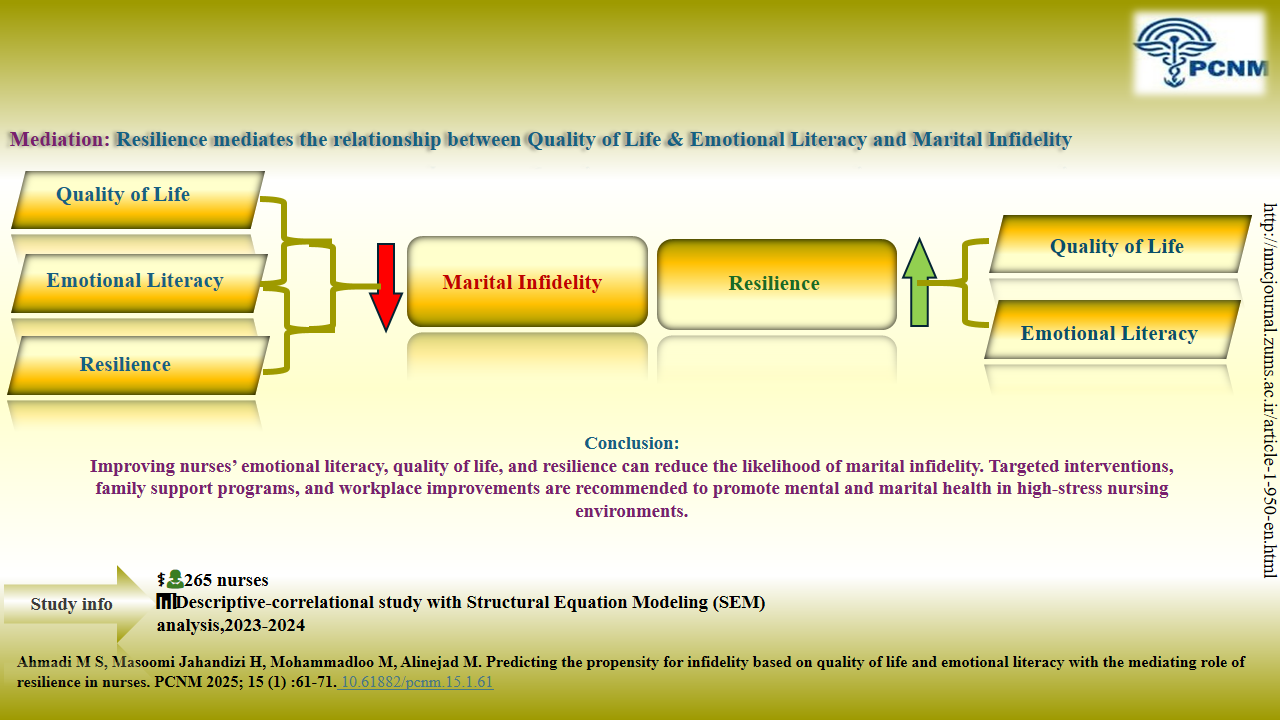
The results of Table 4 demonstrate that both quality of life and emotional literacy have significant negative direct effects on the propensity for infidelity (β = -0.13 and β = -0.23, respectively; p < 0.05). Moreover, quality of life and emotional literacy have significant positive effects on resilience (β = 0.28 and β = 0.26, respectively; p< 0.05). Finally, resilience has a significant negative effect on the propensity for infidelity (β=-0.34; p<0.05). These findings suggest that as nurses' quality of life and emotional literacy increase, their resilience improves, which in turn reduces the propensity for infidelity.
The results of Table 4 demonstrate that both quality of life and emotional literacy have significant negative direct effects on the propensity for infidelity (β = -0.13 and β = -0.23, respectively; p < 0.05). Moreover, quality of life and emotional literacy have significant positive effects on resilience (β = 0.28 and β = 0.26, respectively; p< 0.05). Finally, resilience has a significant negative effect on the propensity for infidelity (β=-0.34; p<0.05). These findings suggest that as nurses' quality of life and emotional literacy increase, their resilience improves, which in turn reduces the propensity for infidelity.
Table 4. Direct Effects between Research Variables
| Variables | Path Coefficients (β) | T-Value | Standard Error | p | ||
| Quality of life | → → |
Propensity for infidelity | -0.13 | -2.23 | 0.085 | p<0.05 |
| Quality of life | → → |
Resilience | 0.28 | 4.50 | 0.035 | p<0.05 |
| Emotional literacy | → → |
Propensity for infidelity | -0.23 | -3.83 | 0.102 | p<0.05 |
| Emotional literacy | → → |
Resilience | 0.26 | 4.16 | 0.041 | p<0.05 |
| Resilience | → → |
Propensity for infidelity | -0.34 | -5.91 | 0.021 | p<0.05 |
Discussion
The present study investigated the roles of quality of life and emotional literacy in predicting the propensity for infidelity among nurses, with an emphasis on the mediating role of resilience. The findings revealed that both quality of life and emotional literacy had significant effects on reducing the propensity for infidelity, both directly and indirectly, through resilience. One of the notable findings of the present study was the higher mean score for the propensity for infidelity in the familial dimension compared to the individual and social dimensions. This suggests that familial pressures and problems, such as marital conflicts, a lack of emotional support, and a lack of spousal harmony, have the greatest effects on nurses' tendency toward high-risk behaviors.
Therefore, preventive interventions in the nursing profession should not only focus on individual resilience and emotional skills but also require special attention to family support and the teaching of communication and conflict resolution skills at the family level. Creating family-centered programs, offering marital counseling, and strengthening positive family interactions can play an important protective role in reducing the propensity for infidelity and enhancing the effects of quality of life and emotional literacy on interpersonal behaviors.
An important finding of this study was the significant negative correlation between quality of life and the propensity for infidelity, which aligns with the results of Ferdowsi et al [13] and Beiromvand et al [12]. Quality of life, as a key aspect of family life, affects the mental health and well-being of couples and is closely related to their physical and psychological health. In families with a higher quality of life, couples invest more emotional and psychological capital into strengthening their marital relationship, and due to mutual understanding, the propensity for infidelity decreases. Hence, quality of life is considered an important predictor of a successful marriage and a preventative factor against infidelity [13]. In high-stress work environments, such as hospitals, quality of life plays a crucial role in preventing maladaptive behaviors. Nurses with a lower quality of life are more susceptible to infidelity due to psychological burnout and emotional pressures. In contrast, nurses with a higher quality of life benefit from better social support, healthier emotional relationships, and more effective stress management skills, all of which serve as protective factors against the propensity for infidelity [34].
The research findings indicate a significant negative effect of emotional literacy on the propensity for infidelity, which is consistent with the results of Shalchian et al.’s study [16]. Emotional literacy is a set of abilities for understanding, interpreting, regulating, and expressing emotions in oneself and others, and it plays a crucial role in improving the quality of interpersonal relationships. Individuals with a high level of emotional literacy use adaptive coping strategies when faced with conflicts and emotional pressures, making them less likely to engage in high-risk behaviors like infidelity. The lack of emotional skills in high-stress work environments, such as the nursing profession, paves the way for maladaptive behaviors, including infidelity. By empowering individuals to correctly recognize their own and others' emotions, appropriately express their feelings, and release negative emotions, emotional literacy helps nurses’ better cope with challenges in stressful situations and improve their emotional relationships [23].
In addition, the results of the present study revealed a significant positive relationship between nurses’ quality of life and resilience, which is consistent with findings from studies conducted by Razmpoush et al. [35] and Moshtaghi et al [36]. To explain this relationship, it can be noted that resilience refers to the psychological ability of individuals to cope with life's pressures, maintain emotional balance, and continue to function effectively in crises. By providing a supportive environment, a sense of satisfaction, and psychological well-being, a desirable quality of life provides the necessary internal and external resources to enhance an individual's resilience [37]. In the nursing profession, marked by exposure to death, illness, patient anxiety, and the physical and psychological pressures caused by resource shortages, resilience plays a fundamental role as a crucial protective factor for maintaining the mental health of staff. Nurses who have a higher quality of life are more likely to be able to return to psychological balance after experiencing intense pressures. These individuals not only suffer less from job burnout but also experience a greater sense of meaning, self-efficacy, and control over their professional lives [38].
The results of the current study indicate a significant positive relationship between emotional literacy and resilience among nurses, which aligns with the findings of Alagheband et al [23], showing that nurses with higher levels of emotional literacy also possess a greater capacity for resilience when facing occupational pressures and crises. In explaining this finding, it can be stated that emotional literacy, which encompasses the ability to identify, understand, manage, and effectively use emotions, is a key factor in regulating an individual's emotional responses under stressful conditions. This ability allows nurses to gain better control over their negative emotions during stressful situations, return to psychological equilibrium more quickly, and prevent the emergence of ineffective reactions. Additionally, individuals with high emotional literacy tend to have better interpersonal skills, enabling them to more easily seek and receive required social support from colleagues and the work environment. The presence of such support networks is a well-known source of resilience. Moreover, these individuals typically experience a greater sense of self-efficacy in solving emotional problems, which also contributes to an increase in their overall resilience [16].
Another finding of this study is the presence of a significant negative correlation between resilience and the propensity for infidelity among nurses. This result aligns with the research of Tamrchi et al [39], which demonstrated that individuals with higher levels of resilience are less likely to resort to maladaptive strategies like emotional or sexual infidelity when faced with emotional or interpersonal conflicts and dissatisfaction. Defined as the ability to return to psychological equilibrium after experiencing a crisis or stress, resilience plays a crucial role in regulating negative emotions, managing frustration, and maintaining psychological well-being in difficult circumstances. In high-stress environments, such as healthcare centers, where nurses encounter a range of emotional, physical, and social challenges, resilience helps them utilize more adaptive coping strategies, such as dialogue, problem-solving, and seeking social support; consequently, they are less susceptible to high-risk behaviors like infidelity. Additionally, resilient individuals are more successful at emotion regulation and impulse control. In crises or feeling emotional deprivation, they can overcome immediate urges and make decisions based on their values, sense of responsibility, and ethical commitments, which acts as a deterrent against infidelity [40].
Ultimately, as demonstrated by the results of the present study, quality of life and emotional literacy indirectly reduce nurses' propensity for infidelity through resilience. Due to the lack of previous research specifically examining the mediating role of resilience in the relationship between these variables, direct comparisons with other studies are not possible. In explaining this finding, it can be said that nurses who have a desirable quality of life and a high level of emotional literacy typically have access to more internal (such as self-efficacy and self-esteem) and external resources (such as social support) to cope with environmental pressures, which strengthens their resilience [21]. According to the protective-risk model, quality of life and emotional literacy act as protective factors that reduce the likelihood of high-risk behaviors like infidelity by enhancing resilience. Resilience plays a mediating role by managing emotions and employing adaptive strategies. Specifically, nurses with higher emotional literacy have a greater ability to regulate their own emotions and understand the emotions of others, and under conflict-ridden situations, they utilize adaptive strategies instead of impulsive reactions. This capability increases their resilience, thereby reducing the occurrence of maladaptive behaviors like infidelity in interpersonal or marital relationships [34]. Overall, it can be concluded that resilience, by acting as a mediator, facilitates and strengthens the path through which quality of life and emotional literacy impact the propensity for infidelity.
This research, despite its best efforts to adhere to scientific principles, faced several limitations. First, the use of self-report tools for measuring sensitive variables, such as the propensity for infidelity, may have been influenced by social response bias. Second, the study's cross-sectional design prevents drawing causal inferences between variables. Third, the sample was limited to nurses from a specific region, which restricts the generalizability of the findings to other nursing populations or similar professions.
Based on the research findings, future studies are encouraged to employ longitudinal or quasi-experimental methods to investigate causal relationships among resilience, emotional literacy, and the propensity for infidelity. This model could also be tested in other high-stress occupational groups, such as individuals working as teachers, social workers, and emergency services staff. It is also recommended that the impact of educational programs designed to enhance resilience and emotional literacy on reducing the propensity for infidelity be examined. Furthermore, medical centers and hospitals should hold training workshops to boost nurses' emotional literacy and resilience, thereby strengthening their coping mechanisms against occupational stressors and pressures. Improving nurses' quality of work life by enhancing working conditions and reducing overtime hours could also help alleviate psychological pressure. Finally, ongoing psychological support programs and preventive interventions are suggested to both decrease the propensity for infidelity and promote resilience and emotional literacy.
Conclusion
Overall, the findings indicated that quality of life, emotional literacy, and resilience had significant negative effects on nurses' propensity for infidelity. Furthermore, quality of life and emotional literacy had significant positive effects on nurses' resilience, and the mediating role of resilience in the relationship of quality of life and emotional literacy with the propensity for infidelity was confirmed. It can be inferred that emotional literacy and quality of life can be used to predict nurses' propensity for infidelity. Therefore, they are of particular importance in providing counseling to reduce infidelity. These findings emphasize the necessity of strengthening resilience, emotional literacy, and improving the quality of life in nurses' training and support programs to reduce high-risk behaviors, such as infidelity in clinical settings.
Ethical Considerations
The present study was approved by the Ethics Committee of Islamic Azad University, Zanjan Branch (IR.IAU.Z.REC.1403.047). Throughout this research, the following ethical principles were observed: Informed consent was obtained from all participants; codes were assigned to those who wished to remain anonymous; results were provided to participants upon request; the reliability and confidentiality of all data and findings were maintained; and participants were free to withdraw from the study or discontinue tests at any time without penalty.
Acknowledgments
This research was extracted from a master's thesis in clinical psychology. The authors would like to sincerely thank all the nurses who participated in this study.
Conflict of Interest
No conflict of interest.
Funding
This research received no external funding or support.
Authors' Contributions
The authors contributed equally to this study.
The present study investigated the roles of quality of life and emotional literacy in predicting the propensity for infidelity among nurses, with an emphasis on the mediating role of resilience. The findings revealed that both quality of life and emotional literacy had significant effects on reducing the propensity for infidelity, both directly and indirectly, through resilience. One of the notable findings of the present study was the higher mean score for the propensity for infidelity in the familial dimension compared to the individual and social dimensions. This suggests that familial pressures and problems, such as marital conflicts, a lack of emotional support, and a lack of spousal harmony, have the greatest effects on nurses' tendency toward high-risk behaviors.
Therefore, preventive interventions in the nursing profession should not only focus on individual resilience and emotional skills but also require special attention to family support and the teaching of communication and conflict resolution skills at the family level. Creating family-centered programs, offering marital counseling, and strengthening positive family interactions can play an important protective role in reducing the propensity for infidelity and enhancing the effects of quality of life and emotional literacy on interpersonal behaviors.
An important finding of this study was the significant negative correlation between quality of life and the propensity for infidelity, which aligns with the results of Ferdowsi et al [13] and Beiromvand et al [12]. Quality of life, as a key aspect of family life, affects the mental health and well-being of couples and is closely related to their physical and psychological health. In families with a higher quality of life, couples invest more emotional and psychological capital into strengthening their marital relationship, and due to mutual understanding, the propensity for infidelity decreases. Hence, quality of life is considered an important predictor of a successful marriage and a preventative factor against infidelity [13]. In high-stress work environments, such as hospitals, quality of life plays a crucial role in preventing maladaptive behaviors. Nurses with a lower quality of life are more susceptible to infidelity due to psychological burnout and emotional pressures. In contrast, nurses with a higher quality of life benefit from better social support, healthier emotional relationships, and more effective stress management skills, all of which serve as protective factors against the propensity for infidelity [34].
The research findings indicate a significant negative effect of emotional literacy on the propensity for infidelity, which is consistent with the results of Shalchian et al.’s study [16]. Emotional literacy is a set of abilities for understanding, interpreting, regulating, and expressing emotions in oneself and others, and it plays a crucial role in improving the quality of interpersonal relationships. Individuals with a high level of emotional literacy use adaptive coping strategies when faced with conflicts and emotional pressures, making them less likely to engage in high-risk behaviors like infidelity. The lack of emotional skills in high-stress work environments, such as the nursing profession, paves the way for maladaptive behaviors, including infidelity. By empowering individuals to correctly recognize their own and others' emotions, appropriately express their feelings, and release negative emotions, emotional literacy helps nurses’ better cope with challenges in stressful situations and improve their emotional relationships [23].
In addition, the results of the present study revealed a significant positive relationship between nurses’ quality of life and resilience, which is consistent with findings from studies conducted by Razmpoush et al. [35] and Moshtaghi et al [36]. To explain this relationship, it can be noted that resilience refers to the psychological ability of individuals to cope with life's pressures, maintain emotional balance, and continue to function effectively in crises. By providing a supportive environment, a sense of satisfaction, and psychological well-being, a desirable quality of life provides the necessary internal and external resources to enhance an individual's resilience [37]. In the nursing profession, marked by exposure to death, illness, patient anxiety, and the physical and psychological pressures caused by resource shortages, resilience plays a fundamental role as a crucial protective factor for maintaining the mental health of staff. Nurses who have a higher quality of life are more likely to be able to return to psychological balance after experiencing intense pressures. These individuals not only suffer less from job burnout but also experience a greater sense of meaning, self-efficacy, and control over their professional lives [38].
The results of the current study indicate a significant positive relationship between emotional literacy and resilience among nurses, which aligns with the findings of Alagheband et al [23], showing that nurses with higher levels of emotional literacy also possess a greater capacity for resilience when facing occupational pressures and crises. In explaining this finding, it can be stated that emotional literacy, which encompasses the ability to identify, understand, manage, and effectively use emotions, is a key factor in regulating an individual's emotional responses under stressful conditions. This ability allows nurses to gain better control over their negative emotions during stressful situations, return to psychological equilibrium more quickly, and prevent the emergence of ineffective reactions. Additionally, individuals with high emotional literacy tend to have better interpersonal skills, enabling them to more easily seek and receive required social support from colleagues and the work environment. The presence of such support networks is a well-known source of resilience. Moreover, these individuals typically experience a greater sense of self-efficacy in solving emotional problems, which also contributes to an increase in their overall resilience [16].
Another finding of this study is the presence of a significant negative correlation between resilience and the propensity for infidelity among nurses. This result aligns with the research of Tamrchi et al [39], which demonstrated that individuals with higher levels of resilience are less likely to resort to maladaptive strategies like emotional or sexual infidelity when faced with emotional or interpersonal conflicts and dissatisfaction. Defined as the ability to return to psychological equilibrium after experiencing a crisis or stress, resilience plays a crucial role in regulating negative emotions, managing frustration, and maintaining psychological well-being in difficult circumstances. In high-stress environments, such as healthcare centers, where nurses encounter a range of emotional, physical, and social challenges, resilience helps them utilize more adaptive coping strategies, such as dialogue, problem-solving, and seeking social support; consequently, they are less susceptible to high-risk behaviors like infidelity. Additionally, resilient individuals are more successful at emotion regulation and impulse control. In crises or feeling emotional deprivation, they can overcome immediate urges and make decisions based on their values, sense of responsibility, and ethical commitments, which acts as a deterrent against infidelity [40].
Ultimately, as demonstrated by the results of the present study, quality of life and emotional literacy indirectly reduce nurses' propensity for infidelity through resilience. Due to the lack of previous research specifically examining the mediating role of resilience in the relationship between these variables, direct comparisons with other studies are not possible. In explaining this finding, it can be said that nurses who have a desirable quality of life and a high level of emotional literacy typically have access to more internal (such as self-efficacy and self-esteem) and external resources (such as social support) to cope with environmental pressures, which strengthens their resilience [21]. According to the protective-risk model, quality of life and emotional literacy act as protective factors that reduce the likelihood of high-risk behaviors like infidelity by enhancing resilience. Resilience plays a mediating role by managing emotions and employing adaptive strategies. Specifically, nurses with higher emotional literacy have a greater ability to regulate their own emotions and understand the emotions of others, and under conflict-ridden situations, they utilize adaptive strategies instead of impulsive reactions. This capability increases their resilience, thereby reducing the occurrence of maladaptive behaviors like infidelity in interpersonal or marital relationships [34]. Overall, it can be concluded that resilience, by acting as a mediator, facilitates and strengthens the path through which quality of life and emotional literacy impact the propensity for infidelity.
This research, despite its best efforts to adhere to scientific principles, faced several limitations. First, the use of self-report tools for measuring sensitive variables, such as the propensity for infidelity, may have been influenced by social response bias. Second, the study's cross-sectional design prevents drawing causal inferences between variables. Third, the sample was limited to nurses from a specific region, which restricts the generalizability of the findings to other nursing populations or similar professions.
Based on the research findings, future studies are encouraged to employ longitudinal or quasi-experimental methods to investigate causal relationships among resilience, emotional literacy, and the propensity for infidelity. This model could also be tested in other high-stress occupational groups, such as individuals working as teachers, social workers, and emergency services staff. It is also recommended that the impact of educational programs designed to enhance resilience and emotional literacy on reducing the propensity for infidelity be examined. Furthermore, medical centers and hospitals should hold training workshops to boost nurses' emotional literacy and resilience, thereby strengthening their coping mechanisms against occupational stressors and pressures. Improving nurses' quality of work life by enhancing working conditions and reducing overtime hours could also help alleviate psychological pressure. Finally, ongoing psychological support programs and preventive interventions are suggested to both decrease the propensity for infidelity and promote resilience and emotional literacy.
Conclusion
Overall, the findings indicated that quality of life, emotional literacy, and resilience had significant negative effects on nurses' propensity for infidelity. Furthermore, quality of life and emotional literacy had significant positive effects on nurses' resilience, and the mediating role of resilience in the relationship of quality of life and emotional literacy with the propensity for infidelity was confirmed. It can be inferred that emotional literacy and quality of life can be used to predict nurses' propensity for infidelity. Therefore, they are of particular importance in providing counseling to reduce infidelity. These findings emphasize the necessity of strengthening resilience, emotional literacy, and improving the quality of life in nurses' training and support programs to reduce high-risk behaviors, such as infidelity in clinical settings.
Ethical Considerations
The present study was approved by the Ethics Committee of Islamic Azad University, Zanjan Branch (IR.IAU.Z.REC.1403.047). Throughout this research, the following ethical principles were observed: Informed consent was obtained from all participants; codes were assigned to those who wished to remain anonymous; results were provided to participants upon request; the reliability and confidentiality of all data and findings were maintained; and participants were free to withdraw from the study or discontinue tests at any time without penalty.
Acknowledgments
This research was extracted from a master's thesis in clinical psychology. The authors would like to sincerely thank all the nurses who participated in this study.
Conflict of Interest
No conflict of interest.
Funding
This research received no external funding or support.
Authors' Contributions
The authors contributed equally to this study.
Type of Study: Orginal research |
Subject:
Nursing
References
1. 1. Cheraghi R, Almasi L, Alinejad V, Aghakhani N, Jasemi M, Eghtedar S. The relationship between emotional intelligence with job performance and occupational stress in nurses working in educational and medical centers in Urmia. Nursing And Midwifery Journal. 2023;21(7):575-588. [https://doi.org/10.61186/unmf.21.7.575]
2. Jor A, Sadeghmoghadam L, Mazloum Shahri SB, Khosravan S. The effect of a family-centered program to manage domestic roles on marital satisfaction in female nurses. Journal Of Research & Health. 2023;13(1):51-58. [https://doi.org/10.32598/JRH.13.1.2063.2]
3. Hackathorn J, Ashdown BK. The webs we weave: predicting infidelity motivations and extradyadic relationship satisfaction. Journal Of Sex Research. 2021;58:170-182. [https://doi.org/10.1080/00224499.2020.1746954] [PMID]
4. Gordon K, Mitchell EA. Infidelity in the time of COVID-19. Family Process. 2020;59(3):956-966. [https://doi.org/10.1111/famp.12576] [PMID]
5. Guerrero S, et al. Incidence and related factors of infidelity among medical doctors and nurses. International Journal Of Environmental Research And Public Health. 2021;18(11):5575. [https://doi.org/10.3390/ijerph18115575] [PMID]
6. Afsharzada MS, Etemadi O, Naghavi A. Marital infidelity: cognitive, behavioral, emotional reactions, and coping strategies among Afghan women. Journal Of Research In Cognitive And Behavioral Sciences. 2025;14(2):13-26. [https://doi.org/10.22108/cbs.2024.141390.1901]
7. Adam A. Perceptions of infidelity: a comparison of sexual, emotional, cyber-, and parasocial behaviors. Interpersona: An International Journal On Personal Relationships. 2019;13(2):237-252. [https://doi.org/10.5964/ijpr.v13i2.376]
8. Ejeh PC. A philosophical examination of the concept and nature of infidelity in marriage as a socio-ethical issue in contemporary society. Social Sciences And Humanity Research. 2022;5(7):36-42. [https://zenodo.org/records/6907107]
9. Azhar A, et al. Linking infidelity stress, anxiety and depression: Evidence from Pakistan married couples and divorced individuals. International Journal Of Human Rights In Healthcare. 2018;11(3):214-228. [https://doi.org/10.1108/IJHRH-11-2017-0069]
10. Alexopoulos C, Taylor LD. Your cheating cognitions: young women's responses to television messages about infidelity. Mass Communication & Society. 2020;23(2):249-271. [https://doi.org/10.1080/15205436.2019.1705350]
11. WHOQOL Group. Measuring quality of life: the development of the World Health Organization Quality of Life Instrument (WHOQOL). Geneva: World Health Organization; 1992.
12. Byramvand Y, Omidi Arjenaki S, Salehzadeh. Prediction of tendency toward marital infidelity based on internet pornography use: the mediating role of marital relationship quality. Journal Of Applied Psychological Research. 2024;14(4):185-201. [https://doi.org/10.22059/japr.2024.336861.644159]
13. Ferdosi S. The prediction of attitudes toward infidelity based on attachment behavior in couple relationships, marital quality relationship and attachment styles in married women. Contemporary Psychology. 2018;13(2):149-157. [https://doi.org/10.29252/bjcp.13.2.149]
14. Zahiri A, Abbas B, Zabihullah S, AndA. The effectiveness of couple therapy based on improving the quality of life on conflict resolution styles, marital satisfaction and quality of life of couples with a history of breaking the contract. Family Psychology. 2019;2(7):1-16. [https://doi.org/10.22034/ijfp.2021.245573]
15. Urganci B, Sevi B, Sakman E. Better relationships shut the wandering eye: Sociosexual orientation mediates the association between relationship quality and infidelity intentions. Journal Of Social And Personal Relationships. 2021;38(4):1401-1409. [https://doi.org/10.1177/0265407521995261]
16. Shalchianpourkhaljan N, Asadi J, Hasanzadeh R, Khajvand Khoshly. The mediating role of cognitive emotion regulation in the relationship between attachment styles and emotional intelligence with tendency toward extramarital relationships. Taraqi-Ye Counseling & Psychotherapy Quarterly. 2022;11(43):26-38.
17. Teoli D, Bhardwaj A. Quality of Life in StatPearls. Treasure Island (FL): StatPearls Publishing; 2023. [https://www.ncbi.nlm.nih.gov/books/NBK536962/]
18. Shaghaghi F, Agha Yousefi A, Mirza Hosseini H. Developing a structural model of the quality of the main family and the tendency to infidelity between spouses through the mediation of self-differentiation. Journal Of Psychological Science. 2021;20(108):2327-2342. [https://doi.org/10.52547/JPS.20.108.2327]
19. Swets JA, Cox CR. Insecure attachment and lower preference for romantic relationship nostalgia predict higher acceptance of infidelity. Personality And Individual Differences. 2023;203:112046. [https://doi.org/10.1016/j.paid.2022.112006]
20. Shafiee Sabet M, Vahedi S, Bahramnezhad F, Dehghan Nayeri N. Investigating the relationship between presentism and resilience of critical care nurses of hospitals affiliated with Tehran University of Medical Sciences. Journal Of The Iranian Institute For Health Sciences Research (Payesh). 2023;22(6):727-735. [https://doi.org/10.61186/payesh.22.6.727]
21. Moshtaghi M, Asghari Ebrahimabad MJ, Salayani F. Associations between resilience and quality of life in nurses: the mediating role of emotional expressivity. Journal Of Mazandaran University Of Medical Sciences. 2020;30(191):53-65. [https://sid.ir/paper/963774/en]
22. Heydarian M, Eisanijad O. The effectiveness of quality of life-based therapy on functioning and quality of life of the families of freed prisoners of war. Military Psychology. 2020;11(44):45-59. [https://jmp.ihu.ac.ir/article_206025.html]
23. ALagheband L, Sharifi HP, Farzad V, Saghayousefi A. Predicting emotional divorce based on emotional literacy, coping styles, quality of life, and resilience mediation. Journal Of Psychological Science. 2020;19(90):733-743. [https://psychologicalscience.ir/article-1-603-fa.pdf]
24. Girma Shifaw Z. Marital communication as a moderator of the relationship between marital conflict resolution and marital satisfaction. American Journal Of Family Therapy. 2022;50(1):23-37.
25. Moor K, et al. Exploring how family carers of a person with dementia manage pre-death grief: A mixed methods study. International Journal Of Geriatric Psychiatry. 2023;38(3):586-597. [https://doi.org/10.1002/gps.5867] [PMID]
26. Kayode AD, Ogwunwuyi BO, Olaiya SF, Araromi CO. Emotional intelligence and marital satisfaction of Christian couples in CAC, Nigeria. Applied Journal Of Economics, Management, And Social Sciences. 2022;3(3):10-16. [https://doi.org/10.53790/ajmss.v3i3.59]
27. Kline RB. Principles and practice of structural equation modeling. 4th ed. New York: Guilford Press; 2016.
28. Bashirpur M, Shafiabadi A, Dokaneheefard F. Psychometric properties of the scale of marital infidelity. Psychometric Quartely. 2018;6(24):37-55.
29. Asghari Moghadam MA, Faghihi S. Validity and reliability of the Health Survey Questionnaire (Short Form-36) in two Iranian samples. Clinical Psychology & Personality. 2003;1(1):1-10.
30. Veismoradi M, Borjali A, Rafezi Z. Predicting nurses' quality of life based on coronavirus-induced anxiety and cognitive flexibility. Bi-Quarterly Journal Of Clinical Psychology And Personality. 2023;21(1):171-180. [https://doi.org/10.22070/cpap.2023.16350.1237]
31. Kimiaee S, Khademian H, Farhadi H, Ghimati A. Develop and Study of Preliminary Psychometric and Validation Characteristic of Iranian Family Psychological Function Scale. Journal Of Modern Psychological Researches. 2012;7(27):145-182. [https://psychologyj.tabrizu.ac.ir/article_4124.html]
32. Connor KM, Davidson JR. Development of a new resilience scale: the Connor-Davidson Resilience Scale (CD-RISC). Depression And Anxiety. 2003;18(2):76-82. [https://doi.org/10.1002/da.10113] [PMID]
33. Sharif Nia H, She L, Froelicher ES, Marôco J, Moshtagh M, Hejazi S. Psychometric evaluation of the Connor-Davidson Resilience Scale among the Iranian population. BMC Psychiatry. 2023;23(1):92. [https://doi.org/10.1186/s12888-023-04580-8] [PMID]
34. Alameddine M, Bou-Karroum K, Ghalayini W, Abiad F. Resilience of nurses at the epicenter of the COVID-19 pandemic in Lebanon. International Journal Of Nursing Sciences. 2021;8(4):432-438. [https://doi.org/10.1016/j.ijnss.2021.08.002] [PMID]
35. Razmpush M, Ramezani K, Maredpour A, Koulivand PH. The role of self-efficacy and resilience in nurses' quality of life. Shefaye Khatam. 2019;7(1):34-42. [https://doi.org/10.29252/shefa.7.1.34]
36. Moshtaghqi M, Asghari Ebrahimabad M, Salayani F. The relationship between resilience and quality of life in nurses: the mediating role of emotional expressiveness. Journal Of Mazandaran University Of Medical Sciences. 2020;30(191):53-65. [https://www.sid.ir/paper/963774/fa]
37. Hu T, Zhang D, Wang J. A meta-analysis of the trait resilience and mental health. Personality And Individual Differences. 2015;76:18-27. [https://doi.org/10.1016/j.paid.2014.11.039]
38. Zahednezhad H, Zareiyan A, Zargar Balaye Jame S. Relationship between quality of work-life, resilience and burnout among nursing professionals during the COVID-19 pandemic in Iran: a cross-sectional study. Belitung Nursing Journal. 2021;7(6):508-515. [https://doi.org/10.33546/bnj.1702] [PMID]
39. Tamrchi F, Asadpour I, Zahrakar K. Presenting a paradigmatic model of underlying factors resulting in marital infidelity based on grounded theory. Journal Of Psychological Science. 2021;20(107):2027-2043. [https://doi.org/10.52547/JPS.20.107.2027]
40. Najafizadeh M, Hamzehpoor-Haghighi T. The role of resilience, conflict resolution strategies, and sensation seeking in predicting attitude to marital infidelity of married female students of Lahijan Azad University. Community Health. 2022;9(1):15-24. [https://sid.ir/paper/1008962/en]
Send email to the article author
| Rights and permissions | |
 |
This work is licensed under a Creative Commons Attribution-NonCommercial 4.0 International License. |