Preventive Care in Nursing and Midwifery
Volume 15, Issue 3 (7-2025)


Original Article
P. 3-13
Abstract
(1244 Views) |
Full-Text (PDF)
(449 Downloads)
|
Full-Text (HTML)
(227 Views)
| Graphical Abstract
| Reseach Highlights
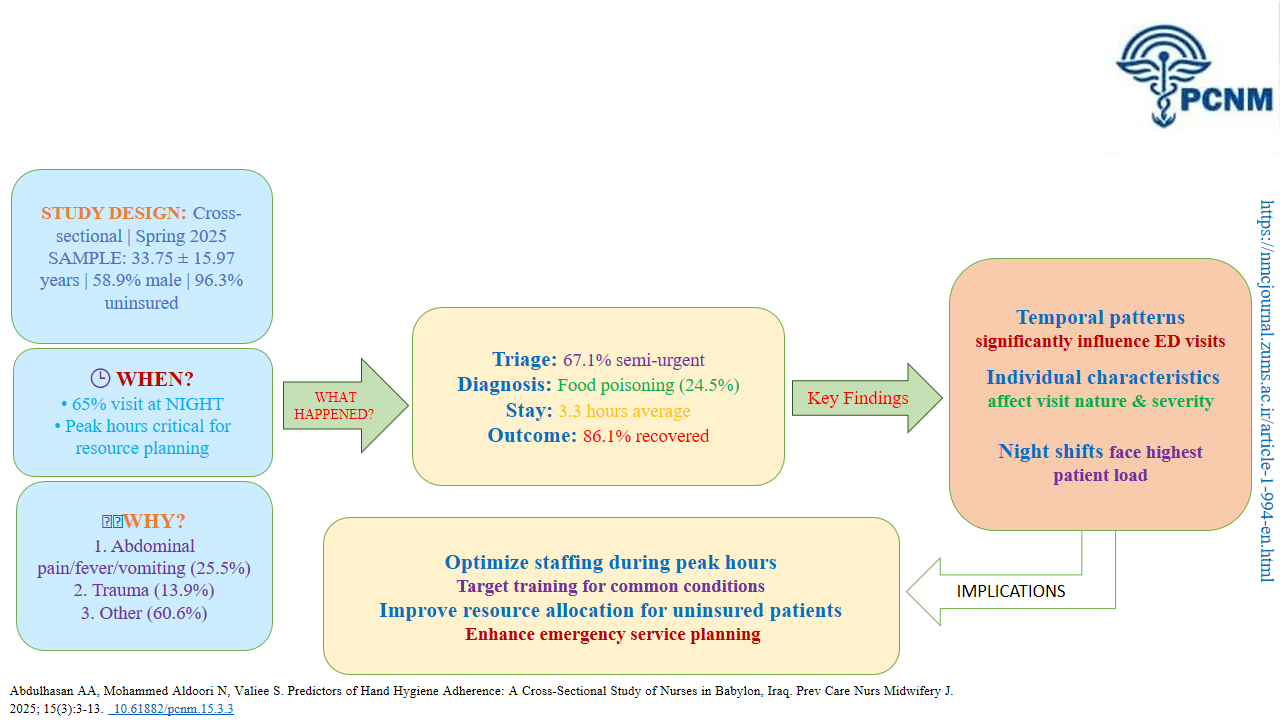
Audience: Nursing managers, infection prevention and control (IPC) officers, and hospital administrators
Individual factors like knowledge and attitude, alongside organizational factors such as workload and resource availability, are key predictors of hand hygiene adherence among nurses. To improve compliance, IPC programs must move beyond basic education to include regular audits with feedback, ensure consistent availability of alcohol-based hand rub at the point of care, and address systemic barriers like high workload to create a sustainable culture of safety.
Graphical Abstract:
Reseach Highlights:
Knowledge Translation StatementAudience: Nursing managers, infection prevention and control (IPC) officers, and hospital administrators
Individual factors like knowledge and attitude, alongside organizational factors such as workload and resource availability, are key predictors of hand hygiene adherence among nurses. To improve compliance, IPC programs must move beyond basic education to include regular audits with feedback, ensure consistent availability of alcohol-based hand rub at the point of care, and address systemic barriers like high workload to create a sustainable culture of safety.
Original Article
Psychological resilience as a mediator in infertile women: A structural equation modeling analysis of self-efficacy, stigma, and fertility quality of life
P. 14-23
Abstract
(995 Views) |
Full-Text (PDF)
(619 Downloads)
|
Full-Text (HTML)
(166 Views)
| Graphical Abstract
| Reseach Highlights
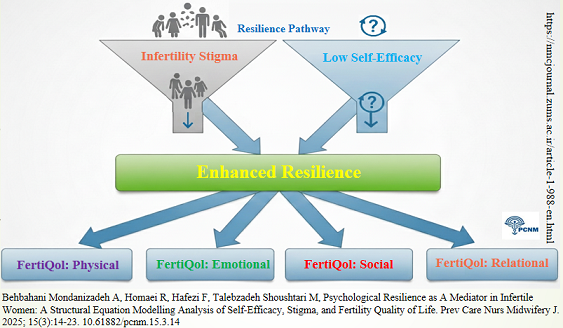
Audience: Infertility counselors, reproductive health nurses, clinical psychologists, and fertility clinic healthcare teams
Psychological resilience is a critical mediator, not just a correlate, that explains how higher self-efficacy leads to better fertility quality of life in infertile women. Integrate targeted resilience-building interventions, such as cognitive-behavioral techniques and stress management training, into standard counseling and nursing care protocols to mitigate the negative impact of stigma and directly enhance patients' psycho-social well-being.
Graphical Abstract:
Reseach Highlights:
Knowledge Translation StatementAudience: Infertility counselors, reproductive health nurses, clinical psychologists, and fertility clinic healthcare teams
Psychological resilience is a critical mediator, not just a correlate, that explains how higher self-efficacy leads to better fertility quality of life in infertile women. Integrate targeted resilience-building interventions, such as cognitive-behavioral techniques and stress management training, into standard counseling and nursing care protocols to mitigate the negative impact of stigma and directly enhance patients' psycho-social well-being.
Concept Analysis
P. 24-40
Abstract
(1104 Views) |
Full-Text (PDF)
(357 Downloads)
|
Full-Text (HTML)
(559 Views)
| Graphical Abstract
| Reseach Highlights
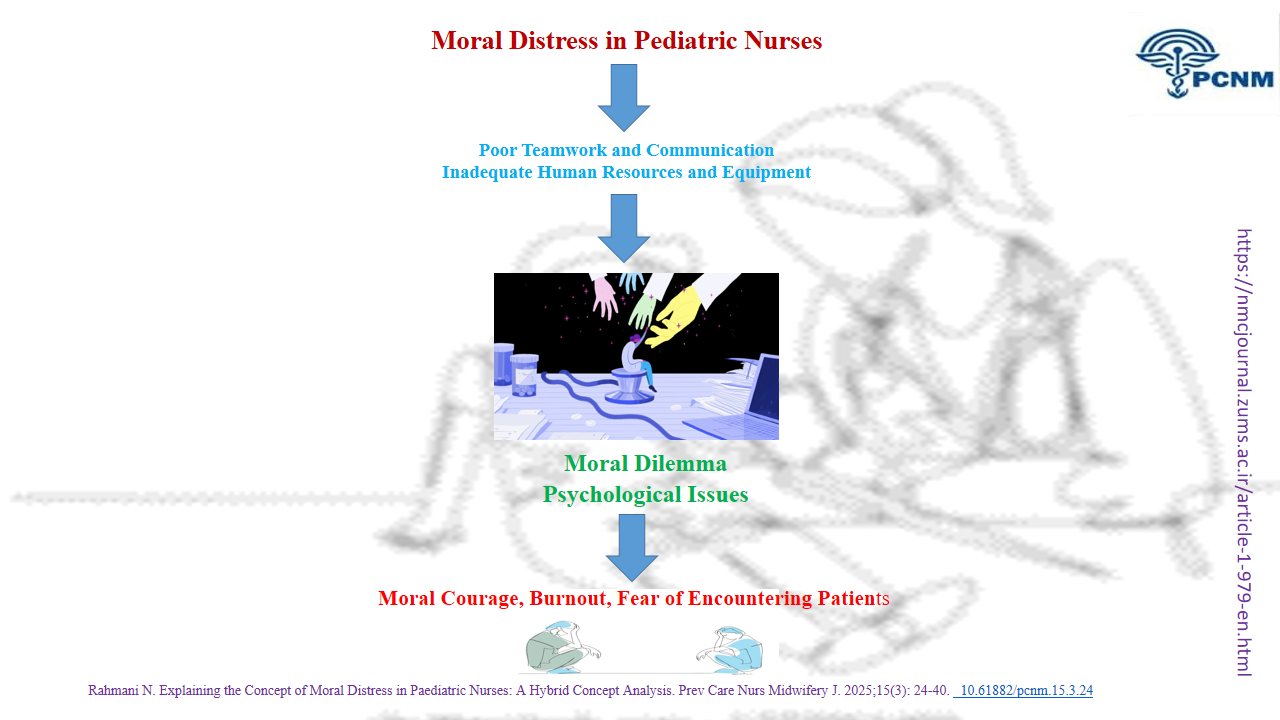
Audience: Pediatric nurse managers, hospital ethics committee members, and nursing educators specializing in pediatrics or ethics
Graphical Abstract:
Reseach Highlights:
Knowledge Translation StatementAudience: Pediatric nurse managers, hospital ethics committee members, and nursing educators specializing in pediatrics or ethics
A refined understanding of moral distress specific to pediatric nursing, encompassing unique conflicts in child advocacy, family dynamics, and perceived powerlessness, provides a necessary foundation for effective intervention. Healthcare institutions should develop targeted support systems, such as structured ethics debriefings and pediatric-focused moral resilience training, informed by this nuanced conceptualization to mitigate distress and retain skilled nursing staff in challenging care environments.
Original Article
Maternal health literacy and its association with breastfeeding self-efficacy and nutritional performance: A cross-sectional study
P. 41-49
Abstract
(990 Views) |
Full-Text (PDF)
(346 Downloads)
|
Full-Text (HTML)
(339 Views)
| Graphical Abstract
| Reseach Highlights

Graphical Abstract:
Reseach Highlights:
Knowledge Translation Statement
Audience: Maternal-child health nurses, lactation consultants, and public health educators
Higher maternal health literacy is significantly associated with greater breastfeeding self-efficacy and improved maternal nutritional performance. Integrate routine health literacy assessments into prenatal and postnatal care to identify at-risk mothers, and provide tailored, clear, and accessible educational support to empower informed infant feeding and self-care decisions, thereby improving both maternal and child health outcomes.
Audience: Maternal-child health nurses, lactation consultants, and public health educators
Higher maternal health literacy is significantly associated with greater breastfeeding self-efficacy and improved maternal nutritional performance. Integrate routine health literacy assessments into prenatal and postnatal care to identify at-risk mothers, and provide tailored, clear, and accessible educational support to empower informed infant feeding and self-care decisions, thereby improving both maternal and child health outcomes.
Original Article
P. 50-60
Abstract
(1147 Views) |
Full-Text (PDF)
(456 Downloads)
|
Full-Text (HTML)
(304 Views)
| Graphical Abstract
| Reseach Highlights
Graphical Abstract:
Reseach Highlights:
Knowledge Translation Statement
Audience: ICU nurse managers, hospital nursing directors, clinical nurse educators, and policymakers in critical care
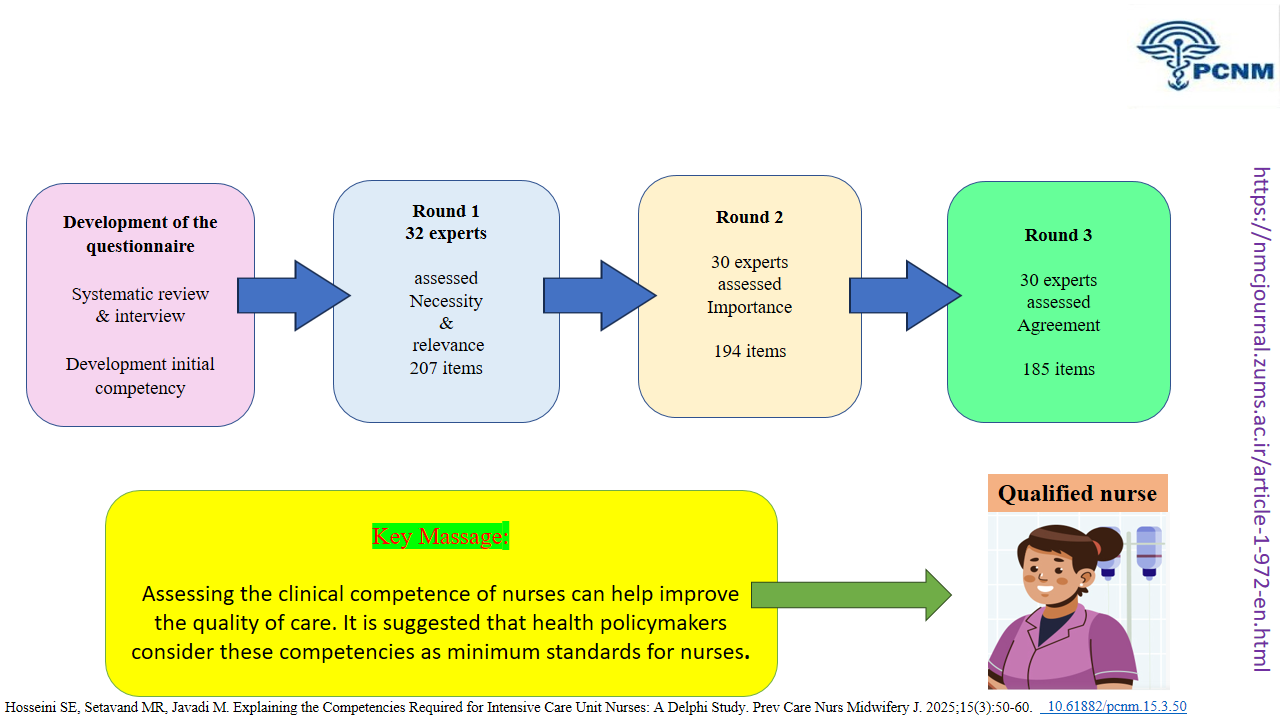
A Delphi study establishes that ICU nurse competency is a multi-dimensional construct requiring both advanced technical skills and essential non-technical skills in ethics, communication, and family care. To ensure a proficient workforce, healthcare institutions must develop and implement standardized, evidence-based competency frameworks that move beyond task-checklists to holistically assess and train nurses in this full spectrum of skills.
Audience: ICU nurse managers, hospital nursing directors, clinical nurse educators, and policymakers in critical care
A Delphi study establishes that ICU nurse competency is a multi-dimensional construct requiring both advanced technical skills and essential non-technical skills in ethics, communication, and family care. To ensure a proficient workforce, healthcare institutions must develop and implement standardized, evidence-based competency frameworks that move beyond task-checklists to holistically assess and train nurses in this full spectrum of skills.
Abstract
(1657 Views) |
Full-Text (PDF)
(437 Downloads)
|
Full-Text (HTML)
(211 Views)
| Graphical Abstract
| Reseach Highlights
Graphical Abstract:
Reseach Highlights:
Knowledge Translation Statement
Audience: Rehabilitation nurse managers, educators, curriculum developers, and healthcare administrators
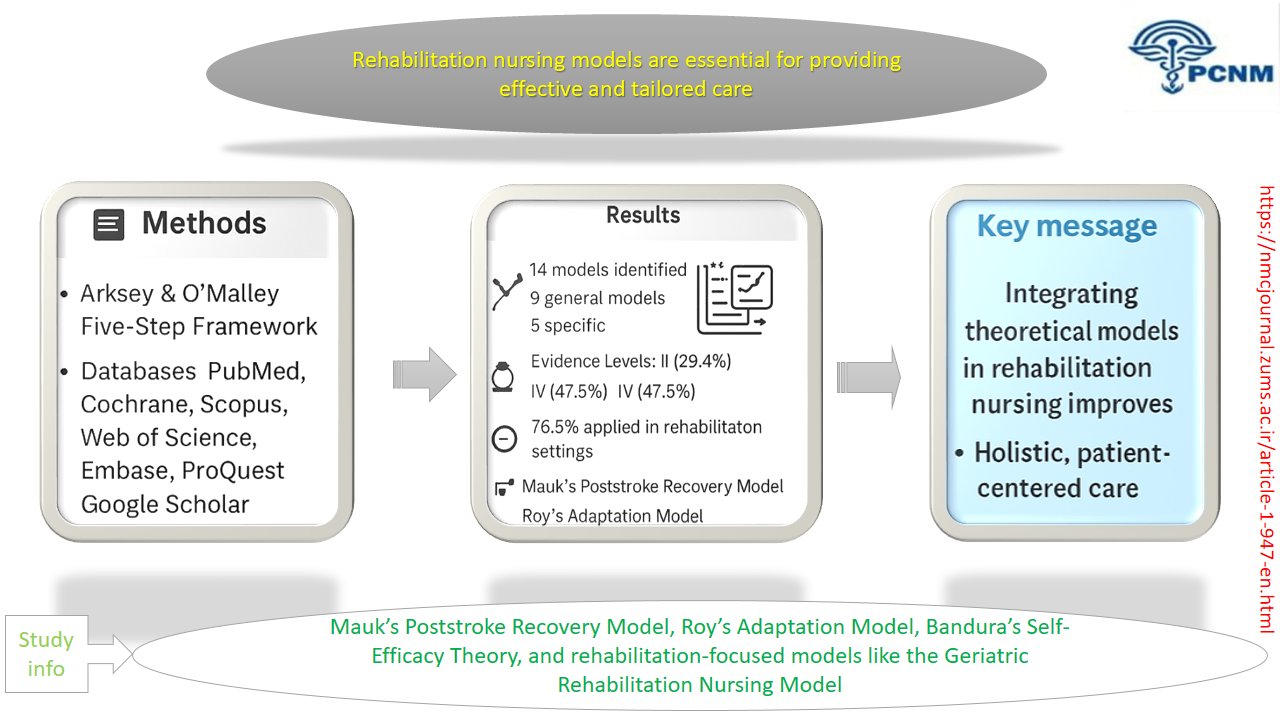
A scoping review synthesizes and categorizes the diverse functional models guiding rehabilitation nursing, such as the Self-Care Model and the King's Theory of Goal Attainment. This synthesized map of the conceptual landscape serves as a foundational resource for educators to structure curricula and for managers to select and implement evidence-based models that systematically enhance patient outcomes and professional practice in rehabilitation settings.
Audience: Rehabilitation nurse managers, educators, curriculum developers, and healthcare administrators
A scoping review synthesizes and categorizes the diverse functional models guiding rehabilitation nursing, such as the Self-Care Model and the King's Theory of Goal Attainment. This synthesized map of the conceptual landscape serves as a foundational resource for educators to structure curricula and for managers to select and implement evidence-based models that systematically enhance patient outcomes and professional practice in rehabilitation settings.
Original Article
The effect of group counseling with positive psychological approach on psychological capital of pregnant women: A randomized clinical trial
P. 71-79
Abstract
(951 Views) |
Full-Text (PDF)
(380 Downloads)
|
Full-Text (HTML)
(154 Views)
| Graphical Abstract
| Reseach Highlights
Graphical Abstract:
Reseach Highlights:
Knowledge Translation Statement
Audience: Midwives, prenatal care nurses, maternal mental health specialists, and clinical psychologists
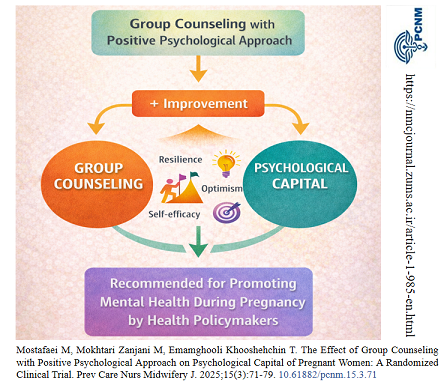
Group counseling based on a positive psychological approach is an effective intervention for enhancing psychological capital (hope, efficacy, resilience, optimism) in pregnant women. Integrate this structured, group-based counseling model into routine prenatal care programs to proactively build psychological resources, promote mental well-being, and support adaptive coping during pregnancy.
Audience: Midwives, prenatal care nurses, maternal mental health specialists, and clinical psychologists
Group counseling based on a positive psychological approach is an effective intervention for enhancing psychological capital (hope, efficacy, resilience, optimism) in pregnant women. Integrate this structured, group-based counseling model into routine prenatal care programs to proactively build psychological resources, promote mental well-being, and support adaptive coping during pregnancy.
Policy Brief
Policy insights into nutritional decision-making in individuals with metabolic syndrome: Implications for food labeling and dietary choices
P. 80-90
Mohammad-Rafi Bazrafshan  , Omid Barghi , Amir Mansouri , MohammadJavad Modarresi , Behnam Masmouei *
, Omid Barghi , Amir Mansouri , MohammadJavad Modarresi , Behnam Masmouei *
Abstract
(835 Views) |
Full-Text (PDF)
(328 Downloads)
|
Full-Text (HTML)
(163 Views)
| Graphical Abstract
| Reseach Highlights
Graphical Abstract:
Reseach Highlights:
Knowledge Translation Statement
Audience: Public health nurses, clinical dietitians, primary care providers, and health policymakers
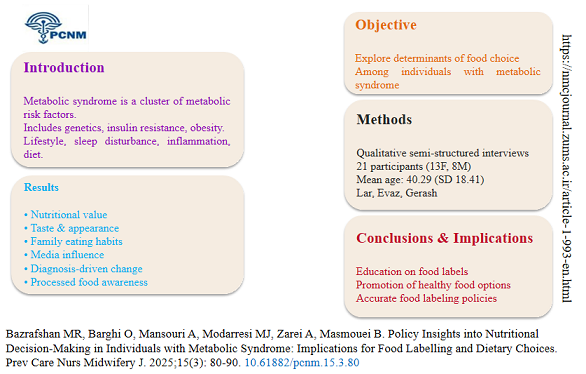
Policy-level tools, such as clear and comprehensible food labeling, are crucial for supporting individuals with metabolic Syndrome in making informed dietary choices. Integrating evidence-based nutritional guidance into straightforward labeling and public health messaging can empower patients and bridge the gap between clinical dietary advice and everyday food selection, thereby improving disease management and health outcomes.
Audience: Public health nurses, clinical dietitians, primary care providers, and health policymakers
Policy-level tools, such as clear and comprehensible food labeling, are crucial for supporting individuals with metabolic Syndrome in making informed dietary choices. Integrating evidence-based nutritional guidance into straightforward labeling and public health messaging can empower patients and bridge the gap between clinical dietary advice and everyday food selection, thereby improving disease management and health outcomes.
Letter to Editor
The importance of psychiatric hospital architecture in promoting mental health: The neglected preventive approach
P. 91-93
Elham Amiri , Behrouz Amini Kordkandi , Mahsa Koohi Garebag , Zahra Khezerlou , Roghaieh Azimzadeh *
, Behrouz Amini Kordkandi , Mahsa Koohi Garebag , Zahra Khezerlou , Roghaieh Azimzadeh *
Abstract
(1361 Views) |
Full-Text (PDF)
(310 Downloads)
|
Full-Text (HTML)
(164 Views)
| Graphical Abstract
| Reseach Highlights
Audience: Psychiatric nurses, mental health administrators, healthcare architects, policymakers
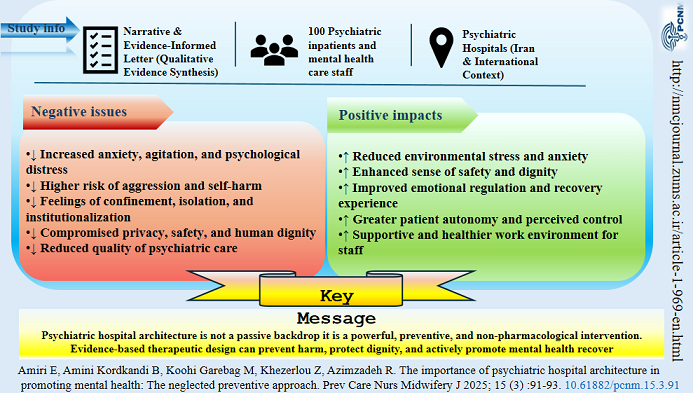
The design of psychiatric hospitals is a critical yet overlooked preventive tool. Incorporating therapeutic elements like natural light and safe spaces directly promotes patient well-being and aids recovery. Therefore, architects, clinicians, and policymakers must collaborate from the start to ensure the physical environment is a fundamental part of treatment.
Graphical Abstract:
Reseach Highlights:
Knowledge Translation StatementAudience: Psychiatric nurses, mental health administrators, healthcare architects, policymakers
The design of psychiatric hospitals is a critical yet overlooked preventive tool. Incorporating therapeutic elements like natural light and safe spaces directly promotes patient well-being and aids recovery. Therefore, architects, clinicians, and policymakers must collaborate from the start to ensure the physical environment is a fundamental part of treatment.