
Preventive Care in Nursing and Midwifery Journal

Volume 15, Issue 4 (10-2025)
Prev Care Nurs Midwifery J 2025, 15(4): 42-51 |
Back to browse issues page


Ethics code: IR.MUK.REC.1404.055


Download citation:
BibTeX | RIS | EndNote | Medlars | ProCite | Reference Manager | RefWorks
Send citation to:


BibTeX | RIS | EndNote | Medlars | ProCite | Reference Manager | RefWorks
Send citation to:
Kareem Halool A, Salah Razzaq M, Valiee S. Characteristics and Temporal Trends of Patients Visiting the Emergency Department in Najaf, Iraq: A Cross-Sectional Study. Prev Care Nurs Midwifery J 2025; 15 (4) :42-51
URL: http://nmcjournal.zums.ac.ir/article-1-1002-en.html
URL: http://nmcjournal.zums.ac.ir/article-1-1002-en.html

Clinical Care Research Center, Research Institute for Health Development, Kurdistan University of Medical Sciences, Sanandaj, Iran , sinavaliee@yahoo.com
Abstract: (523 Views)
Background: Understanding the characteristics of patients and temporal patterns of emergency department visits is crucial for improving service management and optimizing resource allocation.
Objectives: This study aimed to characterize the demographic and clinical profiles of patients and determine the reasons and temporal patterns of visits to the emergency department of Al-Hakeem Hospital in Najaf, Iraq, in 2025.
Methods: This cross-sectional study was conducted on patients visiting the emergency department during a consecutive three-month period in the spring of 2025. Data on demographics, clinical profiles, visit patterns, diagnoses, and treatment were collected using a structured form. Data were analyzed using SPSS version 23, along with descriptive statistics, Chi-square test, Fisher’s exact test, and Kruskal-Wallis test.
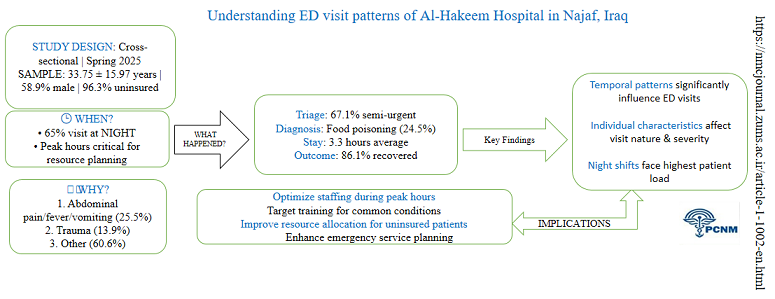
Results: The mean patient age was 33.75 years. The majority were uninsured, married, urban-residing males, arriving most frequently at night via private transport. Common presentations included abdominal pain/fever/vomiting (25.5%) and trauma (13.9%), with food poisoning being the predominant diagnosis. Most patients were triaged as semi-urgent (67.1%) and had no comorbidities. Average consultation time and ED length of stay were 25.17 minutes and 3.3 hours, respectively. The majority recovered. Visit time (morning, afternoon, night, midnight) showed significant associations with multiple variables such as residence, marital status, occupation, insurance status, triage level, chief complaints, diagnosis, disease severity, physical activity, and performed tests (P < 0.05).
Conclusion: Temporal patterns and individual characteristics have a significant influence on ED visits. These findings can help optimize staffing during peak hours, target training for common conditions, and improve resource planning for uninsured patients.
Objectives: This study aimed to characterize the demographic and clinical profiles of patients and determine the reasons and temporal patterns of visits to the emergency department of Al-Hakeem Hospital in Najaf, Iraq, in 2025.
Methods: This cross-sectional study was conducted on patients visiting the emergency department during a consecutive three-month period in the spring of 2025. Data on demographics, clinical profiles, visit patterns, diagnoses, and treatment were collected using a structured form. Data were analyzed using SPSS version 23, along with descriptive statistics, Chi-square test, Fisher’s exact test, and Kruskal-Wallis test.
Results: The mean patient age was 33.75 years. The majority were uninsured, married, urban-residing males, arriving most frequently at night via private transport. Common presentations included abdominal pain/fever/vomiting (25.5%) and trauma (13.9%), with food poisoning being the predominant diagnosis. Most patients were triaged as semi-urgent (67.1%) and had no comorbidities. Average consultation time and ED length of stay were 25.17 minutes and 3.3 hours, respectively. The majority recovered. Visit time (morning, afternoon, night, midnight) showed significant associations with multiple variables such as residence, marital status, occupation, insurance status, triage level, chief complaints, diagnosis, disease severity, physical activity, and performed tests (P < 0.05).
Conclusion: Temporal patterns and individual characteristics have a significant influence on ED visits. These findings can help optimize staffing during peak hours, target training for common conditions, and improve resource planning for uninsured patients.
Full-Text [PDF 759 kb]
(197 Downloads)
| | Full-Text (HTML) (158 Views)
Knowledge Translation Statement
Audience: Nursing managers and hospital administrators
Emergency department patients in Najaf, Iraq are predominantly young, uninsured (96.3%), self-referred (66.3%), and present at night (65%) with semi-urgent conditions, most commonly food poisoning and H. pylori infection, while 89.2% are discharged after recovery. Nursing managers should strengthen primary care referral pathways to reduce non-urgent ED visits, ensure adequate night-shift staffing, and implement targeted public health campaigns on food safety and healthy lifestyles using the ED as a strategic point for brief interventions.
Type of Study: Orginal research |
Subject:
Nursing
Send email to the article author
| Rights and permissions | |
 |
This work is licensed under a Creative Commons Attribution-NonCommercial 4.0 International License. |