
Preventive Care in Nursing and Midwifery Journal

Volume 16, Issue 2 (4-2026)
Prev Care Nurs Midwifery J 2026, 16(2): 13-25 |
Back to browse issues page

Ethics code: IR.IAU.SRB.REC.1404.137


Download citation:
BibTeX | RIS | EndNote | Medlars | ProCite | Reference Manager | RefWorks
Send citation to:


BibTeX | RIS | EndNote | Medlars | ProCite | Reference Manager | RefWorks
Send citation to:
Shahaned-hellaba T, Khodabakhshi-Koolaee A, Falsafinejad M R. Efficacy of Online Mindful Self-Compassion Therapy on Sleep Quality and Pain Adaptation to in Employees with Physical Disabilities: A Quasi-Experimental Study. Prev Care Nurs Midwifery J 2026; 16 (2) :13-25
URL: http://nmcjournal.zums.ac.ir/article-1-1008-en.html
URL: http://nmcjournal.zums.ac.ir/article-1-1008-en.html


Department of Psychology and Educational Sciences, Faculty of Humanities, Khatam University, Tehran, Iran , a.khodabakhshid@khatam.ac.ir
Abstract: (385 Views)
Background: Sleep disturbances and poor pain adaptation are common in individuals with physical disabilities, yet evidence on online interventions for this population remains limited.
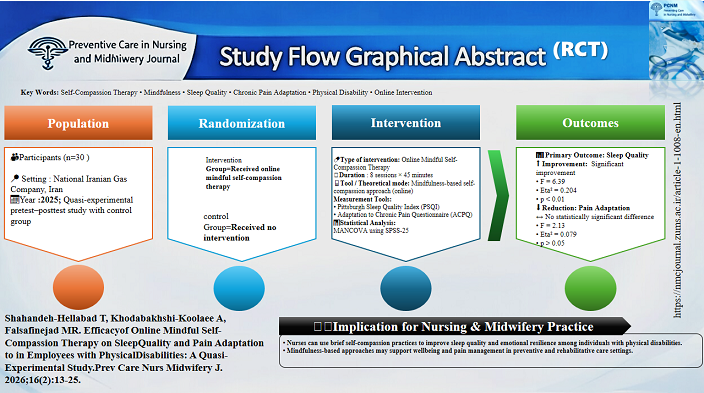
Objectives: This study evaluated online mindful self-compassion therapy's effectiveness on sleep quality and pain adaptation in physically impaired employees of the National Iranian Gas Company.
Methods: This quasi-experimental pretest-posttest study with a control group included 30 employees with physical disabilities, non-randomly assigned to experimental (n=15) or control (n=15) groups. The experimental group received eight 45-minute online mindful self-compassion sessions. Data were collected using the Pittsburgh Sleep Quality Index (PSQI) and Adaptation to Chronic Pain Questionnaire (ACPQ), analyzed via MANCOVA in SPSS-25.
Results: The intervention significantly improved sleep quality in the experimental group (F=6.39; η²=0.204; p<0.01). No significant difference was observed for pain adaptation (F=2.13; η²=0.079; p>0.05). However, this null finding is inconclusive due to very low statistical power (0.29). Post-hoc power analysis indicated 118 participants would be required to reliably detect this medium effect size.
Conclusion: Online mindful self-compassion therapy appears effective for improving sleep quality in individuals with physical disabilities. Regarding pain adaptation, no meaningful conclusion can be drawn due to insufficient power. Future adequately powered trials (target N≈118) are needed. The quasi-experimental design also limits causal inferences.
Objectives: This study evaluated online mindful self-compassion therapy's effectiveness on sleep quality and pain adaptation in physically impaired employees of the National Iranian Gas Company.
Methods: This quasi-experimental pretest-posttest study with a control group included 30 employees with physical disabilities, non-randomly assigned to experimental (n=15) or control (n=15) groups. The experimental group received eight 45-minute online mindful self-compassion sessions. Data were collected using the Pittsburgh Sleep Quality Index (PSQI) and Adaptation to Chronic Pain Questionnaire (ACPQ), analyzed via MANCOVA in SPSS-25.
Results: The intervention significantly improved sleep quality in the experimental group (F=6.39; η²=0.204; p<0.01). No significant difference was observed for pain adaptation (F=2.13; η²=0.079; p>0.05). However, this null finding is inconclusive due to very low statistical power (0.29). Post-hoc power analysis indicated 118 participants would be required to reliably detect this medium effect size.
Conclusion: Online mindful self-compassion therapy appears effective for improving sleep quality in individuals with physical disabilities. Regarding pain adaptation, no meaningful conclusion can be drawn due to insufficient power. Future adequately powered trials (target N≈118) are needed. The quasi-experimental design also limits causal inferences.
Keywords: Self-compassion Therapy, Mindfulness, Sleep Quality, Adaptation to Chronic Pain, Physical Disability, Online Intervention
Type of Study: Orginal research |
Subject:
other
References
1. Fakhri M, Khodabakhshi-Koolaee A, Falsafinejad MR. Investigating the predictive role of mental toughness in resilience and distress tolerance of paralympic athletes. Iranian Rehabilitation Journal. 2024;22(3):375-382. [https://doi.org/10.32598/irj.22.3.18.7]
2. Van Dam K, Gielissen M, Bles R, van der Poel A, Boon B. The impact of assistive living technology on perceived independence of people with a physical disability in executing daily activities: a systematic literature review. Disability and Rehabilitation: Assistive Technology. 2024;19(4):1262-1271. [https://doi.org/10.1080/17483107.2022.2162614] [PMID]
3. Oh J, Aquino M. Enhancing health-related fitness, self-efficacy, and quality of life in adults with physical disabilities: a 9-week community-based structured exercise and mindfulness program. Advanced Exercise and Health Science. 2024;1(3):187-194. [https://doi.org/10.1016/j.aehs.2024.07.001]
4. Van Leeuwen CM, Post MW, Van Der Woude LH, De Groot S, Smit C, Van Kuppevelt D, Lindeman E. Changes in life satisfaction in persons with spinal cord injury during and after inpatient rehabilitation: adaptation or measurement bias? Quality of Life Research. 2012;21(9):1499-1508. [https://doi.org/10.1007/s11136-011-0073-7] [PMID]
5. Hammad MA, Alyami MHF, Awed HS. The association between internet addiction and sleep quality among medical students in Saudi Arabia. Annals of Medicine. 2024;56(1):1-8; 2307502. [https://doi.org/10.1080/07853890.2024.2307502] [PMID]
6. Cao Y, Wu H, Shi S, Xie D. Effects of mindfulness-based stress reduction therapy for sleep quality and perceived stress in patients with spinal cord injury. Explore. 2024;20(5):103037. [https://doi.org/10.1016/j.explore.2024.103037] [PMID]
7. Huang S, Lu Z, Xie S, He J, Lu Y, Pang M, Liu B. Low back pain in aging populations: a global analysis of disability and healthcare burden over three decades. Journal of Back and Musculoskeletal Rehabilitation. 2025;39(1):347-356. [https://doi.org/10.1177/10538127251369280] [PMID]
8. Tran J, Dorstyn DS, Burke ALJ. Psychosocial aspects of spinal cord injury pain: a meta-analysis. Spinal Cord. 2016;54(9):640-648. [https://doi.org/10.1038/sc.2016.66] [PMID]
9. Hearn JH, Cross A. Mindfulness for pain, depression, anxiety, and quality of life in people with spinal cord injury: a systematic review. BMC Neurology. 2020;20(1):1-11. [https://doi.org/10.1186/s12883-020-1619-5] [PMID]
10. Gilbert P. The origins and nature of compassion-focused therapy. British Journal of Clinical Psychology. 2014;53(1):6-41. [https://doi.org/10.1111/bjc.12043] [PMID]
11. Gilbert P, Irons C. Compassion focused therapy. In: The Beginner's Guide to Counselling & Psychotherapy. 2015. p. 127. [https://doi.org/10.4135/9781473918061.n11]
12. Neff KD. The role of self-compassion in development: a healthier way to relate to oneself. Human Development. 2009;52(4):211-214. [https://doi.org/10.1159/000215071] [PMID]
13. Terry ML, Leary MR. Self-compassion, self-regulation, and health. Self and Identity. 2011;10(3):352-362. [https://doi.org/10.1080/15298868.2011.558404]
14. Gilbert P. Introducing compassion-focused therapy. Advances in Psychiatric Treatment. 2009;15(3):199-208. [https://doi.org/10.1192/apt.bp.107.005264]
15. Gilbert P, Choden. Mindful compassion. London: Robinson; 2013.
16. Kabat-Zinn J. Mindfulness. Mindfulness. 2015;6(6):1481-1483. [https://doi.org/10.1007/s12671-015-0456-x]
17. Khodabakhshi-Koolaee, A., Ghadyani, S., & Malekitabar, A. Mindfulness-based stress reduction (MBSR) for improving hope and happiness in men with visual impairment. British Journal of Visual Impairment,2026; 44(1): 3-13; [https://doi.org/10.1177/02646196241294212]
18. Faul F, Erdfelder E, Lang AG, Buchner A. G*Power 3: a flexible statistical power analysis program for the social, behavioral, and biomedical sciences. Behavior Research Methods. 2007;39(2):175-191. [https://doi.org/10.3758/BF03193146] [PMID]
19. Buysse DJ, Reynolds III CF, Monk TH, Berman SR, Kupfer DJ. The Pittsburgh Sleep Quality Index: a new instrument for psychiatric practice and research. Psychiatry Research. 1989;28(2):193-213. [https://doi.org/10.1016/0165-1781(89)90047-4] [PMID]
20. Farrahi Moghaddam J, Nakhaee N, Sheibani V, Garrusi B, Amirkafi A. Reliability and validity of the Persian version of the Pittsburgh Sleep Quality Index (PSQI-P). Sleep and Breathing. 2012;16(1):79-82. [https://doi.org/10.1007/s11325-010-0478-5] [PMID]
21. Zavadilová R, Knotek P. Dotazník adaptace na chronickou bolest. Bolest. 2006; 9:28-33.
22. Hosseininia N, Dousti P, Piryaei N. Psychometric characteristics of the adaptation to chronic pain questionnaire. Recent Innovations in Psychology. 2024;1(3):47-59. [https://doi.org/10.22034/rip.2024.451529.1019]
23. Mohamadpour F. Effectiveness of compassion-based online therapy on suicidal thoughts and pain catastrophizing in female patients with multiple sclerosis in the relapsing-remitting phase. Frontiers in Psychology. 2023; 14: 1-10. [https://doi.org/10.3389/fpsyg.2023.1128308] [PMID]
24. Nooshazari S, Khodabakhshi-Koolaee A, Falsafinejad MR. Efficacy of a mindful compassion intervention on reducing pain catastrophizing and rumination in women with mobility disability: a randomized controlled trial. Preventive Care in Nursing and Midwifery Journal. 2025;15(2):3-12. [https://doi.org/10.61882/pcnm.15.2.3]
25. Sirois FM, Kitner R, Hirsch JK. Self-compassion, affect, and health-promoting behaviors. Health Psychology. 2015;34(6):661-669. [https://doi.org/10.1037/hea0000158] [PMID]
26. Wang Y, Fu T, Wang J, Chen S, Sun G. The relationship between self-compassion, coping style, sleep quality, and depression among college students. Frontiers in Psychology. 2024; 15:1-8. [https://doi.org/10.3389/fpsyg.2024.1378181] [PMID]
27. Ewert C, Vater A, Schroder-Abe M. Self-compassion and coping: a meta-analysis. Mindfulness. 2021;12(5):1063-1077. [https://doi.org/10.1007/s12671-020-01563-8]
28. Li A, Wang S, Cai M, Sun R, Liu X. Self-compassion and life-satisfaction among Chinese self-quarantined residents during the COVID-19 pandemic: a moderated mediation model of positive coping and gender. Personality and Individual Differences. 2021; 170:1-8. [https://doi.org/10.1016/j.paid.2020.110457] [PMID]
29. Lanzaro C, Carvalho SA, Lapa TA, Valentim A, Gago B. A systematic review of self-compassion in chronic pain: from correlation to efficacy. Spanish Journal of Psychology. 2021;24: e26. 1-19. [https://doi.org/10.1017/SJP.2021.22] [PMID]
30. Dou J, Lian Y, Lin L, Asmuri SN, Wang P, Rajen Durai RA. Effectiveness of mindfulness-based interventions on burnout, resilience and sleep quality among nurses: a systematic review and meta-analysis of randomized controlled trials. BMC Nursing. 2025;24(1): 1-14. [https://doi.org/10.1186/s12912-025-03101-0] [PMID]
31. Tahmasebi M, Hossein Fallah M, Yazdi SV. Effectiveness of compassion-focused acceptance and commitment therapy (ACT) on quality of life in male patients with painful spinal cord injury. Mental Health and Lifestyle Journal. 2025;3(1):1-2. [https://doi.org/10.61838/mhlj.3.1.10]
32. Azimi M, Falsafinejad MR, Khodabakhshi-Koolaee A, Jouybari LM. The effect of mindful yoga on fatigue in women with breast cancer: a quasi-experimental study. Jundishapur Journal of Chronic Disease Care. 2025; 14 (14): 1-9. [https://doi.org/10.5812/jjcdc-151438]
33. Jin X, Li H, Chong YY, Mann KF, Yao W, Wong CL. Feasibility and preliminary effects of acceptance and commitment therapy on reducing psychological distress and improving the quality of life of the parents of children with cancer: a pilot randomized controlled trial. Psycho-Oncology. 2023;32(1):165-169. [https://doi.org/10.1002/pon.5941] [PMID]
34. Shirozhan S, Shoja M, Metanat F, Motie M. Functional models in rehabilitation nursing care: a scoping review. Preventive Care in Nursing and Midwifery Journal. 2025;15(3):61-70. [https://doi.org/10.61882/pcnm.15.3.61]
Send email to the article author
| Rights and permissions | |
 |
This work is licensed under a Creative Commons Attribution-NonCommercial 4.0 International License. |