
Preventive Care in Nursing and Midwifery

Volume 16, Issue 3 (7-2026)
Prev Care Nurs Midwifery 2026, 16(3): 86-95 |
Back to browse issues page


Ethics code: 1403.024


Download citation:
BibTeX | RIS | EndNote | Medlars | ProCite | Reference Manager | RefWorks
Send citation to:


BibTeX | RIS | EndNote | Medlars | ProCite | Reference Manager | RefWorks
Send citation to:
Mohammadnejad M, Feizollahzadeh H, Rahmani A. Relationship Between Disease Related Worry and Self Efficacy in Patients With Heart Failure: A Cross Sectional Study. , Prev Care Nurs Midwifery. 2026; 16 (3) :86-95
URL: http://nmcjournal.zums.ac.ir/article-1-1040-en.html
URL: http://nmcjournal.zums.ac.ir/article-1-1040-en.html

Department of Medical-Surgical Nursing, Nursing and Midwifery Faculty, Tabriz University of Medical Sciences, Tabriz, Iran , hosseinfeizalahzadeh@gmail.com
Keywords: Heart Failure, Self Efficacy, Disease Management, Patient Reported Outcome Measures, Health Knowledge Attitudes Practice
Full-Text [PDF 714 kb]
(143 Downloads)
| Abstract (HTML) (614 Views)
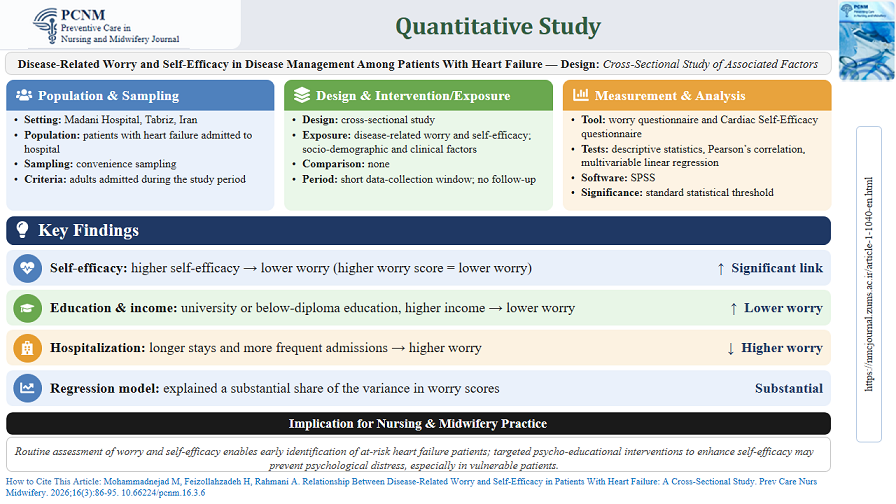
Graphical Abstract:
Reseach Highlights:
Knowledge Translation Statement
Audience: Cardiac nursing managers, heart failure program planners
Greater self-efficacy was associated with less disease-related worry, while longer hospital stays and frequent admissions were linked to more worry. Managers may consider routine assessment of worry and self-efficacy and targeted psycho-educational support for frequently admitted patients.
Full-Text: (65 Views)
Introduction
The World Health Organization has emphasized the growing burden of non-communicable diseases and the need to prioritize them in health policies. HF is a clinical syndrome wherein disease progression leads to decreased cardiac output [1].
It is characterized by symptoms such as chest pain, dyspnea, edema, and dizziness, ultimately leading to activity intolerance and adverse lifestyle alterations [2]. Psychological symptoms such as hopelessness, low self-esteem, and low energy levels are present in approximately 50% of HF patients, contributing to a decline in their functional status [3].
The worry and problems faced by HF patients are multifaceted. Worry is a form of distress that has been defined as a cognitive process in which people feel anxious due to concerns regarding uncertainty about the future and the possibility of negative events [4]. In patients with HF, disease-related worry specifically encompasses concerns about physical symptoms, functional decline, cognitive changes, and uncertain prognosis [5]. High treatment costs and recurrent hospitalizations constitute significant sources of worry [6]. Moreover, living with HF is often experienced as an exhausting and frightening way of life, expressed through increasing disability, weakness, and dependence [7-8]. Most HF patients perceive death as a relief from suffering and express concerns about pain and loss of dignity in life [9]. These patients identify physical symptoms, disability, psychological symptoms, and concerns about death and life as hallmarks of HF [10].
Recent studies have continued to highlight the significant psychological burden experienced by patients with HF. For instance, Costa et al. reported that anxiety remains highly prevalent in this population and is associated with adverse socio-demographic and clinical characteristics [11]. Similarly, Jaarsma et al. emphasized the importance of addressing psychological factors, including worry and self-efficacy, as part of comprehensive HF self-care recommendations [12].
Therefore, a comprehensive and classified assessment of cardiac disease-related worry using precise quantitative tools and methods is essential in the nursing care process for patients with HF, followed by necessary planning to address or mitigate these concerns. Bagheri et al., in a study using a specific questionnaire, examined disease-related worry in HF patients. Results indicated the highest mean score was related to physical-psychological worry [5]. A positive psychological state is crucial in the treatment and care process for patients with HF. Empowering patients to control risk factors, improve lifestyle, and perform self-care behaviors is directly linked to their psychological status. In this regard, patient self-efficacy in disease management represents a key variable that should be considered by the healthcare team, including nurses [13]. Self-efficacy has been defined as individuals' perception of their ability or willingness to change or continue a behavior successfully [14]. Enhancing self-efficacy in disease management can increase patients' confidence in successfully performing self-care behaviors and foster greater hope for life [15]. Consequently, self-efficacy can be a valuable tool for nurses; assessing and promoting self-efficacy in patients with HF may increase their motivation for self-care [16-17].
Understanding the relationship between disease-related worry and self-efficacy is particularly relevant for preventive nursing care, as early identification of patients with low self-efficacy and high worry could enable nurses to implement targeted educational and psychological interventions to prevent the progression of psychological distress into clinically significant anxiety or depression, ultimately reducing the risk of poor health outcomes and hospital readmissions. Various factors, including patient education, age, literacy level, etc., influence self-efficacy. Accurate information and sufficient insight into factors affecting HF patients' ability to manage their disease will aid nurses and healthcare providers in selecting correct therapeutic, educational, and supportive strategies for their care. However, based on American heart association report some factors affecting self-efficacy in disease management remain unidentified, necessitating further research [18]. Given the absence of studies concurrently examining the relationship between disease-related worry and self-efficacy in Iranian patients with HF, and given the need to identify which demographic and clinical factors contribute to patients' worry levels.
Objectives
This study aimed to determine the relationship between disease‑related worry and self‑efficacy, and to identify the independent socio‑demographic and clinical factors associated with worry among patients with HF.
Methods
Study Design
A cross-sectional study design was employed to investigate disease-related worry and its relationship with self-efficacy in disease management among patients with HF.
Participants and Sampling
This study was conducted at Shahid Madani Hospital, a major cardiovascular referral center in Tabriz, Iran. Participants were selected using a convenience sampling method from eligible patients with HF admitted to the hospital's wards between July and August 2023.
Sample size was calculated using the correlation sample size formula: n = [(Z₁₋α/₂ + Z₁₋β) / C] ² + 3, c = 0.5 × ln [(1+r)/ (1-r)]. Based on a pilot study of 25 participants where the correlation between disease-related worry and self-efficacy was estimated at r = 0.35, with α = 0.05 and power (1-β) = 0.90, the required sample size was calculated to be 200. Allowing for a potential 10% attrition rate, the final sample size was estimated to be 220 patients. Inclusion criteria were: (1) age 18 years or older, (2) diagnosis of HF classified as Class II to IV based on the New York Heart Association [18], and (3) physically stable condition and adequate cognitive status to respond to questionnaire items. Exclusion criteria were patient deterioration during data collection precluding continued participation and questionnaires with more than 10% of items unanswered.
Measurement Instruments (Validity & Reliability)
Data were collected using three instruments:
1. Demographic and clinical information form: This form, developed by the researchers and used to collect data on age (years), gender (male/female), marital status (single, married, widowed, divorced), history of other diseases (none, unknown disclosed, hypertension, diabetes, both hypertension and diabetes, other), education level (illiterate, under diploma, diploma, university degree), having children (yes/no), income status (income less than expenses, income equals expenses, income more than expenses), residence status (personal, with parents, rented), number of hospitalizations (< 2 times, 2-5 times, > 5 times), and length of current hospital stay (< 3 days, 3-7 days, > 7 days).
2. Disease-related worry questionnaire in heart failure patients: This 23-item questionnaire, developed and validated by Bagheri et al. (2014) in Iran. It comprises four subscales including cognitive independence (9 items), physical-psychological worry (8 items), functional independence (4 items), and worry about future of disease (2 items). Items are scored on a 6-point Likert scale from 1 (completely agree) to 6 (completely disagree). The total score ranges from 23 to 138, 9 to 54 for cognitive independence, 8 to 48 for physical-psychological worry, 4 to 24 for functional independence, and 2 to 12 for worry about future of the disease subscales, with higher scores indicating lower levels of worry. The content validity of the questionnaire was confirmed, and its reliability, assessed by Cronbach’s alpha, was reported as 0.90 for the entire tool [19]. In the present study Cronbach's alpha was 0.92.
3. Cardiac self-efficacy scale (CSE): This 9-item scale, developed by Steca et al. and validated in Persian by Rajati et al., measures self-efficacy in managing cardiovascular disease [13, 20]. It contains three subscales including self-efficacy in controlling cardiac risk (4 items), self-efficacy in adhering to treatment (2 items), and self-efficacy in recognizing symptoms (3 items).
Items are rated on a 5-point likert scale from 1 (not at all sure) to 5 (completely sure). The scores range from 9 to 45 for total, 4 to 20 for controlling cardiac risk, 2 to 10 for adhering to treatment, and 3 to 15 for recognizing symptoms subscales, with higher scores indicating greater self-efficacy. The Persian version has demonstrated appropriate content, face, and criterion validity. Its reliability, reported by Cronbach's alpha, was 0.80 [20]. In the current study Cronbach's alpha was 0.79.
Data Collection Procedure
After obtaining necessary permits from the Ethics Committee of Tabriz University of Medical Sciences and an introduction letter from the Vice Chancellor for Research, the researcher attended Shahid Madani Hospital. Patient records were reviewed, and patients were checked for eligibility based on the inclusion criteria. When selected patients were stable, the researcher met them, introduced herself, explained the study's objectives, and administered the questionnaires. For illiterate or low-literacy participants, the researcher read the questions aloud, ensured comprehension, and recorded their responses.
Statistical Analysis
Data were analyzed using SPSS software (version 24). Descriptive statistics (frequency, percentage, mean, standard deviation) were used to summarize demographic characteristics and main variables. The relationship between the main variables (self-efficacy and disease-related worry) was assessed using Pearson's correlation coefficient. Multivariable linear regression analysis (enter method) was employed to control for potential confounders and to identify associated independent factors with disease-related worry scores. Assumptions of linear regression (linearity, independence of errors, homoscedasticity, normality of residuals) were checked and met. A p-value of less than 0.05 was considered statistically significant.
Result
Demographic and Clinical Characteristics
Of the 220 eligible patients approached, 208 agreed to participate (response rate: 94.5%). The remaining 12 patients declined participation due to personal reasons (n = 8) or were excluded due to incomplete questionnaires (n = 4).
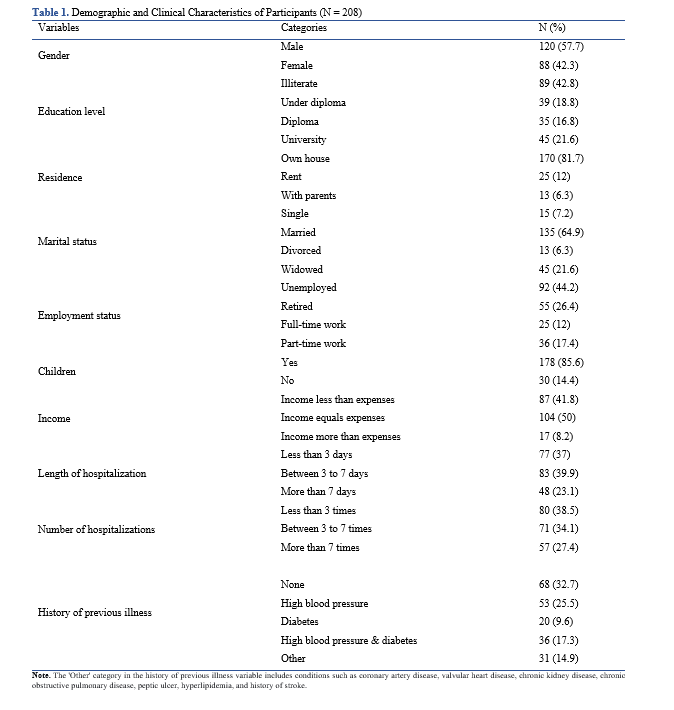
The majority were male (57.7%, n= 120) with a mean (SD) age of 59.73 (12.13, range: 19-88) years. Detailed demographic and clinical characteristics are presented in Table 1.
Status of Disease-related Worry
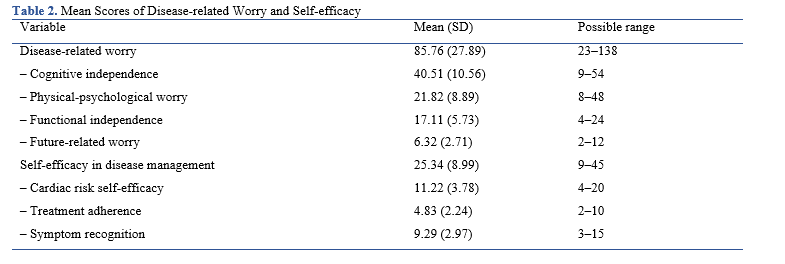
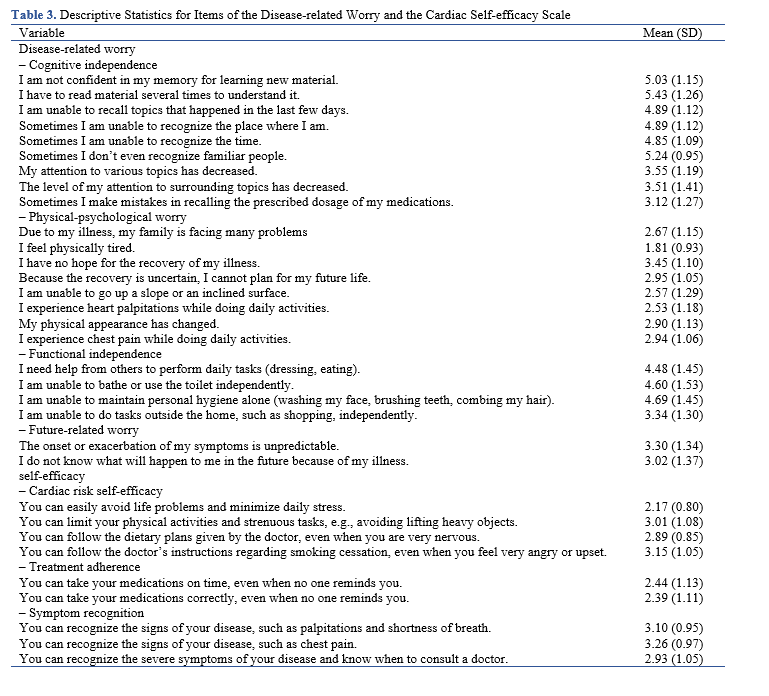
The mean (SD) total score for disease-related worry was 85.76 (27.89) out of a maximum possible score of 138. Higher scores indicating lower levels of worry. Table 2 shows detailed subscale-level scores. The items with the highest levels of worry were "I feel physically tired", "I get palpitations when doing daily activities", and "I am unable to climb a slope or uphill". Detailed item-level scores are presented in Table 3.
Status of Self-efficacy in Disease Management
The mean (SD) total self-efficacy score was 25.34 (8.99) out of 45.
Table 2 shows detailed subscale-level scores. The items with the highest self-efficacy were "you can recognize your disease symptoms like chest pain", "you can follow doctor's orders about quitting smoking, ...", and "you can recognize your disease symptoms like palpitations, ...". Detailed item-level scores are presented in Table 3.
Correlation Between Main Variables
The results of the Pearson correlation coefficient test showed a significant positive correlation between the total score of self-efficacy and the total score of disease-related worry (r = 0.329, p < 0.001), indicating that higher self-efficacy was associated with lower levels of worry. Analyzing the subscales, self-efficacy showed significant positive correlations with cognitive independence (r = 0.358, p < 0.001), physical-psychological worry (r = 0.314, p < 0.001), and functional independence (r = 0.215, p = 0.009). No significant correlation was found between self-efficacy and worry about the future of the disease (r = -0.08, p = 0.340).
Associated Factors with Disease-related Worry
To examine factors associated with disease-related worry scores, multivariable linear regression analysis (enter method) was performed. The independent variables entered into the model included self-efficacy total score and all demographic/clinical variables that showed a significant relationship with worry scores in univariate analyses.
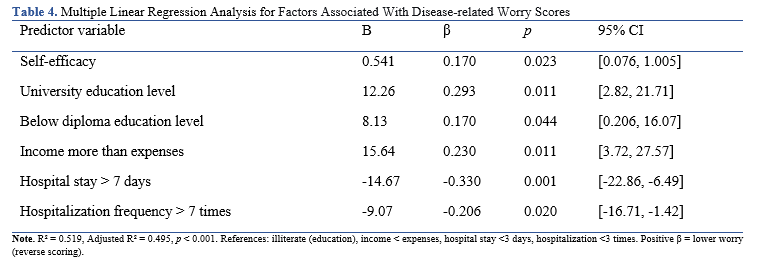
Six variables were identified as associated factors in the regression model (R² = 0.519, Adjusted R² = 0.495, p < 0.001). Variables that were not statistically significant in the final regression model (p > 0.05) included age, gender, marital status, employment status, residence status, having children, and history of previous illness. Table 4 presents the detailed results of the regression analysis.
Discussion
This study aimed to investigate disease-related worry and its correlation with self-efficacy in disease management, as well as to identify the independent socio-demographic and clinical factors associated with disease-related worry among patients with HF. The key findings of this study indicated a moderate level of disease-related worry and a moderate level of self-efficacy among patients with HF. Crucially, a significant positive correlation was found between self-efficacy and lower levels of overall worry (due to reverse scoring of the worry questionnaire), indicating that higher self-efficacy is associated with lower levels of worry. Furthermore, several socio-demographic and clinical factors, including education, income, and hospitalization history, were associated with disease-related worry.
These findings align with those of Bagheri et al. 2014, who also reported significant disease-related worry in this population [5, 19]. This is consistent with qualitative studies describing HF as a "frightening and exhausting" life experience marked by uncertainty and fear of the future [8, 21-23]. The specific worry identified, particularly regarding physical fatigue, palpitations, and functional limitations, highlights the profound impact of HF symptoms on daily life and psychological well-being, consistent with reports by Ekman et al. and Pihl et al. [21, 23] The finding that worry levels were moderate rather than severe could be attributed to coping mechanisms or the specific sample characteristics. Nonetheless, the presence of significant worry underscores the need for routine psychological assessment in HF care, as persistent concerns can evolve into clinical anxiety, adversely affecting outcomes [24, 11-12]. Our findings support calls for holistic care models that integrate psychological support alongside medical management for patients with HF [25].
The moderate level of self-efficacy found is consistent with some domestic studies but lower than reports from certain international contexts [26-27]. This discrepancy might be attributable to variations in healthcare systems, cultural beliefs about illness, and access to supportive resources. The positive correlation between self-efficacy and most worry domains (cognitive independence, physical-psychological, functional independence) is a pivotal finding. It suggests that patients who perceive themselves as more capable of managing cardiac risks, adhering to treatment, and recognizing symptoms experience less worry about their cognitive function, physical symptoms, and daily activities. This aligns with Bandura's theory, where higher self-efficacy fosters resilience and reduces anxiety by enhancing perceived control over challenging situations [14]. Studies by Xiong et al. and Zhang et al. similarly found that higher self-efficacy was associated with reduced fear of disease progression and improved quality of life in patients with HF [28-29]. The lack of a significant relationship between self-efficacy and "worry about the future" is noteworthy. This subscale encompasses fears about unpredictable long-term outcomes, which may be less amenable to personal control through self-management behaviors measured by the CSE scale. Such worry might be more influenced by existential concerns, spiritual factors, or the perceived adequacy of social and healthcare system support [9].
The regression analysis offers a more nuanced understanding of the factors shaping disease-related worry. The finding that self-efficacy positively associated with worry scores (due to reverse scoring) reinforces its role as a potentially modifiable protective factor against distress. Thus, interventions aimed at enhancing self-efficacy could be crucial. The strong influence of socioeconomic factors is evident. Higher education and income predicted significantly less worry, likely mediated by better health literacy, access to resources, greater perceived control over one's life, and reduced financial strain. Conversely, prolonged hospital stays and frequent readmissions were associated with greater worry. These results align with the findings of a recent study, which highlighted the importance of individual and social determinants in health outcomes among HF patients [30].
This study has limitations. The cross-sectional design precludes causal inferences. Convenience sampling from a single tertiary center limits the generalizability of findings to all patients with HF in Iran or other healthcare settings. The use of self-report measures is susceptible to social desirability bias. The study did not include clinical severity indicators such as heart functional class, left ventricular ejection fraction, or duration of illness, which may have provided additional insight into the relationship between disease severity, worry, and self-efficacy. Future studies should incorporate these clinical variables to further elucidate the determinants of disease-related worry in HF patients.Despite these limitations, the study strengths include the use of validated, disease-specific instruments for both worry and self-efficacy, a reasonably large sample size, a high response rate (94.5%), and a comprehensive analysis that controlled for a wide range of potential confounders including demographic and clinical variables, providing a detailed picture of the relationships involved.
Conclusion
In conclusion, this study reveals that patients with heart failure experience a significant burden of disease-related worry, which is inversely related to their level of self-efficacy in managing their condition. Higher self-efficacy is associated with less worry regarding cognitive, physical-psychological, and functional aspects of the illness. Furthermore, socioeconomic factors (education, income) and clinical factors (hospitalization history) are significant determinants of patients' worry levels. These observed associations suggest that future interventional studies could investigate whether enhancing self-efficacy reduces disease-related worry.
Ethical Considerations
The study protocol was approved by the Regional Ethics Committee of Tabriz University of Medical Sciences (IR.TBZMED.REC.1403.024). All participants provided written informed consent after receiving complete information about the study aims and procedures. Participants were assured of the confidentiality of their data, and names were not recorded on the questionnaires. They were informed of their right to withdraw from the study at any time without any consequences. It was also assured that results would be made available to them upon request.
Acknowledgements
The researchers would like to thank the officials of Madani Hospital and all the patients who participated in this study.
Conflict of Interest
The authors declare that they have no competing interests.
Funding
This research did not receive any specific grant from funding agencies in the public, commercial, or not-for-profit sectors.
Authors' Contributions
Conceptualization: M. Mohammadnejad, H. Feizollahzadeh
Methodology: M. Mohammadnejad, H. Feizollahzadeh
Investigation (Data Collection): M. Mohammadnejad
Formal Analysis (Analysis & Interpretation): M. Mohammadnejad, H. Feizollahzadeh
Writing – Original Draft: M. Mohammadnejad, H. Feizollahzadeh
Writing – Review & Editing: H. Feizollahzadeh, A. Rahmani
Supervision: H. Feizollahzadeh, A. Rahmani
All authors read and approved the final manuscript.
Artificial Intelligence Utilization
The authors declare that artificial intelligence (AI) tools were not used for the scientific writing, data analysis, or interpretation of the results of this study. The authors only utilized automated translation and AI-assisted language tools, specifically Google Translate (Google LLC; web version; accessed October 3, 2026) and ChatGPT (OpenAI; GPT-4; accessed October 3, 2026), solely to assist with translating the draft from Persian into English. All translated text was critically evaluated and edited by the authors to ensure scientific accuracy and clarity. The authors assume full responsibility for the entire published work.
Data Availability Statement
The datasets generated and/or analyzed during the current study are available from the corresponding author on reasonable request.
It is characterized by symptoms such as chest pain, dyspnea, edema, and dizziness, ultimately leading to activity intolerance and adverse lifestyle alterations [2]. Psychological symptoms such as hopelessness, low self-esteem, and low energy levels are present in approximately 50% of HF patients, contributing to a decline in their functional status [3].
The worry and problems faced by HF patients are multifaceted. Worry is a form of distress that has been defined as a cognitive process in which people feel anxious due to concerns regarding uncertainty about the future and the possibility of negative events [4]. In patients with HF, disease-related worry specifically encompasses concerns about physical symptoms, functional decline, cognitive changes, and uncertain prognosis [5]. High treatment costs and recurrent hospitalizations constitute significant sources of worry [6]. Moreover, living with HF is often experienced as an exhausting and frightening way of life, expressed through increasing disability, weakness, and dependence [7-8]. Most HF patients perceive death as a relief from suffering and express concerns about pain and loss of dignity in life [9]. These patients identify physical symptoms, disability, psychological symptoms, and concerns about death and life as hallmarks of HF [10].
Recent studies have continued to highlight the significant psychological burden experienced by patients with HF. For instance, Costa et al. reported that anxiety remains highly prevalent in this population and is associated with adverse socio-demographic and clinical characteristics [11]. Similarly, Jaarsma et al. emphasized the importance of addressing psychological factors, including worry and self-efficacy, as part of comprehensive HF self-care recommendations [12].
Therefore, a comprehensive and classified assessment of cardiac disease-related worry using precise quantitative tools and methods is essential in the nursing care process for patients with HF, followed by necessary planning to address or mitigate these concerns. Bagheri et al., in a study using a specific questionnaire, examined disease-related worry in HF patients. Results indicated the highest mean score was related to physical-psychological worry [5]. A positive psychological state is crucial in the treatment and care process for patients with HF. Empowering patients to control risk factors, improve lifestyle, and perform self-care behaviors is directly linked to their psychological status. In this regard, patient self-efficacy in disease management represents a key variable that should be considered by the healthcare team, including nurses [13]. Self-efficacy has been defined as individuals' perception of their ability or willingness to change or continue a behavior successfully [14]. Enhancing self-efficacy in disease management can increase patients' confidence in successfully performing self-care behaviors and foster greater hope for life [15]. Consequently, self-efficacy can be a valuable tool for nurses; assessing and promoting self-efficacy in patients with HF may increase their motivation for self-care [16-17].
Understanding the relationship between disease-related worry and self-efficacy is particularly relevant for preventive nursing care, as early identification of patients with low self-efficacy and high worry could enable nurses to implement targeted educational and psychological interventions to prevent the progression of psychological distress into clinically significant anxiety or depression, ultimately reducing the risk of poor health outcomes and hospital readmissions. Various factors, including patient education, age, literacy level, etc., influence self-efficacy. Accurate information and sufficient insight into factors affecting HF patients' ability to manage their disease will aid nurses and healthcare providers in selecting correct therapeutic, educational, and supportive strategies for their care. However, based on American heart association report some factors affecting self-efficacy in disease management remain unidentified, necessitating further research [18]. Given the absence of studies concurrently examining the relationship between disease-related worry and self-efficacy in Iranian patients with HF, and given the need to identify which demographic and clinical factors contribute to patients' worry levels.
Objectives
This study aimed to determine the relationship between disease‑related worry and self‑efficacy, and to identify the independent socio‑demographic and clinical factors associated with worry among patients with HF.
Methods
Study Design
A cross-sectional study design was employed to investigate disease-related worry and its relationship with self-efficacy in disease management among patients with HF.
Participants and Sampling
This study was conducted at Shahid Madani Hospital, a major cardiovascular referral center in Tabriz, Iran. Participants were selected using a convenience sampling method from eligible patients with HF admitted to the hospital's wards between July and August 2023.
Sample size was calculated using the correlation sample size formula: n = [(Z₁₋α/₂ + Z₁₋β) / C] ² + 3, c = 0.5 × ln [(1+r)/ (1-r)]. Based on a pilot study of 25 participants where the correlation between disease-related worry and self-efficacy was estimated at r = 0.35, with α = 0.05 and power (1-β) = 0.90, the required sample size was calculated to be 200. Allowing for a potential 10% attrition rate, the final sample size was estimated to be 220 patients. Inclusion criteria were: (1) age 18 years or older, (2) diagnosis of HF classified as Class II to IV based on the New York Heart Association [18], and (3) physically stable condition and adequate cognitive status to respond to questionnaire items. Exclusion criteria were patient deterioration during data collection precluding continued participation and questionnaires with more than 10% of items unanswered.
Measurement Instruments (Validity & Reliability)
Data were collected using three instruments:
1. Demographic and clinical information form: This form, developed by the researchers and used to collect data on age (years), gender (male/female), marital status (single, married, widowed, divorced), history of other diseases (none, unknown disclosed, hypertension, diabetes, both hypertension and diabetes, other), education level (illiterate, under diploma, diploma, university degree), having children (yes/no), income status (income less than expenses, income equals expenses, income more than expenses), residence status (personal, with parents, rented), number of hospitalizations (< 2 times, 2-5 times, > 5 times), and length of current hospital stay (< 3 days, 3-7 days, > 7 days).
2. Disease-related worry questionnaire in heart failure patients: This 23-item questionnaire, developed and validated by Bagheri et al. (2014) in Iran. It comprises four subscales including cognitive independence (9 items), physical-psychological worry (8 items), functional independence (4 items), and worry about future of disease (2 items). Items are scored on a 6-point Likert scale from 1 (completely agree) to 6 (completely disagree). The total score ranges from 23 to 138, 9 to 54 for cognitive independence, 8 to 48 for physical-psychological worry, 4 to 24 for functional independence, and 2 to 12 for worry about future of the disease subscales, with higher scores indicating lower levels of worry. The content validity of the questionnaire was confirmed, and its reliability, assessed by Cronbach’s alpha, was reported as 0.90 for the entire tool [19]. In the present study Cronbach's alpha was 0.92.
3. Cardiac self-efficacy scale (CSE): This 9-item scale, developed by Steca et al. and validated in Persian by Rajati et al., measures self-efficacy in managing cardiovascular disease [13, 20]. It contains three subscales including self-efficacy in controlling cardiac risk (4 items), self-efficacy in adhering to treatment (2 items), and self-efficacy in recognizing symptoms (3 items).
Items are rated on a 5-point likert scale from 1 (not at all sure) to 5 (completely sure). The scores range from 9 to 45 for total, 4 to 20 for controlling cardiac risk, 2 to 10 for adhering to treatment, and 3 to 15 for recognizing symptoms subscales, with higher scores indicating greater self-efficacy. The Persian version has demonstrated appropriate content, face, and criterion validity. Its reliability, reported by Cronbach's alpha, was 0.80 [20]. In the current study Cronbach's alpha was 0.79.
Data Collection Procedure
After obtaining necessary permits from the Ethics Committee of Tabriz University of Medical Sciences and an introduction letter from the Vice Chancellor for Research, the researcher attended Shahid Madani Hospital. Patient records were reviewed, and patients were checked for eligibility based on the inclusion criteria. When selected patients were stable, the researcher met them, introduced herself, explained the study's objectives, and administered the questionnaires. For illiterate or low-literacy participants, the researcher read the questions aloud, ensured comprehension, and recorded their responses.
Statistical Analysis
Data were analyzed using SPSS software (version 24). Descriptive statistics (frequency, percentage, mean, standard deviation) were used to summarize demographic characteristics and main variables. The relationship between the main variables (self-efficacy and disease-related worry) was assessed using Pearson's correlation coefficient. Multivariable linear regression analysis (enter method) was employed to control for potential confounders and to identify associated independent factors with disease-related worry scores. Assumptions of linear regression (linearity, independence of errors, homoscedasticity, normality of residuals) were checked and met. A p-value of less than 0.05 was considered statistically significant.
Result
Demographic and Clinical Characteristics
Of the 220 eligible patients approached, 208 agreed to participate (response rate: 94.5%). The remaining 12 patients declined participation due to personal reasons (n = 8) or were excluded due to incomplete questionnaires (n = 4).
The majority were male (57.7%, n= 120) with a mean (SD) age of 59.73 (12.13, range: 19-88) years. Detailed demographic and clinical characteristics are presented in Table 1.
Status of Disease-related Worry
The mean (SD) total score for disease-related worry was 85.76 (27.89) out of a maximum possible score of 138. Higher scores indicating lower levels of worry. Table 2 shows detailed subscale-level scores. The items with the highest levels of worry were "I feel physically tired", "I get palpitations when doing daily activities", and "I am unable to climb a slope or uphill". Detailed item-level scores are presented in Table 3.
Status of Self-efficacy in Disease Management
The mean (SD) total self-efficacy score was 25.34 (8.99) out of 45.
Table 2 shows detailed subscale-level scores. The items with the highest self-efficacy were "you can recognize your disease symptoms like chest pain", "you can follow doctor's orders about quitting smoking, ...", and "you can recognize your disease symptoms like palpitations, ...". Detailed item-level scores are presented in Table 3.
Correlation Between Main Variables
The results of the Pearson correlation coefficient test showed a significant positive correlation between the total score of self-efficacy and the total score of disease-related worry (r = 0.329, p < 0.001), indicating that higher self-efficacy was associated with lower levels of worry. Analyzing the subscales, self-efficacy showed significant positive correlations with cognitive independence (r = 0.358, p < 0.001), physical-psychological worry (r = 0.314, p < 0.001), and functional independence (r = 0.215, p = 0.009). No significant correlation was found between self-efficacy and worry about the future of the disease (r = -0.08, p = 0.340).
Associated Factors with Disease-related Worry
To examine factors associated with disease-related worry scores, multivariable linear regression analysis (enter method) was performed. The independent variables entered into the model included self-efficacy total score and all demographic/clinical variables that showed a significant relationship with worry scores in univariate analyses.
Six variables were identified as associated factors in the regression model (R² = 0.519, Adjusted R² = 0.495, p < 0.001). Variables that were not statistically significant in the final regression model (p > 0.05) included age, gender, marital status, employment status, residence status, having children, and history of previous illness. Table 4 presents the detailed results of the regression analysis.
Discussion
This study aimed to investigate disease-related worry and its correlation with self-efficacy in disease management, as well as to identify the independent socio-demographic and clinical factors associated with disease-related worry among patients with HF. The key findings of this study indicated a moderate level of disease-related worry and a moderate level of self-efficacy among patients with HF. Crucially, a significant positive correlation was found between self-efficacy and lower levels of overall worry (due to reverse scoring of the worry questionnaire), indicating that higher self-efficacy is associated with lower levels of worry. Furthermore, several socio-demographic and clinical factors, including education, income, and hospitalization history, were associated with disease-related worry.
These findings align with those of Bagheri et al. 2014, who also reported significant disease-related worry in this population [5, 19]. This is consistent with qualitative studies describing HF as a "frightening and exhausting" life experience marked by uncertainty and fear of the future [8, 21-23]. The specific worry identified, particularly regarding physical fatigue, palpitations, and functional limitations, highlights the profound impact of HF symptoms on daily life and psychological well-being, consistent with reports by Ekman et al. and Pihl et al. [21, 23] The finding that worry levels were moderate rather than severe could be attributed to coping mechanisms or the specific sample characteristics. Nonetheless, the presence of significant worry underscores the need for routine psychological assessment in HF care, as persistent concerns can evolve into clinical anxiety, adversely affecting outcomes [24, 11-12]. Our findings support calls for holistic care models that integrate psychological support alongside medical management for patients with HF [25].
The moderate level of self-efficacy found is consistent with some domestic studies but lower than reports from certain international contexts [26-27]. This discrepancy might be attributable to variations in healthcare systems, cultural beliefs about illness, and access to supportive resources. The positive correlation between self-efficacy and most worry domains (cognitive independence, physical-psychological, functional independence) is a pivotal finding. It suggests that patients who perceive themselves as more capable of managing cardiac risks, adhering to treatment, and recognizing symptoms experience less worry about their cognitive function, physical symptoms, and daily activities. This aligns with Bandura's theory, where higher self-efficacy fosters resilience and reduces anxiety by enhancing perceived control over challenging situations [14]. Studies by Xiong et al. and Zhang et al. similarly found that higher self-efficacy was associated with reduced fear of disease progression and improved quality of life in patients with HF [28-29]. The lack of a significant relationship between self-efficacy and "worry about the future" is noteworthy. This subscale encompasses fears about unpredictable long-term outcomes, which may be less amenable to personal control through self-management behaviors measured by the CSE scale. Such worry might be more influenced by existential concerns, spiritual factors, or the perceived adequacy of social and healthcare system support [9].
The regression analysis offers a more nuanced understanding of the factors shaping disease-related worry. The finding that self-efficacy positively associated with worry scores (due to reverse scoring) reinforces its role as a potentially modifiable protective factor against distress. Thus, interventions aimed at enhancing self-efficacy could be crucial. The strong influence of socioeconomic factors is evident. Higher education and income predicted significantly less worry, likely mediated by better health literacy, access to resources, greater perceived control over one's life, and reduced financial strain. Conversely, prolonged hospital stays and frequent readmissions were associated with greater worry. These results align with the findings of a recent study, which highlighted the importance of individual and social determinants in health outcomes among HF patients [30].
This study has limitations. The cross-sectional design precludes causal inferences. Convenience sampling from a single tertiary center limits the generalizability of findings to all patients with HF in Iran or other healthcare settings. The use of self-report measures is susceptible to social desirability bias. The study did not include clinical severity indicators such as heart functional class, left ventricular ejection fraction, or duration of illness, which may have provided additional insight into the relationship between disease severity, worry, and self-efficacy. Future studies should incorporate these clinical variables to further elucidate the determinants of disease-related worry in HF patients.Despite these limitations, the study strengths include the use of validated, disease-specific instruments for both worry and self-efficacy, a reasonably large sample size, a high response rate (94.5%), and a comprehensive analysis that controlled for a wide range of potential confounders including demographic and clinical variables, providing a detailed picture of the relationships involved.
Conclusion
In conclusion, this study reveals that patients with heart failure experience a significant burden of disease-related worry, which is inversely related to their level of self-efficacy in managing their condition. Higher self-efficacy is associated with less worry regarding cognitive, physical-psychological, and functional aspects of the illness. Furthermore, socioeconomic factors (education, income) and clinical factors (hospitalization history) are significant determinants of patients' worry levels. These observed associations suggest that future interventional studies could investigate whether enhancing self-efficacy reduces disease-related worry.
Ethical Considerations
The study protocol was approved by the Regional Ethics Committee of Tabriz University of Medical Sciences (IR.TBZMED.REC.1403.024). All participants provided written informed consent after receiving complete information about the study aims and procedures. Participants were assured of the confidentiality of their data, and names were not recorded on the questionnaires. They were informed of their right to withdraw from the study at any time without any consequences. It was also assured that results would be made available to them upon request.
Acknowledgements
The researchers would like to thank the officials of Madani Hospital and all the patients who participated in this study.
Conflict of Interest
The authors declare that they have no competing interests.
Funding
This research did not receive any specific grant from funding agencies in the public, commercial, or not-for-profit sectors.
Authors' Contributions
Conceptualization: M. Mohammadnejad, H. Feizollahzadeh
Methodology: M. Mohammadnejad, H. Feizollahzadeh
Investigation (Data Collection): M. Mohammadnejad
Formal Analysis (Analysis & Interpretation): M. Mohammadnejad, H. Feizollahzadeh
Writing – Original Draft: M. Mohammadnejad, H. Feizollahzadeh
Writing – Review & Editing: H. Feizollahzadeh, A. Rahmani
Supervision: H. Feizollahzadeh, A. Rahmani
All authors read and approved the final manuscript.
Artificial Intelligence Utilization
The authors declare that artificial intelligence (AI) tools were not used for the scientific writing, data analysis, or interpretation of the results of this study. The authors only utilized automated translation and AI-assisted language tools, specifically Google Translate (Google LLC; web version; accessed October 3, 2026) and ChatGPT (OpenAI; GPT-4; accessed October 3, 2026), solely to assist with translating the draft from Persian into English. All translated text was critically evaluated and edited by the authors to ensure scientific accuracy and clarity. The authors assume full responsibility for the entire published work.
Data Availability Statement
The datasets generated and/or analyzed during the current study are available from the corresponding author on reasonable request.
Type of Study: Orginal research |
Subject:
Nursing
References
1. World Health Organization. Global status report on noncommunicable diseases 2014. Geneva: World Health Organization; 2014. [https://www.who.int/publications/i/item/9789241564854]
2. McDonagh TA, Metra M, Adamo M, Gardner RS, Baumbach A, Böhm M, et al. 2021 ESC guidelines for the diagnosis and treatment of acute and chronic heart failure. European Journal of Heart Failure. 2022;24(1):4-131. [https://doi.org/10.1002/ejhf.2333] [PMID]
3. Sokoreli I, de Vries JJG, Pauws SC, Steyerberg EW. Depression and anxiety as predictors of mortality among heart failure patients: systematic review and meta-analysis. Heart Failure Reviews. 2016;21(2):49-63. [https://doi.org/10.1007/s10741-015-9517-4] [PMID]
4. McDonnell GA, Pope AW, Schuler TA, Ford JS. The relationship between cancer-related worry and posttraumatic growth in adolescent and young adult cancer survivors. Psycho-Oncology. 2018;27(9):2155-2164. [https://doi.org/10.1002/pon.4785] [PMID]
5. Bagheri H, Yaghmaei F, Ashktorab T, Zayeri F. Evaluation of illness related worries in heart failure patients. Journal of Knowledge and Health in Basic Medical Sciences. 2014;9(2):40-46. [https://doi.org/10.22100/jkh.v9i2.356]
6. Heo S, Lennie TA, Okoli C, Moser DK. Quality of life in patients with heart failure: ask the patients. Heart & Lung. 2009;38(2):100-108. [https://doi.org/10.1016/j.hrtlng.2008.04.002] [PMID]
7. Nordfonn OK, Morken IM, Bru LE, Husebø AML. Patients' experience with heart failure treatment and self-care: a qualitative study exploring the burden of treatment. Journal of Clinical Nursing. 2019;28(9-10):1782-1793. [https://doi.org/10.1111/jocn.14799] [PMID]
8. Holden RJ, Schubert CC, Mickelson RS. The patient work system: an analysis of self-care performance barriers among elderly heart failure patients and their informal caregivers. Applied Ergonomics. 2015;47:133-150. [https://doi.org/10.1016/j.apergo.2014.09.009] [PMID]
9. Murray SA, Kendall M, Boyd K, Worth A, Benton TF. Exploring the spiritual needs of people dying of lung cancer or heart failure: a prospective qualitative interview study of patients and their carers. Palliative Medicine. 2004;18(1):39-45. [https://doi.org/10.1191/0269216304pm837oa] [PMID]
10. Cortis JD, Williams A. Palliative and supportive needs of older adults with heart failure. International Nursing Review. 2007;54(3):263-270. [https://doi.org/10.1111/j.1466-7657.2007.00558.x] [PMID]
11. Costa FM, Martins SP, Moreira EC, Cardoso JC, Fernandes LP. Anxiety in heart failure patients and its association with socio-demographic and clinical characteristics: a cross-sectional study. Porto Biomedical Journal. 2022;7(4):e177. [https://doi.org/10.1097/j.pbj.0000000000000177] [PMID]
12. Jaarsma T, Hill L, Bayes-Genis A, La Rocca HPB, Castiello T, Čelutkienė J, et al. Self-care of heart failure patients: practical management recommendations from the Heart Failure Association of the European Society of Cardiology. European Journal of Heart Failure. 2021;23(1):157-174. [https://doi.org/10.1002/ejhf.2008] [PMID]
13. Steca P, Greco A, Cappelletti E, D'Addario M, Monzani D, Pancani L, et al. Cardiovascular management self-efficacy: psychometric properties of a new scale and its usefulness in a rehabilitation context. Annals of Behavioral Medicine. 2015;49(5):660-674. [https://doi.org/10.1007/s12160-015-9698-z] [PMID]
14. Sarkar U, Ali S, Whooley MA. Self-efficacy and health status in patients with coronary heart disease: findings from the heart and soul study. Psychosomatic Medicine. 2007;69(4):306-312. [https://doi.org/10.1097/PSY.0b013e3180514d57] [PMID]
15. Clark AM, Freydberg CN, McAlister FA, Tsuyuki RT, Armstrong PW, Strain LA. Patient and informal caregivers' knowledge of heart failure: necessary but insufficient for effective self-care. European Journal of Heart Failure. 2009;11(6):617-621. [https://doi.org/10.1093/eurjhf/hfp058] [PMID]
16. Riegel B, Moser DK, Anker SD, Appel LJ, Dunbar SB, Grady KL, et al. State of the science: promoting self-care in persons with heart failure: a scientific statement from the American Heart Association. Circulation. 2009;120(12):1141-1163. [https://doi.org/10.1161/CIRCULATIONAHA.109.192628] [PMID]
17. Aghajanloo A, Negarandeh R, Janani L, Tanha K, Hoseini-Esfidarjani SS. Self-care status in patients with heart failure: systematic review and meta-analysis. Nursing Open. 2021;8(5):2235-2248. [https://doi.org/10.1002/nop2.805] [PMID]
18. Yancy CW, Jessup M, Bozkurt B, Butler J, Casey DE Jr, Drazner MH, et al. 2013 ACCF/AHA guideline for the management of heart failure: a report of the American College of Cardiology Foundation/American Heart Association task force on practice guidelines. Journal of the American College of Cardiology. 2013;62(16):e147-e239. [https://doi.org/10.1016/j.jacc.2013.05.019] [PMID]
19. Bagheri H, Yaghmaei F, Ashktorab T, Zayeri F. Psychometric properties of illness related worries questionnaire (IRWQ) in heart failure patients. Iranian Journal of Psychiatric Nursing. 2014;2(4):23-33. [http://ijpn.ir/article-1-284-en.html]
20. Rajati F, Sharifiebad T, Tavakol K, Almasi A, Karami S, Jamshidi HS, et al. Psychometric properties of the Persian version of cardiovascular management self-efficacy scale. Journal of Cardiovascular Nursing. 2021;36(4):357-365. [https://doi.org/10.1097/JCN.0000000000000649] [PMID]
21. Pihl E, Fridlund B, Martensson J. Patients' experiences of physical limitations in daily life activities when suffering from chronic heart failure: a phenomenographic analysis. Scandinavian Journal of Caring Sciences. 2011;25(1):3-11. [https://doi.org/10.1111/j.1471-6712.2010.00780.x] [PMID]
22. Sundin K, Bruce E, Barremo AS. Elderly women's experiences of support when living with congestive heart failure. International Journal of Qualitative Studies on Health and Well-being. 2010;5(2):5064. [https://doi.org/10.3402/qhw.v5i2.5064] [PMID]
23. Ekman I, Ehnfors M, Norberg A. The meaning of living with severe chronic heart failure as narrated by elderly people. Scandinavian Journal of Caring Sciences. 2000;14(2):130-136. [https://doi.org/10.1111/j.1471-6712.2000.tb00573.x] [PMID]
24. Borkovec TD, Alcaine OM, Behar E. Avoidance theory of worry and generalized anxiety disorder. In: Heimberg RG, Turk CL, Mennin DS, editors. Generalized anxiety disorder: advances in research and practice. New York: The Guilford Press; 2004. p. 77-108.
25. Seif SS, Gholami M, Tarrahi MJ, Hossein Pour AH, Valiniaei S, Bazgir Z. The relationship between health literacy and perceived self-efficacy in cardiovascular patients hospitalized in Khorramabad educational hospitals in 2018. Journal of Nursing Education. 2018;7(3):14-21. [http://jne.ir/article-1-873-en.html]
26. Baradaranfard F, Babaee S, Boroumand S, Mosleh S, Jafari F, Binaee N. The relationship between quality of life and cardiovascular self-efficacy in patients with heart failure: a descriptive correlation study. Jundishapur Journal of Chronic Disease Care. 2018;7(4):e68431. [https://doi.org/10.5812/jjcdc.68431]
27. Kerwagen F, Sahiti F, Albert J, Bauser M, Morbach C, Güder G, et al. Sex-related differences in self-efficacy in patients with heart failure: a pooled cross-sectional study of the German Competence Network Heart Failure. European Journal of Cardiovascular Nursing. 2025;24(1):46-55. [https://doi.org/10.1093/eurjcn/zvae112] [PMID]
28. Xiong J, Qin J, Zheng G, Gao Y, Gong K. The relationship between symptom perception and fear of progression in patients with chronic heart failure: a multiple mediation analysis. European Journal of Cardiovascular Nursing. 2023;22(6):638-646. [https://doi.org/10.1093/eurjcn/zvad024] [PMID]
29. Zhang X, Fang W, Zhang Y, Yang M, Wang M, Fan X. The relationship between fatigue, exercise self-efficacy, fear of movement, and quality of life in patients with heart failure: a moderated mediation model. Journal of Health Psychology. 2025;30(8):1855-1867. [https://doi.org/10.1177/13591053241273655] [PMID]
30. Bakhshayesh M, Hojatansari M, Rabie Siahkali S. Investigating the relationship of electronic health literacy and self-care behaviors with life quality in patients with heart failure. Preventive Care in Nursing and Midwifery Journal. 2023;13(4):30-40. [http://nmcjournal.zums.ac.ir/article-1-869-en.html]
Send email to the article author
| Rights and permissions | |
 |
This work is licensed under a Creative Commons Attribution-NonCommercial 4.0 International License. |