
Preventive Care in Nursing and Midwifery Journal

Volume 15, Issue 4 (10-2025)
Prev Care Nurs Midwifery J 2025, 15(4): 3-5 |
Back to browse issues page


Ethics code: 000000


Download citation:
BibTeX | RIS | EndNote | Medlars | ProCite | Reference Manager | RefWorks
Send citation to:


BibTeX | RIS | EndNote | Medlars | ProCite | Reference Manager | RefWorks
Send citation to:
Amiri E, Amini Kordkandi B, Koohi Garebag M, Khezerlou Z, Azimzadeh R. The Role of Dignity and Psychological First Aid in Enhancing Psychiatric Health. Prev Care Nurs Midwifery J 2025; 15 (4) :3-5
URL: http://nmcjournal.zums.ac.ir/article-1-968-en.html
URL: http://nmcjournal.zums.ac.ir/article-1-968-en.html
Elham Amiri  , Behrouz Amini Kordkandi , Mahsa Koohi Garebag , Zahra Khezerlou , Roghaieh Azimzadeh *
, Behrouz Amini Kordkandi , Mahsa Koohi Garebag , Zahra Khezerlou , Roghaieh Azimzadeh *
Department of Medical Surgical Nursing, School of Nursing and Midwifery, Urmia University of Medical Sciences, Urmia, Iran. , azimzadeh20@gmail.com
Keywords: Mental Health, Psychological Support, Patient Rights, Crisis Intervention, Psychosocial Intervention
Full-Text [PDF 618 kb]
(201 Downloads)
| Abstract (HTML) (922 Views)
Knowledge Translation Statement
Audience: Nursing managers and hospital administrators
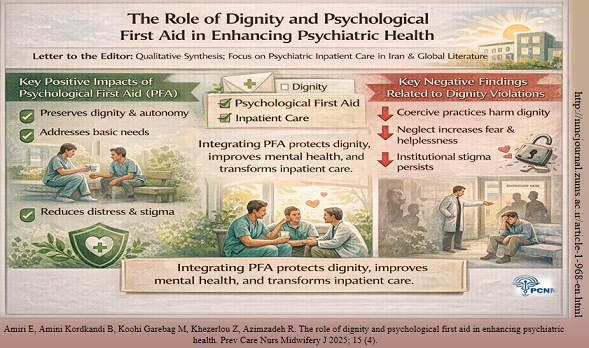
Patient dignity in psychiatric settings is routinely violated through prolonged isolation, forced labor, and physical restraints based on subjective staff judgment rather than objective criteria. Psychological First Aid (PFA), focusing on safety, practical needs, autonomy, and non-judgmental validation, offers a practical tool to uphold dignity. Nursing managers should integrate PFA principles into daily psychiatric nursing practice through continuous training and reflective practice, moving beyond basic education to fundamentally shift toward person-centered care.
Full-Text: (110 Views)
Dignity is a core principle in psychiatric care, profoundly affecting individuals with mental health challenges [1,2]. Psychiatric illness inherently jeopardizes one's sense of self-worth, a threat amplified by stigma and social rejection. This letter briefly highlights common challenges to patient dignity in psychiatric settings. It emphasizes how Psychological First Aid (PFA) can serve as a practical tool to uphold dignity in direct patient encounters [3].
Sadly, neglect and abuse of people with psychiatric conditions are alarmingly common even within care settings [3,4]. During hospitalization, patients' dignity is often stripped away by practices that clearly violate the Patients’ Bill of Rights. Examples include prolonged isolation beyond guidelines, forced labor, and use of physical restraints without objective criteria [4,5]. A critical issue is the use of physical restraint, a measure that severely damages dignity. This action is often based on staff’s subjective judgment rather than objective criteria, allowing staff emotions to influence the duration of restraint. Consequently, patients' basic needs (such as hunger, thirst, or hygiene) are often inadequately addressed during these vulnerable times, further compromising their dignity [5].
Patients consistently identify autonomy, respect, and confidentiality as key pillars of their dignity [3, 4, 6]. Neglecting these principles can lead to fear, hostility, feelings of worthlessness, and overall psychological distress [3]. Psychological First Aid (PFA) offers an efficient and supportive framework designed to quickly reduce immediate psychological distress and strengthen coping skills [7, 8]. It is crucial to understand that PFA, which is not a form of psychotherapy, should be seen as a direct, immediate, point-of-care intervention that actively preserves patient dignity by reducing distress, enhancing autonomy, and ensuring immediate attention to basic needs through a series of measurable and tangible actions.
The effectiveness of PFA relies on its simple, person-centered approach, which provides measurable steps to counteract the dignity violations detailed above. For example, its core mission to Champion Safety and Comfort directly fulfills a fundamental ethical need: creating a safe, calm, and predictable environment. This practice immediately respects the patient's dignity and is a direct countermeasure to the fear and humiliation reported in institutional settings. Additionally, the Targeting Practical Needs principle is essential. By identifying and promptly addressing basic needs (such as food or warmth) during vulnerable times, such as when a patient is under restraint or isolation, PFA directly challenges the most concrete dignity violations (such as neglecting hygiene or hunger) often reported during coercive actions. The model further promotes Restoring Autonomy and Control by prioritizing deep, active listening, listening without pressuring the individual to share. This simple act of respecting the patient's right to communicate on their own terms fundamentally supports their sense of control, a vital defense against the helplessness often imposed by coercive care. Ultimately, the principle of Validating Through Non-Judgment helps the individual feel valued, accepted, and truly understood, providing the most direct and effective way to counteract the widespread stigma and social rejection that significantly undermine patient self-worth [7, 8].
To effectively enhance patient dignity, which must be the primary ethical goal, it is vital that front-line health professionals (primarily nurses and psychologists) deeply integrate PFA principles into their daily practice. Basic training is insufficient; practitioners urgently need ongoing professional development and a fundamental shift in mindset toward a genuinely patient-centered approach. This requires targeted strategies, including continuous PFA training and reflective practice, to consistently uphold dignity. Therefore, the key question remains: by prioritizing person-centered interventions like PFA, can the profession move beyond policy debates and actively ensure that the dignity of individuals with psychiatric disorders is protected and championed across all care settings? This letter argues that this goal is indeed achievable.
Ethical Considerations
N/A
Acknowledgments
N/A
Conflict of Interest
The authors declare no conflicts of interest.
Funding
No funding was received for this research.
Authors' Contributions
All authors contributed to the conception and design of the study and conducted the literature search. Amiri E and Azimzadeh R: drafted the manuscript. All authors critically revised it for important intellectual content, approved the final version, and agreed to be accountable for all aspects of the work.
Artificial Intelligence Utilization
ChatGPT (OpenAI) was used only for minor grammar, clarity editing, and limited translation support. The authors confirm full responsibility for the final version.
Data Availability Statement
N/A
Sadly, neglect and abuse of people with psychiatric conditions are alarmingly common even within care settings [3,4]. During hospitalization, patients' dignity is often stripped away by practices that clearly violate the Patients’ Bill of Rights. Examples include prolonged isolation beyond guidelines, forced labor, and use of physical restraints without objective criteria [4,5]. A critical issue is the use of physical restraint, a measure that severely damages dignity. This action is often based on staff’s subjective judgment rather than objective criteria, allowing staff emotions to influence the duration of restraint. Consequently, patients' basic needs (such as hunger, thirst, or hygiene) are often inadequately addressed during these vulnerable times, further compromising their dignity [5].
Patients consistently identify autonomy, respect, and confidentiality as key pillars of their dignity [3, 4, 6]. Neglecting these principles can lead to fear, hostility, feelings of worthlessness, and overall psychological distress [3]. Psychological First Aid (PFA) offers an efficient and supportive framework designed to quickly reduce immediate psychological distress and strengthen coping skills [7, 8]. It is crucial to understand that PFA, which is not a form of psychotherapy, should be seen as a direct, immediate, point-of-care intervention that actively preserves patient dignity by reducing distress, enhancing autonomy, and ensuring immediate attention to basic needs through a series of measurable and tangible actions.
The effectiveness of PFA relies on its simple, person-centered approach, which provides measurable steps to counteract the dignity violations detailed above. For example, its core mission to Champion Safety and Comfort directly fulfills a fundamental ethical need: creating a safe, calm, and predictable environment. This practice immediately respects the patient's dignity and is a direct countermeasure to the fear and humiliation reported in institutional settings. Additionally, the Targeting Practical Needs principle is essential. By identifying and promptly addressing basic needs (such as food or warmth) during vulnerable times, such as when a patient is under restraint or isolation, PFA directly challenges the most concrete dignity violations (such as neglecting hygiene or hunger) often reported during coercive actions. The model further promotes Restoring Autonomy and Control by prioritizing deep, active listening, listening without pressuring the individual to share. This simple act of respecting the patient's right to communicate on their own terms fundamentally supports their sense of control, a vital defense against the helplessness often imposed by coercive care. Ultimately, the principle of Validating Through Non-Judgment helps the individual feel valued, accepted, and truly understood, providing the most direct and effective way to counteract the widespread stigma and social rejection that significantly undermine patient self-worth [7, 8].
To effectively enhance patient dignity, which must be the primary ethical goal, it is vital that front-line health professionals (primarily nurses and psychologists) deeply integrate PFA principles into their daily practice. Basic training is insufficient; practitioners urgently need ongoing professional development and a fundamental shift in mindset toward a genuinely patient-centered approach. This requires targeted strategies, including continuous PFA training and reflective practice, to consistently uphold dignity. Therefore, the key question remains: by prioritizing person-centered interventions like PFA, can the profession move beyond policy debates and actively ensure that the dignity of individuals with psychiatric disorders is protected and championed across all care settings? This letter argues that this goal is indeed achievable.
Ethical Considerations
N/A
Acknowledgments
N/A
Conflict of Interest
The authors declare no conflicts of interest.
Funding
No funding was received for this research.
Authors' Contributions
All authors contributed to the conception and design of the study and conducted the literature search. Amiri E and Azimzadeh R: drafted the manuscript. All authors critically revised it for important intellectual content, approved the final version, and agreed to be accountable for all aspects of the work.
Artificial Intelligence Utilization
ChatGPT (OpenAI) was used only for minor grammar, clarity editing, and limited translation support. The authors confirm full responsibility for the final version.
Data Availability Statement
N/A
Type of Study: Letter to editor |
Subject:
Nursing
References
1. 1. Alipour Nodooshan K, Mehrandasht A, Ghods A, Malekian MR, Movahedi Sirat S. A systematic review of studies assessing patients' rights and human dignity by iranian researchers in the health systems. Health Research Journal. 2021;6(2):125-38. [https://doi.org/10.52547/hrjbaq.6.2.125]
2. Amiri E, Galehdarifard A, Baghaei R, Ebrahimi H, Habibzadeh H, Habibpour Z, et al. Revitalizing open-door policies in psychiatric institutions: A Strategy for Preserving Patient Dignity-A Letter to the Editor-in-Chief. Nurs Midwifery J. 2024;22(4):337-40. [https://doi.org/10.61186/unmf.22.4.337]
3. Amiri E, Baghaei R, Ebrahimi H, Habibzadeh H. Barriers to maintaining dignity for patients with schizophrenia: A qualitative study. Nurs Ethics. 2025;32(2):560-74. [https://doi.org/10.1177/09697330241262320] [PMID]
4. Amiri E, Ebrahimi H, Habibzadeh H, Baghaei R. Organizational silence and hidden threats to patients' dignity with schizophrenia: A qualitative study. Nurs Ethics. 2024;31(7):1205-19. [https://doi.org/10.1177/09697330241262312] [PMID]
5. Cusack P, Cusack FP, McAndrew S, McKeown M, Duxbury J. An integrative review exploring the physical and psychological harm inherent in using restraint in mental health inpatient settings. Int J Ment Health Nurs. 2018;27(3):1162-76. [https://doi.org/10.1111/inm.12432] [PMID]
6. Amiri E, Ebrahimi H, Habibzadeh H, Baghaei R. Family caregivers' role in dignity of people with schizophrenia: A qualitative study. Nursing Ethics. 2025;32(6):1911-1925. [https://doi.org/10.1177/09697330251319372] [PMID]
7. Findley PA, Halpern J, Rodriguez R, Vermeulen K. Psychological first aid: A tool for mitigating conflict in the Middle East. In: Mental health and addiction care in the Middle East. Cham: Springer; 2016. p. 155-70. [https://doi.org/10.1007/978-3-319-41556-7_10]
8. Everly Jr GS, Lating JM. The Johns Hopkins guide to psychological first aid. Baltimore: JHU Press; 2022. [https://doi.org/10.56021/9781421444000]
Send email to the article author
| Rights and permissions | |
 |
This work is licensed under a Creative Commons Attribution-NonCommercial 4.0 International License. |