
Preventive Care in Nursing and Midwifery Journal

Volume 16, Issue 1 (1-2026)
Prev Care Nurs Midwifery J 2026, 16(1): 4-14 |
Back to browse issues page


Ethics code: 2023/1568


Download citation:
BibTeX | RIS | EndNote | Medlars | ProCite | Reference Manager | RefWorks
Send citation to:


BibTeX | RIS | EndNote | Medlars | ProCite | Reference Manager | RefWorks
Send citation to:
Karamelikli E, Cuvadar A, Bulut B, Yilmaz S N. Investigating the Level of Knowledge About HPV and Sexually Transmitted Disease Prevention Behaviors of Midwifery Students and Related Factors: A Cross-Sectional Study. Prev Care Nurs Midwifery J 2026; 16 (1) :4-14
URL: http://nmcjournal.zums.ac.ir/article-1-986-en.html
URL: http://nmcjournal.zums.ac.ir/article-1-986-en.html

Midwifery Department, Health Sciences Faculty, Karabük University, Karabük, Turkey , elnazkaramelikli@karabuk.edu.tr
Abstract: (802 Views)
Background: Human papillomavirus (HPV) infection and other sexually transmitted diseases (STDs) remain major public health concerns, particularly among young adults. Midwifery students, as future healthcare professionals, play a key role in prevention, patient education, and counseling.
Objectives: This study aimed to assess the level of knowledge about HPV and STD prevention behaviors among midwifery students and their relationship with demographic factors.
Methods: This cross-sectional study was conducted at 327 midwifery students (1st to 4th year) of the Department of Midwifery, Faculty of Health Sciences, Karabuk University, Türkiye from January to March 2024. Data were collected using a sociodemographic questionnaire, the HPV Knowledge Scale (0-33), and the Scale of Behaviors for Protection from Sexually Transmitted Diseases (STD-SCS; 21–105). Data were analyzed in R software using independent-samples t-tests, ANOVA, Pearson correlation, and multiple linear regression.
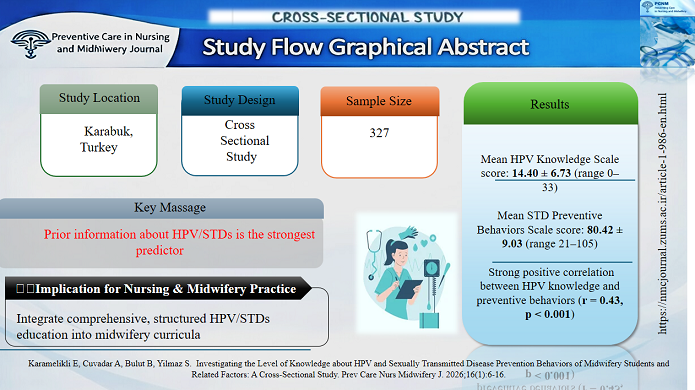
Results: The mean (SD) HPV knowledge and STD prevention scores were 14.40 (6.73) and 80.42 (9.03), respectively. Students with prior STD/HPV information had significantly higher scores on both measures than those without (p < 0.001). HPV knowledge differed by grade level (F = 15.82, p < 0.001), but prevention scores did not (F = 2.18, p = 0.090). A moderate positive correlation was found between knowledge and prevention scores (r = 0.43, p < 0.001), and knowledge significantly predicted prevention behaviors in regression analysis (β = 0.44, p < 0.0001).
Conclusion: Higher HPV knowledge was associated with better preventive behaviors among midwifery students. Although HPV knowledge increased with academic grade, preventive behaviours did not. These findings highlight the need for stronger, structured HPV education within midwifery curricula.
Objectives: This study aimed to assess the level of knowledge about HPV and STD prevention behaviors among midwifery students and their relationship with demographic factors.
Methods: This cross-sectional study was conducted at 327 midwifery students (1st to 4th year) of the Department of Midwifery, Faculty of Health Sciences, Karabuk University, Türkiye from January to March 2024. Data were collected using a sociodemographic questionnaire, the HPV Knowledge Scale (0-33), and the Scale of Behaviors for Protection from Sexually Transmitted Diseases (STD-SCS; 21–105). Data were analyzed in R software using independent-samples t-tests, ANOVA, Pearson correlation, and multiple linear regression.
Results: The mean (SD) HPV knowledge and STD prevention scores were 14.40 (6.73) and 80.42 (9.03), respectively. Students with prior STD/HPV information had significantly higher scores on both measures than those without (p < 0.001). HPV knowledge differed by grade level (F = 15.82, p < 0.001), but prevention scores did not (F = 2.18, p = 0.090). A moderate positive correlation was found between knowledge and prevention scores (r = 0.43, p < 0.001), and knowledge significantly predicted prevention behaviors in regression analysis (β = 0.44, p < 0.0001).
Conclusion: Higher HPV knowledge was associated with better preventive behaviors among midwifery students. Although HPV knowledge increased with academic grade, preventive behaviours did not. These findings highlight the need for stronger, structured HPV education within midwifery curricula.
Keywords: Health Education, Human Papillomavirus, Midwifery Students, Prevention Behaviors, Sexually Transmitted Diseases.
Full-Text [PDF 895 kb]
(251 Downloads)
| | Full-Text (HTML) (135 Views)
Knowledge Translation Statement
Audience: Nursing managers and hospital administrators
Higher HPV knowledge correlates with better preventive behaviors among midwifery students, yet knowledge increases with grade while behaviors do not improve. Prior structured information was the strongest predictor of both outcomes. Managers should integrate skills-based HPV education into curricula through practical training and targeted interventions for international students, bridging the knowledge-behavior gap to prepare competent future midwives.
Type of Study: Orginal research |
Subject:
Midwifery
References
1. Landray I, Carpenter J, Berendes S, Palmer M, Free C. Factors associated with sexually transmitted reinfections, number of sexual partners and condom use among previously infected young people. International Journal of STD & AIDS. 2025; 36:808-815. [https://doi.org/10.1177/09564624251348693] [PMID]
2. De Wit J, Adam P, Daas D, Jonas K. Sexually transmitted infection prevention behaviours: health impact, prevalence, correlates, and interventions. Psychology & Health. 2023; 38:675-700. [https://doi.org/10.1080/08870446.2022.2090560] [PMID]
3. Neves M, Maldonado B, Golin G, Mansano I, Avanzi I, Simões L, et al. Sexually transmitted infections among young adults: an analysis of risk behaviors and preventive practices. Contribuciones a las Ciencias Sociales. 2025; 18 (2): 1-21. [https://doi.org/10.55905/revconv.18n.2-134]
4. Çeşmeci, Y., Köylü, B., Sulaiman, J., Sancak, E., Şenel, S., Baki, H. E., & Kışlal, M. (2015). HPV infections and HPV vaccine through the eyes of interns. Turkish Journal of Obstetrics and Gynecology ، 12(3)، 85-92. [https://doi.org/10.4274/tjod.61623]
5. Shapiro GK. HPV vaccination: an underused strategy for the prevention of cancer. Current Oncology. 2022;29(5):3780-3792. [https://doi.org/10.3390/curroncol29050303] [PMID]
6. Turki Jalil, A., & Karevskiy, A. The Cervical Cancer (CC) Epidemiology and Human Papillomavirus (HPV) in the Middle East. International Journal of Environment, Engineering and Education. 2020; 2 (2): 7-12. [https://doi.org/10.55151/ijeedu.v2i2.29]
7. Shamseddine AA, Burman B, Lee NY, Zamarin D, Riaz N. Tumor immunity and immunotherapy for HPV-related cancers. Cancer Discovery. 2021;11(8):1896-1912. [https://doi.org/10.1158/2159-8290.CD-20-1760] [PMID]
8. Centers for Disease Control and Prevention. Basic information about HPV and cancer. 2025 [accessed 2025 Feb 9]. [https://www.cdc.gov/cancer/hpv/basic-information.html]
9. World Health Organization. Human papillomavirus vaccines: WHO position paper (2022 update). Weekly Epidemiological Record. 2022; 97:645-672. [https://iris.who.int/server/api/core/bitstreams/d63ca5e2-a966-41a8-9fc2-c4e2ff4efc14/content]
10. Xu J, Abudurusuli G, Rui J, Li Z, Zhao Z, Xia Y, et al. Epidemiological characteristics and transmissibility of HPV infection: a long-term retrospective study in China. Epidemics. 2023; 44:1-9. [https://doi.org/10.1016/j.epidem.2023.100707] [PMID]
11. Trottier H, Ferreira S, Thomann P, Costa M, Sobrinho J, Prado J, et al. Human papillomavirus infection and reinfection in adult women: the role of sexual activity and natural immunity. Cancer Research. 2010;70(21):8569-8577. [https://doi.org/10.1158/0008-5472.CAN-10-0621] [PMID]
12. Ferlay J, Ervik M, Lam F, et al. Global cancer observatory: cancer today. Lyon: International Agency for Research on Cancer; 2024 [accessed 2026 Jan 7]. [https://gco.iarc.who.int/today]
13. Centers for Disease Control and Prevention. HPV vaccination recommendations. 2025 [accessed 2025 Feb 9]. [https://www.cdc.gov/vaccines/vpd/hpv/hcp/recommendations.html]
14. World Health Organization. Scaling up HPV vaccine introduction. 2016 [accessed 2025 Nov 10]. [https://www.who.int/publications/i/item/scaling-up-hpv-vaccine-introduction]
15. Spayne J, Hesketh T. Estimate of global human papillomavirus vaccination coverage: analysis of country-level indicators. BMJ Open. 2021;11 (9): 1-9. [https://doi.org/10.1136/bmjopen-2021-052016] [PMID]
16. İşgüder, Ç. K., Oktay, G., Doğru, H. Y., Delibaş, İ., Özsoy, A. Z., Çeltek, N. Y., & Okan, İ. Evaluation of HPV vaccine knowledge level of health school students. Journal of Contemporary Medicine. 2017; 7 (1): 1-7. [https://doi.org/10.16899/gopctd.302511]
17. Başli M, Aksu H, Toptaş B. Knowledge and opinions of health school students about HPV and HPV vaccine. Ankara Journal of Health Sciences. 2019;8(1):1-17. [https://dergipark.org.tr/en/pub/ankara-j-health-sci/issue/46362/508775]
18. Çınar İO, Tuncer İ, Aslan GK, Alataş E. Knowledge and attitudes of university students toward HPV infection and vaccine prevention in Turkey. Asia-Pacific Journal of Oncology Nursing. 2019;6(3):300-307. [https://doi.org/10.4103/apjon.apjon_10_19] [PMID]
19. Shakurnia, A., Ghadiri, A., Javadzade, N., & Hamidi, M. Awareness and knowledge of medical, nursing and midwifery students about HPV infection and its vaccine. Preventive Care in Nursing and Midwifery Journal. 2022; 12 (4): 54-63. [https://doi.org/10.52547/pcnm.12.4.54]
20. Waller J, Ostini R, Marlow LAV, McCaffery K, Zimet G. Validation of a measure of knowledge about human papillomavirus using item response theory. Preventive Medicine. 2013;56(1):35-40. [https://doi.org/10.1016/j.ypmed.2012.10.028] [PMID]
21. Demir Bozkurt F, Özdemir S. Validity and reliability of a Turkish version of the human papillomavirus knowledge scale. Journal of the Turkish German Gynecological Association. 2023;24(3):177-186. [https://doi.org/10.4274/jtgga.galenos.2023.2022-10-9] [PMID]
22. Kılavuz M, Yiğit F. Behavioural scale for protection from sexually transmitted diseases. BMC Women's Health. 2023;23(1):1-11. [https://doi.org/10.1186/s12905-023-02658-9] [PMID]
23. Z, Verimer T. Awareness of vocational school students on sexually transmitted diseases. Aydın Health Journal. 2024;10(1):69-85. [https://dergipark.org.tr/en/download/article-file/3678539]
24. Yörük S, Açıkgöz A, Ergör G. Determination of knowledge levels, attitudes and behaviors of female university students concerning HPV. BMC Women's Health. 2016; 16:1-8. [https://doi.org/10.1186/s12905-016-0330-6] [PMID]
25. Panatto D, Amicizia D, Trucchi C, et al. Sexual behaviour and risk factors for HPV infections in young people in Italy. BMC Public Health. 2012; 12:1-8. [https://doi.org/10.1186/1471-2458-12-623] [PMID]
26. Kops NL, Bessel M, Horvath J, et al. Factors associated with HPV and STI coinfections among Brazilian young adults. BMJ Open. 2019;9: 1-9. [https://doi.org/10.1136/bmjopen-2018-027438] [PMID]
27. Fauk NK, Crutzen R, Merry MS, et al. Determinants of unprotected sexual behaviours among MSM in Indonesia. Global Journal of Health Science. 2017;9(8):47-56. [https://doi.org/10.5539/gjhs.v9n8p47]
28. Filimonovic J, Relic M, Relic G, et al. Factors associated with STI testing among Serbian high school students. Clinical Epidemiology and Global Health. 2024; 29:1-6. [https://doi.org/10.1016/j.cegh.2024.101750]
29. Şahin HÖ, Özerdoğan Ö, Duran MN. Knowledge, attitudes and behaviors of medical students toward HPV. Family Practice and Primary Care. 2020;5(3):69-75. [https://doi.org/10.22391/fppc.639212]
30. Aldawood E, Dabbagh D, Alharbi S, Alzamil L, Faqih L, Alshurafa HH, Dabbagh R. HPV Vaccine Knowledge and Hesitancy Among Health Colleges' Students at a Saudi University. J Multidiscip Healthc. 2023 Nov 14; 16:3465-3476. [https://doi.org/10.2147/JMDH.S438633] [PMID]
31. Koutrakou P, Trigoni M, Sarafis P, et al. Knowledge and perceptions of Greek students about human papilloma virus, vaccination and cervical cancer screening. Children. 2022;9(12):1-12. [https://doi.org/10.3390/children9121807] [PMID]
32. Karahan S, Ağadayı E, Koç MM, et al. Knowledge, attitudes and behaviors of medical students about HPV. KSU Medical Journal. 2023;18(3):78-85. [https://dergipark.org.tr/en/pub/ksutfd/article/1166590]
33. Demir DSY. The relationship between HPV knowledge and health literacy in university students. Turkiye Klinikleri Journal of Medical Sciences. 2025;45(4):216-226. [https://doi.org/10.5336/medsci.2025-110139]
Send email to the article author
| Rights and permissions | |
 |
This work is licensed under a Creative Commons Attribution-NonCommercial 4.0 International License. |