Preventive Care in Nursing and Midwifery
Volume 15, Issue 4 (10-2025)
Prev Care Nurs Midwifery 2025, 15(4): 52-59 |
Back to browse issues page


Ethics code: IR.LARUMS.REC.1403.015


Download citation:
BibTeX | RIS | EndNote | Medlars | ProCite | Reference Manager | RefWorks
Send citation to:


BibTeX | RIS | EndNote | Medlars | ProCite | Reference Manager | RefWorks
Send citation to:
Sookhak F, Asadi A, Monjazeb N, Safarpour N, Sheikh Ali Khani M S, Razavi M R, et al . Identifying Challenges and Policy Strategies to Improve Working Conditions for Women in Pre-Hospital Emergency Operations: A Qualitative Study. Prev Care Nurs Midwifery 2025; 15 (4) :52-59
URL: http://nmcjournal.zums.ac.ir/article-1-1009-en.html
URL: http://nmcjournal.zums.ac.ir/article-1-1009-en.html
Fatemeh Sookhak  , Ali Asadi , Negin Monjazeb , Nasim Safarpour , Mohammad Sina Sheikh Ali Khani , Mohammad Reza Razavi , Ali Mohammad Parviniannasab , Mohammad Rafi Bazrafshan *
, Ali Asadi , Negin Monjazeb , Nasim Safarpour , Mohammad Sina Sheikh Ali Khani , Mohammad Reza Razavi , Ali Mohammad Parviniannasab , Mohammad Rafi Bazrafshan *
Department of Nursing, School of Nursing, Larestan University of Medical Sciences, Larestan, Iran , Seeder2007@gmail.com
Keywords: Emergency Medical Technicians, Women Working, Emergency Medical Services, Occupational Stress, Gender Equity.
Full-Text [PDF 608 kb]
(242 Downloads)
| Abstract (HTML) (907 Views)
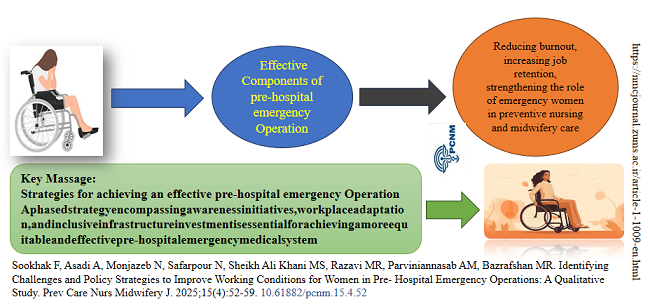
Graphical Abstract:
Reseach Highlights:
Knowledge Translation Statement
Audience: Nursing managers and hospital administrators
Female emergency medical technicians in Iran face socio-cultural challenges (fear of public non-acceptance, cultural sensitivities, lack of family acceptance, inappropriate uniforms), physical-ergonomic challenges (difficulty moving patients and handling heavy equipment), and organizational challenges where job satisfaction depends on managerial support. Nursing managers should redesign gender-appropriate ergonomic uniforms, procure lighter equipment, formalize dispatch protocols prioritizing female crews for female patients, and launch targeted social media campaigns highlighting female EMT competencies.
Full-Text: (188 Views)
Introduction
Emergency situations are critical conditions in which an individual's physical or psychological state suddenly deteriorates, requiring immediate and essential medical interventions [1, 2]. Prehospital emergency medical systems play a vital role in providing initial medical services and transporting patients to healthcare facilities [3]. The primary objective of this care system is to deliver first aid as quickly as possible to save lives, prevent further injury, and accelerate patient recovery [4, 5]. In recent years, the role of women in this care system has expanded, bringing diverse skills such as enhanced communication and patient rapport, which are critical in emergency settings. However, this integration occurs within a complex socio-cultural context. Gender role theory posits that societal expectations can create conflicts between professional duties and traditional gender norms, leading to unique occupational stressors for women in non-traditional fields [6]. This theoretical lens helps explain how cultural and social barriers, such as public perception, family acceptance, and workplace dynamics, directly translate into professional challenges for female emergency medical technicians (EMTs), including limited career advancement, inadequate resources, and psychological pressure. Despite their growing presence, women remain significantly underrepresented in prehospital emergency roles. Research and national reports show that men constitute the majority of the operational workforce in Iran's prehospital emergency system, while women's participation in emergency operations remains limited [7]. This underrepresentation is not unique to Iran but part of a global pattern in emergency medical services (EMS). For instance, studies from the United States and Europe report female representation in ground EMS roles ranging from 20% to 30%, indicating that structural gender inequality is a widespread, though variably pronounced, issue [8].
This structural inequality, compounded by multidimensional challenges, significantly impacts the performance and retention of these personnel. Research indicates that female EMS providers face disproportionate occupational hazards, including gender-based discrimination, higher rates of workplace violence, and increased risk of burnout compared to their male counterparts [9]. The high prevalence of occupational burnout in this field, particularly among women, coupled with a persistent lack of public and institutional recognition of their capabilities, underscores an urgent need for targeted, strategic interventions. While prior studies have often quantified the prevalence of such issues, there is a gap in qualitative research that delves into the lived experiences and contextual nuances of these challenges from the perspective of the female EMTs themselves and translates these findings into actionable, phased policy frameworks [10].
Objectives
This study aimed to qualitatively explore the multifaceted challenges perceived by female emergency medical technicians in Iran's prehospital care system and to identify practical solutions and policy strategies proposed by the participants. Ultimately, it sought to develop a phased policy framework to guide interventions for improving their occupational conditions and well-being.
Methods
Type of Study
This qualitative study employed a conventional qualitative content analysis approach. In this approach, coding categories are derived inductively and directly from the raw data, without imposing pre-existing categories or theoretical frameworks.
Study Population
The participants in the study comprised female operational personnel working in prehospital emergency departments across Iran [Table 2]. Purposeful sampling for women was conducted with maximum variation regarding age, degree, years of work experience, and city of employment. Data collection and analysis were carried out concurrently, persisting until data saturation was achieved during the 29th interview, at which time no additional themes or insights were identified. We conducted three additional interviews to ensure that no new data would be generated.
The inclusion criteria for the study were as follows: participants had to be female operational staff (technicians) in the pre-hospital emergency system, express willingness to participate in the study and provide informed consent, and be able to communicate their experiences in Persian. The exclusion criterion was applied if a participant expressed unwillingness to continue their participation at any stage of the research.
Sampling Method
Participants were selected using a purposive sampling strategy with maximum variation to ensure diversity in key characteristics relevant to the research question. We aimed to include participants with variation in work experience and geographic location, recruiting from multiple cities, including Rafsanjan, Sirjan, Jiroft, Shiraz, Tehran, and Mashhad, to represent different socio-cultural contexts within Iran.
Sampling continued concurrently with data analysis until theoretical data saturation was achieved. Saturation was determined when no new relevant codes or themes emerged from three consecutive interviews. The final sample size was 32 participants. The inclusion of participants with relatively limited work experience is acknowledged as a characteristic of the sample that may influence the depth of insights into long-term structural challenges; this is addressed in the Limitations section.
Data Collection
Data were collected through semi-structured, in-depth interviews. An interview guide, developed based on the study objectives, contained open-ended questions designed to explore participants' experiences, perceived challenges, and proposed solutions. These questions encompassed key domains such as a typical workday and specific challenges encountered; interactions with the public and patients; issues related to equipment, uniforms, and teamwork; as well as suggestions for improvement. Illustrative opening questions included, for example, inquiries about public attitude and acceptance following the recent launch of the women's emergency service, the problems faced as an operational force in prehospital emergency, challenges in using ambulance equipment and tools, and specific difficulties experienced while working as a female operational force in the prehospital emergency department. All interviews were conducted in Persian, in a private setting agreed upon with each participant. Following the obtainment of written informed consent, each interview was audio-recorded and subsequently transcribed verbatim for analysis. Observational field notes were also taken during the process.
Data Analysis
Data analysis adhered to the step‑by‑step procedure of conventional qualitative content analysis. First, the research team immersed itself in the data through repeated reading of the interview transcripts to achieve an in‑depth understanding (Familiarization). Next, meaningful units, phrases, or paragraphs relevant to the research aims were identified, condensed, and labeled with preliminary codes in an open coding phase (Generating Initial Codes). These codes were then constantly compared and grouped into potential sub‑categories and broader main categories (Searching for Themes). Finally, the emerging categories were iteratively reviewed, refined, and organized into coherent themes that accurately reflected the data (Reviewing and Defining Themes). Throughout this process, MAXQDA software (version 2010) was used to manage the analysis.
To uphold the trustworthiness of the findings, encompassing credibility, dependability, confirmability, and transferability, several strategies as outlined by Lincoln and Guba were employed throughout the study. These included member checking, where preliminary findings were shared with a subset of participants (n=5) to verify their accuracy; regular peer debriefing sessions with two experienced qualitative researchers not involved in data collection to discuss the coding and analysis; the maintenance of a detailed audit trail documenting all analytical decisions; and the provision of thick, rich descriptions of the research context and participants to allow readers to assess the transferability of the results meaningfully.
Result
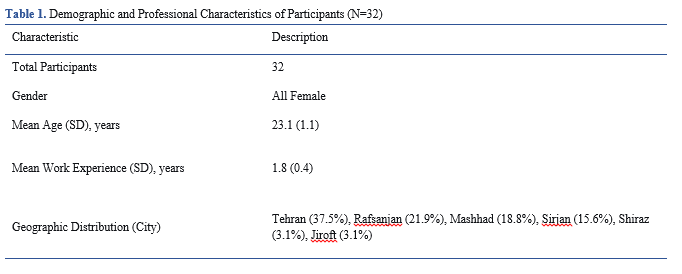
The study included 32 female EMTs. The sample's demographic and professional characteristics are summarized in Table 1.
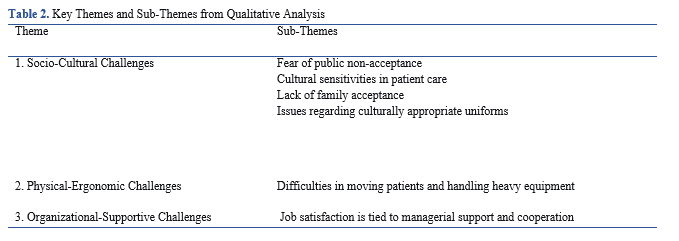
Analysis of the qualitative data revealed three primary themes characterizing the occupational challenges faced by female emergency medical technicians (EMTs) in Iran's prehospital care system. These themes, along with their corresponding sub-themes, are summarized in Table 2 and are presented in detail in the following sections.
1. Socio-cultural challenges
Social and cultural factors represented significant challenges for female personnel. This theme encompassed several key sub-themes articulated by the participants.
The challenge of fear of not being accepted by people
Participants frequently reported initial anxiety regarding public perception. One 26-year-old EMT stated, "At the beginning of my work, I experienced a lot of stress due to the fear of not being accepted by the public, but thank God, people's interactions with us were excellent." Another participant (23 years old) emphasized the need for greater public recognition, noting, "Female personnel should be more recognized as emergency staff among the public."
The challenge of treating patients with female staff
Cultural sensitivities in patient care emerged as a specific barrier. Participants suggested that increasing public awareness was crucial for full acceptance of women's emergency services. A 23-year-old participant advocated, "Cultural awareness should be promoted among the people so that the women's emergency services are fully accepted in society." A practical solution was proposed by a 24-year-old EMT, who said, "The female service staff should be exclusively designated for female patients."
The challenge regarding female staff uniforms
The inadequacy of operational clothing was a consistently cited issue. Participants described the uniforms as unsuitable and uncomfortable for the physical demands of the job. A 23-year-old participant remarked, "The operational clothing for female personnel is not suitable for their work at all," and another of the same age added, "The clothing for female personnel is neither appropriate nor comfortable during work." A 24-year-old participant concluded, "The operational clothing for female personnel is inadequate and needs to be reconsidered." Echoing this, an emergency staff member from Tehran emphasized, "There is a need to design a standard uniform for the comfort of female personnel during missions."
The challenge of family acceptance of female personnel attending the prehospital emergency room
Gaining familial support was another hurdle. A 23-year-old participant shared her personal experience, revealing, "At first, my family was against my work, but they agreed at my insistence."
2. Physical challenges
Physical demands constituted a distinct and major challenge, primarily centering on patient handling.
Challenges in moving and transporting patients on a stretcher
This sub-theme was nearly universal. Participants cited a lack of sufficient strength and the physical difficulty of the task. A 26-year-old EMT explained her limitation was "due to a lack of sufficient strength for moving patients and transporting stretchers." A 23-year-old participant stated, "We have limitations regarding patient transport with stretchers," while a 22-year-old colleague described the common recourse: "We face challenges in transporting patients in the work environment, so we rely on the assistance of male colleagues." The challenge was noted in various settings, as a 24-year-old participant indicated: "We encounter some limitations when moving and transporting patients, especially when we are at the patient's home or outside the hospital."
3. Organizational-supportive challenges
The level of institutional support was identified as a fundamental factor influencing professional experience and job satisfaction.
The level of satisfaction of female employees with their jobs
Participants directly linked their job satisfaction to the quality of managerial cooperation and support. A 24-year-old participant's statement encapsulated this connection: "I worked hard to achieve my job and gain the satisfaction of those in charge...If the authorities cooperate well with us, much of the dissatisfaction among female emergency room personnel could be resolved."
Discussion and Policy Implication
This study reveals that the professional experience of female emergency medical technicians (EMTs) in Iran is shaped by a duality of significant systemic challenges and strong personal resilience. While they confront structural, physical, and socio-cultural barriers, their narratives are equally marked by high job satisfaction, positive public reception, and supportive teamwork. This paradox creates a critical foundation for actionable policy: the gap between anticipated cultural resistance and documented public support represents a strategic opportunity for confident reform.
1. Navigating Social Perception and Building Public Legitimacy
A central finding was the contrast between initial fears of social non-acceptance and widespread reports of positive public interactions. Participants noted excellent public reception and growing trust from female patients, indicating that cultural barriers are surmountable in practice [7]. This provides a solid foundation for public engagement. The corresponding short-term strategy is to launch targeted awareness initiatives via social media to highlight female EMTs' competencies and impact, leveraging existing public legitimacy to foster greater social license for further investment.
2. Addressing Physical-Ergonomic and Safety Challenges
Physical demands, including moving patients and handling heavy equipment, alongside ill-fitting uniforms, were universal challenges. These are critical issues affecting operational efficiency, safety, and professional dignity. Therefore, medium-term strategies must include: a) redesigning standard uniforms to be gender-appropriate, ergonomic, and culturally congruent, and b) prioritizing procurement of lighter medical equipment (e.g., compact oxygen cylinders). As supported by global literature, such ergonomic interventions are vital for making emergency work accessible and safe for women [9, 12].
3. Reconfiguring Operational Models for Inclusion and Efficiency
The study highlighted two effective models: prioritized dispatch of female teams to female patients, which enhanced patient comfort and trust, and successful mixed-gender teamwork, which improved knowledge transfer and task management [7, 13].
These practices inform the long-term strategy to expand the female workforce and create operational bases designed for mixed-gender teams. This approach addresses underrepresentation while institutionalizing a proven, effective model, though it requires upfront investment.
4. Synthesis and Localization of Global Insights
Our findings resonate with global evidence on female underrepresentation and gender-based challenges in EMS [8, 11]. However, the pronounced concern over culturally appropriate uniforms and familial acceptance reflects unique socio-cultural dynamics in Iran. Conversely, the reported positive public reception and job satisfaction offer a contrasting and encouraging local asset [7]. This underscores that while core challenges are global, effective policy must be localized, leveraging specific cultural strengths such as community ties.
5. Direct Policy Implications: From Evidence to Action
The findings translate into clear policy imperatives. First, the documented public trust is an underutilized asset that must be actively leveraged through strategic communication to create an enabling environment for bigger change. Second, investments in gender-sensitive equipment and infrastructure are not discretionary but essential for operational efficacy and workforce safety. Third, the successful micro-practices of team dispatch and mixed-gender collaboration should be scaled into formal systemic protocols. The proposed phased approach, building awareness, adapting the workplace, and then investing in structure, is designed to create cumulative momentum, where early wins in public perception justify subsequent resource allocations.
This study's limitations include potential social desirability bias in self-reported data, the qualitative design's inability to quantify prevalence, and a sample drawn primarily from urban centers with relatively limited work experience. These factors may affect the generalizability of findings to rural settings or senior personnel. Future research should include a more geographically and professionally diverse sample.
Policy Recommendations
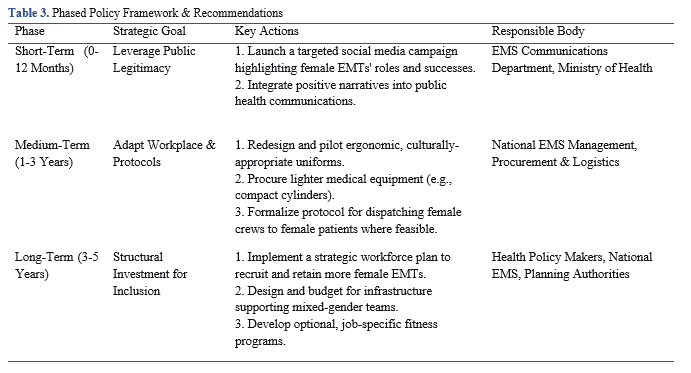
Based on the findings, we propose the following phased policy framework to translate evidence into tangible improvements for female EMTs and the emergency system. The summarized recommendations are presented in Table 3.
Conclusion
In conclusion, this study identifies a critical policy opportunity: the chasm between perceived cultural barriers and the actual, documented public support for female EMTs in Iran. This support, coupled with the workforce's clear resilience, provides a robust platform for decisive action. The phased strategy outlined, from building public awareness and adapting workplaces to committing to inclusive structural investment, offers a pragmatic roadmap. The final imperative for decision-makers is to move beyond isolated pilots and adopt a confident, systemic, and adequately resourced approach. By aligning institutional strategy with this demonstrated social readiness, Iran can transform its prehospital emergency system into a more equitable, effective, and resilient service for all.
Ethical Considerations
This study received ethical approval from the Ethics Committee of Larestan University of Medical Sciences (IR.LARUMS.REC.1403.015). Written informed consent was obtained from all participants. Confidentiality, anonymity, and the right to withdraw were strictly ensured.
Acknowledgements
The authors gratefully acknowledge the financial support provided by Larestan University of Medical Sciences (Project No. 1403-200). We also sincerely thank all individuals who participated in and contributed to this study.
Conflict of Interest
The authors declare no conflict of interest.
Funding
This study was financially supported by Larestan University of Medical Sciences (Project No. 1403-200).
Authors' Contributions
Conceptualization: M.-R. Bazrafshan
Methodology: M.-R. Bazrafshan
Investigation: A. Asadi
Formal Analysis: F. Sookhak, M.R. Razavi, A.M. Parviniannasab
Writing – Original Draft: F. Sookhak
Writing – Review & Editing: N. Monjazeb, N. Safarpour, M.S. Sheikh Ali Khani, M.-R. Bazrafshan
Supervision: M.-R. Bazrafshan
All authors read and approved the final manuscript.
Artificial Intelligence Utilization for Article Writing
AI-based tools were used to improve language quality and enhance grammatical accuracy during manuscript preparation.
Data Availability Statement
The data supporting the findings of this study are available from the corresponding author upon reasonable request. Due to privacy and ethical considerations, the original interview transcripts are not publicly available.
Emergency situations are critical conditions in which an individual's physical or psychological state suddenly deteriorates, requiring immediate and essential medical interventions [1, 2]. Prehospital emergency medical systems play a vital role in providing initial medical services and transporting patients to healthcare facilities [3]. The primary objective of this care system is to deliver first aid as quickly as possible to save lives, prevent further injury, and accelerate patient recovery [4, 5]. In recent years, the role of women in this care system has expanded, bringing diverse skills such as enhanced communication and patient rapport, which are critical in emergency settings. However, this integration occurs within a complex socio-cultural context. Gender role theory posits that societal expectations can create conflicts between professional duties and traditional gender norms, leading to unique occupational stressors for women in non-traditional fields [6]. This theoretical lens helps explain how cultural and social barriers, such as public perception, family acceptance, and workplace dynamics, directly translate into professional challenges for female emergency medical technicians (EMTs), including limited career advancement, inadequate resources, and psychological pressure. Despite their growing presence, women remain significantly underrepresented in prehospital emergency roles. Research and national reports show that men constitute the majority of the operational workforce in Iran's prehospital emergency system, while women's participation in emergency operations remains limited [7]. This underrepresentation is not unique to Iran but part of a global pattern in emergency medical services (EMS). For instance, studies from the United States and Europe report female representation in ground EMS roles ranging from 20% to 30%, indicating that structural gender inequality is a widespread, though variably pronounced, issue [8].
This structural inequality, compounded by multidimensional challenges, significantly impacts the performance and retention of these personnel. Research indicates that female EMS providers face disproportionate occupational hazards, including gender-based discrimination, higher rates of workplace violence, and increased risk of burnout compared to their male counterparts [9]. The high prevalence of occupational burnout in this field, particularly among women, coupled with a persistent lack of public and institutional recognition of their capabilities, underscores an urgent need for targeted, strategic interventions. While prior studies have often quantified the prevalence of such issues, there is a gap in qualitative research that delves into the lived experiences and contextual nuances of these challenges from the perspective of the female EMTs themselves and translates these findings into actionable, phased policy frameworks [10].
Objectives
This study aimed to qualitatively explore the multifaceted challenges perceived by female emergency medical technicians in Iran's prehospital care system and to identify practical solutions and policy strategies proposed by the participants. Ultimately, it sought to develop a phased policy framework to guide interventions for improving their occupational conditions and well-being.
Methods
Type of Study
This qualitative study employed a conventional qualitative content analysis approach. In this approach, coding categories are derived inductively and directly from the raw data, without imposing pre-existing categories or theoretical frameworks.
Study Population
The participants in the study comprised female operational personnel working in prehospital emergency departments across Iran [Table 2]. Purposeful sampling for women was conducted with maximum variation regarding age, degree, years of work experience, and city of employment. Data collection and analysis were carried out concurrently, persisting until data saturation was achieved during the 29th interview, at which time no additional themes or insights were identified. We conducted three additional interviews to ensure that no new data would be generated.
The inclusion criteria for the study were as follows: participants had to be female operational staff (technicians) in the pre-hospital emergency system, express willingness to participate in the study and provide informed consent, and be able to communicate their experiences in Persian. The exclusion criterion was applied if a participant expressed unwillingness to continue their participation at any stage of the research.
Sampling Method
Participants were selected using a purposive sampling strategy with maximum variation to ensure diversity in key characteristics relevant to the research question. We aimed to include participants with variation in work experience and geographic location, recruiting from multiple cities, including Rafsanjan, Sirjan, Jiroft, Shiraz, Tehran, and Mashhad, to represent different socio-cultural contexts within Iran.
Sampling continued concurrently with data analysis until theoretical data saturation was achieved. Saturation was determined when no new relevant codes or themes emerged from three consecutive interviews. The final sample size was 32 participants. The inclusion of participants with relatively limited work experience is acknowledged as a characteristic of the sample that may influence the depth of insights into long-term structural challenges; this is addressed in the Limitations section.
Data Collection
Data were collected through semi-structured, in-depth interviews. An interview guide, developed based on the study objectives, contained open-ended questions designed to explore participants' experiences, perceived challenges, and proposed solutions. These questions encompassed key domains such as a typical workday and specific challenges encountered; interactions with the public and patients; issues related to equipment, uniforms, and teamwork; as well as suggestions for improvement. Illustrative opening questions included, for example, inquiries about public attitude and acceptance following the recent launch of the women's emergency service, the problems faced as an operational force in prehospital emergency, challenges in using ambulance equipment and tools, and specific difficulties experienced while working as a female operational force in the prehospital emergency department. All interviews were conducted in Persian, in a private setting agreed upon with each participant. Following the obtainment of written informed consent, each interview was audio-recorded and subsequently transcribed verbatim for analysis. Observational field notes were also taken during the process.
Data Analysis
Data analysis adhered to the step‑by‑step procedure of conventional qualitative content analysis. First, the research team immersed itself in the data through repeated reading of the interview transcripts to achieve an in‑depth understanding (Familiarization). Next, meaningful units, phrases, or paragraphs relevant to the research aims were identified, condensed, and labeled with preliminary codes in an open coding phase (Generating Initial Codes). These codes were then constantly compared and grouped into potential sub‑categories and broader main categories (Searching for Themes). Finally, the emerging categories were iteratively reviewed, refined, and organized into coherent themes that accurately reflected the data (Reviewing and Defining Themes). Throughout this process, MAXQDA software (version 2010) was used to manage the analysis.
To uphold the trustworthiness of the findings, encompassing credibility, dependability, confirmability, and transferability, several strategies as outlined by Lincoln and Guba were employed throughout the study. These included member checking, where preliminary findings were shared with a subset of participants (n=5) to verify their accuracy; regular peer debriefing sessions with two experienced qualitative researchers not involved in data collection to discuss the coding and analysis; the maintenance of a detailed audit trail documenting all analytical decisions; and the provision of thick, rich descriptions of the research context and participants to allow readers to assess the transferability of the results meaningfully.
Result
The study included 32 female EMTs. The sample's demographic and professional characteristics are summarized in Table 1.
Analysis of the qualitative data revealed three primary themes characterizing the occupational challenges faced by female emergency medical technicians (EMTs) in Iran's prehospital care system. These themes, along with their corresponding sub-themes, are summarized in Table 2 and are presented in detail in the following sections.
1. Socio-cultural challenges
Social and cultural factors represented significant challenges for female personnel. This theme encompassed several key sub-themes articulated by the participants.
The challenge of fear of not being accepted by people
Participants frequently reported initial anxiety regarding public perception. One 26-year-old EMT stated, "At the beginning of my work, I experienced a lot of stress due to the fear of not being accepted by the public, but thank God, people's interactions with us were excellent." Another participant (23 years old) emphasized the need for greater public recognition, noting, "Female personnel should be more recognized as emergency staff among the public."
The challenge of treating patients with female staff
Cultural sensitivities in patient care emerged as a specific barrier. Participants suggested that increasing public awareness was crucial for full acceptance of women's emergency services. A 23-year-old participant advocated, "Cultural awareness should be promoted among the people so that the women's emergency services are fully accepted in society." A practical solution was proposed by a 24-year-old EMT, who said, "The female service staff should be exclusively designated for female patients."
The challenge regarding female staff uniforms
The inadequacy of operational clothing was a consistently cited issue. Participants described the uniforms as unsuitable and uncomfortable for the physical demands of the job. A 23-year-old participant remarked, "The operational clothing for female personnel is not suitable for their work at all," and another of the same age added, "The clothing for female personnel is neither appropriate nor comfortable during work." A 24-year-old participant concluded, "The operational clothing for female personnel is inadequate and needs to be reconsidered." Echoing this, an emergency staff member from Tehran emphasized, "There is a need to design a standard uniform for the comfort of female personnel during missions."
The challenge of family acceptance of female personnel attending the prehospital emergency room
Gaining familial support was another hurdle. A 23-year-old participant shared her personal experience, revealing, "At first, my family was against my work, but they agreed at my insistence."
2. Physical challenges
Physical demands constituted a distinct and major challenge, primarily centering on patient handling.
Challenges in moving and transporting patients on a stretcher
This sub-theme was nearly universal. Participants cited a lack of sufficient strength and the physical difficulty of the task. A 26-year-old EMT explained her limitation was "due to a lack of sufficient strength for moving patients and transporting stretchers." A 23-year-old participant stated, "We have limitations regarding patient transport with stretchers," while a 22-year-old colleague described the common recourse: "We face challenges in transporting patients in the work environment, so we rely on the assistance of male colleagues." The challenge was noted in various settings, as a 24-year-old participant indicated: "We encounter some limitations when moving and transporting patients, especially when we are at the patient's home or outside the hospital."
3. Organizational-supportive challenges
The level of institutional support was identified as a fundamental factor influencing professional experience and job satisfaction.
The level of satisfaction of female employees with their jobs
Participants directly linked their job satisfaction to the quality of managerial cooperation and support. A 24-year-old participant's statement encapsulated this connection: "I worked hard to achieve my job and gain the satisfaction of those in charge...If the authorities cooperate well with us, much of the dissatisfaction among female emergency room personnel could be resolved."
Discussion and Policy Implication
This study reveals that the professional experience of female emergency medical technicians (EMTs) in Iran is shaped by a duality of significant systemic challenges and strong personal resilience. While they confront structural, physical, and socio-cultural barriers, their narratives are equally marked by high job satisfaction, positive public reception, and supportive teamwork. This paradox creates a critical foundation for actionable policy: the gap between anticipated cultural resistance and documented public support represents a strategic opportunity for confident reform.
1. Navigating Social Perception and Building Public Legitimacy
A central finding was the contrast between initial fears of social non-acceptance and widespread reports of positive public interactions. Participants noted excellent public reception and growing trust from female patients, indicating that cultural barriers are surmountable in practice [7]. This provides a solid foundation for public engagement. The corresponding short-term strategy is to launch targeted awareness initiatives via social media to highlight female EMTs' competencies and impact, leveraging existing public legitimacy to foster greater social license for further investment.
2. Addressing Physical-Ergonomic and Safety Challenges
Physical demands, including moving patients and handling heavy equipment, alongside ill-fitting uniforms, were universal challenges. These are critical issues affecting operational efficiency, safety, and professional dignity. Therefore, medium-term strategies must include: a) redesigning standard uniforms to be gender-appropriate, ergonomic, and culturally congruent, and b) prioritizing procurement of lighter medical equipment (e.g., compact oxygen cylinders). As supported by global literature, such ergonomic interventions are vital for making emergency work accessible and safe for women [9, 12].
3. Reconfiguring Operational Models for Inclusion and Efficiency
The study highlighted two effective models: prioritized dispatch of female teams to female patients, which enhanced patient comfort and trust, and successful mixed-gender teamwork, which improved knowledge transfer and task management [7, 13].
These practices inform the long-term strategy to expand the female workforce and create operational bases designed for mixed-gender teams. This approach addresses underrepresentation while institutionalizing a proven, effective model, though it requires upfront investment.
4. Synthesis and Localization of Global Insights
Our findings resonate with global evidence on female underrepresentation and gender-based challenges in EMS [8, 11]. However, the pronounced concern over culturally appropriate uniforms and familial acceptance reflects unique socio-cultural dynamics in Iran. Conversely, the reported positive public reception and job satisfaction offer a contrasting and encouraging local asset [7]. This underscores that while core challenges are global, effective policy must be localized, leveraging specific cultural strengths such as community ties.
5. Direct Policy Implications: From Evidence to Action
The findings translate into clear policy imperatives. First, the documented public trust is an underutilized asset that must be actively leveraged through strategic communication to create an enabling environment for bigger change. Second, investments in gender-sensitive equipment and infrastructure are not discretionary but essential for operational efficacy and workforce safety. Third, the successful micro-practices of team dispatch and mixed-gender collaboration should be scaled into formal systemic protocols. The proposed phased approach, building awareness, adapting the workplace, and then investing in structure, is designed to create cumulative momentum, where early wins in public perception justify subsequent resource allocations.
This study's limitations include potential social desirability bias in self-reported data, the qualitative design's inability to quantify prevalence, and a sample drawn primarily from urban centers with relatively limited work experience. These factors may affect the generalizability of findings to rural settings or senior personnel. Future research should include a more geographically and professionally diverse sample.
Policy Recommendations
Based on the findings, we propose the following phased policy framework to translate evidence into tangible improvements for female EMTs and the emergency system. The summarized recommendations are presented in Table 3.
Conclusion
In conclusion, this study identifies a critical policy opportunity: the chasm between perceived cultural barriers and the actual, documented public support for female EMTs in Iran. This support, coupled with the workforce's clear resilience, provides a robust platform for decisive action. The phased strategy outlined, from building public awareness and adapting workplaces to committing to inclusive structural investment, offers a pragmatic roadmap. The final imperative for decision-makers is to move beyond isolated pilots and adopt a confident, systemic, and adequately resourced approach. By aligning institutional strategy with this demonstrated social readiness, Iran can transform its prehospital emergency system into a more equitable, effective, and resilient service for all.
Ethical Considerations
This study received ethical approval from the Ethics Committee of Larestan University of Medical Sciences (IR.LARUMS.REC.1403.015). Written informed consent was obtained from all participants. Confidentiality, anonymity, and the right to withdraw were strictly ensured.
Acknowledgements
The authors gratefully acknowledge the financial support provided by Larestan University of Medical Sciences (Project No. 1403-200). We also sincerely thank all individuals who participated in and contributed to this study.
Conflict of Interest
The authors declare no conflict of interest.
Funding
This study was financially supported by Larestan University of Medical Sciences (Project No. 1403-200).
Authors' Contributions
Conceptualization: M.-R. Bazrafshan
Methodology: M.-R. Bazrafshan
Investigation: A. Asadi
Formal Analysis: F. Sookhak, M.R. Razavi, A.M. Parviniannasab
Writing – Original Draft: F. Sookhak
Writing – Review & Editing: N. Monjazeb, N. Safarpour, M.S. Sheikh Ali Khani, M.-R. Bazrafshan
Supervision: M.-R. Bazrafshan
All authors read and approved the final manuscript.
Artificial Intelligence Utilization for Article Writing
AI-based tools were used to improve language quality and enhance grammatical accuracy during manuscript preparation.
Data Availability Statement
The data supporting the findings of this study are available from the corresponding author upon reasonable request. Due to privacy and ethical considerations, the original interview transcripts are not publicly available.
Type of Study: Orginal research |
Subject:
Nursing
References
1. Haghani F, Sadeghi N. Training in pre-hospital emergency: needs and truths. Iranian Journal Of Medical Education. 2011;10(5):1273-80. [http://ijme.mui.ac.ir/article-1-1636-en.html]
2. Al-Shaqsi S. Models of international emergency medical service (ems) systems. Oman Medical Journal. 2010;25(4):320-3. [https://doi.org/10.5001/omj.2010.92]
3. Luiz T. Emergency medicine tomorrow. Anasthesiologie Intensivmedizin Notfallmedizin Schmerztherapie AINS. 2003;38(4):296-302. [https://europepmc.org/article/med/12728923]
4. Khankeh H, Alinia S, Masoumi G, Khorasani zavareh D, Ranjbar M, Daddoost L, et al. Prehospital services by focus on road traffic accidents: assessment in developed and developing countries. Journal Of Health Promotion Management. 2013;2(2):71-9. [http://jhpm.ir/article-1-74-en.html]
5. Mehmood A, Rowther AA, Kobusingye O, Hyder AA. Assessment of pre-hospital emergency medical services in low-income settings using a health systems approach. International Journal Of Emergency Medicine. 2018;11(1):53. [https://doi.org/10.1186/s12245-018-0207-6] [PMID]
6. Zimmer M, Czarniecki DM, Sahm S. Gender-sensitive considerations of prehospital teamwork in critical situations. Philosophy, Ethics, And Humanities In Medicine. 2024;19(1):3. [https://doi.org/10.1186/s13010-024-00153-z] [PMID]
7. Aziznejhad E, Dadashzadeh A, Sarbakhsh P, Asghari E, Jabbarzadeh F. The presence of women in pre-hospital emergency medical services from the perspective of the staff: a cross-sectional feasibility study. Critical Care Nursing. 2024;17(1):45-54. [https://doi.org/10.30491/jcc.17.1.45]
8. Ericsson C, Lindström V, Andersen JV, Jørgensen TM, Alex J, Venesoja A. Gender (in)equality in nordic ambulance services: do ambulances have glass ceilings? Scandinavian Journal Of Trauma, Resuscitation And Emergency Medicine. 2025;33(1):45. [https://doi.org/10.1186/s13049-025-01358-7] [PMID]
9. Roth K, Köppen J, Henschke C. Workplace violence and burnout among emergency medical service workers and nurses in Germany: a cross-sectional study. Human Resources For Health. 2025;23(1):66. [https://doi.org/10.1186/s12960-025-01026-y] [PMID]
10. Makkink AW, Nkhoma BE. Gender discrimination in the emergency services: female paramedic experiences in South Africa. African Journal Of Primary Health Care & Family Medicine. 2025;17(1):e1-e11. [https://doi.org/10.4102/phcfm.v17i1.4945] [PMID]
11. Rudman JS, Farcas A, Salazar GA, Hoff JJ, Crowe RP, Whitten-Chung K, et al. Diversity, equity, and inclusion in the United States emergency medical services workforce: a scoping review. Prehospital Emergency Care. 2023;27(4):385-97. [https://doi.org/10.1080/10903127.2022.2130485] [PMID]
12. McCann-Pineo M, Keating M, McEvoy T, Schwartz M, Schwartz RM, Washko J, et al. The female emergency medical services experience: a mixed methods study. Prehospital Emergency Care. 2024;28(4):626-34. [https://doi.org/10.1080/10903127.2024.2306248] [PMID]
13. Gonsoulin S, Palmer CE. Gender issues and partner preferences among a sample of emergency medical technicians. Prehospital And Disaster Medicine. 1998;13(1):41-7. [https://doi.org/10.1017/S1049023X0003301X]
Send email to the article author
| Rights and permissions | |
 |
This work is licensed under a Creative Commons Attribution-NonCommercial 4.0 International License. |