
Preventive Care in Nursing and Midwifery Journal

Volume 16, Issue 1 (1-2026)
Prev Care Nurs Midwifery J 2026, 16(1): 77-84 |
Back to browse issues page

Ethics code: IR.SSU.REC.1395.239


Download citation:
BibTeX | RIS | EndNote | Medlars | ProCite | Reference Manager | RefWorks
Send citation to:


BibTeX | RIS | EndNote | Medlars | ProCite | Reference Manager | RefWorks
Send citation to:
Hosseini S E, Hosseini S. The Relationship between Academic Resilience and Academic Satisfaction of Undergraduate Nursing Students at Iran University of Medical Sciences. Prev Care Nurs Midwifery J 2026; 16 (1) :77-84
URL: http://nmcjournal.zums.ac.ir/article-1-1028-en.html
URL: http://nmcjournal.zums.ac.ir/article-1-1028-en.html


Nursing and Midwifery Care Research Center, Department of Medical Surgical Nursing, School of Nursing and Midwifery, Iran University of Medical Sciences, Tehran, Iran , esmat.hosseini_110@yahoo.com
Abstract: (348 Views)
Background: Studying in medical sciences, especially nursing, involves psychological, environmental, and clinical pressures that influence students’ academic satisfaction and mental well-being. Academic resilience, as a psychological strength in facing challenges, plays an important role in maintaining balance and achieving academic success.
Objective: This study aimed to examine the relationship between academic resilience and academic satisfaction among undergraduate nursing students.
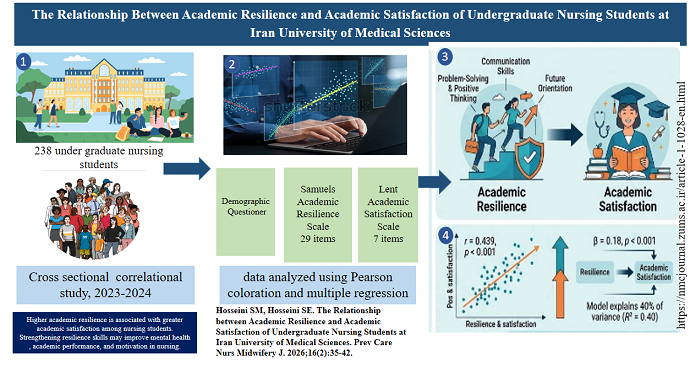
Methods: This correlational study was conducted on 238 undergraduate nursing students at the School of Nursing and Midwifery, Iran University of Medical Sciences, Iran. Participants were recruited through convenience sampling from March 2023 to June 2024. Data were collected using a demographic questionnaire, the Samuels Academic Resilience Scale, and the Lent Academic Satisfaction Scale. Data were analyzed using Pearson correlation coefficient and multiple regression in SPSS v.16.
Results: The majority of the students participating in the study were female (52.1%), single (98.7%), and had a mean (SD) age of 22.83 (3.61). The mean (SD) scores for academic resilience and academic satisfaction were 99.46 (12.62) and 21.11 (6.64), respectively. A positive and significant correlation was observed between resilience and academic satisfaction (r = 0.439, p < 0.001). After adjustment for confounders, resilience remained a significant predictor of satisfaction (β = 0.18, p < 0.001), and the model explained 40% of the variance (R² = 0.40)
Conclusion: Academic resilience significantly improves nursing students’ academic satisfaction. Strengthening resilience skills can enhance mental health, academic performance, and overall satisfaction; therefore, resilience training should be included in educational programs and explored in future intervention studies.
Objective: This study aimed to examine the relationship between academic resilience and academic satisfaction among undergraduate nursing students.
Methods: This correlational study was conducted on 238 undergraduate nursing students at the School of Nursing and Midwifery, Iran University of Medical Sciences, Iran. Participants were recruited through convenience sampling from March 2023 to June 2024. Data were collected using a demographic questionnaire, the Samuels Academic Resilience Scale, and the Lent Academic Satisfaction Scale. Data were analyzed using Pearson correlation coefficient and multiple regression in SPSS v.16.
Results: The majority of the students participating in the study were female (52.1%), single (98.7%), and had a mean (SD) age of 22.83 (3.61). The mean (SD) scores for academic resilience and academic satisfaction were 99.46 (12.62) and 21.11 (6.64), respectively. A positive and significant correlation was observed between resilience and academic satisfaction (r = 0.439, p < 0.001). After adjustment for confounders, resilience remained a significant predictor of satisfaction (β = 0.18, p < 0.001), and the model explained 40% of the variance (R² = 0.40)
Conclusion: Academic resilience significantly improves nursing students’ academic satisfaction. Strengthening resilience skills can enhance mental health, academic performance, and overall satisfaction; therefore, resilience training should be included in educational programs and explored in future intervention studies.
Full-Text [PDF 737 kb]
(70 Downloads)
| | Full-Text (HTML) (56 Views)
Knowledge Translation Statement
Audience: Nursing managers and hospital administrators
Academic resilience significantly predicts nursing students' academic satisfaction, with a positive correlation between resilience and satisfaction, where resilience training could enhance mental health and academic performance. Married students, those in higher semesters, and alcohol consumers reported lower satisfaction, suggesting targeted support needs. Nursing managers and educators should integrate resilience-building programs, including stress management workshops, mindfulness exercises, and problem-solving training, into nursing curricula to support student well-being and prepare them for preventive, high-quality care.
Type of Study: Orginal research |
Subject:
Nursing
References
1. Javaid ZK, Chen Z, Ramzan M. Assessing stress causing factors and language related challenges among first year students in higher institutions in Pakistan. Acta Psychologica. 2024;248(1):1-9. [https://doi.org/10.1016/j.actpsy.2024.104356] [PMID]
2. Islam MS, Rabbi MF. Exploring the sources of academic stress and adopted coping mechanisms among university students. International Journal on Studies in Education (IJonSE). 2024;6(2):255-271. [https://doi.org/10.46328/ijonse.203]
3. Amsrud KE, Lyberg A, Severinsson E. Development of resilience in nursing students: A systematic qualitative review and thematic synthesis. Nurse Education in Practice. 2019;41(10):1-13. [https://doi.org/10.1016/j.nepr.2019.102621] [PMID]
4. Ye W, Strietholt R, Blömeke S. Academic resilience: underlying norms and validity of definitions. Educational Assessment, Evaluation and Accountability. 2021;33(1):169-202. [https://doi.org/10.1007/s11092-020-09351-7]
5. Cai Z, Meng Q. Academic resilience and academic performance of university students: the mediating role of teacher support. Frontiers in Psychology. 2025;16(1):1-11. [https://doi.org/10.3389/fpsyg.2025.1463643] [PMID]
6. Hafeez FA, Mohsin MN. Effect of resilience on academic achievement of university students. Journal of Social Sciences Research & Policy. 2024;2(3):127-134. [http://jssrp.org.pk]
7. Tran TX, Vo TTT, Ho C. From academic resilience to academic burnout among international university students during the post-COVID-19 new normal: An empirical study in Taiwan. Behavioral Sciences. 2023;13(3):1-13. [https://doi.org/10.3390/bs13030206.10.3390/bs13030206] [PMID]
8. Bagdžiūnienė D, Žukauskaitė I, Bulotaitė L, Sargautytė R. Study and personal resources of university students' academic resilience and the relationship with positive psychological outcomes. Frontiers in Psychology. 2025;16(5):1-16. [https://doi.org/10.3389/fpsyg.2025.1517359] [PMID]
9. Talebi Z, Sanagoo A, Saeedi E, Mancheri H, Saeedi S, Mehr-Avar F, et al. Study of nursing and midwifery students' satisfaction with their field of study. Nursing Development in Health Journal. 2022;13(2):17-24. [https://ndhj.lums.ac.ir/browse.php?a_id=346&sid=1&slc_lang=en]
10. Rossini S, Mazzotta R, Kangasniemi M, Badolamenti S, Macale L, Sili A, et al. Measuring academic satisfaction in nursing students: a systematic review of the instruments. International Journal of Nursing Education Scholarship. 2022;19(1):1-17. [https://doi.org/10.1515/ijnes-2021-0159] [PMID]
11. Medina-Ramirez SA, Rojas-Humpire R, Canaza JF, Hernandez F, Huancahuire-Vega S. Online academic satisfaction during the COVID-19 pandemic in medical students: role of sleep, psychological issues, college adjustment, and digital skills. F1000Research. 2022;11(3):1-16.
3 [https://doi.org/10.12688/f1000research.76127] [PMID]
12. Ozdemir C, Kaplan A. Factors affecting psychological resilience, self‐efficacy and job satisfaction of nurse academics: A cross‐sectional study. International Nursing Review. 2025;72(1):1-9. [https://doi.org/10.1111/inr.13007] [PMID]
13. Bushehri MS, Dinmohammadi M, Farahani-Hosseinabadi M, Saatchi M. Factors associated with academic resilience in nursing students: the role of individual, academic, and social factors. BMC Medical Education. 2026;26(1):1-7. [https://doi.org/10.1186/s12909-026-08875-8] [PMID]
14. Samuels WE: Development of a non-intellective measure of academic success: towards the quantification of resilience. The University of Texas at Arlingtonat ProQuest Dissertations & Theses; 2004:1-217. [https://wesamuels.net/pdfs/Dissertation_Mechanical_for_William_Ellery_Samuels.pdf]
15. Lent RW, Singley D, Sheu H-B, Gainor KA, Brenner BR, Treistman D, Ades L. Social cognitive predictors of domain and life satisfaction: Exploring the theoretical precursors of subjective well-being. Journal of Counseling Psychology. 2005;52(3):429-442. [https://doi.org/10.1037/0022-0167.52.3.429]
16. Soltaninejad M, Asiabi M, Ahmdi B, Tavanaiee Yosefian S. A study of the psychometric properties of the academic resilience inventory (ARI). Quarterly of Educational Measurement. 2014;5(15):17-35. [https://jem.atu.ac.ir/article_267.html]
17. Ojeda L, Flores LY, Navarro RL. Social cognitive predictors of mexican american college students' academic and life satisfaction. Journal of Counseling Psychology. 2011;58(1):1-94. [https://doi.org/10.1037/a0021687] [PMID]
18. Hashemi T, Vahedi S, Mohebbi M. The structural relationship of school and parental bonding with academic satisfaction and academic control: the mediating role of academic self-efficacy. Journal of Cognitive Strategies in Learning. 2016;3(5):1-20. [https://asj.basu.ac.ir/article_1357.html?]
19. Meneghel I, Martínez IM, Salanova M, De Witte H. Promoting academic satisfaction and performance: building academic resilience through coping strategies. Psychology in the Schools. 2019;56(6):875-890. [https://doi.org/10.1002/pits.22253]
20. Shen Y, Feng H, Li X. Academic resilience in nursing students: A concept analysis. BMC Nursing. 2024;23(1):1-10. [https://doi.org/10.1186/s12912-024-02133-2] [PMID]
21. Nga NNQ, Mai DTT, Thuy PT, Linh TTT. Impact of resilience, social support, and perceived health status on happiness among nursing students: a cross-sectional study. Nursing Practice Today. 2025;12(3):295-303. [https://doi.org/10.18502/npt.v12i3.18978]
22. Romano L, Consiglio P, Angelini G, Fiorilli C. Between academic resilience and burnout: The moderating role of satisfaction on school context relationships. European Journal of Investigation in Health, Psychology and Education. 2021;11(3):770-780. [https://doi.org/10.3390/ejihpe11030055] [PMID]
23. Sæther SMM, Knapstad M, Askeland KG, Skogen JC. Alcohol consumption, life satisfaction and mental health among Norwegian college and university students. Addictive Behaviors Reports. 2019;10:1-9. [https://doi.org/10.1016/j.abrep.2019.100216] [PMID]
24. Morjigcs S. High school alcohol intake impairs academic success in a dose-dependent manner. Medical Bag. 2023:1-10. [https://doi.org/10.1016/j.jadohealth.2023.07.008] [PMID]
25. Tahira SS, Khan EA, Arif MI. Problems and challenges faced by married students to continue their study at university level. Annals of Human and Social Sciences. 2023;4(4):405-411. [https://doi.org/10.35484/ahss.2023(4-IV)39]
26. Amni S, Suwarjo S. Undergtaduate students'mariage. Jurnal Bimbingan Dan Konseling Islam. 2020;10(2):218-226. [https://doi.org/10.29080/jbki.2020.10.2.218-226]
27. Wach F-S, Karbach J, Ruffing S, Brünken R, Spinath FM. University students' satisfaction with their academic studies: personality and motivation matter. Frontiers in Psychology. 2016;7:1-12. [https://doi.org/10.3389/fpsyg.2016.00055] [PMID]
Send email to the article author
| Rights and permissions | |
 |
This work is licensed under a Creative Commons Attribution-NonCommercial 4.0 International License. |